
Since classes at the University of Akron resumed on March 30, I teach the same class twice daily to accommodate my students’ schedules because some are essential workers while others have returned to homes in other time zones.
In a physical classroom, I seldom sit down. I walk between desks asking questions of students in an effort to spark discussion and as many “Ah-ha!” moments as possible.
Now, sitting at my desk in my home office, my students’ faces appear in little boxes on my laptop screen. Rather than robust discussions, we practically have to use Robert’s Rules of Order to hear one another.
In-person classes were abruptly and necessarily halted due to COVID-19. We lost two weeks of instruction while everyone scrambled to move to online instruction. I worry whether I can sufficiently prepare my students for next semester’s required composition course in rhetoric.
While we were off, I assigned the new documentary by filmmaker Lynn Novick, “College Behind Bars.” During our first week back, we discussed each of the four, hour-long episodes.
Bard College, through it’s Bard Prison Initiative (BPI), offers coursework in several New York state prisons where incarcerated individuals can earn associate’s and bachelor’s degrees. The program is overwhelmingly funded by private donations, which is pound foolish of our government.
For every dollar spent on college in prison, taxpayers save five dollars through dramatically reduced recidivism rates. Furthermore, receiving an education has the added advantage of giving a person, once released from prison, a far better chance of becoming an employed — and therefore tax-paying — citizen.

In the fourth episode of the series, Dyjuan Tatro, one of Bard’s incarcerated students says: “For the first time in my life, education is something I’ve totally dedicated myself to. How do I communicate the impact education is having on me? This is changing fundamentally the way I think, believe and [the way I] interact with people.”
Tatro finished his B.A. in mathematics after he was released in 2017. After working for an elected official and a technology firm, he’s now back at BPI as their government affairs and advancement officer, procuring funding to expand the program.
That’s a compelling message for students like mine, who are also reaching for the benefits of an education in difficult, if not as extreme as prison, circumstances. I contacted Tatro, and on April 8 he gave a compelling online lecture to my students.
In 1970, the United States had a prison population of roughly 196,000. Today, the U.S. has the dubious distinction of having more people imprisoned than any other country: 2.1 million incarcerated individuals, with another 4.5 million people on probation or parole.
Tatro pointed out that the increased number of people in prison does not correlate to a commensurate increase in the rate of crime. It is instead due to bad policies, most famously perhaps the 1994 Clinton Crime Bill, which created the “three strikes” rule in which people thrice convicted of even small, non-violent offenses were sentenced to prison for decades or, all too often, life.
That same bill also eliminated federal funding for college coursework in prisons, effectively ending most efforts to rehabilitate the swelling number of incarcerated people in America.
As our prison population mushroomed, so did the monetization of incarceration. Prisons, Tatro pointed out, are now considered economic stimulus vehicles for one group of poor people, often poor farming communities, to oversee the imprisonment of another group of poor people, often urban people of color.
My students wanted to know if Tatro saw his time in prison as a blessing in disguise, a question he’s often asked.
His answer could not have been more clear:
″Prison isn’t good for anyone and it’s not a blessing in any way. But Bard College was a blessing and it changed the trajectory of my life. Unfortunately, we live in a country that doesn’t provide all its citizens equal access to education.”
In one of the last public events I attended before gatherings were suspended by COVID-19, I ran into the president of the University of Akron, Dr. Gary Miller. I introduced myself and asked if he’d read the open letter I wrote to him in this column last November. In it, I encouraged him to do more to support our first-generation and at-risk students.
“We’re doing a lot more than you know,” was his answer. Hmmm, I thought, if that’s so, the university is doing a great job keeping those things secret.
Gosh, if I knew about these mysterious things, I would no longer ask students to sit with me in the library while doing their schoolwork in order to build effective study habits, or walk them to the health center, the counseling center and the writing lab.
What I said was, “I’m on the ground, in the classroom working with these students.”
“Oh, well, we have a lot of plans we just need to put them into place,” replied Miller before making a quick exit. Miller’s second comment is the opposite of “We are doing more than you know.”
Not only defensive, Miller’s answer was politically tone deaf. How hard would it have been to have instead said, “We share your concerns?” My open letter to Miller was full of encouragement for his tenure, though critical of the university’s board of trustees, a perspective commonly held by everyone who cares about UA’s students.
The University of Akron is an urban college with many first-generation college students and an abysmal graduation rate. My at-risk students are mostly intelligent, engaged young adults whose lives are full of competing responsibilities. We have a duty to support their education as it can have the same tremendous impact on their lives that Bard College had on Dyjuan Tatro.
This column first appeared in the Akron Beacon Journal on Sunday, April 26, 2020.


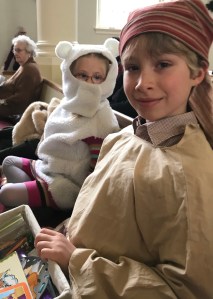 This month, Leif and Lyra participated in the Christmas pageant. During the first rehearsal, Lyra, in the role of an angel, fiddled with her halo until it broke. Rehearsing on the morning of the pageant, Lyra refused to stand to the side of the chancel with the other angels. She wanted to sit on the steps with the manger animals. And so, shortly before the performance, Lyra became one of them.



 Even though the top 100 Beatles songs played on continuous loop all weekend, I kept missing the final 10. As several jars of golden preserves cooled on the counter and peach skins and pits simmered on the stovetop, I proofread while waiting to hear the number one song. A perfect mash up of Lennon and McCartney pieces, “A Day in the Life” was deservedly chosen for the second year in a row.



 “I think you want me to be gay!” laughed my son Hugo a few years back, stressing the word “want.”

 Lyra loved ocean waves knocking her back as she sat on the shoreline and with all our big boys there, adults outnumbered children. Eyes were always on Leif as he learned to boogie board while someone else played with Lyra in the surf.
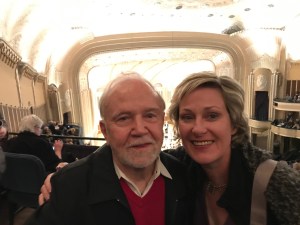
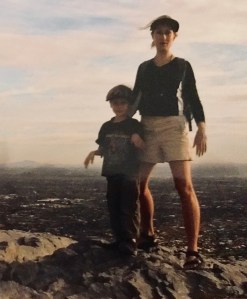 Before Jules was old enough for school, he’d quietly play with whatever was available when I met friends for lunch. “I just wanted to be with my mama,” he now recalls. Sometimes it was frustrating. Doctor’s appointments, for example, were tough because until he was about 7, he’d become distraught if he couldn’t stay right next to me on an exam table.









 This is why I am truly thrilled about the LIFE (Learning Is For Everyone) Project, a pilot program launched by Community Legal Aid in Akron. In workshops held across the city, parents can learn what educational services are available and how to ask for them.
 Once properly diagnosed, Claude began appropriate interventions. By the end of the third grade, he was reading chapter books. He went on to get a degree in English literature from the University of Michigan and writes for The Devil Strip, an Akron arts and culture publication.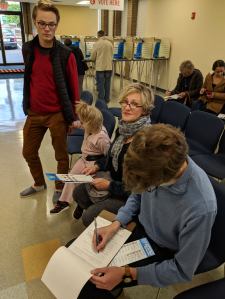

 Earlier this semester, students in my English composition classes at the University of Akron read
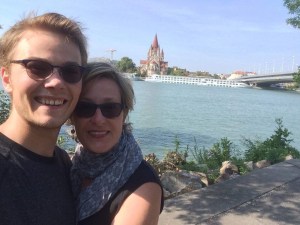 A Viking inheritance as sure as my blue eyes, wanderlust courses through my veins. I’ve purchased less expensive houses and driven old cars to have more money for travel. Any dog I adopt and any child I birth quickly learns to enjoy road-tripping.
 In mid-July, I sat on our front stoop with Leif and Lyra. We live on a busy street, but our house sits far back from the road. I went inside to refill my glass of water, gone all of 30 seconds, when I heard Leif screaming, “Lyra, no! Come back!”
 Last spring, we dismantled our dangerously derelict play set, which Lyra loved. With my tax refund, I bought a new, bigger play set. However, because we’re considering selling our house to reduce expenses, we delayed construction. Now it’s (mostly) built and keeping Lyra engaged. If we move, I’ll buy another one.

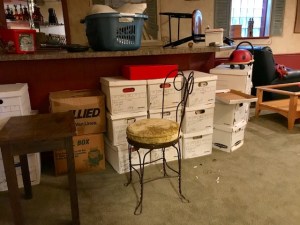 In the 1967 film Barefoot in the Park, newlyweds played by Jane Fonda and Robert Redford move into their first apartment together. They own so little, the apartment holds their vibrant emotions more than their meager belongings.

