
Two seasons of the year, spring and fall, one parent in every household with children too young for high school takes on an unpaid, part-time job: clothing processor. The assignment is most labor intensive in the fall thanks to school clothes and winter gear.
With my first three boys, the task was simple. Sorting in chronological order from eldest to youngest, I analyzed everything — pants, T-shirts, long-sleeved shirts, sweaters, even underwear.
What no longer fit was set in a pile for the next boy to wear.
In the basement of our 1909 home was a room half the size of the house’s footprint. It contained the washer, dryer and utility sink, along with a gas canning stove, which I never used but found antiquely charming. To the left of the two-burner stove was a wooden basket that caught laundry from a two-story chute. On the right, deep shelves lined the wall.
Rows of baseball cleats, track cleats, both rain and snow boots waited in orderly lines on these shelves to be, yet again, the correct size for one of my sons. Below the shelves were large plastic tubs, labelled in black Sharpie on masking tape: SHIRTS. PANTS. STUFF. Stuff was pjs, undies and anything else that wasn’t shirts or pants.
On a rack over the little stove hung winter and rain coats, along with snow and rain pants.
It was a good system, and my second son, Hugo, was its major beneficiary. Claude kept his clothes gently worn and stain-free. Hugo fixed that right away, spilling spaghetti sauce or chocolate milk on his shirts, particularly the white ones. He also excelled at putting holes in the knees of his pants, which I’d repair with iron-on patches patterned with red flames.
After Hugo’s turn, some clothing went to Goodwill or the trash, leaving Jules with a mix of old and new clothing. New sometimes meant purchased at stores in the mall, but could also mean just “new to us.”
I know some people cannot bring themselves to wear clothes once owned by a stranger. I figure once washed, it’s no different than any of our other clothes. I consider myself a veteran thrifter, and we live in a region with stellar thrift stores. The Village Discount Outlet, which we just call the Villager, is this family’s favorite.
In the fourth grade, Claude lost two GAP hoodie sweatshirts purchased at the mall. He’d get warm when playing, remove and forget them. Thereafter, his sweatshirts were all thrifted.
Later, when Claude needed his first sports coat, I found a Burberry jacket with a light blue window-pane pattern on a dark mustard background at a thrift store near the old Randall Park Mall in Cleveland. The purchase price and alterations totaled less than $50.
With my littles, however, I had to revamp my system. For one thing, I don’t pass Leif’s clothes to Lyra (except for school shirts). I thought I would, but after four boys, oh, what fun girls clothes are!
My new system starts the same as my old system: go through everything — drawer by drawer, closet by closet — and remove outgrown items. Some clothes, especially shirts with designs (dinosaurs for Leif, sequins for Lyra), require covert removal on the part of the clothing processor.
Outgrown clothes are organized in three piles: consignment shop, hand-me-downs and Goodwill.
Before giving away our hand-me-downs, I take the first pile to Hipsters Children’s Consignment shop in Bainbridge.
Every other week, I have lunch with our Uncle Bascom who lives in the village just west of Bainbridge. I leave Akron by 10 in order to stop first at Hipsters. While Becky, the delightful owner, goes through the clothing I brought to consign, I shop. Whatever she doesn’t take ends up in my hand-me-down pile.
Living in Bainbridge and its surrounding communities are many very rich people. “Let me tell you about the very rich. They are different from you and me,” F. Scott Fitzgerald once wrote.
True, perhaps, but they, too, have to clothe their children.
Shopping at Hipsters, I imagine the very rich purchase entire wardrobes for their children every season. And this is wonderful! It means the consigned stock is largely high-end brands, many of which I’ve never heard of until I find them there.
On my last visit, I bought Leif a pair of Shaun White snow pants by Burton for $20 (retail $125), and for Lyra a pair by Columbia for $17.99 (retail $50). The Velcro on both pairs is so pristine I doubt either have ever spent a moment outdoors on a child’s body. Mmm-mm, I do love a good bargain!
Life has many bookends. After our lunches, Bascom has me go through clothes — both his and those of his cousin Sandy with whom he lived for 60 years until Sandy’s death in 2008. Gracious in all things, at 97, Bascom has been diligently Marie Kondo-ing his possessions so that one day we won’t have to.
I’ve taken shearling coats, Irish sweaters purchased at Saks, varieties of leather jackets, and more, some of which the big boys have happily adopted. I always take everything, knowing Bascom feels better giving them to me rather than discarding them in a donation box. And this makes him feel foolish, which he reminds me each time I place his piles of clothes next to bags from Hipsters.
I send encouragement to all my fellow clothes processors. Once we’ve reviewed and replaced our kids’ winter gear, which will soon be in full use, this season’s work will be finished. And that means … preparations for the holidays will soon begin. Oh, my.
This first appeared in the Akron Beacon Journal on Sunday, November 3, 2019.
———
©2019 the Akron Beacon Journal (Akron, Ohio)
Visit the Akron Beacon Journal (Akron, Ohio) at www.ohio.com
Distributed by Tribune Content Agency, LLC.




 Even though the top 100 Beatles songs played on continuous loop all weekend, I kept missing the final 10. As several jars of golden preserves cooled on the counter and peach skins and pits simmered on the stovetop, I proofread while waiting to hear the number one song. A perfect mash up of Lennon and McCartney pieces, “A Day in the Life” was deservedly chosen for the second year in a row.



 “I think you want me to be gay!” laughed my son Hugo a few years back, stressing the word “want.”

 Lyra loved ocean waves knocking her back as she sat on the shoreline and with all our big boys there, adults outnumbered children. Eyes were always on Leif as he learned to boogie board while someone else played with Lyra in the surf.

 Before Jules was old enough for school, he’d quietly play with whatever was available when I met friends for lunch. “I just wanted to be with my mama,” he now recalls. Sometimes it was frustrating. Doctor’s appointments, for example, were tough because until he was about 7, he’d become distraught if he couldn’t stay right next to me on an exam table.











 This is why I am truly thrilled about the LIFE (Learning Is For Everyone) Project, a pilot program launched by Community Legal Aid in Akron. In workshops held across the city, parents can learn what educational services are available and how to ask for them.
 Once properly diagnosed, Claude began appropriate interventions. By the end of the third grade, he was reading chapter books. He went on to get a degree in English literature from the University of Michigan and writes for The Devil Strip, an Akron arts and culture publication.


 Earlier this semester, students in my English composition classes at the University of Akron read
 A Viking inheritance as sure as my blue eyes, wanderlust courses through my veins. I’ve purchased less expensive houses and driven old cars to have more money for travel. Any dog I adopt and any child I birth quickly learns to enjoy road-tripping.
 In mid-July, I sat on our front stoop with Leif and Lyra. We live on a busy street, but our house sits far back from the road. I went inside to refill my glass of water, gone all of 30 seconds, when I heard Leif screaming, “Lyra, no! Come back!”
 Last spring, we dismantled our dangerously derelict play set, which Lyra loved. With my tax refund, I bought a new, bigger play set. However, because we’re considering selling our house to reduce expenses, we delayed construction. Now it’s (mostly) built and keeping Lyra engaged. If we move, I’ll buy another one.




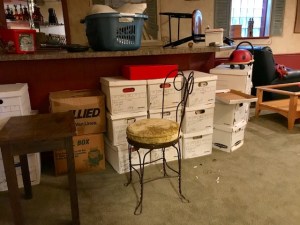 In the 1967 film Barefoot in the Park, newlyweds played by Jane Fonda and Robert Redford move into their first apartment together. They own so little, the apartment holds their vibrant emotions more than their meager belongings.




 The underside of the porch is open but covered with lattice. I slid the lattice to one side and sent Leif, who was 7 at the time, into the dusty space. One by one, he delivered the kittens to us.

 Good parents, like good pet owners, take into consideration what is best for each member of the family and the family as a whole. With divorce, relocating for jobs, choosing where and with whom to live, taking ego out of the equation isn’t always easy, but it is necessary. What is best for the children? Where will they thrive?
 In the 1980s, a bumper sticker that read “Kill Your Television” was common, especially around college campuses. A rather radical notion at the time, today, when most people have smartphones in their pockets, it seems charmingly quaint.
 When my big boys were little, we had a tank-like monitor that got no television reception. We used it to watch videos or DVDs. Claude and Hugo had cartoon movies they watched repeatedly, but also had long runs with musicals such as The Sound of Music and Seven Brides for Seven Brothers.





 Whoopsie Piggle