
On an August day many years ago, I went to Cleveland-Hopkins Airport with my baby on my hip and my first two boys dressed as Batman and Spider-Man.
We walked to a gate inside the terminal where we watched a plane from Arizona land and taxi to the gate. Minutes later my grandmother walked through the door and we enthusiastically greeted her.
Four weeks later, we took Grandma to a different gate at Cleveland-Hopkins, said tearful goodbyes, then stayed at the gate to watch her plane take off.
I keenly remember that visit because it was the last time my grandma came to Ohio. I also remember it because just days later two planes flew into the World Trade Center towers, irrevocably changing many aspects of life as we knew it.
How quaint it now seems to watch planes take off and land from inside airport terminals when you have no ticket to fly.
During one of her recent press conferences with Gov. Mike DeWine, Ohio Department of Health Director Dr. Amy Acton described how nobody comes to understand the impact and length of the current pandemic overnight. Like all new realities, it takes time to process.
That first week the kids were out of school, I understood why all institutions of learning were closed — too many people in close proximity. But it never occurred to me that all non-essential businesses, including hair salons, would also close and I postponed taking my 7-year-old daughter, Lyra, for a much-needed trim.
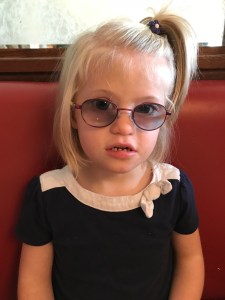
Lyra’s long, blonde hair is stunning when clean and brushed out, which is no easy feat as her scalp is very tender. And the longer her hair, the more easily it tangles.
Lately, no matter how gently I comb, nor how much detangler I use, Lyra screams, cries and quivers when I do her hair. Max and I joke that if the neighbors hear Lyra getting her hair brushed, they’ll call children’s services.
Traumatizing Lyra with brush and comb also traumatizes me. Exasperated, perhaps as much by six weeks of quarantine as Lyra’s struggle, last weekend I did what would be the unthinkable in normal times.
I went to remove Lyra’s ponytail holder so she could take a bath. I’d barely tugged when she began screaming and yelling: “I don’t want it, I won’t have it! No hair, no hair!” I went to the kitchen, grabbed a pair of utility scissors, returned to the bathroom and lopped off Lyra’s entire ponytail.
She went from looking like actress Veronica Lake to resembling a Dickensian street waif.


The next day, I trimmed Lyra’s hair here and there and she has something like the shag haircut I had at her age in the early 1970s. A comb easily glides through what’s left, a relief for us both, for who knows when she’ll be able to have it fixed by a professional?
We don’t take 10-year-old Leif or Lyra anywhere except Max’s (solo) office and the metro parks on uncrowded weekdays. I cringe when I see children in grocery stores, but I also know some people have no choice but to take their children with them.
We never watch TV news, but do listen to our local NPR station, WKSU, most days. I turn it off whenever stories air on COVID-19 rates of infection and death tolls. Yet Leif, who understands what is happening in ways that Lyra can’t, is exhibiting signs of strain.
A month into shelter-at-home, Leif got up from the desk where he was doing school work, came to me and wrapped his arms around my waist. With his face buried between my arm and my side, I suddenly realized he was sobbing.
“What’s wrong?” I asked.
“I don’t want you to die of COVID. I love you, Mama.” I assured him I was not likely to die of COVID, even if I caught it, while silently wondering if what I said was true.
“Are you afraid of catching COVID-19?” I asked Max when we were grocery shopping a few days later. When he told me he was, I asked if his life insurance policy was paid up and we laughed.
Gallows-humor memes and cartoons are cropping up like ants in my kitchen on the first warm days of spring. A recent New York Times article explained why: humor helps us cope. People in Nazi concentration camps, soldiers in WWI and those who endured the bubonic plague all indulged in dark humor.
Later that day when Max asked me the same question, we discovered our greatest fear is one and the same: What if Lyra, who has Down syndrome and therefore may be less resilient, contracted COVID-19? Just typing those words makes my eyes well up.
What will our new reality look like when a COVID-19 vaccine becomes available and this exhausting pandemic ends? Nobody knows.
I hold out hope that having gone through this together — not just as families, communities, states or countries, but as an entire planet of people — we may come out on the other side better able and willing to work together on other issues facing all of humanity.
This was first published in the Akron Beacon Journal on May 3, 2020.

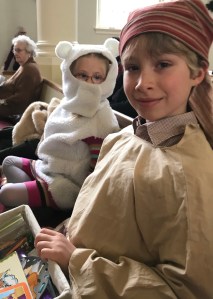 This month, Leif and Lyra participated in the Christmas pageant. During the first rehearsal, Lyra, in the role of an angel, fiddled with her halo until it broke. Rehearsing on the morning of the pageant, Lyra refused to stand to the side of the chancel with the other angels. She wanted to sit on the steps with the manger animals. And so, shortly before the performance, Lyra became one of them.



 Even though the top 100 Beatles songs played on continuous loop all weekend, I kept missing the final 10. As several jars of golden preserves cooled on the counter and peach skins and pits simmered on the stovetop, I proofread while waiting to hear the number one song. A perfect mash up of Lennon and McCartney pieces, “A Day in the Life” was deservedly chosen for the second year in a row.



 “I think you want me to be gay!” laughed my son Hugo a few years back, stressing the word “want.”

 Lyra loved ocean waves knocking her back as she sat on the shoreline and with all our big boys there, adults outnumbered children. Eyes were always on Leif as he learned to boogie board while someone else played with Lyra in the surf.
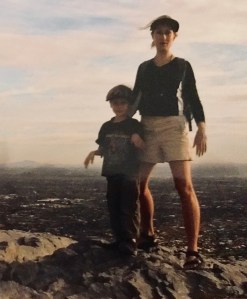 Before Jules was old enough for school, he’d quietly play with whatever was available when I met friends for lunch. “I just wanted to be with my mama,” he now recalls. Sometimes it was frustrating. Doctor’s appointments, for example, were tough because until he was about 7, he’d become distraught if he couldn’t stay right next to me on an exam table.










 This is why I am truly thrilled about the LIFE (Learning Is For Everyone) Project, a pilot program launched by Community Legal Aid in Akron. In workshops held across the city, parents can learn what educational services are available and how to ask for them.
 Once properly diagnosed, Claude began appropriate interventions. By the end of the third grade, he was reading chapter books. He went on to get a degree in English literature from the University of Michigan and writes for The Devil Strip, an Akron arts and culture publication.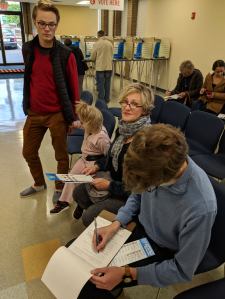

 Earlier this semester, students in my English composition classes at the University of Akron read
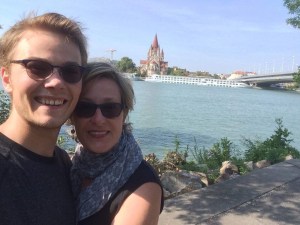 A Viking inheritance as sure as my blue eyes, wanderlust courses through my veins. I’ve purchased less expensive houses and driven old cars to have more money for travel. Any dog I adopt and any child I birth quickly learns to enjoy road-tripping.
 In mid-July, I sat on our front stoop with Leif and Lyra. We live on a busy street, but our house sits far back from the road. I went inside to refill my glass of water, gone all of 30 seconds, when I heard Leif screaming, “Lyra, no! Come back!”
 Last spring, we dismantled our dangerously derelict play set, which Lyra loved. With my tax refund, I bought a new, bigger play set. However, because we’re considering selling our house to reduce expenses, we delayed construction. Now it’s (mostly) built and keeping Lyra engaged. If we move, I’ll buy another one.



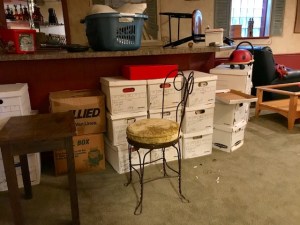 In the 1967 film Barefoot in the Park, newlyweds played by Jane Fonda and Robert Redford move into their first apartment together. They own so little, the apartment holds their vibrant emotions more than their meager belongings.

