Uncategorized

Readers share fond memories of Claire and Gloria Cressler

Over the years I have shared several stories about my friend Claire Cressler and his wife, Gloria. In 2020, long after they both had died, I moved into Claire and Gloria’s home. Guests frequently tell me my house has a comforting warmth. I believe that comes from the abiding love Claire and Gloria shared in the home, both with each other and their friends, for over 60 years.

While it pleases me to share stories of the Cresslers, stories shared with me by readers who knew them are even more wonderful.

Claire was a graphic artist at the same billboard company his entire career and the first reminiscence I received was from Elaine Slaybaugh, whose father was a colleague of Claire’s:

“Claire was a name I often heard in my childhood. My father, Lyle Kimmel, sold advertising for General Outdoor Advertising. He would think of a picture and slogan that might be displayed on a billboard and present that idea to an Akron-based company and would often call upon Claire to do sketches of that idea. One vivid sketch I remember as an 8-year-old [in 1948] was for a furniture company with a robin saying, ‘Come on in and feather your nest.’ Claire was a talented and gentle person from my past.”

A younger reader, Patty Fann, knew the Cresslers from church:

“I was acquainted with the Cresslers when we attended the same church, Church of Our Savior in West Hill. I can’t say I knew them; I always admired them. I was a young mother and they were a dapper older couple who kept mostly to their group of the church’s ‘old guard.’ I remember his well trimmed mustache and her beautiful, colorful clothes.”

Reader Ned Thiell sent a photo of a Cressler painting he owns, along with this note:

“My parents were friends with Claire and Gloria. I knew them from church and can picture them to this day. They were so nice and always made me smile. In the mid-seventies my father acquired from Claire a painting of South Howard Street as it was being demolished for ‘urban renewal.’ It hung over their fireplace for more than 45 years. We all valued and enjoyed its presence. As an architect I particularly identified with the buildings and the message that nothing lasts forever. I inherited the painting from my parents, and it now hangs in my home. It reminds me of an Akron long gone, and always the Cresslers.”

Reader Ned Thiell owns this Claire Cressler painting of South Howard Street in Akron.
Reader Ned Thiell owns this Claire Cressler painting of the demolition of South Howard Street.

These letters and conversations have allowed me to become better acquainted with Gloria, who died four years before I met Claire, and, as strange as it may sound, continue my friendship with Claire, who died in 2008. I felt this keenly when I recently spent over two hours with reader Karen Cimini at her home.

Cimini’s mother, Esther Weiss, became best friends with Gloria Winter in kindergarten at Portage Path Elementary in the late 1920s. The two remained close while growing up during the Depression when everyone in the neighborhood did whatever they could to get by. The girls often skipped school to take Gloria’s wagon around town searching for bottles they could turn in for the 2-cent deposit.

Both graduated from West High School and at age 19 married and moved with their newly enlisted husbands to cities on the East Coast – Boston for Esther and Morry Tass, Baltimore for Gloria and Claire Cressler– where the men trained and waited for orders to a World War II theater. This commonly took several months, and the couples rented apartments in their temporary cities until Morry was sent to the Philippines, Claire to England.

This portrait of Esther Weiss Tass was pained by Claire Cressler in 1946.
Karen Cimini’s mother, as painted by Claire Cressler in 1946.

Everyone reunited in Akron after the war and in 1946 Claire painted a portrait of Esther, which hangs in Cimini’s living room. In the years just after the war, Esther and Morry had two children, Martin and Karen. Gloria and Claire, who never had children, doted on those of their friends and Cimini regularly received beautifully wrapped gifts from the Cresslers, including two Whimsy Dolls.

The two couples attended each other’s parties and at one held by the Cresslers, Cimini, who is Jewish, saw a private Christmas tree (as opposed to those in department store windows) for the first time. Their home was also where Cimini first saw a martini glass and ate a maraschino cherry (placed in her first Shirley Temple mocktail).

The more Cimini described mid-century Gloria Cressler, the more I envisioned Auntie Mame from the eponymous Broadway play. Gloria regularly wore toreador pants and once a shiny golden balloon dress. She smoked cigarettes in black, theater-length holders and wore cat’s eye glasses with highly exaggerated points. Meanwhile, Claire was the first person Cimini ever saw in what she considered an “artist’s hat,” a beret, and smoked a pipe.

Now, dear readers, at the end of our engaging conversation, Cimini shared a mystery for you. When visiting the Cresslers at age 7, Cimini read a Western to them from her school reader. Subsequently, Claire painted a large Western scene, possibly 3-feet wide by 2-feet high, that included mountains. Cimini’s second grade teacher, Mrs. Koon, hung it in her classroom in what was then the new section of the old Fairlawn Elementary School. And there it remained even after Cimini had completed the second grade. Sixty-eight years later, she can’t help but wonder if the painting still exists?

If anyone has any information, please contact me at whoopsiepiggle@gmail.com.

This column was first published in the Akron Beacon Journal on Sunday, September 27, 2026.

Uncategorized

Dolly Parton unified us, no matter our differences

When I was 5 years old, my mother married an Appalachian man who had grown up near the Ohio River. The radio in his car and our garage, where he spent much of his weekends refinishing furniture and fixing things, was always tuned to the local country and western station.

It wasn’t unusual in the 1970s to enjoy a variety of music genres. Hit songs that crossed between pop and country were common. Weekly television music variety shows, such as “Hee Haw,” (country) “Soul Train” (R & B, soul and, later, hip hop) and “Lawrence Welk” (big band), were popular. “The Porter Wagoner Show” introduced many, including me, to Dolly Parton, who was a regular cast member from 1967 to 1974.

I was 8 when Parton released the album “Jolene,” which my stepdad promptly purchased and I frequently played on our stereo’s turntable. The title track’s continuous guitar refrain, which sounds simple but has a surprisingly complex finger-picking pattern, thrums through the piece like a steady train engine while Parton’s unforgettable voice implores a woman with “flaming locks of auburn hair, with ivory skin and eyes of emerald green” not to take her man, even though she can.

Dolly Parton smiles while speaking during the grand opening of Dolly's Tennessean Travel Stop on June 24 in Cornersville, Tennessee.
Dolly Parton smiles while speaking at the grand opening of Dolly’s Tennessean Travel Stop on June 24 in Cornersville, TN. Bryan West/The Tennessean, USA TODAY network

Someone at the bar where my mother worked claimed Parton’s inspiration for the song came from a young girl who, after Parton had performed at a county fair, gave the singer her school photo. Upon the back she had written: “To Dolly from Jolene.”

It made me happy to think a gifted musician would write such a beautiful song because of a child’s simple gift. Decades later I’d learn that story is only partly true, but given Parton’s empathetic personality, it was wholly believable.Do

In 1980, the film “9 to 5,” in which Parton had a leading role, added movie star to her resume. She wrote and recorded the title song with its staccato beat that captures the “tick-a-tick-a-tick” both of an electric typewriter and the grind of a job where the workers are just another “step on the bossman’s ladder.” That year, the swing choir at my high school, and probably hundreds across the country, performed the song as it was a breeze to choreograph.

The soundtrack to my young adult years is mostly new wave and punk, but I regularly returned to Parton for what is to my ears the same as a good home-cooked meal is to my stomach − comfort. When my son Hugo was 3, his favorite CD was “Dolly Parton’s Greatest Hits.” He played it on continuous repeat, just as I had played “Jolene” 25 years earlier, singing along with all of Parton’s best-know songs.

Years later, when he was an undergrad at Eastman School of Music, Hugo spent several summers working at Tanglewood, the summer home of Boston Symphony Orchestra. Like Blossom Music Festival, performers from a variety of musical genres also hold concerts at Tanglewood. It was there that Hugo saw Parton and while her voice was as delightful as always, his main takeaway was her self-deprecating humor as she made fun of her own boobs or claimed she could play the saxophone backwards, then turned her back to the audience before blowing out a tune.

The outpouring of admiration and affection for Parton after her death last month is unlike any I can recall for a public figure. Her sparkly exterior, routinely lampooned in the first decades of her career, was a foil for a savvy heart and mind. A brilliant songwriter, singer, instrumentalist and consummate performer, she was also a shrewd businesswoman whose career began at a time (the 1960s), place (Nashville) and in an industry (country music) where, to quote columnist George Will, it “was not a lagoon of advanced thinking about the emancipation of women.”

Who else in this divisive era could rise above culture wars to embrace her status as a gay icon (with a wardrobe, wig and makeup collection the envy of any drag queen), give $1 million of her own money for the development of the COVID vaccine and not lose the love and respect of the most conservative Americans? After Parton’s death was announced, President Trump ordered flags at government buildings and facilities across the nation to be flown at half staff for a week in her honor. Her abiding, kind intelligence and ability to seemingly never take offense somehow unified people, at least in their admiration of her, no matter their differences.

I read the news of Parton’s passing while sitting at my laptop and immediately streamed the song in which she sings, “Little sparrow, little sparrow, precious fragile little thing. Little sparrow, little sparrow, flies so high and feels no pain.” Though Dolly Parton wasn’t little or fragile, she was indeed precious. May she fly high and feel no pain.

This column was first published in the Akron Beacon Journal on Sunday, September 6, 2026.

Down syndrome · Education · Lyra's Latests · Parenting & Family · Uncategorized

Daughter’s last year of camp marks the end of an era

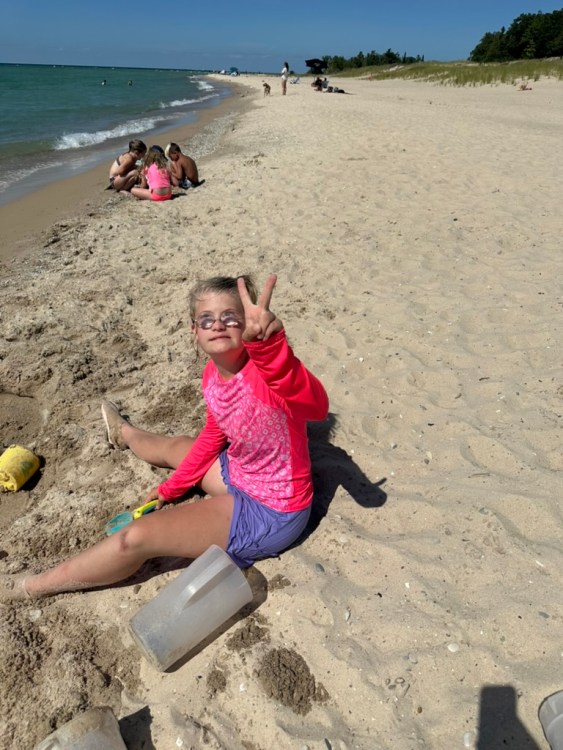
For the past 33 years, my five children and I have spent time each summer in Charlevoix, Michigan, 50 miles south of the Mackinac Bridge. For many years, I left my first three kids, all close in age, with their grandparents, who stored bikes, fishing gear, boogie boards, basketballs and more for the handful of weeks they had the kids. The boys spent their days at Lake Michigan, just half a block from the grandparents’ house, or exploring the town on bike and foot. They checked in as needed, mostly at mealtimes.

As there is a nine-year gap between my third and fourth children, the grandparents were much older when my last two kids’ were big enough for summer visits. Their grandma suggested we enroll them at Camp McSauba, a city-run day camp on a ski hill next to Lake Michigan, so I could stay up north and work remotely. Because Grandpa had been a city employee, the fee was just $85 a week in 2015, the first year my son Leif attended.

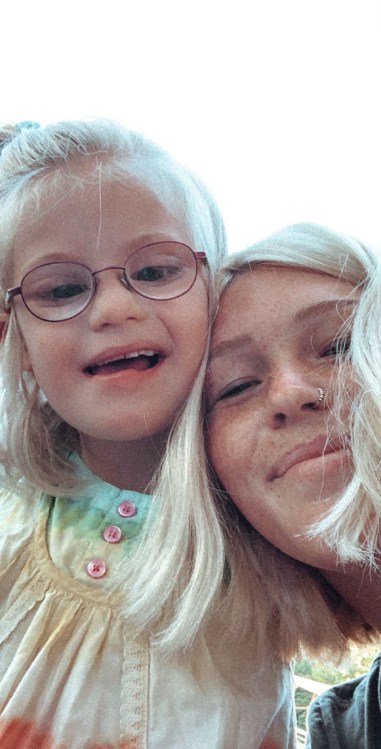
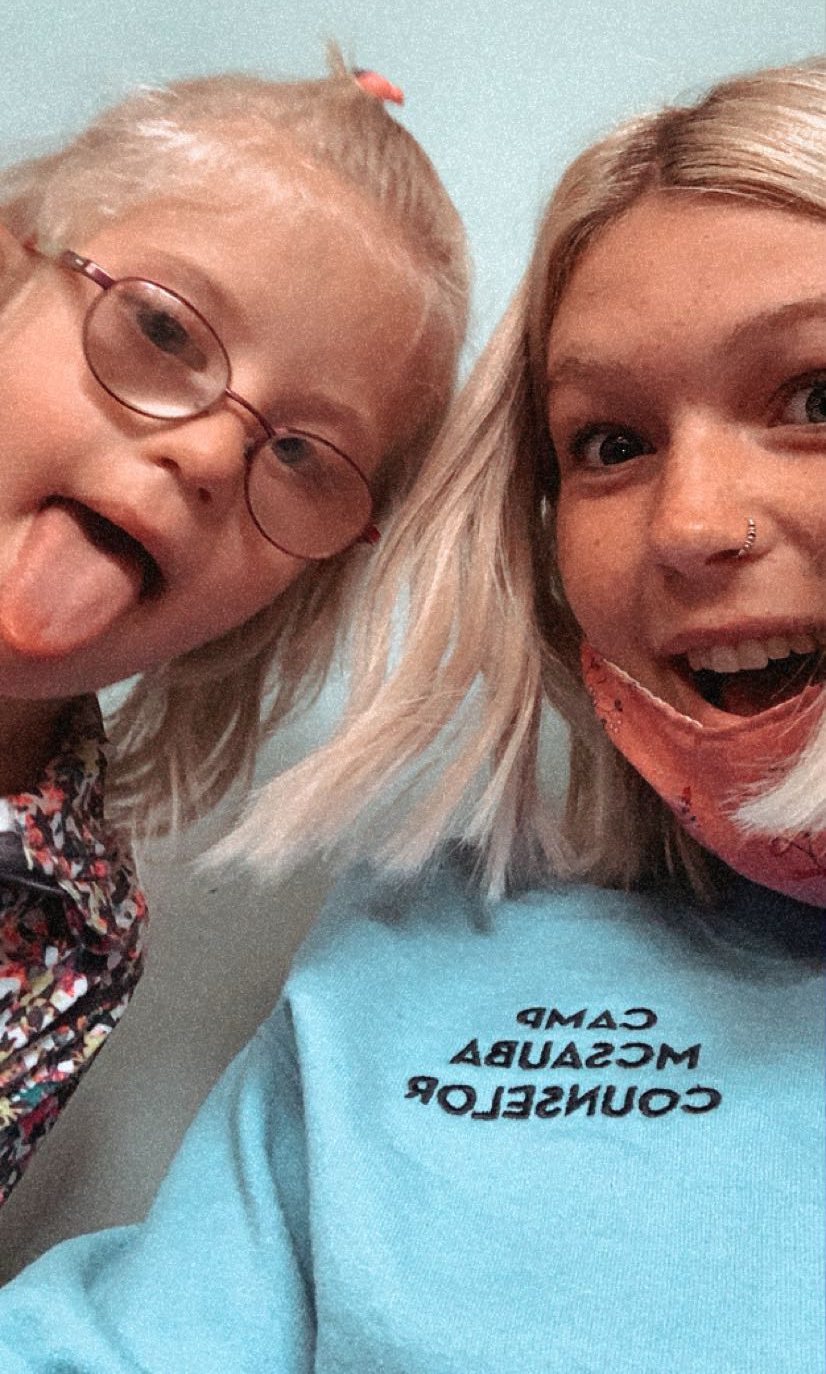
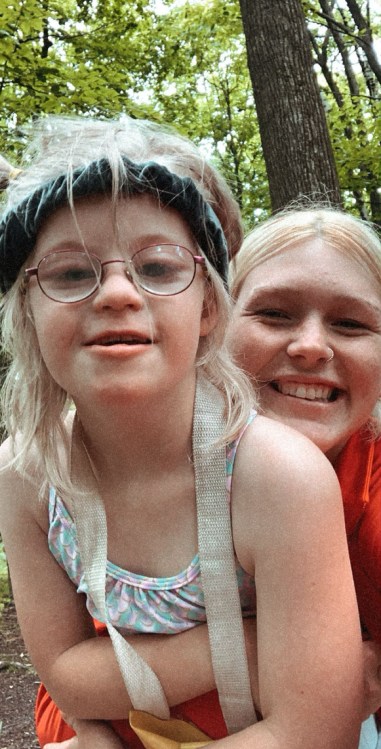
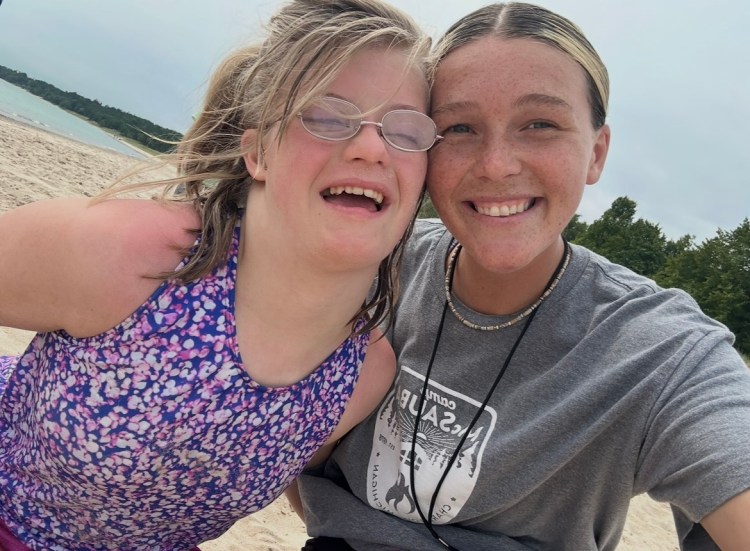
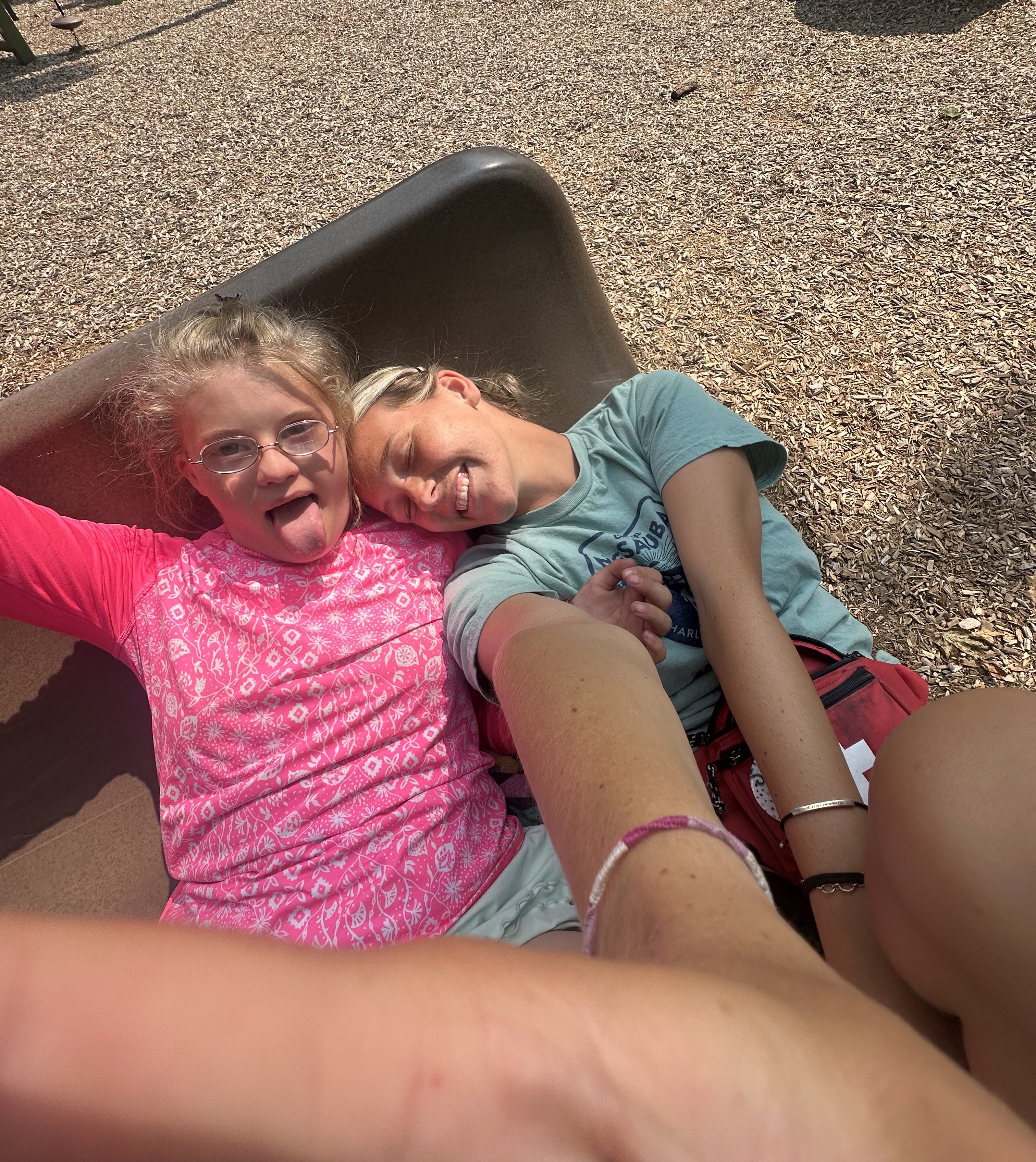
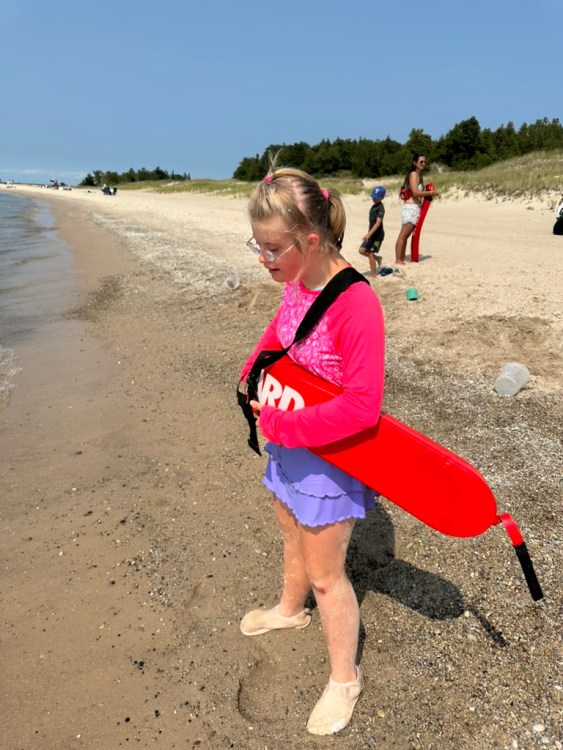
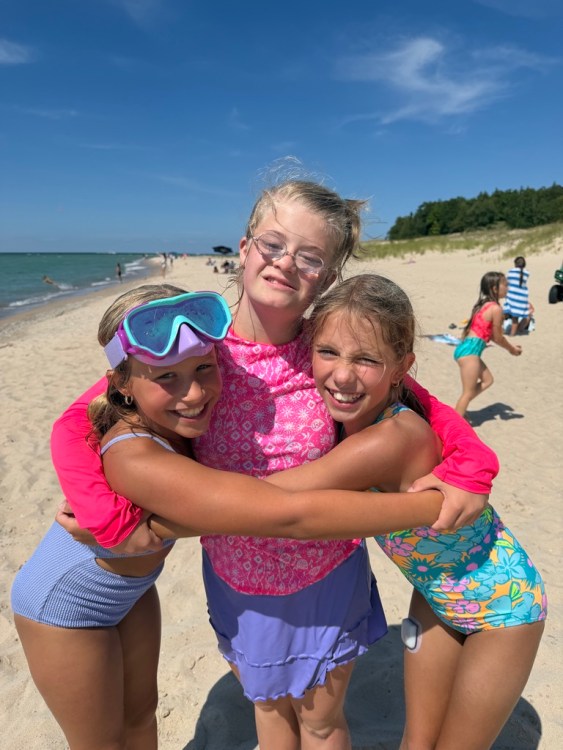
Close relationships develop among camp counselors and children who return every year. Several Camp McSauba counselors were recent high school graduates when Leif and Lyra first attended and I have enjoyed watching these young adults grow and mature alongside my children. One wrote a college paper in which she described how integrating Lyra, who has Down syndrome, at a “typical” day camp benefits everyone.

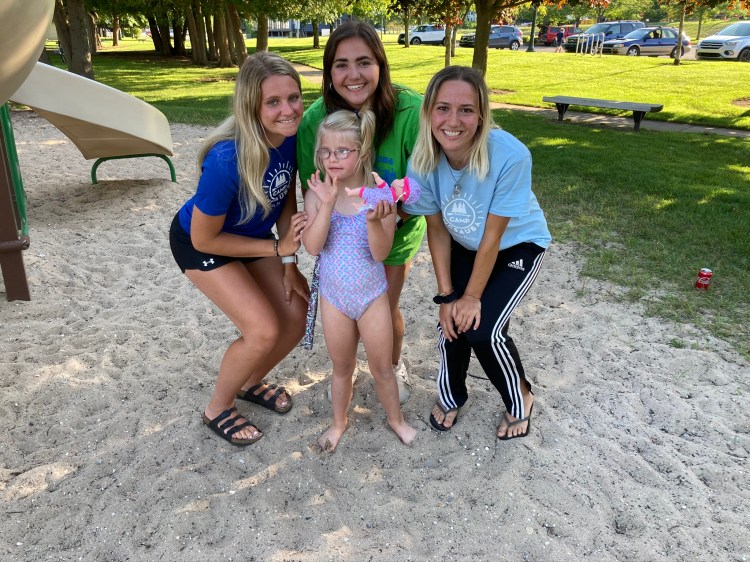
Enrollment for camp is weekly, and children are placed in groups by age. The groups have an assigned counselor (or two, depending upon enrollment numbers) and several often requested Lyra’s group, including sisters Caroline and Ali Jarema. This summer was the first neither of the sisters were counselors because Caroline is now a pediatric occupational therapist and Ali a special ed teacher, both at the local school district where they taught summer school this year. They came to camp after work one day specifically to visit with Lyra.

The counselors always fully accepted and integrated Lyra at Camp McSauba. But the first year she attended, that was not true of the director, a woman around my age. No more than 15 minutes after I had dropped off Leif and Lyra on the first day, the director called me. She said Lyra had gotten her socks wet and needed a dry pair and also, “We are not set up for her to be here.”

I returned to camp with a fresh pair of socks and a (polite) piece of my mind. Lyra had spent the previous two years in Akron Public Schools Early Learning Program preschool and was comfortable in group settings. Yet all that director could see was Lyra’s Down syndrome, not a child behaving just like all the other 5-year-old campers. Lyra remained at camp that week, but the director demonstrably never warmed to her, which I found unnerving. I sent Leif alone the following weeks.

On a spring day when Lyra was perhaps 7, I stood in my kitchen in Akron and watched her struggling to carry a heavy laundry basket filled with dolls.

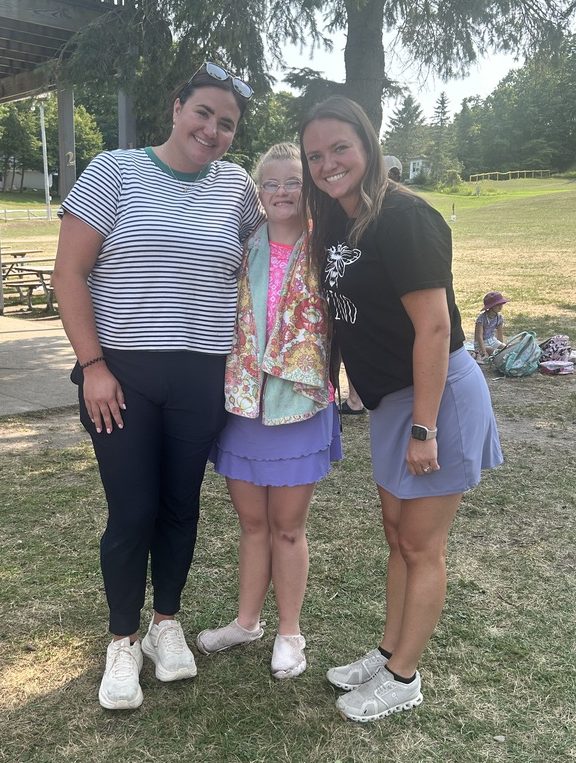
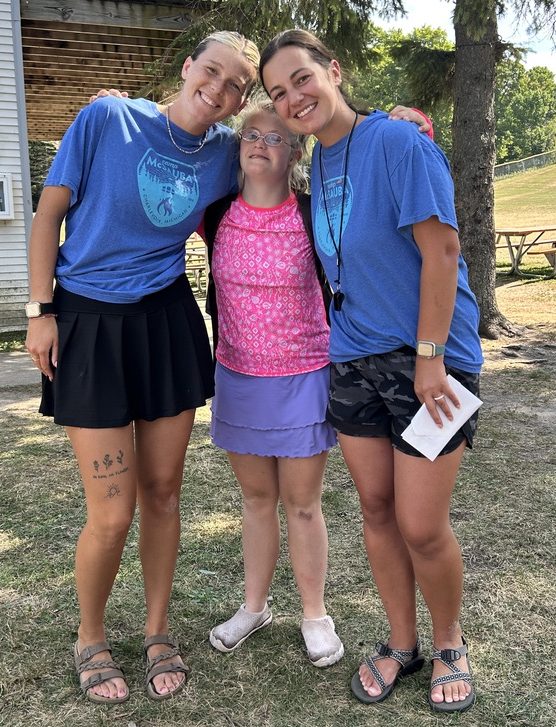
Lyra between camp directors Kirsten Peck and Meredith Walker.

“Where are you taking your babies?” I asked when she reached the back door.

“To Camp McSauba,” she told me before dragging the basket outside. I promptly shared this in a text message with Meredith Walker, the camp director since Lyra’s second year. Her heart melted like mine. Meredith was just 21 when she became camp director in 2019. Since then, she has graduated from college, become a fourth grade teacher, gotten married and, last year, gave birth to her first child.

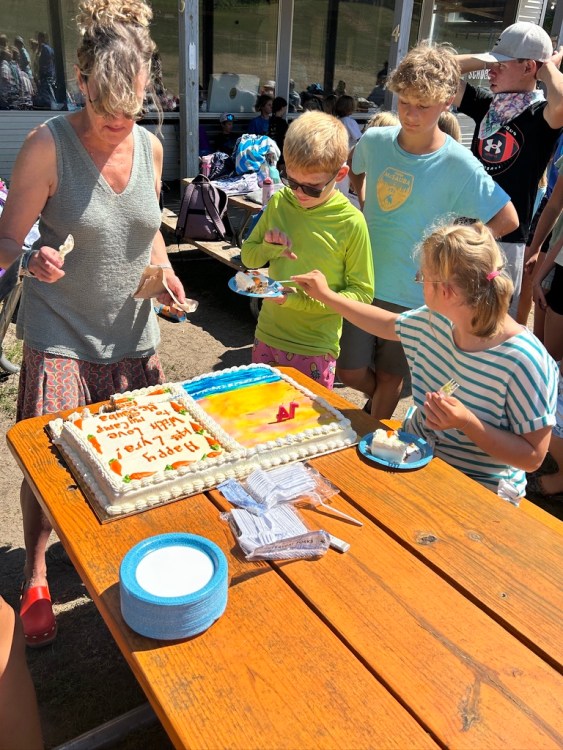
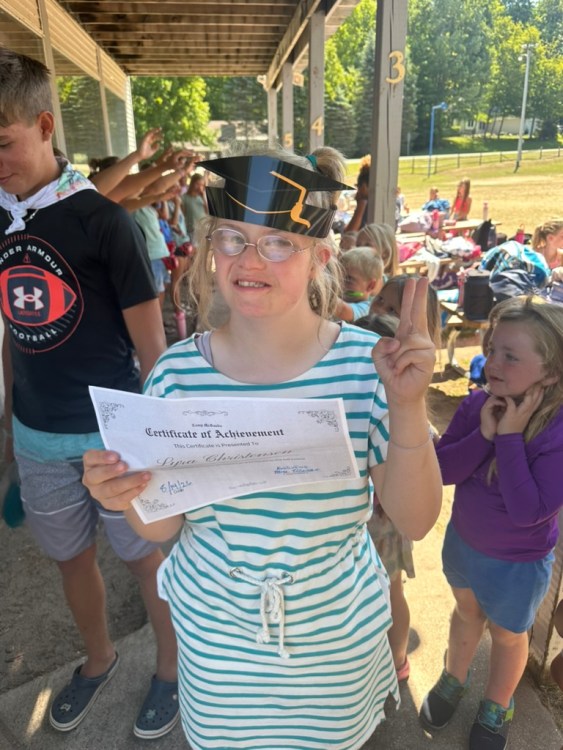
Camp McSauba welcomes children ages 5 through 13. Three summers ago, Leif openly cried on his final day, as did several of the counselors. This year, the last day of camp was also Lyra’s 14th birthday. At lunchtime, I arrived with the largest sheet cake I’ve ever purchased, enough for 70 campers and several counselors. Everyone sang happy birthday to Lyra and, at the end of the day, a graduation ceremony was held for those, including my girl, who will be too old to return next year.

There’s a poignancy like none other when children do things you always wanted them to do, like graduate high school, leave for college or career, choose a life partner, become parents themselves. As my last child, Lyra’s graduation from summer camp marks the end of an era. From time to time we’ll return to Charlevoix as we have many dear friends there. But next summer, instead of picking which weeks to attend camp, we’ll ask, “Where do we want to go this year?”

This column was first published in the Akron Beacon Journal on Sunday, August 23, 2026.