Home renovation · Parenting & Family · Uncategorized

The key to a healthy family with grown kids: Showing up

I once knew two women whose husbands were brothers and, on the first weekend of each month, the two families and the husbands’ parents would take turns working at one of the young couples’ homes or that of the parents. Young cousins played while older cousins, aunts, uncles and grandparents either worked on a project or helped cook meals for everyone.

I easily imagined one day doing the same with my own sons when they were grown.

The primary job of parents, however, is to raise children who will fledge and become self-sufficient adults who pursue their own aspirations, not those of their parents, wherever that may take them. My first two children left Ohio to pursue college degrees in the arts, while my third child went to Columbus, where they changed majors at OSU multiple times.

During COVID, all my children returned to Akron. For several months, marked more by camaraderie than lockdown stress, we again all lived together. Then, one by one, they resumed their journeys in life. My eldest went to Texas for graduate school, after which he took a job in D.C. My second son followed his girlfriend west, eventually settling in Wisconsin, while my third child left for Columbus and many other places.

But in my heart, I not-so-secretly hoped that, like so many people raised in Akron, when my children had children of their own, they would return home. For a few months last year, my deepest wish looked as though it would come true. While visiting to help with projects at my home, my son Hugo and his wife, Claudia, announced they were expecting a baby and also looking for work in Northeast Ohio. I immediately cried.

“Would you rather win the lottery,” my fourth and youngest son asked me, “or have Hugo and Claudia move back?”

“No contest. Have them move home,” I replied.

I’m sad to confirm that the reports of a flat job market − low firing rates coupled with low hiring rates − are all too true. After many months of job hunting, my son and daughter-in-law didn’t find jobs, or even any promising leads, in Northeast Ohio. And so, with an incoming baby and other good reasons to move out of their apartment, the couple bought a house in Wisconsin.

Just weeks before the baby’s due date, I stayed with Hugo and Claudia in their new home and worked with my son in a yard that’s all his. Because the housing market is incredibly tight in Madison (the world headquarters of Epic, a medical software company), the previous owners had done little to spruce up the place, which had been a rental, before putting it on the market.

Like the descendants of farmers that we are, Hugo and I grabbed shovels and started digging. We tore out an overgrown, trash-collecting privet bush, pulled up yards of sprouting fat roots from a tree that no longer exists and planted hydrangea bushes.

The work was deeply satisfying, but there was too much to accomplish in just one visit, including the removal of an overwhelming number of old bush stumps. I therefore proposed that our family descend upon the young couple July Fourth weekend. The baby would be about a month old, everyone would have holiday time off from work and, with four healthy men working together, a landscaped yard was within reach.

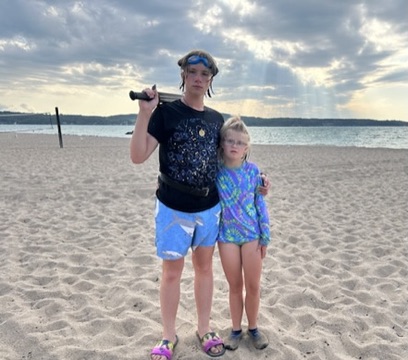
Holly Christensen's family members wait for their turn to hold their newest member, Flora.
Waiting in line to hold our newest family member, Baby Flora.

On July 2, my eldest son flew to Madison from D.C., while my youngest two children, their father, Max (my ex, but still family), and I arrived in a minivan loaded with goodies for our family’s new star.

For weeks beforehand, my daughter, Lyra, excitedly talked about going to Madison to see “Baby Florence.” If we’d have let her, Lyra would have held her niece all weekend, but she was up against a deep bench of stiff competition. None of us checked into the hotel until we had first met and held our wee, sweet Flora, as her parents call her.

The next morning, Max and my eldest son left the hotel at 6 a.m. to rent a stump grinder. Then, while I cooked a 14-egg frittata in a pan on the stove and sausages in the oven, the men began the yard’s transformation. For three days and four nights, we worked hard, cooked often and played several rounds of euchre.

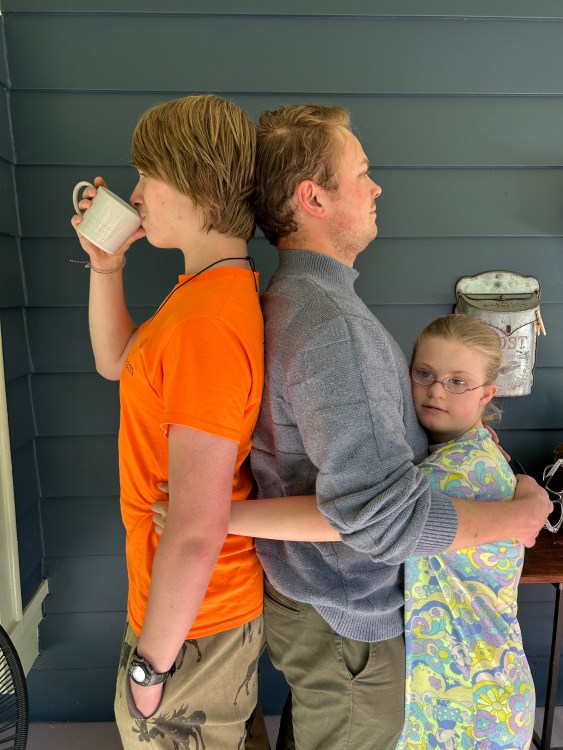
Family members pitch in to help Holly Christensen's son work on his new yard.
Claude, Max and Leif pitch in to help Hugo landscape the yard of his and his wife’s first home.

The main ingredient in the recipe for a healthy family is showing up.

My grandchild may live farther away than I prefer, but our family remains close, held by bonds that are reinforced each time we pull together, which is harder to arrange and happens less frequently than if everyone lived in Northeast Ohio. But the extra effort is well worth it.

This column was first published in the Akron Beacon Journal on Sunday, July 19, 2026.
Parenting & Family · Uncategorized

Taking kids on a grand globe-trotting adventure

My friend Jen has always been restless.

We met more than 25 years ago at Ohio State University. After graduation, she worked for a year on a farm in Kansas cultivating native prairie plants. Then she joined the Peace Corps and worked for two years with farmers in Honduras.

She met Milan after returning from the Peace Corps. They moved to the East, got married, changed their last names to Marvelous and settled in Philadelphia. When their first two children were still small, Jen insisted they move to the countryside near Ithaca, N.Y. They bought property, had twins, and raised their four girls and some chickens while Jen worked on a nursing degree.

A few years later, they moved back to Philly. Jen is a hospital nurse while Milan runs their properties, fixer-uppers that he fixes up and rents out. He also home-schools the girls. Occasionally, Jen flies off, volunteering her nursing skills in places like Haiti after the 2010 earthquake.

But for many years, maybe all along, her deepest desire was to circumnavigate the globe with her family. And you know what? She did it. They left when their girls were 15, 12, 9 and 9.

It was August 2015 and I was pulling weeds in our garden when she called. “We’re on the highway in Colorado, driving an Auto Driveaway car from Philly to San Francisco. Then we’ll head up to Canada.”

“Wait, you mean now? You’re leaving now?” It’s not that I didn’t believe they’d actually do it, but Jen had talked about this trip and documented the extensive preparations on her blog, Tripping Fantastic, for so long it felt like an ever-receding horizon.

In Vancouver, they boarded a cruise ship, spent 16 nights at sea, disembarking in Shanghai. From there, they took a train, buses and taxis to Laos, where they stayed for a month before heading to Thailand.

In January, when I was in Detroit for job-related training, I sat in my hotel room reading Jen’s blog. Her family settled in Bangkok, a temporary home base from which they explored the Malay Peninsula including volunteering at an elephant sanctuary and watching the sun rise on the first morning of 2016 at the ancient ruins of Angkor Wat in Cambodia.

They arrived in India in February. I studied ancient Indian art and architecture at OSU, but have never been to the Asian subcontinent. As late winter gray prevailed outside my office window, saturated colors exploded from my desktop screen — Jen’s photos from the state of Rajasthan.

Post after post left me with a mix of longing to take such a trip with my family and yet also feeling inadequate to the challenges of such travel. This was not a curated tour by way of Hilton hotels. With lots of research beforehand and during the trip, it was done on the cheap and, after the initial cruise, never plush. Once they journeyed on a train in China with no seats, only bunk beds flanking the walls, making it impossible to sit upright. The photo made me queasy with claustrophobia.

By spring, they had traveled from India through Nepal and back to China. I saw these countries in ways I had not imagined from listening to the news. China looks modern and efficient. In India, ancient civilizations remain impressed upon the hustle-bustle of the present day.

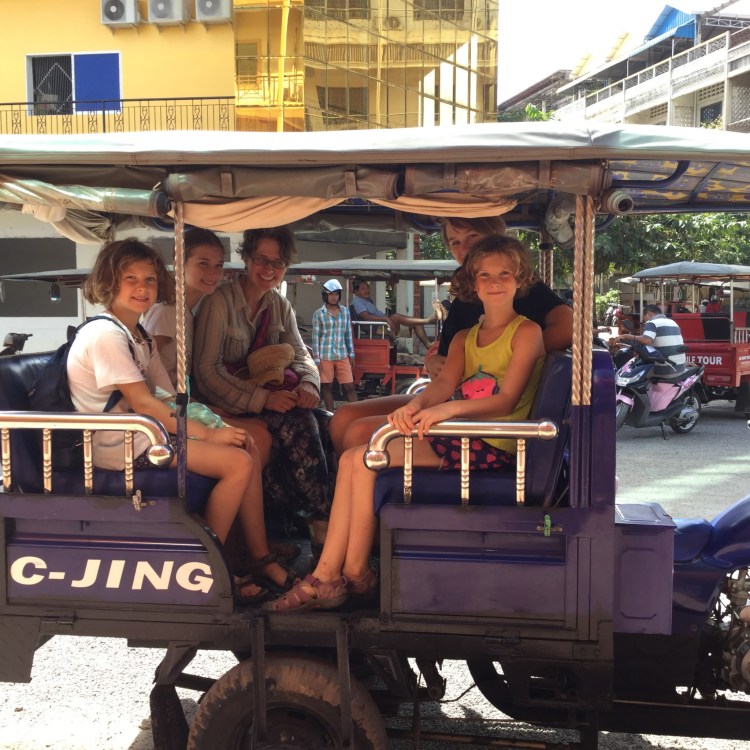
Jen Marvelous and her four daughters in Bangkok, Thailand in 2015.

When they backtracked to China, I thought maybe they were returning home. But instead they took the Trans-Siberian Railway from Beijing to Russia. From the eastern countryside beginning with Lake Baikal, they traveled to Moscow, stopping in Mongolia along the way. And from Russia they went to Istanbul just after the attempted coup.

Last summer, they wended their way through Europe: Romania, Greece, Croatia, Italy, France, England, Ireland and, finally, Spain where they boarded a ship in Barcelona. It brought them across the Atlantic to New York City.

Thirteen months, $86,000, six people. They circled the Earth.

Jen’s parents live in Northeast Ohio. She visited them soon after returning and we met for lunch.

“I keep thinking how a trip like that would completely change the way your children view life, the world, everything!” I told her. I have traveled with my children to many places, but nothing like my friend had done.

“Yeah, well, we’ll see. When they weren’t crying that we’d ruined their lives, they liked most of it. I think.”

“What!?!”

“Seriously, it was hot in Istanbul, so they didn’t want to leave our hotel and just laid around the room. But when they Facetimed their friends, they stuck their phones out the window to show them where we were, like it was fabulous. It could be frustrating at times.”

Ah, kind of like all parenting.

If you do your job right as a parent, it’s impossible for your kids to appreciate it. This is true of both the quotidian — say, providing nutritious meals, helping with homework, regular bedtimes — as well as the exceptional, like a trip around the world.

You don’t do it expecting them to say, “Thanks for buying organic food and cooking a delicious dinner for me yet again.” You do it because that’s what it is to be a parent and they don’t appreciate it because it’s all they know.

However, on the days when your children seem particularly ungrateful, remind yourself that one day they will have to take care of themselves and perhaps children of their own. It is then that they will truly appreciate all you’ve done for them and want to tell you so.

Certainly one day, if not already, Jen’s girls will.

This was first published in the Akron Beacon Journal on Sunday, June 3, 2017.

Civil Rights · Down syndrome · Lyra's Latests · Parenting & Family · Uncategorized

Jesse Ridgway misleads with Down syndrome abortion post

In 2014, my youngest children and I attended a family-friendly party in a sprawling yard where I had a long conversation with a smart and funny woman my age. Nearby, my nearly 2-year-old daughter, Lyra, moved remarkably fast using her newly perfected bear walk.

“She’s so cute, how she crawls on her hands and feet,” the woman said.

“Yeah, it takes children with Down syndrome longer to crawl and walk.”

“Wait, your daughter has Down syndrome?”

“Oh, yes,” I said.

“You are so much stronger than I could have been,” she said, but I disagreed.

“No,” she continued, “I’m telling you that you are stronger than I was. In my late 30s, I was still single and had IVF to get pregnant. When I was pretty far along, they told me the baby had Down syndrome and gave me two days to decide. I couldn’t do it. I would have been alone, I … I didn’t do it.”

“I have no judgment,” I said, knowing this woman made the best decision she could with the information she was given. The features on her face rearranged themselves, her eyes going from narrowed and intense to widely opened.

“But I see your daughter and,” she paused, “it makes me wonder…”

I was reminded of that conversation when I recently learned of a YouTube influencer and his wife who decided to terminate her planned pregnancy. Until then, I had never heard of Jesse Ridgway, whose story-telling videos have earned him over 4 million followers.

Weeks earlier, the Ridgways had shared with the public the exciting news of their pregnancy. Then, on June 3, Ridgway posted on his X account that his wife had undergone an abortion because of a fetal DS diagnosis. Rather than simply asking for privacy and compassion, Ridgway felt the need to justify why they had chosen to end the pregnancy, describing what he believes living with DS to be like, not only for people with the syndrome, but also their families. His post contains both misleading and patently false information, as well as his assessment that “Down Syndome isn’t a ‘blessing’, it is objectively shitty from a health perspective.”

Over a decade ago, I began making an automatic monthly donation to Down Syndrome Diagnosis Network, a non-profit with the primary mission of educating health care professionals on how to give accurate, up-to-date information on Down syndrome at the time of diagnosis. Unfortunately, as Ridgway’s post underscores, the work of the network is far from over.

In his post, Ridgway states the odds of having a baby with DS are 1 in 1,000, which is true if the mother is 28. But at 31, Ashley Ridgway’s chances of having a baby with DS were 1 in 800. When I was pregnant with my daughter at 45, my odds were 1 in 30. For a 20-year-old, it is 1 in 2,000.

Choosing to bring a child into the world always includes the gamble of a diagnosis. But unlike other diagnoses, such as autism spectrum disorder, ADHD, eating disorders, childhood cancer, depression, bi-polar disorder, addiction and many more, DS can be definitively diagnosed prenatally because it is caused by the observable presence of an extra twenty-first chromosome.

Are there challenges raising a child with DS? Of course there are, as there are with any child.

As for health concerns, Ridgway is correct that roughly 50% of newborns with DS are born with heart conditions, the most common of which is atrioventricular septal defect (AVSD). But in the past 40 years, tremendous advances in cardiac care have occurred and, according to the National Institutes of Health, over 95% of newborn AVSD surgeries are successful, including for babies with DS.

Ridgway also mentions hearing challenges and vision problems, yet that is not the same as deafness and blindness. Many hearing problems people with DS have are treatable conditions, such as “glue ear” in which secretions accumulate in the middle ear, something simply solved by regular monitoring and cleaning when needed. Similarly, the majority of vision problems in Down syndrome are the same as those in the typical population: nearsightedness, farsightedness and astigmatism − all of which are easily corrected.

But of all the misleading statements Ridgway made, the most egregiously false is: “I didn’t realize just how rough it is for the child, let alone the family…”

Dr. Brian Skotko, a Northeast Ohio native who is now the director of the Down Syndrome Program at Mass General Brigham in Boston, has conducted several studies on the quality of life for people with DS and their families. He found that “nearly 99 percent of people with DS indicated that they were happy with their lives, 97 percent liked who they are, and 96 percent liked how they look.” He also surveyed siblings of people with DS and 88% said that they are better people for having had a brother or sister with DS. That finding was surely no surprise to Skotko, who has a sister with DS.

As for parents, a National Institutes of Health study found the divorce rate for couples with a child with DS is lower than in families that have a child with a different birth diagnosis and also lower for those with children that have no identified disability.

I respect the Ridgways’ decision to terminate a wanted pregnancy in the face of a DS diagnosis, just as I respected the choice of the woman I met 12 years ago. But I call him out, particularly as someone whose job is literally to influence people, for using his experience to promote the bigotry of ableism − the belief that those among us without certain IQs, abilities and incomes are strictly a burden, not valued members of society. As with any bigotry or bias − which are always based upon falsehoods− getting to know someone seemingly unlike you often leads to the discovery they are not so different after all.

This column was first published in the Akron Beacon Journal on Sunday, June 21, 2026.