
Uncategorized

Finding hope in troubling times with poetry and science

On the fifth day
the scientists who studied the rivers
were forbidden to speak
or to study the rivers.
The scientists who studied the air
were told not to speak of the air,
and the ones who worked with farmers
were silenced...

Four days after Donald Trump’s first inauguration in 2017, all information on climate change was removed from the White House website and all scientists who worked for the federal government were forbidden to speak publicly about their research without pre-approval. By the end of that day, poet Jane Hirshfield had written “On the Fifth Day” and shared it widely. It went viral and, three months later, Hirshfield collaborated with the Wick Poetry Center at Kent State University to create a Poets for Science teach-in tent on the National Mall during the first March for Science.

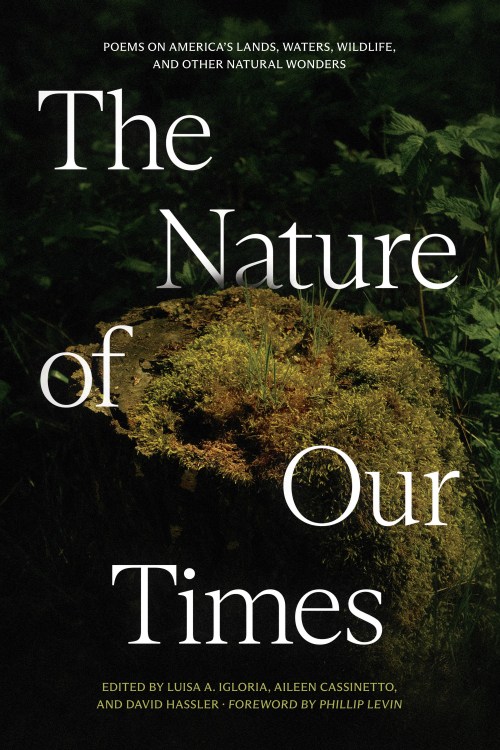
Last fall, the Wick Poetry Center, along with the nonprofit The Nature Record worked in association with Paloma Press to publish “The Nature of Our Times,” a Poets for Science anthology to complement the The Nature Record’s U.S. National Assessment, the first holistic assessment of the U.S. lands, waters and wildlife, scheduled for release later this year.

The U.S. National Assessment outlines the “status, observed trends, and future projections of America’s lands, waters, wildlife, biodiversity, and ecosystems and the benefits they provide, including connections to the economy, public health, equity, climate mitigation and adaptation, and national security.” In order to fulfill the mandated mission of the U.S. Global Research Program (created by Congress in 1990), scientists and citizens have worked since 2022 to catalogue the current condition of the environment for the assessment.

While change in everything is continuous, right now it is happening at an accelerated pace not only in nature and the environment, but also in national and global politics and technology. And yet, we live at a time when all too frequently the value of science and the humanities is dismissed and the funding for both is cut off.

When great changes rapidly occur, uncertainty and anxiety are inevitable. Yet, opportunities also exist. There is a growing decentralized movement afoot seeking to strengthen the connection between science and the humanities, between data-driven research and the spirit. As Hirshfield has pointed out, the microscope and the metaphor are both instruments of discovery. Scientists usually present their research findings in fact-laden reports, whereas poetry, and other genres of writing, help people feel the awe of all that science describes and discovers.

The Wick Poetry Center at Kent State University is hosting a multi-day gathering in Kent, Ohio.

With that understanding, this November the Wick Poetry Center will bring together an array of scientists, such as former NOAA Administrator Jane Lubchenco and Phillip Levin, the director of The Nature Record; and writers, including Hirshfield, current U.S. Poet Laureate Arthur Sze, and past laureate Tracy K. Smith. The three-day event, called The Poets for Science Gathering, is something of a cross between an academic conference and a festival. The Gathering will include presentations, workshops, readings and performances − totaling 90 sessions.

Naturally, some sessions focus on nature and the environment, such as the reading “Strength in Many Voices: Contemporary Ecopoetry Anthologies,” the performance “I Pledge…a Performance and Creation Expression of Our Connection to the Environment” and the presentation “Losing Species: Poetry That Responds to the Science of Animal Precarity.” But there are also sessions on community, including those of people who are Appalachian, Indigenous, Jewish and LGBTQ, as well as a session on the intersectionality of people who tick off multiple identity boxes. Sessions on outer space are complemented by those on microscopic worlds, including one presentation that does both: “Scale as Poetic and Scientific Playground: From Gut Flora to Supernovae.” All sessions are listed on The Gathering’s website.

But The Gathering isn’t just panelists and presentations − it is also crucially about community and participation. Just as the research for the U.S. National Assessment included citizens who shared their observations of natural environments across the country, the public is enthusiastically encouraged to attend The Gathering and engage with writers, scientists, researchers, educators, students, clinicians, policy makers and community organizers, through structured and unstructured events, readings – and, of course, a book fair. Registration for all three days costs $275 with meals included, $200 without meals and $150 for students, which includes meals.

The Gathering website features a video of a starling murmuration, something we are lucky to be able to observe in Northeast Ohio. Thousands of birds move en masse as though one entity, bending and twisting in what is a perfect visual example of synergy − where the whole is greater than the sum of its parts. And is that not emblematic of this moment?

For no matter what a single person’s response is to the rapid changes occurring in the environment and technology, government and geopolitics, it is by gathering together to share our diverse knowledge and perspectives that we can gain the insight and capacity to best meet the current moment.

This column was first published in the Akron Beacon Journal on Sunday, May 24, 2026.
Uncategorized

Anthology of poetry a perfect companion to scientific assessment of nature in America

In 2009, my three children and I drove to the Rocky Mountains for a family reunion. Though I hadn’t visited the Rockies since I’d lived in Wyoming two decades earlier, as we began our ascent into the mountains, they felt like an old friend whom time cannot estrange. Surrounded by flat prairies that emphasize the overwhelming enormity and ruggedness of the mountains, the range leaves an indelible impression. 

But as the car reached higher altitudes, the landscape became horribly unfamiliar. Once verdant mountainsides covered in pine forests had turned a reddish color, not unlike that of a commonly used deck paint, which is also the color of pine needles after a tree has died. Though dead, the desiccated trees looked ashamed of their hideousness. To prevent wildfires, National Forest Service employees worked to clear cut the pine corpses, which were stacked in piles as large as barns. It looked to be a job with no end.

For the first time in my life, climate change wasn’t abstract reports of faraway glaciers melting, sea levels rising or storms growing stronger. Everywhere I looked for several days I saw the immediacy of climate change and its impact. The winters in Colorado are no longer cold enough to kill pine beetles and their numbers skyrocketed. Hungry beetles gorged until their food source, in this case pine trees, collapsed.

In 1990, Congress created the U.S. Global Change Research Program to “assist the Nation and the world to understand, assess, predict, and respond to human-induced and natural processes of global change.” Under this mandate, 15 federal agencies worked with scientists and citizens from all walks of life to create a first-of-its-kind National Nature Assessment (NNA1) of the “status, observed trends, and future projections of America’s lands, waters, wildlife, biodiversity, and ecosystems and the benefits they provide, including connections to the economy, public health, equity, climate mitigation and adaptation, and national security.”

This comprehensive assessment was nearing completion when its federal funding was pulled this January. Given the critical and urgent value of the NNA1–for how can we understand how our climate is changing if we do not take stock of where it is now–the non-federal authors of the assessment formed a new non-profit, United by Nature, sought and received non-governmental funding to complete their work.

The NNA1 is scheduled to be released this fall as is “Nature of Our Times,” a poetry anthology companion to the NNA1. Many of the book’s poems reflect solastalgia, a word that means longing for a home that still exists but is rapidly changing before our eyes, just as the Rocky Mountains were when I visited 15 years ago.

I thought of that trip when reading Phil Levin’s foreword to “Nature of Our Times.” The director of United by Nature, Levin describes a knowledge that “resists spreadsheets and equations. It is the knowledge that comes from standing still. From watching a great blue heron glide above a salt marsh or listening to the layered calls of frogs at dusk. The lessons from such stillness are different than science, but no less true. And they remind us that the root of so much science is reverence.”

Kent State University’s Wick Poetry Center was a natural partner for the anthology. In 2017, poet Jane Hirshfield wanted a poetry presence at that year’s Earth Day March for Science on the Mall in Washington D.C. and collaborated with the Wick Poetry Center to create Poets for Science. Why poetry? When I asked Wick’s director David Hassler this question, he explained, “Poems focus receptivity to being aware and attending nature, as the late environmentalist and scholar Joanna Macy wrote, ‘whether as midwives to a new chapter of nature or hospice providers to a dying world, because presence and action are needed regardless.’ Poems offer us the possibility of emotionally shared experience that can spur people to interact beyond data and politics.” 

Hirshfield puts it this way: “The microscope and the metaphor are both instruments of discovery.” Scientific data can be overwhelming, sometimes even obtuse, to the non-scientist. Whereas poetry, which speaks to emotions, can help communicate our understanding of science.

Poets for Science created an ongoing interactive website and put out a call for poems on how nature shapes our lives and how we can shape the future of nature. The website accepts submissions from anyone, not just published poets, and so far has received over 1,300 submissions, 210 of which were selected for the book and organized in four sections: Nature & Well-Being: Self & Community, Nature & Heritage, Nature, Risk & Change, Now & in the Future: Bright Spots.

This Thursday, Sept. 18, “Nature of Our Times” will be released. That evening at 7, there will be a poetry reading and discussion with Levin and the book’s co-editors at the Kent State Student Center Ballroom Balcony. The following day, Cleveland Public Library’s downtown branch will unveil more than two dozen banners with poems from the book coupled with nature photography. 

Poetry won’t solve nature loss, but according to Levin, “The poet’s job is to speak what cannot be said in any other way. The scientist’s job is to seek the truth with rigor and openness. The public’s job—our job—is to listen, to learn, and to respond.”

This was first published in the Akron Beacon Journal on Sunday, September 14, 2025.

Uncategorized

Where will we be a year from now?

Is this what you expected life to look like a year ago? 

When my children were all young, the changes I noticed from year to year were often typical milestones: first steps, potty training, starting school, riding bikes.  

In those labor-intensive years coated with more body fluids than I care to recount, raising children felt like my major contribution to the world. It still does. 

Three of my children are now grown and contribute to society. They are active citizens who participate in our democracy and in their communities. They also know how to cook and clean a home, and I’m fairly certain they regularly do both. 

In times of great change, however, simply contemplating one’s life at the end of the year seems remiss. 

We are about to embark on the third year of a global pandemic; the effects of climate change are no longer a distant cataclysm; and liberal democracy, of which this country has long been the world’s leading example, is looking precariously wobbly. 

Alone, each of these can overwhelm anyone paying attention. When dished up together, as they are, it might feel as though the best course is to rock to and fro in a fetal position. 

But I suggest otherwise. 

We can’t wish away COVID-19, a warming planet or an assault on democratic values. They are here and must be recognized and addressed with thoughtful urgency. 

And consider this: positive paradigm shifts can, and often do, occur alongside or just after major calamities. According to Stanford professor Walter Scheidel, the worse a pandemic or plague, the more it results in leveling societal inequalities. 

It’s hard to know how long the COVID pandemic will prevent economies from returning to the way they were (if they ever do), but what is clear is that many workers no longer accept wages that leave them below the poverty level and often working in unsafe conditions. 

I worked part-time at World Market, a retail store, for five years and even with sterling reviews I never received a raise larger than 25 cents an hour. When I left in 2018, my hourly wage was less than $10. This holiday season, new hires at World Market started at $13 an hour. 

As a freelance writer and adjunct faculty with the University of Akron — employment that paid living wages just a generation ago — I work hard for little. When receiving government assistance during the first year of the pandemic, it gave me previously unknown financial capacity, and what I reasonably should always earn. 

Endless fires in California, rapid increases in U.S. sea levels and tidal flooding, devastating December tornadoes in Kentucky — the time to sit back and chit-chat about the impact of and solutions for climate change is past. Yet only recently has it been possible to inject the topic of climate change into any serious political discussions.  

Yes, many corporations that deal in fossil fuels, as well as the politicians they lobby, give little more than lip service to seeking paths away from combustible energies to those that are renewable, but the shift has begun. Individuals, communities and states that recognize the consequences of ignoring the facts are moving ahead with changes. It’s still too little, too late, but the tide is shifting. 

Dissatisfaction with government and societal status quo abounds on both the left and the right, but how to address that dissatisfaction divides the nation. Autocracies have always existed elsewhere, but not in the United States, long a beacon of democracy. That is, for now. 

In the current issue of The Atlantic, Barton Gellman reminds us that just six days into this year, “insurrectionists injured scores of police officers and trashed the hallowed building revered as the citadel of our democracy. Chanting ‘Hang Mike Pence,’ they threatened the sitting vice president’s life. They bashed police officers with poles bearing the American flag. They carried the Confederate battle flag through the Capitol rotunda. They despoiled the building with their urine and feces.” 

That all Republicans are not unified in pursuing and prosecuting all participants — including those in government — of this treasonous assault on our government is horrifying, but hardly shocking.  

The title of Gellman’s article is “January 6 Was Practice” and in it he outlines how we now live in a country in which only one of the two major political parties, the Democrats, is willing to lose an election. 

Dispiriting as this is, American citizens of all political persuasions have stopped passively observing government and have become active participants, proving that election turnout is greater in countries with significant discontent, if not outrage, with the way things are. 

This time last year, I easily imagined the pandemic would by now be behind us and I was buoyed by an incoming president’s commitment to addressing climate change and systemic inequality. 

Today, I am certain of only two things: the times are a-changing and these changes challenge us all. When looking back next year, the world will be different, and hopefully better, than it is now.