
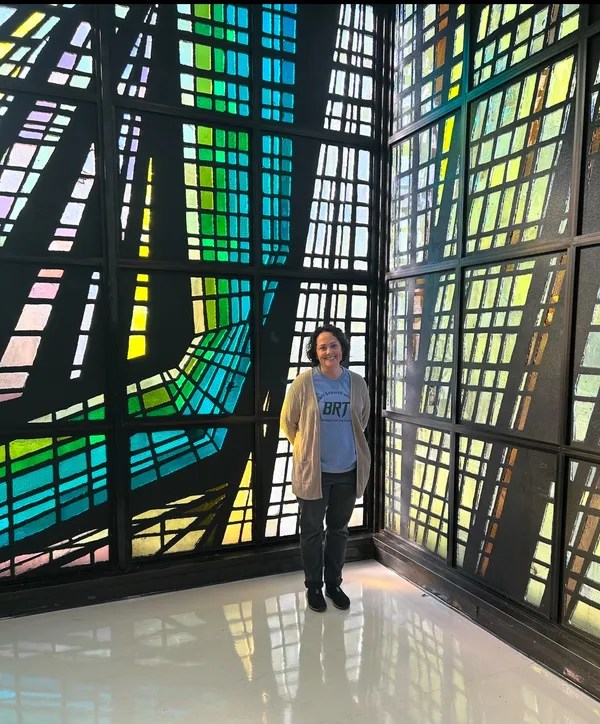
When I recently parked across the street from Bridges Learning Center, I was shocked at how many times I’ve driven by the building without noticing it. A pleasant combination of Brutalist and Prairie styles of architecture, Bridges is set further back on Thornton Street than its neighbor, Akron’s Fire Station No. 4. The school building is a hidden gem, and what occurs inside its walls is even more valuable. We are fortunate in the United States that federal law guarantees all states must provide all students with a Free Appropriate Public Education (FAPE) in the Least Restrictive Environment (LRE). This has not always been the case and is the result of hard-won civil rights campaigns waged in the second half of the last century. (For more on that history, read “Being Heumann: An Unrepentant Memoir of a Disability Rights Activist.”)
Mandated to educate all children, what do public school districts do when a child’s behavior limits or prevents them, and often their classmates, from learning? Ideally, they follow clearly defined steps of positive behavior intervention supports (PBIS) to help students learn to regulate their emotions. As a tutor in two elementary buildings in Akron schools over three years, I have witnessed faculty, administrators and staff patiently assist students with PBIS.
But what if a child does not adequately respond to these intervention supports? Smaller districts might pay for the student to be placed outside the district at specialized schools. But Akron, like many larger districts, has its own dedicated facility. Bridges Learning Center was created in 2006 when programs for elementary and middle school students merged. A decade later, high school classes were added and, since 2019, the former Reidinger Middle School has been home to Bridges Learning Center.
One might imagine the school having a carceral environment, but quite the opposite is true – every corner of the building is calm, orderly and inviting. It reflects the school’s mission to “provide social, behavioral, and academic skills through high quality teaching…by creating a positive, nurturing and supportive environment.” Michele Angelo, the school’s principal, repeatedly used the words “restorative” and “family” or “team” approach to describe what occurs in the school. Students in the United States with special education needs receive Individualized Education Plans (IEPs) – protocols developed by educators, specialists and the student’s guardians as a team – that outline specific, individual services and accommodations needed. All students at Bridges were placed on IEPs in their home schools, and it was their IEP teams at their home schools that determined a placement at Bridges was appropriate.
The range of student abilities at Bridges includes children with multiple physical and cognitive disabilities, children who are non-verbal and children with various learning disabilities. For a few students, placement at Bridges is determined to be the best location for the duration of their education. But the goal for most of the 102 students currently at Bridges (the majority of whom are in grades 3 to 12) is to acquire the necessary emotional regulation needed to return to their home schools.
How do the faculty and staff at Bridges accomplish this goal? Each classroom is staffed with a teacher, an intervention specialist (special education teacher) and an aide. Also, three full-time, floating educational assistants are available to go to any room where extra assistance is needed. And Red Oak Behavioral Health, which partners with schools throughout the district, has two counselors and three case managers at Bridges full time.

But wait, there’s more. Art therapist Shenan May and music therapist Edie Steiner work with students both one-on-one and in group settings. In addition to their education and experience in art and music therapies, they have been trained in dialectical behavior therapy-informed (DBT) practices. According to the Cleveland Clinic’s website, DBT “focuses on helping people accept the reality of their lives and their behaviors, as well as helping them learn to change their lives, including their unhelpful behaviors.” Ms. Steiner’s classroom is filled with instruments, including several electric guitars and two drum sets – much of it purchased with grant funding. I could devote an entire column to the benefits of these therapies, but a quick look at Ms. Steiner’s board for her classes shows the seamless integration of music and behavioral development students experience in her class.
Behind Bridges are expansive fields the school integrates into its student experience. Second grade teacher, Kim Zeffer, obtained funding from Lowe’s to install several raised planting beds, gardening equipment, benches and more. One of the Red Oak therapists received grant money to create a remote-control race car team. As any parent knows, most kids love RC cars. Participation on the RC team helps students “focus on teamwork, problem-solving, and self-regulation during races.”
And Bridges also helps its students prepare for life after they leave. High school students, some of whom are reintegrating after time in juvenile detention or residential placement for mental health issues, not only work on academics and emotional regulation, but also with other governmental service providers such as Summit DD, Ohio Department Job and Family Services and High School Job Training that come to the building to help with job training and placement.
Bridges’s students are members of our community. The team approach at Bridges is an effective way to assist these students to succeed not only when they return to their home schools, but throughout their lives. What happens inside Bridges helps not only its students, it’s a benefit to us all.
This was first published in the Akron Beacon Journal on Sunday, October 12, 2025.

 Whoopsie Piggle