
Uncategorized

Hosting out-of-town guest a refresher on all Akron has to offer

When my youngest son, Leif, and I shared the same spring break last month, we drove to DC and stayed with my eldest son, Claude, who lives just two Metro stops from the National Mall. On our first day we visited the Natural History Museum where it is always, regardless of the day or season, packed cheek to jowl with school-aged children. At the Freer Gallery, I introduced Leif to Whistler’s Peacock Room, which has a history as captivating as its beauty.
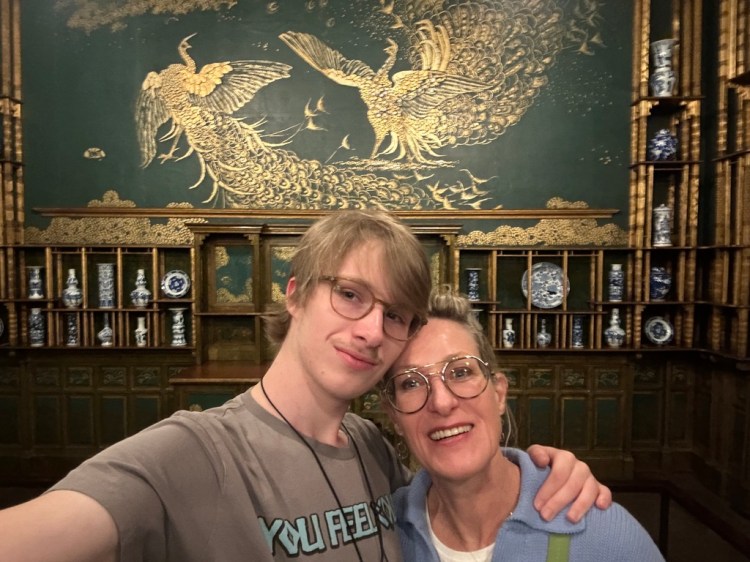
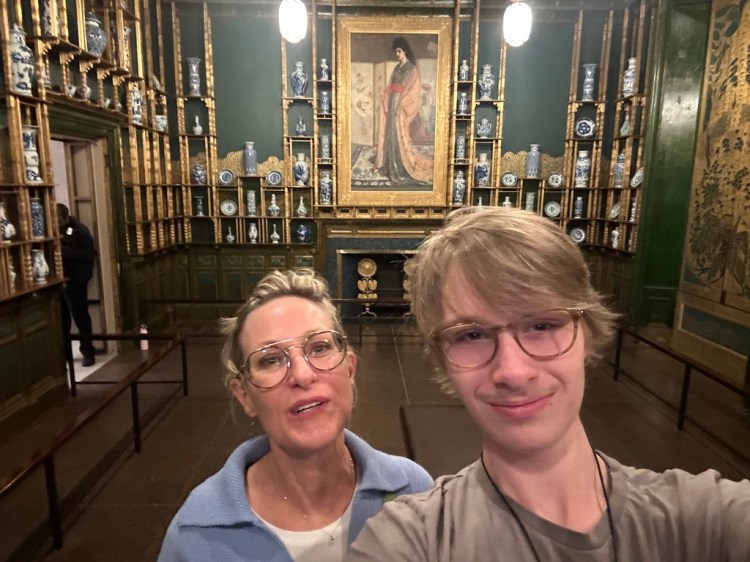
The fighting fowls at one end of the former dining room represent Whistler and his patron/enemy, Frederick Richards Leyland. Created in 1876-’77, the entire room was moved from London to American industrialist Charles Freer’s Detroit mansion in 1904. It has been at the Smithsonian since 1923.

On another day, which was sunny but made frigid by wind gusts I’ve learned are common in DC, my boys and I walked the length of the mall to the Lincoln Memorial, then over to the tidal basin where blossoming cherry trees softly accented the rock-cut memorials to MLK, FDR and Thomas Jefferson.
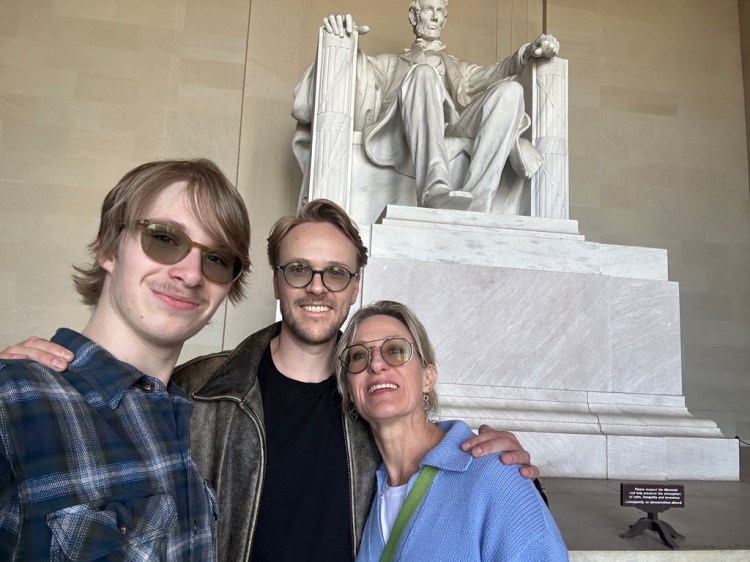
I have visited DC countless times in my adult life, but it had been 40 years since I’d seen the Lincoln or Jefferson Memorials.

“It’s been since I moved here, four years ago, for me,” Claude told us.

And that’s how it is, isn’t it? It takes an out-of-town visitor for a local to revisit places they are proud exist in their city.

Last April, I did just that. As Akronites know, it can be hard to lure Cleveland-area residents down here, so I was happy when my friend James accepted my offer of a one-day, 5-cent tour of Akron and made the trek from Tremont. After lunch at the Mustard Seed Market Café in Highland Square, we hopped into my 6-speed Venue.

James and I became acquainted through our appreciation of art and design, so naturally the first place I took him to was…the downtown Akron-Summit County Library. In the early 2000s, renovations designed by NYC architecture firm Gwathmey Siegel doubled the library’s size, while making every square foot welcoming, intimate and light-filled.

When turning north onto South Main Street from Cedar Street, large letters that spell the word LIBRARY, which are illuminated at night, seem to magically float above the center of the street.
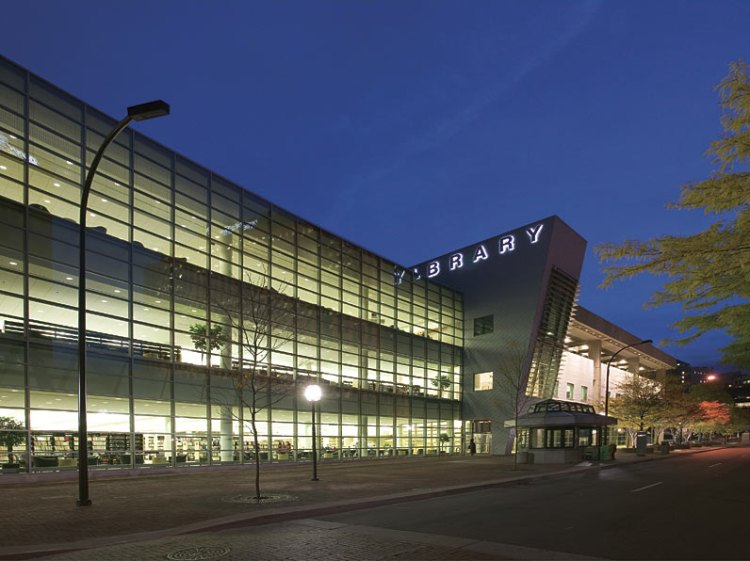
Main Street is a straight path, but it drifts oh-so-slightly to the west at the block where the library is located on the east side of the street. The designers used this minute angle, and an exterior cantilevering black-marble feature, to create the identifying effect, visible from more than a mile away.

The library’s designers understood most people would enter the building from its underground garage entrance. Just inside is a walkway ramp with stainless steel railings and a floor of brushed glass-block.

But it does not feel sterile or cold. On the right side, long windows framed in light-colored wood punctuate an interior wall separating the ramp from the work tables on the library’s first floor. On the left, floor-to-ceiling exterior window flood the entryway with sunlight ‒ a dramatic ascent into brightness after the dark, cavernous garage.

James and I toured every department in the library before I took him to the hallway outside the auditorium where, hung on the far wall, are two Claire Cressler paintings.

Two Claire Cressler paintings are on display at the Akron-Summit County Public Library Main Library in downtown Akron.

From the library, we walked across the street to the Akron Art Museum.

Three years after the library’s renovation, the art museum also underwent a significant expansion and renovation under the visionary leadership of then-director Mitchell Kahan. A baby-bear-sized museum ‒ not too big, not too small ‒ the Akron Art Museum has a notable permanent collection. When we visited, the temporary exhibit “She said, She said,” with artwork by 37 contemporary women artists, was on display.

As with the library, James was suitably impressed. “Look at all these Cindy Shermans! You know my wife contributed on a Sherman book?” I had not, but neither was surprised.

I then drove James around the University of Akron campus, pointing out the Dale Chihuly statue in the circle outside the Goodyear Polymer Center. Dozens of blue geometric blobs, reminiscent of plastic grocery bags filled with air, cluster around a pole atop a wide concrete cylinder. My four sons call it the “rock candy sculpture” after the wooden sticks with large sugar crystals on one end.

The Dale Chihuly sculpture stands in front of the University of Akron's Goodyear Polymer Center on Monday, April 21, 2025, in Akron, Ohio.

As a steady rain prevented us from walking, I slowly drove the narrow roads of Glendale Cemetery, the final resting place of many of important Akronites, including John Buchtel and Frank Seiberling.

“It’s more impressive than Lake View Cemetery on Cleveland’s east side!” James said, and I agreed.

He then asked, “Did Olmsted design it?” No, but it’s founder modeled it after Boston’s Mount Auburn Cemetery, a place that significantly influenced Frederick Law Olmsted and his park designs.

We tried to end the day at Edgar’s Restaurant, but they were booked for a function (and sadly, are now permanently closed), so I took him to Hop House on High Street, near the spot where Sojourner Truth gave a speech in 1851. We enjoyed beer, along with pizza and salad from Totally Baked Pizzeria, a separate business located next door to Hop House that delivers to the bar.

It was a good day and seeing Akron through the eyes of a newcomer joyfully reminded me why I love living here.

This was first published on Sunday, April 12, 2026 in the Akron Beacon Journal.
Parenting & Family · Uncategorized

Thanksgiving where people stay put while the art of Norman Rockwell travels

On July 7, 2007, the expanded and renovated Akron Art Museum reopened with a retrospective exhibit of American painter Norman Rockwell. In my 1970s childhood, Rockwell’s endearing, if not sentimental, covers from the Saturday Evening Post — 322 painted over 47 years — were ubiquitously reproduced. 

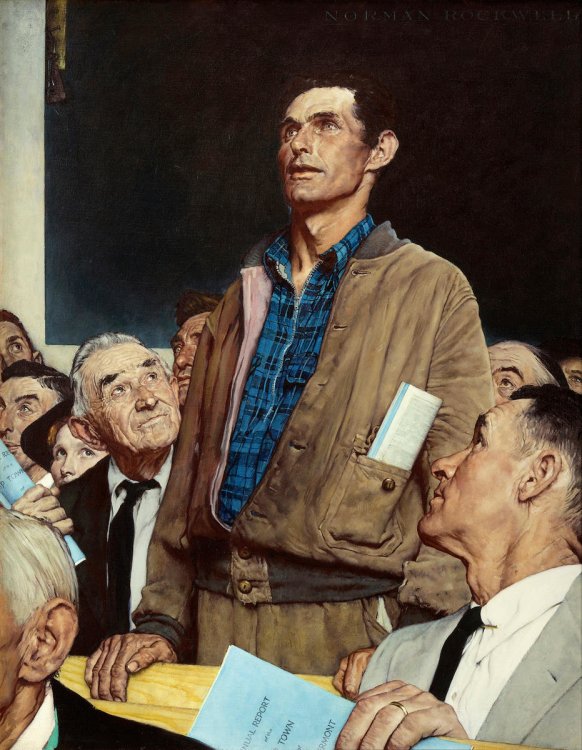
Rockwell’s 1943 “Freedom of Speech.”

Yet Rockwell did not shy away from political subjects, including 1943’s Four Freedoms covers (freedom of speech and of worship, from want and from fear), 1961’s “Golden Rule” (a version of which Nancy Reagan gifted the United Nations in 1985) and 1964’s iconic “The Problem We Live With” in which 6-year-old Ruby Bridges walks to school escorted by four U.S. marshals. Bridges was the first Black child to attend a formerly all-white public elementary school in New Orleans. Though not shown, Rockwell makes clear that the crowd Bridges walked past was viciously hostile.

My first three sons, then ages 13, 10 and 7, enjoyed the exhibit, but it most impressed my second son, Hugo. The following spring, when Miller South students were to dress as their favorite artist, Hugo wore a chambray shirt, khaki pants, horn rimmed glasses and held a  tobacco pipe in his mouth — just as Rockwell does in a self-portrait. Ten years later, when Hugo worked at Boston Symphony Orchestra’s summer home in Lenox, Massachusetts, he toured Rockwell’s nearby home and museum.

Over the years, I’ve purchased Rockwell collectibles at thrift stores and estate sales for Hugo. The most treasured is a museum-quality book with glossy color reprints, several lightly attached to pages so they can be removed and framed. Last month at the American Cancer Society Discovery Shop in Wallhaven, I found six porcelain replicas of various Rockwell Saturday Evening Post covers. All were 50% off their already reasonable prices.

But did my nearly 28-year-old, recently married son really want half a dozen figurines? I called to check.

“Oh, it’s impossible to go overboard on Rockwell, Mama. Claudia and I were just joking that we might need to buy a display cabinet for my collection.”

After we hung up, I also found several mugs emblazoned with Rockwell images. I bought them all.

Holly Christensen found these Norman Rockwell collectibles for her son Hugo's birthday at the American Cancer Society Discovery Shop in Akron's Wallhaven neighborhood.
Hugo’s birthday bounty. Three of the figurines included miniature copies of the original Saturday Evening Post cover they replicate.

For many years, my family made the long drive to northern Michigan for Thanksgiving. My stepmom’s next door neighbor, who spent Thanksgivings in Ohio, would let us stay at her house. My stepmom and I used both kitchens to cook up enough dishes to cover a large table while my boys helped their grandpa, the city sexton, tidy the cemetery before he furloughed during winter’s coldest months.

After my first two sons went away to college, we managed complicated logistics to continue spending Thanksgiving together in Michigan, which we all treasured. And then, like many families, we did not gather in 2020 because of COVID. The next summer, my stepmom and the neighbor got into a (stupendously silly) dispute and we lost our place to stay.

Everyone came to Akron in 2022, but last year, Hugo, whose birthday was on Thanksgiving, had to work that weekend. From Akron and D.C., we made our way to Madison, Wisconsin. where Hugo and his wife live. Hugo again must work this year but rather than travel, we’ve decided to stay in our respective cities. There are those who persist, sometimes at great lengths, in carrying on traditions long after they are enjoyable. Forced annoyance, if not misery, makes no sense. It can also preclude the joy found in fresh experiences.

Once the decision was made, I felt a sense of relief. No long drive after days of packing food, gifts (might as well swap Christmas presents when together) and all that is needed for several humans and dogs. And with just my two youngest children with me, to heck with the traditional (labor intensive) dinner portrayed in Rockwell’s “Freedom from Want.” 

The dad of my littles (now 14 and 12) had no plans, so I invited him to join us. Together we will make pork shoulder roast with peach and whole grain mustard gravy, mashed potatoes, Brussel sprouts, coleslaw and my butternut squash pies, which for more than a quarter century Hugo has considered his birthday “cakes.”

Alas, Hugo won’t be here for his pies this Thanksgiving and I had to spend a small fortune to ship his birthday bounty of fragile figurines to Madison. But I am comforted by two thoughts. First, someone’s Rockwell collection, probably donated by their children, happily made its way to a new collector. Secondly, I will make my pies again in mid-December when Hugo flies to Akron to spend a long weekend with me. 

All will be well, and all will be well and all manner of things will be well. Blessings on your Thanksgiving.