Uncategorized

Beginning Today

A laminated sign that hangs on our cereal cupboard knob.

Each morning the Plain Dealer is delivered to our doorstep. On school days, Hugo gets up at 5:30 am, starts the coffee, feeds the dogs and retrieves the paper. Because of his intense performance and rehearsal schedule, mornings are when Hugo does most of his homework. But first, Hugo reads the comics. Jules usually calls second and because Max is hurrying off to work, I let him read them before I do. Some days I don’t get to them until the end of the day and when that happens, I verify whether my horoscope panned out accordingly or not.

But now, on the dark mornings of winter break, the boys have been sleeping in and I read the comics while they still dream in their chilly bedroom over the garage.

On Monday, the comics dwelt overwhelmingly with New Year’s Eve and specifically with resolutions for the New Year. I had moved on to the other sections of the paper when the boys joined me one by one at the table with their coffee and cereal. “Have any of you thought of anything you want to do differently in the New Year?” I asked them. Nobody responded coherently and taking advantage of the relative silence, I went on. “We’ve had a wonderful year if you think about it: Claude has just finished his first semester of college, Hugo is doing well in Madrigals, band and school, Jules has just grown up in so many ways. We had Lyra this year, Max is in a good place at work, I’m writing regularly.” It would be fair to say that Leif has been tyrannical as a two-year-old, but kindly nobody did.

I also mentioned the dark events in the past month—the shootings in Newtown and upstate New York as well as the horrific rape and murder of a young woman on a bus in India. Violence and suffering are at the elbow of merrier holiday cheer this year. None of the victims could have predicted these events and taken preventative measures. Which means there is nothing to rule out similar events happening in our own lives. Thinking of the loved ones of victims of events known and unknown subdues my joy at what a good year 2012 has been for my family.

Less notably so too has the cold and flu season subdued our holidays. Often, I don’t catch the colds that the boys bring home and share with one another like a pocketful of tricks. I eat well, take my vitamins and wash my hands frequently. When I do fall to their viruses, I’m often last. I fell to the latest sinus virus two days after Christmas and, as Hugo says, it’s a hell of a cold. After talking with the boys about their resolutions, I took more medicine and by nine in the morning was back in bed. Lying there, I caught up on email with my phone.

When I go to bed, particularly in the daytime, I imagine a sonar implant going off in each of the children’s brains because within five minutes they start appearing in the bedroom I share with Max. The first to arrive on Monday morning was Hugo, still in his robe. “Go and get Claude and Jules, Max too, and tell them to come up to the bed,” I told him. Each Sunday, NPR sends me an email of the previous week’s most emailed stories, it’s a great feature and I highly recommend signing up for it. Once everyone had flopped onto our queen-sized bed, I read to them one of the top stories.  It was about a study of 9- to 11-year-old children who intentionally performed daily acts of kindness. These kids were found to be happier and more accepting of their peers than the control group. Furthermore, the piece mentions similar findings in studies on adults. (Random Acts Of Kindness Can Make Kids More Popular : Shots – Health News : NPR)

“You know,” said Max, “I heard on the news yesterday about someone giving a Starbucks barista $20 to pay for the people behind him in line. One of those people also gave money and for most of the day everyone’s drinks were paid for by someone else.” I had heard that report too but then Max went on to tell me something none of us knew, which is that he regularly buys coffee for the person behind him at Starbucks. Max has a long commute to work and many mornings he stops halfway for a cup of coffee. “It makes a lot of people uncomfortable and I have to tell them ‘No strings, just let me get your coffee for you,’ but last week there was a man who came up and said to me, ‘You probably don’t remember me, but once when I was having a bad day, you bought my coffee for me and it made a real difference.’”

So instead of generic New Year’s resolutions, I asked everyone to think about doing random acts of kindness for a day or two and then talking about them at dinner. On New Year’s Day, Hugo shoveled the back parking area without being asked. Jules made bacon and pancakes for everyone for breakfast. Claude shoveled the sidewalk by the street, which is difficult because the pavement is uneven and the snow, much of which was plowed off of the street, is crustier. Max fixed a small wooden bowl my grandfather had made and my grandma had given me, which had cracked and sat in stacked layers on my dresser for nearly two years. But I who had initiated this kind act challenge, found it difficult to find an act of kindness to perform. I think the word “intentional” has me hung up. It seems like cheating if in an impromptu situation I am nice as opposed to planning a kind act. By day’s end, I felt as if I’d been generally nice but had failed to produce a planned act of kindness.

Human history is woefully stuffed with tales of aggression. Last month’s headlines were horrific, but little different than any month previous when considering all countries and not just our own. And the past is unchangeable. I like the political mantra Think Globally, Act Locally. I recycle, buy locally when possible, consider how the food I put in my mouth was raised and prepared. I always vote, I volunteer for campaigns and I give money to local candidates. I wonder if, along with environmental and political issues, random acts of kindness fulfill the grassroots goal of local action affecting global outcomes? I think most often I am a local optimist and a global cynic. Is Think Globally, Act Locally just a placebo to feel better about an individual lack of empowerment to change the world’s problems? Occasionally one person, like Dr. Paul Farmer who is the subject of Tracy Kidder’s book Mountains Beyond Mountains, is able to change a segment of the world for the better, but few of us have the ability or desire to be a Paul Farmer. The best we can do is facilitate the Paul Farmers we know while ethically comporting our own lives. (Mountains Beyond Mountains: The Quest of Dr. Paul Farmer, a Man Who Would Cure the World: Tracy Kidder: 9780812973013: Amazon.com: Books.)

Back to the Role of Parent

I stated in my first post that I do not want this to be a just another mommy blog, that discussed in these posts will, yes, be my family, but also questions on life and politics. But so often, if not always, all points swing back to family.

Family Is Practice

My children have been raised as Shambhala Buddhists and so far continue to view their spiritual development within that paradigm. They all know how to meditate, which is in some ways the equivalent of prayer in other faiths, and ideally done daily. While I don’t monitor them, I’m fairly confident that nobody in this house can claim daily meditation practice. What I do hear is from all of us is a desire to meditate more. It’s hard. Finding  15 quiet minutes in a house where seven people live, two of whom are babies, is nearly impossible when the sun is up. Yet those same meditation interrupters are the best teachers. Being a good parent means regularly putting the needs of your children ahead of your own desires. You desire sleep, but you stay up with a sick child. You desire listening to the radio in the car, but you listen to a Kindermusik CD for the umpteenth time. You want to react to your teen’s anger with equal anger but you don’t, or if you do, you later apologize with sincerity like you’ve not shown in an apology to anyone else. And for these and so many more examples, a fellow Shambhala Buddist once printed up T-shirts with the phrase “Family Is Practice.” One needn’t be Buddhist to understand this.

I would like to say that I am actively raising empathetic children who are growing into compassionate adults who will approach life with mindfulness. As their mother, I question my objectivity to analyze my sons’ qualities. What I do see is three teens (okay, Jules is still 12 ½) who enjoy their younger siblings. They are patient with Leif when he throws tantrums, they play with him in ways that border the worlds of adults and children and which Leif loves, and they pay attention to when he needs something, including a diaper change. All of them hold Lyra like she’s the best bundle of goodness they’ve ever come upon, which she is, but they’ve figured this out on their own. And that means they are considering someone other than themselves. Who knows if they’ll take that out into the world of their adult lives? I don’t, but I hope they do.

No Easy Pieces

I told Max before my last post that again I hadn’t written anything light and funny. “You’re Scandanavian, you can’t help that you keep going back to you inner Kierkegaard.” I don’t know if it’s my heritage or my personality, but I do brood. I’ve been working on this post for several days, contemplating the richness of my personal life and the contentment I see, at this moment, in all my children and my partner. All of this contextualized in the dark events reported last month.

True Confession: I love Facebook. I have issues from time to time with the policies of the company, but as a tool for communication, I embrace the technology. Before Facebook, family and friends rarely saw photos of my kids, as I’m just not efficiently organized enough for printing and mailing hard copies. With Facebook, I have stayed in communication with people who have moved away or I don’t see regularly. I have rediscovered old friends and become better acquainted with people I barely knew from my childhood. I don’t friend everyone and rarely unfriend someone.

When I checked Facebook this morning I found the following post written by someone with whom I went to junior high school:

I have come to the conclusion the only reason there are so many stupid people is that it’s against the law to shoot them!

Besides being profoundly tone deaf to the news, I imagine the person who posted this does not actually wish to shoot, and by implication kill, anyone. I imagine that this person had a frustrating day. Perhaps the traffic was bad getting home from work. Perhaps the cashier at the grocery store was rude. And, yes, perhaps someone did something stupid. I’ve been frustrated on days when things don’t happen as I want them to. Sometimes I can look past it, but other times it can put me in a foul mood. I may yell at the kids to clean the kitchen when asking them would have gotten the same, if not better, results. I withdraw in my own home, wishing to be left alone, which I will categorically tell anyone who tries to talk to me.

I don’t assume this person meant shoot people with limited IQs, such as my daughter. I don’t assume this person meant shoot people who aren’t college educated, such as my parents. I don’t assume this person meant shoot people with high IQs who have learning disabilities, such as two of my sons. I assume this person’s definition of “stupid” in this context was “anyone who prevents me from having what I want when I want it.” We’ve all been there. I imagine the people being called stupid were also not the family or friends of the person who posted. Random acts of kindness are easier given to those we know and love. It is harder for those we don’t know and harder still for those whom we don’t like for whatever reason. If there is transformative power in being kind, I suspect it is even greater when being kind to a stranger or an enemy.

This person’s post provides the perfect illustration of a commonly quoted Buddhist slogan:

Desire is the foundation of aggression.

It also causes me to think of my own language. At times, I speak with words that would convey a violence I don’t intend. For example, I recently said I wanted to pinch Leif’s head off when he was in the throes of a full-blown tantrum. And

My Random Act

I haven’t committed one that is intentional. Perhaps I will stop before speaking and think of what my words mean before I say them. Today is a new day full of promise and opportunity for me to do so. I hope anyone who reads this will consider doing the same. According to the aforementioned study, it may make you happier. I can’t tell you it will change the world, but the effects can ripple beyond you and your day, just as they did for the person whom Max bought a cup of coffee. Maybe acting locally while thinking globally is a placebo. But for most of us, it’s what we have to work with. Just try it.

Uncategorized

We Are All in Newtown

It is mid-December 2012 and in the background of daily life are the impending holidays and the end of the Mayan calendar on December 21, which some people suggest predicts the end of time. Last week, I thought I would write this week about the holidays, celebrating Christmas in all its pagan glory when my children have been raised exclusively as Buddhists. Last week, I finished my weekly Whoopsiepiggle post on Thursday and planned to edit it one more time before posting it the next day. But last Friday, before I had posted, a friend told me of the shooting in Newtown, Connecticut. I didn’t post on Friday. I wondered whether or not to post on Saturday. Would posting, by resuming my weekly routine, help process such an emotionally eviscerating event? Or would holding off on posting show respect for the dead much like a moment of silence? I posted on Saturday and I’m still not sure if that was the better choice.

Mayan calendar or not, it may feel like the end of time has come for the families of the 20 first-graders murdered in their school. The friend who told me of the shooting takes my sixth-grader, Jules, to school each morning with her own first-grade son. After she called, I wanted to back up time to earlier that morning when we were chatting in my driveway while Jules climbed into her Jeep. The air was crisp but not frigid, the matte finish of frost coated the lawn and the sky pinked the horizon. At just past 8 o’clock, it was the beginning of the last hour of life for twenty little children and the adults who tried to protect them.

People die everyday. Approximately 150,000 of them worldwide. In 2000, it was estimated that roughly 1,500 people are murdered each day on our planet. Sometimes these events hit us because the person who dies is someone we know, someone we love dearly and when they pass, it can feel as if something inside us dies too. Other times, strangers die in ways that captivate our sensibilities and make us pause in our otherwise self-absorbed lives. The destruction of the Twin Towers on 9/11/01, the South Asian tsunami in 2004, last year’s tsunami in Japan. We gasp when other humans, particularly those who live most like us, suddenly stop living with little or no warning. If it could happen to them, it could happen to us is the feeling deep inside. Perhaps even relief that it happened to someone else and not to us.

This past year brought an onslaught of mass killings in the U.S. Humans killing other humans whom they didn’t even know for no apparent reason other than insanity. Last February, after a boy in the nearby town of Ravenna, Ohio randomly shot and killed three students, we practiced a lockdown drill at the school where I worked and Jules attends. The community at the private, Waldorf school feels like that of a healthy church community in the way we come together to help out the school and one another. The dogma is the Waldorf pedagogy we have all chosen for our children. I have long had a list of things I would buy the school were I to win the lottery—things like energy efficient doors and windows. After the Ravenna shooting I became acutely aware, as I sat at a desk from which I could see the main doors to the building, that our school was not adequately prepared for an intruder with an assault weapon. My wish list for the school is now very different. Then again, the fact that Sandy Hook elementary was far more prepared was of little consequence when the assailant just shot his way into the building.

A week after the Ravenna shooting, we learned of an Episcopalian school’s headmistress being murdered in her office by a recently fired teacher. They had let him in because they knew him and never suspected his guitar case contained a gun. Working at the K-8 school my son attends is the only job I have ever had where I felt a deep concern for my physical safety. Not because there was anyone I was afraid of but because it is clear that nobody at any of the school shootings this past year thought they were in any danger of inexplicable violence.

What’s Different?

With each mass killing this past year, not only at schools but also a movie theater in Colorado and a Sikh temple in Wisconsin, I observed something as grim as the murders themselves: We as a nation have become desensitized to mass murders committed with alarming efficiency. Until last Friday, I never expected uproar for gun control because I knew, as apparently did the politicians, that it was pointless. I have long had the sinking feeling that we will just live with these crimes in this country, that it is one of the negatives in the cost benefit analysis of living in the richest country in the world. People talk about Canada having a preferred approach to a number of social and criminal issues but I do not know a single American who has moved to Canada in response to American policies.

I wrote in Whoopsiepiggle last week that having children changed me, made me a better person. I was not a bad person before and, if anything, my kids have taught me to be kinder to myself. Losing a child under any circumstance would also change me. Perhaps more deeply than having them in the first place. To lose a child to unspeakable violence, to wonder what your baby’s terrifying last minutes of life were like, and to know that as the parent you were utterly incapable of protecting your child, these things shatter my heart as a distant observer.

That’s the difference.

According to a recent study, mothers who lose a child, even a child out of the home, have a 133% greater chance of dying themselves in the subsequent two years. This horrific event has made many turn inward, go deeper than we did in any of the multiple mass killings of the past year. This time there is much discussion of gun control, access to mental healthcare, and the fact that middle class white men have perpetrated the overwhelming majority of these massacres. These discussions are happening because this crime, even given our gun death saturated news cycles, was too much for us.

I don’t doubt that many people have turned to their faith to help them process this event. There’s nothing to make sense of, the killing of 20 innocent children and their adult educators is insane. My faith does not ascribe spiritual causation to events whether they are good or bad. But I have learned through my practice to observe our behavior when things are very difficult. Particularly at times of grief can our hearts become softer, more open, vulnerable and compassionate. It is a tenderness we would do well to cultivate, to carry into our interactions for as long as possible.

In the days following 9/11, the French paper, Le Monde ran the headline, “We Are All Americans.” As a nation and perhaps beyond our borders I see many people grieving as if we are all family with the people of Newtown, Connecticut. A friend posted on her Facebook wall yesterday: “I have to stop watching television. All I’ve been doing is crying.” Another person responded that she too had been crying and her TV was off.

Why?

An longtime friend who now lives in California stayed with us over the weekend. Also Buddhist, she and I briefly discussed that in this or any situation the question of why is irrelevant. Whatever has happened has happened, so now what?

But the soul cries why. Why were these children born if only to be taken? Why did the killer pick that day, that school, that classroom, those children? Why had the killer not been treated, hospitalized, or jailed? If I were a parent of one of the murdered children, I imagine I’d ask myself why I hadn’t kept the child home that day.

Questions of why only lead to despair because in the end, we have no control over what happened. The dead are gone, many now buried. And nothing will bring them back. We will all die and soon, in relative terms. For most of us, 99.9% of the world’s population will not notice our passing. And soon thereafter, within a few decades, we will be forgotten in the vast darkness of time.

What will we do with the very limited time we have? We will cry for those little children as surely as we cry for their families whose pain breaks us open and for the moment brings us together with people we will never know. We will try to sustain the compassion we feel for one another in the shadow of this tragedy because right now, in this holiday season when shopping seems so hollow, when the fiscal cliff now seems inconsequential, our perceptions of “us and them” are momentarily suspended while we grieve for the dead in Newtown, Connecticut.

And maybe, before we re-swaddle our conscious minds with our busy lives, we will finally address the complex issues of these now common massacres. Twenty children were heinously sacrificed. It need not have been in vain.

Uncategorized

What We Keep

Max and I have a new fantasy for disposing of our extra furniture and belongings: buy a small house in Charlevoix, Michigan and haul it up there. We’ve picked out the house, it’s right next door to my step-mom and her husband and where we occasionally stay we visit. It’s small enough to be easily maintained and the kids can roll right over to Grandma’s in the mornings when we are there.

In our minds, we have already moved in. We know where the extra dressers will go, the three double beds we don’t need, the antique shelves, the 1950s dinette, the extra dishes, cookware and linens. Don’t forget the decorative objects, original paintings, coffee table books. All fit perfectly in our little pied-à-terre.

Never mind that the cottage is not for sale. Nor that we couldn’t afford it if it were. Nor that we already own three homes. And what about the fact that not only does the house we live in have a three car attached garage, there is an outbuilding that is the equivalent of a four car garage? All full, yet only the mini-van gets parked inside.

“We live like hoarders!” I plaintively whined to Max this past weekend as I listed the rooms stacked with boxes. We’ve been in the house just over a year and, as the demands of our daily lives overtook the formerly pressing need to unpack, we became oblivious to the boxes. So much so that now we blithefully trot the goatpaths between the walls-o’-cardboard. Yikes! We really are hoarders!

For every improvement, there is an attendant cost.

That sounds like a quote from someone historical, but it’s just me (I wish I could say, an equal and opposite cost, because it sounds catchier. But that’s generally not the case). I first struck on this notion when I was an undergrad and at the time was pondering computer software. Computers were beginning to make automatic corrections and, as someone who began writing in the days of electric typewriters, I wondered if grammar and spelling would degrade in younger generations. Looking at the writing of my teenaged sons, I think it has. Hugo especially has pervasive capitalization errors because he relies on auto correct to clean it up for him. Sometimes it does and sometimes it does not.

The word “cost” sounds negative and sometimes it is.

Take for example, buying a house. You might improve your financial situation by paying for a mortgage, in sense paying yourself, rather than giving your money to a landlord. However, as the homeowner, you now must do the yard work and maintenance on the house. Maybe you love yard work and maintenance, so that’s great for you. But all homeowners have had those times when things unexpectedly break and you, not your landlord since you don’t have one, have to replace them.

When I divorced, I got the house. The same month I took sole possession the water heater broke. A few weeks later the dehumidifier died. Followed in short order by the refrigerator, the washer, the dryer, the oven and the garage door opener. I became well acquainted with Alan, a sales clerk in the appliance section at Home Depot.

I believed then as I do now that I had greater security for my children and myself by owning my home. But without Home Depot’s wonderful 12 months-same-as-cash programs, I would not have been able to replace everything that broke in a timely fashion. Even with interest free financing, my money was pinched making those payments.

In other cases, improvements may only seem like they have an attendant cost but as those cute t-shirts say, it’s all good.

In the first few months after I had Claude, my first child, it was impossible to get anywhere on time. Born in January, I’d feed and burp him, change his diaper and dress him in his little snowsuit. I’d put on my coat and as I picked him up to walk out the door, he’d poop. I’d take off my coat, his snowsuit, his pants and diaper, clean his butt and then rewind. Or he’d spit a belly’s worth of milk down his front, causing another adventure in tiny clothing. It was then that I realized I had lived a completely self-absorb existence pre-baby.

Six weeks before Claude’s third birthday, I had my second baby. I was better at getting a baby out the door and would often have wee Hugo bundled into his car seat before suiting Claude up for the cold. Still, anything that involved getting in and out of the car overwhelmed me. There is no dashing into a store when you have two small children. The stroller has to come out, the baby goes in the stroller and then the toddler comes out. Hopefully you don’t leave the diaper bag behind, because you most certainly will need it if you do. In those days when I would see a woman pushing a stroller with one baby in it and no other children around, I would think she doesn’t know how easy she has it.

Now I have five, count them, five children! The Episcopalian Church across the street from our home has a community dinner each Wednesday evening. We are not members of the church, but have many friends who are. One in particular has made it a point to invite us to come each week and who could resist? I don’t have to plan a dinner, the boys don’t have to do the dishes and we get to visit with friends. Best of all, the food is delicious!

“You know,” I said to Hugo and Jules as we walked over to the church last week, “there are five of us here right now, but it doesn’t feel like so many people.” I was holding Lyra and Hugo had Leif’s hand. Max had gone to visit his elderly uncle that evening.

“What are you talking about?” asked Hugo.

“Well, if you had told me when I was a young woman that one day I would have five children, I would have imagined some crazy scene, like kids running around all over the place. But I’m walking with four of you right now and it’s not crazy—it’s just us, you know what I mean?”

“Yeah, well, we’re each other’s company, we’re your peeps,” said Hugo.

Granted, I don’t have five little kids, which would be far more chaotic than having a young man (Hugo) and an adolescent (Jules) help me with the two peanuts. As my mother’s only child, growing up was very different for me than it is for my own children. I spent most evenings by myself while my mother worked in bars and my stepfather traveled for his job. I cannot imagine having only one child. Or as Lena Olin’s character says about small families in the film The Polish Wedding, “You wouldn’t bake just two cookies, would you?”

I greatly appreciate the fact that the human population is growing at a rate many find alarming and I fail big time on the reduce, reuse, recycle mantra in terms of putting so many humans on the planet. But I am a better person for having become a mother. Perhaps only one or two would have done the trick. But I had five. And I have learned from my five kids both that I am not the center of the universe but it is paramount that I take good care of myself in order to take good care of them. Children have humbled me and taught me how to hold my seat as the boss. They keep me grounded by reminding me who I am while pushing me to be my very best and to reach, reach, reach. Sound familiar? That’s because it’s also how I raise them—it’s a symbiotic gig. My kids bust my butt better and more often than anyone else. And they believe in me more than most do or will. Claude and Hugo regularly tell me to publish my book. That they believe in my writing makes me want to be a better writer. Every day.

Sometimes it’s a no-brainer that what you lose is better off lost.

Leaving a soul-sapping marriage is always an improvement, no matter how difficult it is to do so.

For years, I complained about what I did not like about my marriage. Then one day I did something different: I declared what I needed. I needed a partner who showed up, both physically and emotionally, for the boys and me. I needed sovereignty and for my partner to be a real partner. To support my ambitions just as I supported his; to invest in our children just as I had done; to build a life that on most days meant being together was better, easier even, than being single. And I was no longer willing to accept IOUs for changes in our relationship. That bank had gone belly up.

I got what I wanted, but not where I thought I’d find it. My demands were too high for my ex-husband, which is neither his fault nor mine. We found the meaning of “irreconcilable differences,” the cause often cited in newsworthy divorces. Our divorce was not newsworthy, but rather followed a predictable pattern to the bitter end, routinely confirming just how irreconcilable our differences really were.

I got what I wanted when, a year later, I fell in love with my friend, Max. He hit everything on my list. I fell in love with him a second time when many months later, he stepped into the lives of my boys and filled a void. Not by buying them things or trying to impress them. But simply by showing up. Even when it is inconvenient, even for situations that simply aren’t fun.

A New Life in a New House

Max had just built a three-story addition onto his home in a northeastern suburb of Cleveland when we converted from friends to lovers. It had been the home of Max’s father, who had died almost ten years earlier. Many of his father’s things—furniture, art, collectibles, papers—were still there.  Before returning to Ohio and his father’s house, Max had lived for more than a decade in other states and had packed a household of his own into the 1930s bungalow. While the older parts of the house were as full as a funky antique shop, the rooms in the new addition were invitingly open. A new life accepted the invitation.

My house is in Akron where, in 2003, my children and I solidly rooted after years of moving. When my ex-husband moved away, he took with him many family heirlooms he’d inherited including three dining room tables and two hutches. Beautiful as they were, it was a relief to see them go for they made me feel like the curator in a museum. If the house felt a little empty, or refreshingly open, it quickly refilled with furniture like water pouring into a capsized boat. One friend gave me a couch; another gave me dressers. Max himself brought over a leather wing-backed chair, a cabinet and tables. Soon my 1909 four square was as full as it had ever been.

For three years, we happily lived in two homes. When we had our first baby together, Max decidedly began staying most weeknights at my house and on the weekends we pretended his house was our pied-à-terre. His two cats grew terribly fat and lonely.

I don’t recall when we started looking for another house. We certainly didn’t rush and had we not had the world’s most patient realtor (www.barbsnyder.com), we might never have bought a third home. Time and again, a house would look appealing online and appalling in person. We soon realized that as much as modern floor plans have to offer, we prefer old construction. Solid doors, brass handles, curves in the plaster, quirks in the design, windows wherever possible. We’d go months without looking at any houses.

And then, like at the end of Miracle on 34th Street when child actress Natalie Wood sees the house she’s been dreaming of and makes her mother and (soon to be) stepfather stop and go inside with her where they find Santa’s cane in the corner of a room, we knew immediately when we had found our home. All other houses we had dashed through, knowing instantly that they were not what we wanted. In the house that was to become ours, we went from floor to floor, room to room, squeezing hands, whispering, “Look at this.” Because he was the most resistant to moving, we had taken Jules with us whenever we looked at houses, including that day. “Please buy this house!” he told us. That evening, Max made an offer. It was quickly accepted.

It took us six months to fully move in. First, we emptied and rented Max’s house. Then we did the same with mine. Things we had long housed were discarded. For Max, that meant many of his father’s things. What had once been hard became easy, as we built our future instead of holding onto another’s past.

But like archaeology, it has happened in layers. Since moving in, we have had garage sales, taken a truckload of things to Habitat for Humanity, sent boxes of art to Max’s sisters in Colorado, sold things in an auction, given more to the American Cancer Society’s local Discovery Shop. And the back garage is filled with furniture that doesn’t fit in the new house. Built in 1940, it calls for a mid-century aesthetic and we both came from Arts and Crafts homes. Our Arts and Crafts pieces of furniture look incongruous in the new home. We have loved them, but they don’t belong here.

I only have one piece I’ve yet to let go of (yes, other than books of mine waiting for shelves to be built, the rest really is Max’s stuff). An antique child’s armoir-dresser built of dark wood in Mission style. It was in my room until I was in high school. Years ago, my mother called and said she was going to sell it unless I wanted to pick it up. Hugo used it for several years, but doesn’t fit in any of our current rooms. Corralled in the back garage with the other outcasts, a man spied it at our last garage sale and insisted on buying it. He kept coming back to the house to offer me more money until I cried. I just wasn’t ready to let it go. Not yet. Soon. Maybe.

p.s. Max reminds me, and wants me to inform you, that we have more rooms without goatpaths (kitchen, dining room, living room and four bedrooms) than with (our two offices and the basement). 

p.p.s. The basement is really big.

Lyra's Latests · Uncategorized

Learning About Lyra

“Is there a vagina?” I immediately asked the midwife.

After a summer of crop-killing drought, it rain fell the day my last child was born. For the first time in two months, we turned off the air conditioning and opened our windows and a soft breeze cleared out the re-circulated air. Sitting on my side of the bed, I looked out the screen door to our veranda while I waited for each contraction, watching the soft rain, breathing in the fragrant storm. When I began to push, just a couple of hours after hard labor had begun, the storm seemed to move with me. Still falling in straight lines, the rain grew heavy and splattered noisily on the heat-hardened ground. Fifteen minutes later the baby emerged, the rain stopped and, as unbelievable as it sounds, the clouds parted just enough for a shaft of sunlight to settle onto the soaked lawn.

My fifth child is my first daughter. Or so the doctors had told me during a level II ultrasound eighteen weeks into my pregnancy. But reading an ultrasound is a subjective art and there are no guarantees of the analysis. We knew this.

Lyra on her fifth day

Because I was 46, I underwent many prenatal tests while expecting my last child. The extensive blood work and high-level ultrasounds did not reveal any abnormalities and when, in my last trimester, I had a fetal echocardiogram, the cardiologist said everything looked beautiful and beautiful is better than good. Having decided we would not terminate a pregnancy if the fetus had Down syndrome, my partner and I passed on an amniocentesis. More importantly, I felt certain I would lose the baby if I had an amnio. Like me, my grandma, who mothered me unlike anyone else, had four boys. Her only daughter died at birth because of the Rh blood factor. Grandma had negative blood and, like her first child, her baby girl’s blood was positive. At the birth of her first child, a boy, Grandma’s blood created antibodies against his positive blood type, which remained in her body and, later, killed her daughter. I, too, have negative blood and my daughter’s is positive, but since the 1970s there has been a remedy for this. After each of my babies’ births, I was given a RhoGam shot that prevented my body from building antibodies to positive blood.

Grandma kept trying for a daughter, even when my grandfather did not agree, but she only had boys. When I learned my fifth child was female, I believed an amniocentesis would cause me to lose my baby just as the Rh factor took Grandma’s daughter. It isn’t logical, I understand, but I felt very strongly about this connection. I still do.

Bluish and slippery when the midwife handed her to me, the baby screamed long and loudly. Her eyes remained closed as I began nursing her. Her skin pinked up, her umbilical cord was cut and our girl, whom we named Lyra, was perfect. When she finally opened her eyes, I mentioned that they looked “Downsy.” Then I saw the bulk of skin on the back of her neck, and then the ghostly pallor of her pupils. I mentioned these things to the midwife, who had listened to Lyra’s heart the moment she was born, and she told us she’d fully examine the baby in a bit, to just hold her for a while. In the middle of our bed, Lyra’s father and one of her brothers huddled with me around our new child. The midwife knew. So did my friend who was there to photograph the birth.

My daughter has Down syndrome. And, when she was born, she was blind. The murky white of her pupils, the color of breast milk in a glass bottle, was due to bi-lateral cataracts. Leaving me to revisit what I thought I desired in a daughter, what it is to have Down syndrome and, ultimately, what it means to be fully human.

The first weeks of Lyra’s life whirled past us as we dashed to one appointment after another, first verifying her Down syndrome (DS), that she had no life threatening conditions (as can often be the case with babies with DS), and, most urgently, taking care of the cataracts in her eyes. Once her eyes were surgically cleared, we had an impending presidential election to absorb so much of our attention—along with daily life in a family of seven.

We made ourselves busy. Too busy to really take in what it means to have a child with Down syndrome. Too busy to spend time with uncomfortable questions as they slither up from the cracks of my mind. On the day Lyra was born, the midwife wisely counseled us to stay off of the computer for a while, to just spend time with our daughter. But just as important was to find support and accurate information as to what a diagnosis of Down syndrome means today in the United States.

I wish I had worried less about who my daughter would become and enjoyed the baby she was. ~ a mother, quoted in Babies with Down Syndrome

The test for Down syndrome is a yes-no test. Your child either has an extra 21st chromosome or she doesn’t and the results are back in as early as 48 hours. Lyra was born at home on a Tuesday. On Friday, we received the call confirming her diagnosis. But no test can tell you the severity of your child’s Down syndrome. You just have to wait and see.

There are, however, varieties of Down syndrome, including something called Mosaic Down syndrome in which not all of the cells contain the extra 21st chromosome. To learn what type of DS a child has requires a karyotype test, for which it takes many weeks to receive the results. Even though about 95% of children with DS have Nondisjunction Trisomy 21karyotypeTrisomy 21, or an extra chromosome in all of their cells, for nearly three months, I held on to the odds that Lyra was one of the 5% with Mosaic DS. She has few markers, I reasoned with myself, she’s developing beautifully and while there are no guarantees that a child with Mosaic DS will have milder symptoms, fewer medical problems or an easier life, I wanted it to be so.  I wanted it because maybe, just maybe, Lyra would have fewer struggles. And, yes, be more typical.

Which is just magical thinking.

Magical Thinking 

In a healthy mind, magical thinking can help us cope with something very difficult. In 2005, Joan Didion published her memoir, The Year of Magical Thinking, about her life in the months after her husband died suddenly of a heart attack. In essence the first three stages of grief on the Kübler-Ross model—denial, anger, and bargaining—all represent an element of magical thinking. The last two of the five stages, depression and acceptance, strike me as the points at which reality sets in.

Oldest & Youngest: Claude and Lyra

Did we grieve because Lyra has Down syndrome? I know I did. But not all the time. Max immediately saw her as perfect and has continued to do so. The constant refrain from all of her brothers was and is, She’s so dang cute! Mostly, I enjoyed her for the baby she was, sweet and easy to hold, but I cannot help but wonder, as a child and adult, who she will become. At three months old, she only weighed 9lbs. 12 oz., which is less than two of my boys weighed at birth. She didn’t hold her head up as well as they did at three months due to hypotonia, or low muscle tone, which is a common characteristic of Down syndrome. But she remained in the range of normal development, even when compared to a typically developing baby her entire first year.

I have heard many people with Down syndrome children speak of uncanny coincidences, odd and, yes, magical things that occur with and around their children. Martha Beck wrote an entire book on it, Expecting Adam. When word got out that Lyra has DS, many friends recommended the book and one gave me a copy. Beck and her husband were in PhD programs at Harvard when they discovered they were pregnant with their son Adam, who has Down syndrome. Odd things happen throughout the pregnancy that Beck ultimately decides are very spiritual in nature, perhaps the work of angels or other spiritual beings.

On a warm day in late October when I had just finished reading Expecting Adam, I was overwhelmed with my day’s schedule, our clutter-filled house, the children needing to be reminded of things like, shut the door when you come in. Where are my angels? I have a child with Down syndrome too! I thought petulantly. That evening, I took two-month-old Lyra and went to a Down syndrome support group meeting, leaving my two-year-old son, Leif at home with his older brothers. As soon as I pulled into the parking lot where the meeting was held, my son Hugo called me.

“I don’t know what happened,” he said, fear in his voice.

“What?” I asked.

“Well, I was in the living room and Jules was in the kitchen,” he said.

“Yeah, so?” I asked.

“Leif had been in the basement, at least I thought he was in the basement, watching a movie,” Hugo continued.

“Okay, what is it?” I asked holding my cell phone ever tighter in my right hand.

“Well, I don’t know exactly what happened,” said Hugo and I wanted him shake him.

“What the hell happened?” I yelled.

“You don’t have to yell!” Hugo snapped back. “Leif must have gone out back through the porch and, uh, somehow the gate wasn’t locked because, well, this lady came to the door with Leif. She said he was on the street.”

We live on the busiest street in a small city. There are four lanes of traffic in front of our house. Across the street is a large church that has a playground where we often take Leif. A few days later, I learned the entire story. Leif had started to cross the street with no regard to traffic. A woman driving down the street saw a man, who was walking on the sidewalk, stop and pull Leif back onto the sidewalk. And then the man continued on his way. When the woman in her car saw that Leif didn’t belong to the man who’d pulled him to safety, she parked her car, got out, and went up to our little boy. She asked him where he lived and brought him home. Later, the woman told a friend the story. The friend knows us and called me.

I read the paper every day. Bad things happen all the time. Two strangers likely saved my son’s life. Was it the work of angels? Fate? Or mere coincidence? I can’t say. But I hung up the phone and thought of my earlier complaint. “I’m sorry, I take it all back! We’re good! Thank you!” I said outloud.

Max and I both believed we could have a child with special needs if we were audacious enough to try for a second baby together. At least, we occasionally mentioned it to each other in the year after we had Leif, who was born without any diagnoses when we were 44 years old. I wondered if trying again was hubristic, was I daring the gods, did I think I was somehow superior to the odds of having a baby with an extra chromosome, which were high? No, I did not. In fact, I quietly believed the odds were more than high. I believed they were certain.

Clearly many would see this as an unacceptable outcome because more than half the women in the U.S. who learn they are carrying a fetus with Down syndrome elect to terminate the pregnancy. Others, like Martha Beck, may see having a child with Ds as a gift, a reward for parents who might feel chosen by a higher power. To me, it’s neither.

As with all my children before I conceived them, I felt that there was a child out there, the last one, waiting to come to our family, and that it was my girl. Max would also on occasion say things like, “It would be nice for Leif to have a sibling close to his age; he’ll be so young when Jules goes off to college.”

And so, when Leif was just two months shy of his second birthday, we bought an ovulation kit and Lyra was conceived the first month we used it. On Thanksgiving Day.

But What Can We Expect?

On Lyra’s second day of life, we had a long discussion with a genetic therapist. She took her time with us as we began to learn that the expectations for children with Down syndrome are radically different than they were when we were growing up. For example, consider this fact: When I graduated from high school in 1983, the life expectancy for someone with DS was 25. Now it is 60 and increasing.

Today, children with Down syndrome benefit from early interventions including speech, physical and occupational therapies. There are highly organized support groups nationwide including, in Northeast Ohio, The Upside of Downs, a group who has been tremendously helpful to us from the moment we first contacted them. There are also national organizations including the National Down Syndrome Congress whose video, “More Alike than Different,” explodes old notions of what adults with DS are like and what they can do. As does the documentary movie, Monica and David, about a married couple, who both have DS.

The success stories are encouraging and truly heart warming—I easily become weepy watching them. But like buying a new car and suddenly seeing everywhere the same car, in the same color, it now seems that I see children and adults with Down syndrome all the time, not just at functions for families in the DS community, but as I am out in daily life. And clearly not all of them function as highly as the young people in the aforementioned videos.

The truth is none of us know what our journey will be with any of our children, whether or not they have Down syndrome. I have two sons with severe dyslexia who have required significant interventions. I have one son who turns to gold anything he sets his mind to—academics, sports, music, visual art. And it is that son who regularly commandeers immense amounts of my parenting time, attention and certainly energy. I could not have predicted any of these journeys with my oldest three sons when they were babies in my arms. I love none of them any more or any less for who they have become. Rather, much of the joy in having a large family is getting to watch both how similar and how different each child is from the others.

With Lyra we are immediately aware that we have a unique journey. There is a helpful analogy often told in the Down’s community about giving birth to a baby with Down syndrome. It’s as though you were preparing for a trip to Italy—you found your dates, purchased the items you thought you needed. Perhaps you’ve been to Italy before and are looking forward to returning. Or maybe it is your first time, but friends of yours who have been to Italy before tell you what to expect, how to plan for your trip. The big day comes, you board a plane and make the long, tiring flight to Italy. But when you disembark, you find yourself in Holland.

My view of Lyra while hiking with her in the baby carrier on my chest. December 6, 2012

We arrived in Holland with Lyra, because we quickly knew she had Down syndrome. And like customs officials at international airports, in the first year of her life, we met with an onslaught of medical officials as we worked to make sense of where we were.  Even after more than a year of familiarizing ourselves with our situation, we don’t yet know on which roads our journey with Lyra will take us or what cities we will end up in. Only as she grows, and we learn how having that extra chromosome specifically affects Lyra, will we be given our unique map to follow in this territory that in one short year was no longer felt foreign.

Uncategorized

Lists and Real Life

“Knife fight or sex are the only two acceptable answers, remember?” asked Max. I had just told him when people asked me about the stitches on my face, I was going to say I’d been in a car accident. But that excuse isn’t on the list.

I have various lists I keep in my head. Not like David Lettermen who counts down his lists following Mark Twain’s method of going from the odd to the outlandish (read the list of what people will bet on in Twain’s short story, “The Jumping Frog of Calaveras County” and you’ll see what I mean). My first list, started in my childhood, was promises for when I became an adult. Sadly, I didn’t write that list down and have forgotten much of it save for three items:

  1. Buy good Halloween candy. I think this is something of a universal promise of children to their adult selves yet amazingly many adults forget what it was like to get those generic nougat candies wrapped in orange and black wax paper. Sadly, we don’t get trick or treaters at our new home, not a one. Last year, the first year we were here, our teenagers who had stayed home to hand out the candy were the delighted beneficiaries of my candy largesse.
  2. Do all you can to help your kids’ acne go away. Again, a no brainer if, like me, you were ever a teen with acne. My ex-husband didn’t ever have acne, which is perhaps why he told the court that I was inappropriately spending money on non-essential medicine when I took Claude to the dermatologist when he was fifteen.  Claude’s skin had erupted like a painful field of spring dandelions and he could not shave his face. It seems the judge had acne as a teen too because he found Claude’s expenses to be entirely reasonable.
  3. Buy high quality, soft toilet paper. My mother, who was a cocktail waitress, stole the commercial POM brand toilet paper from the bars she worked in. You could use POM teepee to scrub floors it’s so rough. Charmin or Cottonelle are the only brands allowed in my house. (Yes, it makes us fall short yet again on the reduce, reuse, recycle mantra because these brands don’t use post-consumer contents, but this is a promise I am keeping)

“Knife fight or sex” fall under the list of Rules for Life, as the only responses to questions regarding physical injury in order to avoid going into the mundane details of what really happened. Saying the stitches on my face were caused by sex would only encourage further questioning. A knife fight, however, holds some water for the three incisions on the right side of my face found just under my eyebrow, below my nostril and on my cheek. The dark blue sutures add to the effect. Little Leif asked if he could kiss my boo-boos when he first saw them, but when he leaned in and looked closer, he changed his mind and just kissed my mouth instead. Fair enough.

The knife-wielding assailant was a plastic surgeon and the scene was a full-blown surgical suite at a nearby hospital this past Monday. It seemed overkill to me and I said so. I was told that insurance providers require it nowadays (and if you want to know the real reason why American health care is more expensive, with costs rising faster, than in any other first world country, look no further than insurance companies, but I digress). If I had known I was going to be required to wear a hospital gown, I might have shaved my legs for the occasion (I stopped some weeks ago when we went from skirt to pants weather).

Overkill indeed. I had removed from my face what the paperwork described as “lesions.” Years ago, I called these same spots beauty marks as I felt they were not unattractive, think of the character Peppy Miller being given a signature beauty mark above her lip in the film The Artist, which helped make her a star. But with time, and especially pregnancy, my beauty marks grew. And grew. Morphing into witches’ moles, I could have cackled, “Candy, my pretty?” at Halloween had any little beggars come to our door. When pregnant with Lyra, these grotesque growths also became suspiciously itchy. And so, after consulting with my doctor, I decided to trade in lesions for scars.

You find out how good your insurance is when you file a claim. The same it seems is true with Rules for Life. I wish just one person would play along with me. Instead, many friends and acquaintances have looked at me with a mix of horror and sincere concern and ask What happened? Or, Are you okay? And when I say, as I have many times this week, Knife fight! They say, come on, really, Were you in a car accident? (What did I tell you, Max?)

I like the idea of being mysterious, but I have lived a relatively filter free life. It’s not something I chose but rather, like Turret’s syndrome, what was in my mind used to flow unencumbered down the path to my mouth and out a wide delta of public speech. An insanely acrimonious divorce helped me cultivate a modicum of privacy and I no longer tell anyone everything. But when friends are clearly worried by my gruesome appearance, I cannot toss it off with humor. I cave and tell them I had bits taken off.

You may ask, Why not hide the evidence under Band Aids?  Sure, there’d be some questions, but perhaps not as many. First of all, the surgeon said not to, but I’m hardly a model patient and have bucked medical recommendations aplenty. I’ll tell you the real reason: because I know what I like and how I like to look. And I’m mighty comfortable in my skin and don’t need to hide my cosmetic imperfections. That is now. Consider this quote:

Those “precious middle years—those beautiful years when a man finally understands what he is about to lose and is eager to make the most of it.”

I read this line in the novel Suite Française while waiting in pre-op for my “surgery.” Published in French in 2004 and translated to English in 2006, it was written in the early 1940s by Irène Némirosvsky and left with her daughter when the Germans sent the author to Auschwitz in 1942, where she died soon thereafter at age 39. Only in the 1990s did her daughter realize it was a novel and not a collection of handwritten notes. The history of this manuscript and its author is as compelling as the novel itself, which is about the German occupation of France during World War II. For more see: Irène Némirovsky – Wikipedia, the free encyclopedia

Most days, being middle aged feels like a gift. Yes, I feel osteoarthritis in my right knee when the weather turns cold and dry as it has this past month. Yes, there is only so much good lotions can do for aging skin. But I also see that I’ve likely lived more years than I have years left to live and perhaps therein lies liberation. I’ve already had eight more years on this planet than Irène Némirosvsky, how have I made the most of it? I ask myself this almost everyday. The quotidian—I have loved my children and by all accounts raised them well—is that enough for me? It is important, but the fact that I beg the question reveals the answer. No, it is not. So far mothering my children has been the most important work of my life and perhaps it always will be. But it is not enough.

Not everyone who is lucky enough to live a long life becomes introspective, philosophical or spiritual (I know several choice examples of those who haven’t and I’m sure you do too), but many do. A good part of that comes with letting go. I will never look as good as I did when I was nineteen. But at nineteen I didn’t like the way I looked and now, at nearly 47, I do. At nineteen, you would never have found me in public with stitches all over my face—not if I could help it. But at 46, I not only carry on, I rather enjoy the way the grocery store cashiers struggle with the impulse to stare at my wounds. (A wee obnoxious, I know)

Still to this day women are steeped in a societal stew that encourages us to be the objects of desire. I know I was. But such an object has no real desire of its own and truly many women still struggle to know what it is they want. I know I have. Many women “d’un certain âge,” as the French put it, become lost when they can no longer trade in on their looks. And who can blame them? Consider the film Searching for Debra Winger, which directly addresses the fact that few Hollywood actresses, regardless of talent, continue to get good roles after the age of 40. (Searching for Debra Winger – Movie Trailer – YouTube)

At the top of the Rules of Life is: Don’t let someone else give you your rules to live by. That’s not as easy as it sounds and it certainly wasn’t always the case. It took me over 40 years to shrug off the rules for womanly living complicit with keeping me from following my life’s desires. Even though I studied French feminism in college, even though I had a subscription to Ms. Magazine early on, even though in my 20s I intellectually knew the very points I am making right now in this post. At 41, I realized what I was going to lose and woke up to make the most of it. The choices I made as a result were scary at the time. But I saw that death without living was far scarier and a very real possiblity. It happens all the time.

Uncategorized

(Over the River and through the Woods to Grandmother’s House We Go) x 2.

Reduce, Reuse, Recycle.

We blew the first rule of green living. We try to live simply, but with seven people in this family,  it’s not so simple. Our new Toyota Sienna, purchased when the cost of fixing the old Sienna was greater than its value by a couple thousand dollars, can theoretically transport eight passengers, all seat-belted.

Figure two adults in the front seats. As my two oldest sons are now 6’2” and 6’ tall, four of us fit the physical description of “adult.”

The two captain’s seats in the second row are each dedicated to a car seat—one for two-year-old Leif and the other for this year’s newest member, Lyra. The middle seat in the second row, which is almost as narrow as a coach seat on a commercial airlines, had to be removed in order to access the back row of seats.

The back row, with the least amount of leg room possible as the middle seats have to be pushed all the way back to accommodate the toddler and infant car seats, might work if we had children under ten years of age, but note the heights mentioned above. Also, in this family, our height is all leg. Hugo and I have 32” inseams, Claude’s is 34”.

Lily & Hoover, ready to roll

In the very back, where the families in the Sienna ads store their luggage, we have a folded down stroller, which we very much will use, and two Shelties. Those are dogs that look like little collies and luckily like lying together in close quarters.

Where to put the turkey? The small suitcases of clothing? The diapers? The boys’ backpacks? My laptop? So much for simple living.

We departed  in two vehicles on two different days.

I left yesterday in the Sienna with Jules and the babies, the dogs, the turkey and all that these beings needed. Max is leaving shortly in his Camry with Hugo and will grab Claude in Ann Arbor on his way up north to Grandma’s house in Charlevoix. Until the kids drive on their own to Grandma’s, I don’t see how we will be able to do it any differently.

We are a modern family.

Grandma is my stepmom. Grandpa is her husband but not my dad. My dad and stepmom, who married when I was three, divorced in the early 90s after Dad had moved to Arizona in 1990. My stepmom never joined him in Arizona and he never returned to Michigan. Fulfilling the cliché that is life, Dad met another woman with children of her own and eventually seemed to forget about us. My stepmom never did and she has been the primary grandparent of my boys’ lives until I met Max through whom they have gained a second set of grandparents. Even before Max and I began producing blonde babies of our own, Max’s mom claimed my three boys as full members, with all privileges, of her grand-brood.

Every time I’ve had a baby, my stepmom was soon there to take care of us for as long as she could stay. As soon as they were old enough, my boys began spending many weeks each summer with Grandma and Grandpa in northern Michigan,  their house just a block from sandy Michigan Beach on Lake Michigan. And we come up every other Thanksgiving for Grandma’s holiday dinner. Her herbed rolls, made from scratch and cooked in loads of butter, are worth every gram of fat. I’ve never mastered her herb rolls and I’ve told Jules, who began baking breads this fall, to pay close attention tomorrow.

For years I have supplied the turkey, fresh-killed on the farm for which I host a co-op, which makes me sound like one of those über-mom-bloggers, but the way I host it is pretty lazy. All I do is reveal to the people in the co-op the code to my garage where I keep a refrigerator for the weekly deliveries. The members take turns (in alphabetical order) driving each Saturday to pick up the orders and bring them to the fridge in my garage. As a result, my food is delivered to my home every week.

This year’s turkey was executed and sealed in a plastic bag on Monday and delivered to my garage fridge that evening. I popped him in the Playmate cooler before we left yesterday and later today I will brine the bird in the same cooler. Playmates are the perfect size for brining a turkey and with a fresh-killed bird brining is, in my opinion, necessary.

When you buy your meat straight from the farmer who raised it, you inevitably learn a thing or two that you won’t pick up with your frozen Butterball. For example, meat must age in order to be edibly tender. We’ve all heard of aged beef, right? What that means is not some secret preparation, like the Kobe beef cattle who get massaged in life. Aging means a little decomposition. My fresh Tom hasn’t aged, but the brining will meet the requirements by helping break down his tougher connective tissues. Meanwhile, because he’s never been frozen, he’s not full of water. Nor chemicals or drugs because he’s also organic.

Grandma & Lyra

Which I guess gets to my point—know what is real and what really is. Your meat was an animal with a body who enjoyed being alive but I enjoy eating meat more than letting some animals continue to enjoy life. I don’t eat animals from factory farms when I can help it. Factory farm animals didn’t enjoy life as much as my organic turkey, though I’m sure they didn’t want to die for someone’s meal. I am thankful for our food, the people who grew it and the creatures who died so we could eat them. If it sounds ecumenical, it should.

That your blood relatives are genetically related is real. But real family are the people who show up, regardless of what you call them—mom, friend, brother, neighbor. Some of us are lucky to find family in our relatives. Some of us have to look beyond genetics to find our families. And my boys and I know the difference. We are all eager to get over the river and through the woods to my stepmom’s, and their very real grandma’s, house whenever we can.

When we arrived at 11:30 last night, there was a pot of split pea & ham soup waiting for us on the stove and bread baking in the oven.

Uncategorized

Getting to Goals

One reason why I started this blog was to give myself deadlines. I didn’t plot out goals when I began, but I see now that posting once a week, at minimum, is my goal. I got that memo last week when I did not post and felt like my boss should write me up.

Who’s my boss? You might ask. She’s a severe taskmaster named Helga. She lives inside my head and is always ready with a pen and a long pad of legal paper, the yellow kind, to list my mistakes in grand detail. Her hair is wound up tightly in a French twist and her glasses perch in the middle of her nose so that she can look over them and glare at me, which she does often. Come to think of it, Helga looks quite a bit like me—only thinner and perpetually wearing suits (usually slate-grey wool flannel, pencil skirt ending just below the knees, silk blouse with elongated collar points).

We have a love-hate relationship, Helga and me. Not easily amused, she makes me write and miserable when I don’t.

Ah, but last week. My dedicated writing days are Tuesdays, Wednesdays and Thursdays–the days when two-year-old Leif goes to daycare. But, I tell Helga, last week was not any old week. There was the election and anxiety kept me up much of Monday night. A week later, I cannot recapture that heart-thudding anxiety, which was so real and is now literally unimaginable, though factually I know it was there. Big events will do that—wedding preparations, a set of final exams, even Christmas—all truck in anxiety in advance of their arrival. Born, I imagine, out of the desire to control something that is never controllable. I know others were feeling the same early last week, because so many (of all political persuasions) were posting it on Facebook.

Feeling groovy after finishing a four hour shift of GOTV on Election Day.

Tuesday was, of course, Election Day. Akron Public Schools are closed when we have elections because many of the schools are polling locations. Currently, Hugo is my only child in an APS school and I signed him up to work Get Out The Vote (GOTV) with me. His only complaint was that we had to be at the Democratic Headquarters at nine a.m. Four years ago, when he was eleven, Hugo walked to the Obama headquarters on his own volition, while I was at work, and asked what he could do to help. They had him roll posters for as long as he was willing.

Last week, we went together to a union hall for packets of addresses and directions to the neighborhood we were to work. If you haven’t done it before, you might think GOTV would be stressful, going to the doors of complete strangers. On Election Day, the goal is not to convince people to vote for the Democratic candidates but rather to make sure previously identified Democrats have voted and, if not, encourage them to do so as soon as possible. Generally, these voters are happy to see you, but Hugo was naturally nervous and went with me to the first few houses before we split up and took opposite sides of the streets we were working.

Working GOTV often reminds me of an issue that is important to me—the reality versus the mythology of poverty. See this Truthout.org piece on what these myths are and how perniciously they impact society: Lies of Plutocracy: Exploding Five Myths that Dehumanize the Poor. By chance, this year the neighborhoods I walked for the Democrats were poor, working class neighborhoods including one near the Akron Zoo, which I drive through often. When driving, I see the boarded up houses and the few that are in derelict condition.

But when going to the doors of the homes in this neighborhood, I saw what I do not when driving by at 35-45 miles an hour. Modest homes kept as tidy, if not tidier, than mine. Lawns edged around the sidewalks, weed-free gardens, porches swept clean.  Children well cared for and friendly. Ubiquitous evidence that poor people are overwhelmingly NOT lazy, no more so (perhaps even less so) than any other demographic. Many people gave me guarded looks when answering their doors—just as I do when strangers knock on my door, but once I identified myself as working for the Obama campaign, many adults were happy to talk with me about the election. Lyra was a great assist as I carried her on my chest in her Ergo baby carrier, older women often telling me to “keep that baby warm, now!”

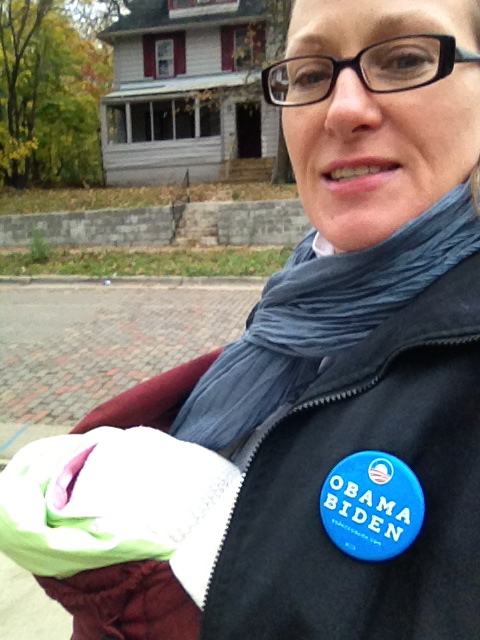
Citizen Lyra helps with the 2012 GOTV

True confession: I enjoy working in predominantly African-American neighborhoods where I would not typically have reason to venture. It’s no secret that black Americans frequently do not feel welcome in predominantly white neighborhoods. The tragedy of Treyvon Martin earlier this year gives grim evidence as to why. So why should I feel entitled to waltz through a black neighborhood? Well, I don’t. Not because I am afraid I will be shot, I’m not, but as a white woman, I do not want anyone in a black neighborhood to think I’ve condescended to ask for his or her vote. And were the candidate for whom I was urging them to hustle to the polls for white, it just might smack of condescension. But he isn’t. The candidate, our president, is black and my children will not recall a time when a black president was unimaginable. But it is my opinion that Barack Obama is, irrespective of his color, one of the best presidents of my lifetime.

Shortly after Obama won his first presidential election, the satirical online magazine, The Onion, posted this piece: Nation’s Blacks Creeped Out By All The People Smiling At Them | The Onion – America’s Finest News Source. I suppose I’m one of those people, I felt so good after we elected (and re-elected, perhaps just as remarkably) Barack Obama. Yes, there is so much work to be done with regards to race relations and poverty in this country—and don’t think the two aren’t connected, they are. See point number three in the above TruthOut.org piece. Seemingly the hardest part is how to even have a discussion in this country about race, particularly across racial lines. Having a black man win the presidency and then win re-election does not mean we do not have significant work to do with regards to issues of race and poverty, we do. But we are, at least in leadership, in this one instance, moving in the right direction. And it momentarily puts a white middle class mama like me on common ground with some working-class black Americans. It is a place of hope for change, real change, because we all want the economy to improve and good jobs to become more plentiful. But to move past the intransigence of “Us versus Them”–whether the paradigm is class, color, religion, sexual orientation–is tectonic change. And a worthy goal. Perhaps the most worthy goal in life.

And so Hugo and I worked our packets, going to each and every door on our lists. That night, we stayed up to watch the results come in and, as we did four years ago, when Ohio was called for President Obama, we trudged out back and shot off three Roman Candles, before filing to bed. We were spent. Wednesday, my head ached and I was tired like a sick person. I did not drink the night of the election, but I felt hungover nonetheless. It’s over; finally this long election is over. May the work of our government, the essential work, now begin. May our leaders work with sincerity and not cynicism, for all citizens, not just those they agree with, and may they guide the nation out of war and economic recession. And perhaps in so doing, guide themselves away from polemic politicking.

On Thursday of last week, we took our little Lyra to the Down’s Clinic at Akron Children’s Hospital for an evaluation by their medical team. But that is a topic for another post, which I know Helga believes should reasonably post this week. If I can be sure of anything in this world it’s that she’ll keep after me until it does.

Uncategorized

Addendum to Voting Like I Parent

Many of you have asked if I’ve talked to my neighbors who are, to my surprise, voting for Romney-Ryan. Briefly, yes. And then I followed up with an email asking them to read the New Yorker’s endorsement of Obama (The New Yorker’s Endorsement of Barack Obama : The New Yorker). Because it’s a magazine, and not a newspaper, the New Yorker can and does go into greater depth and detail about why Obama should be re-elected and why Romney does not deserve the presidency.

Also, the Newsweek piece by Andrew Sullivan that I cited can be found here: Andrew Sullivan on the Promise of Obama’s Second Term – Newsweek and The Daily Beast.

Finally, I forgot to add that in addition to keeping good (great) grades, Hugo obtained a job at a dog groomers just before school began. He never has a day where he has not a single obligation, be it choir, band, or work. And he seems the better for it. He has so far paid $400 of the $750 he needs to go to NYC in March with the choir. He has also had to learn to navigate with his boss a performance schedule that at times conflicts with his work schedule. We parents do our children a great favor when we neglect to save them. They are better off saving themselves. Or, as I tell them, I will always push you, but I’ve got your backs.

Uncategorized

Voting Like I Parent

I abruptly stopped sleeping last night at three a.m. and stayed awake for over two hours, until Max’s phone alarm signaled what I already knew—5:30, time to get up. Only then was I able to doze lightly, which I did for an hour, the comforting sounds of my boys starting their day drifted in with the smell of the coffee Hugo had brewed.

Until I was in my late 20s, I slept deeply through the night, every night. My days in college and graduate school at Ohio State University were long–each day I walked miles to and around campus and worked most nights. I had a boyfriend who marveled, was jealous even, at how easily I dropped into solid sleep for eight to ten hours.

This ended, irrevocably it seems, when at 28 I gave birth to my first child. Not only did I wake to nurse him, I roused if he coughed, cried or just wiggled. Before he moved into his own room, I had another baby and then another. All four of my boys moved into their own rooms long ago and baby Lyra has slept through the night since birth (she’s a jackpot of a baby). Yet I often find myself awake at night, most commonly at three o’clock or, as I call it, my Fretting Hour. I fret about issues both personal and global, mostly stuff I have little or no control over and that seem all the more important because in the middle of the night my rational mind can be hard to locate.

However, since mid-August when Lyra was born, I have had little trouble sleeping through the night. I’ve been physically whooped due to the birth, the many visits to doctors’ offices and Akron Children’s Hospital. And then there are the other four children who still need attention, food, driven to school. It’s all good.

What kept me up last night started on Saturday when we were trick or treating in our neighborhood. “I didn’t know they were Republicans,” said my son Jules, dressed as a mad scientist, as we walked past the house of friends. When I assured him that they weren’t, he pointed to the Romney-Ryan sign by no means hiding in our friends’ front yard. I must have had visual denial to have missed it. These friends, like me, voted for Obama in 2008 and abhorred the Bush presidency and what it seemingly stood for—a prioritization of political party interests over those of the nation, like they’re playing some crazy football game in Washington D.C. These friends also believe in the full array of civil rights for our GLBT citizens and that women should receive equal pay for their work and have full access to health care. And I thought that they believed in a safety net for those citizens who need it.

Though Obama and his administration have worked towards long term goals for our nation and not politically expedient goals for his re-election–goals like averting economic disaster and rebuilding the economy, ending the war in Iraq, ensuring the rights of all citizens, rebuilding our relationships with our allies and, yes, bringing affordable healthcare to all Americans–these friends of mine want to fire Obama. I have been walking around gobsmacked because I now see that the race must really be as tight as the media says it is and perhaps Obama will lose.

I have long been a Democrat, but I didn’t start out that way and who knows? If the Republicans at all resembled the party that they were in the mid-twentieth century, when states rights, personal and fiscal responsibility were the hallmarks of their platform, I may yet have continued to vote for their candidates. Like Barry Goldwater, who had little to no tolerance for religious extremists, Christian fundamentalists who twist and turn history to convince themselves that our founding fathers would have us become a theocracy and expect the Republican party to swear allegiance to their agenda. Or Bob Dole, who became a staunch supporter of Food Stamp Act in 1964 and the Americans with Disabilities Act in 1990. The key difference between the pre- and post-Gingrich era Republicans seems to be an understanding of poverty. Older, if you will, Rockefeller Republicans who lived through the Great Depression and World War II did not view poverty as a character flaw but something that can happen to anyone. Now working class Americans are, according to Romney, a group who consider themselves victims and have become dependent upon the government and whom Romney does not take into consideration. He’s written them, including my children and me, off.

How did the Republicans win the hearts and minds of people who directly suffer from the consequences of their trickle down policies? How is it that my friends can reasonably blame the Bush Administration for getting the economy in such an abysmal state and then turn around and want to fire Obama for not fixing it fast enough and, furthermore, want to hand the reins of government back to the Republicans who will return us to the policies that got us in this mess to begin with?

I don’t have the answer to that question because I cannot imagine voting for a party that has become so ideologically extreme and capricious with power when they have it. I don’t reward my children for behaving irresponsibly, so why would I do so with my vote?

Consider my second son, Hugo, to whom everything comes easily and who has required by far more of my parenting time, energy and creative approaches than all of my other children put together. From the time he was toddler until quite recently, he has resisted being held accountable for his actions. Even if he had done something on accident, say bumped into another child causing him or her to fall, Hugo could not stand to apologize and would get in more trouble for his reaction to being busted than for the initial infraction. But I’ve continued to hang in there with him, show him that his behavior has consequences while trying to cultivate in him empathy for others. Sometimes I’m less graceful at this than others. Just ask Hugo and he’ll happily tell you how I once chased him through the house and up into his top bunk bed only to tell him if he ever went to jail I wouldn’t bail him out. He’s now fifteen and last spring I found myself constantly having to ride him to do his homework, household chores and manage his money. He wanted me simply to give him money when he needed it, clean up after him, drive him where he wanted to go and, ironically, monitor his schoolwork.

We had gotten into a cycle that was, for me at least, chronically frustrating. I would tell him repeatedly to do his homework and housework, he’d repeatedly agree to do it, but then wouldn’t. Instead he’d make excuses as to why he didn’t do what he said he would and continue to ask for money and rides. When this cycle of him telling me what I wanted to hear but never delivering on it became clear to me, I pulled the plug. I stopped monitoring his homework and I made him pay in cash to have his room vacuumed and dusted. I also stopped giving him money and rides. If he wanted to be treated like a roommate, so be it.

Hugo relaxing between school and marching band practice.

But as his mother, it’s my job to push him and I did so by putting his passion on the chopping block. Hugo plays in multiple bands and sing in multiple choirs at his high school, but it’s not what he does, a musician is who he is. I never have to tell him to practice music but rather often need him to put down the guitar in order to do other things (like homework and chores). Beginning this fall, I warned him that if his grades slip below a 3.7 I will pull him from one of his bands. I don’t check online to see if his homework has been turned in, I don’t ask about his grades. It’s his responsibility to organize himself, he’s old enough. The result? Hugo is exercising more self-discipline and I’m not haranguing him. He has all As on his first grade card of the year. And he’s frankly more pleasant to be around. This only works because Hugo knows, from experience, that I am not bluffing. I don’t play poker with my children when I tell them what consequences they can expect for their behavior, both good and bad. I always follow through (and truly it can at times be harder on me than on them to do so when I have to follow through on consequences for the bad).

The Republicans love power, they love being in power. To be fair, so do the Democrats, but so far the Dems still seem to generally remember that the best interests of the country, not just the party, are why they are in government. As Andrew Sullivan pointed out in the September 22nd issue of Newsweek, a second term for Barack Obama may just shake the GOP enough to move them away from the extreme right cliff they’ve found themselves on and back towards the center where good government and the majority of Americans can be found.

By this time next week, we will know if more of the electorate agree with me or if, like my friends, they believe the unsubstantiated promises of the GOP. In hopes of a better night’s sleep tonight, I went first thing this morning to my county’s Board of Elections and voted for a second term for Barack Obama and will follow up by volunteering for the campaign in the days ahead. I hope you will all join me.

Lyra's Latests · Uncategorized

I See You and You See Me

“Your daughter sees like a newborn,” said her eye surgeon, “even though she’s two months old.”

Two months old? Isn’t that the same as newborn or at least, newly born? Well, yes, in terms of adjusting to another child in the household. But in terms of brain development, two months old is, well, getting up there.

Lyra was born on August 14 with many markers of Down syndrome (DS) and cataracts in both eyes. Because I am 46, I underwent many prenatal tests, except an amniocentesis, while expecting Lyra. The extensive blood work and high-level ultrasounds did not reveal any abnormalities and when I had a fetal echocardiogram, the cardiologist said everything looked beautiful and, “beautiful is better than good.” Having decided we would not terminate a pregnancy if the baby had DS, Max and I passed on an amnio.

Superstitiously or intuitively, I was certain I would lose the baby if I had an amnio. My Grandma Dorothy, who was a mother to me, had four boys and I have four boys. Her only daughter, her second child, died at birth because of the Rh blood factor. Grandma had negative blood and her baby girl’s was positive. I too have negative blood and my daughter’s is positive, but since the 1970s there has been a remedy. After each of my babies’ births, I was given a RhoGam shot, which prevented my body from building antibodies to positive blood.

Grandma kept trying for a daughter, even when my grandfather did not agree, but she only had boys. I, too, kept trying for daughter (albeit with full support from my partner), and when I learned my fifth child was female, I felt an amnio would cause me to lose my baby just as the Rh factor took Grandma’s daughter. It isn’t logical, I understand, but I felt emotionally very strong about this connection. I still do.

Lyra was born on a Tuesday. On Wednesday, we were squeezed into an appointment at a pediatricians’ office affiliated with Akron Children’s Hospital (ACH). They referred us to ACH’s pediatric geneticist whom we saw on Thursday and before we left, a vial of Lyra’s blood was drawn for genetic testing. On Friday, the blood results confirmed Lyra’s Down syndrome. The following Monday we saw our first pediatric ophthalmologist, who sent us to a second surgeon, who immediately scheduled Lyra for surgeries at the tender ages of six weeks and seven weeks.

Why so young? Because a newborn’s brain is bubbling with growth and without any visual input, Lyra’s brain would not have developed all the necessary components to process what it is to have sight. The same can be true of hearing and the other senses. Neurologist and author Oliver Saks has written accounts of adults regaining hearing only to be miserably confused and want to return to the deaf world their brains’ knew and understood. In the Val Kilmer film, At First Sight, a blind man has an operation to regain his vision. In a poignant scene, he cannot make sense of glass and ends up breaking a window.

And that’s how Lyra came to have eye surgery at the tender age of six and seven weeks. Each eye had to be dilated for a week post-surgery to minimize scarring after which she began wearing contact lenses. She’s too young for surgical implants–her eyes are still rapidly growing. Her contact lenses are similar to mine and will be cleaned monthly and replaced every three months. The correction, however, is not at all similar—I don’t see very well without my glasses or contacts as my prescription is about a -4. Lyra’s prescription is a +20.

Lyra after her right eye had the lensectomy. That eye is clear while the left has the visible cataract she was born with.

Oddly, I did not think of Lyra as blind until the first cataract was removed. But she was. When she was a month old and coming out of the newborn sleepiness, we noticed her eyes were starting to wander around, each rambling about in its socket. Her brain was becoming the brain of a blind person.

Only one in 10,000 kids with Down syndrome are born with cataracts, though most kids with cataracts have DS. Of all the possible and serious medical problems attendant to DS (heart problems of varying degrees of severity occur in forty to sixty percent of people with DS), we are grateful cataracts is all Lyra has to deal with. We felt that way immediately and said so to the ophthalomologist the first time we met him. Just as soon as he put her second contact in her left eye, her eyes began tracking in sync, her brain quickly discovering how to process all the visual stimulation she is now receiving.

After receiving both contact lenses, Lyra gobbles up all the visual stimulation she can get.

She has now been wearing both her lenses for one week and it is as if she has been awakened. She searches for our faces when she hears our voices, looks at our eyes and smiles. I loved my blind girl fiercely, but this smile of recognition by my now seeing daughter is incomparable to any other I’ve known. No lover has melted my heart with a single gaze the way this recently born peanut has.  Many years ago, when my big boys were wee, I learned a children’s song in which the verse goes, “I see you and you see me, la-la-la-la-la-la-la.” When I sing it to Lyra, as I often do lately, it is not a sweet, meaningless ditty. It says everything about the first two months of our life with Lyra and hers with us.

Uncategorized

Is Anybody Out There?

My family gets a daily newspaper delivered to our home every morning and, as we all stumble down and pour our coffee (everyone down to Jules, who’s 12, have a morning cuppa), we call out who gets the comics first, second and so on. The kids read most of the strips I don’t (or don’t often), such as Garfield. I read ones that they don’t, such as Doonesbury. I get it. When I was in college in the late 80s-early 90s, I had friends who read Doonesbury regularly, but I couldn’t keep track of all the characters and didn’t know their histories and it didn’t seem worth trying. That is until George W. Bush was president and was depicted as a floating and frayed Roman helmet.  I still don’t know the storylines of most of the characters prior to the Bush II administration, but I have continued to read Doonesbury daily.

And as I start this blog, my first that is not a class assignment or private loop to connect with other writers, but a put it out there public blog, many of Gary Trudeau’s latest strips concern a previously successful writer, Rick, who now finds himself blogging for free on Huffpo. His wife is a successful political operative, his ne’er-do-well son has a runaway bestselling (wholly fictitious) memoir, while Rick struggles to even gain access to interviewees. So blogging is like hitting bottom for writers, or traditional writerly types.

Which raises a question: Does anyone else in their 40s feel caught between the new and old? I wrote my high school, and many of my undergraduate, papers on an electric typewriter. We had to look things up on the card catalog in the library (remember how they smelled? Closed up trays of paper, exuding the possibility of anything you wanted to know), haul books home and search for the facts to back up our assertations. But computers and the internet came while we were still young enough to grab on and switch gears. Today my own children have to do something called “dialecticals” whenever they have a reading assignment in high school. Very busy work, in which students must cite usually 30 passages in the book and explain why they are important to the piece, which is designed to minimize oh-so-easy online cribbing. Are paperbound Cliff Notes even still published? I can no longer write with pen and paper for any length of time, but I agonize at the thought of publishing becoming an entirely (or mostly) electronic media. I once crafted an entire (Flintstone-esque) living room suite of furniture using all my boxes of books I had yet unpacked after moving. I had a couch that could seat four, a coffee table and a recliner. I should have taken a picture, which would have been with a camera containing film (sigh).

But back to blogging: Unlike the fictitious Rick, I don’t have a successful writing career in my past. I’ve written successful academic papers, grant applications, newlsetters and so on, but I haven’t received paychecks strictly for my writing. I’m starting at the bottom. Many of my big plans have shifted over the nearly 19 years I’ve been a mother. Most recently, Max and I decided to have one more baby so that two-year-old Leif would have a sibling to grow with at home after all his older brothers had gone off. We assumed that before this last baby was born I’d have fulltime employment with benefits–career employment. We assumed incorrectly.

So here I am trying to write with small children at my breasts and knees (at least my breasts aren’t at my knees, not yet). I’m not an overachiever, try as I might to be one, so blogging feels about right. And since I started Whoopsie Piggle, all of a week ago, I find I’m thinking once again like a writer.

My 18-year-old son is coming home from college this weekend and I plan to have him help me with the technical aspects of this new endeavor. Unlike the blogger in Doonesbury, my boy won’t make me feel out of touch. Of course, my boy hasn’t published a runaway bestseller either. Not yet.

Uncategorized

Sunday Morning Start (Monday Evening Finish)

Blogs, hmm, who does that?

I have found the few mom blogs I’ve viewed are often intimidating or annoying–who has the time to cook fresh meals from scratch (locally grown, organic ingredients), hand wash cloth diapers and start a charity for children and their families? Hippie Martha Stewarts. Right, except there is that fantasy lurking in the depths of my soul too. Clean, yet quirky home. Artistically talented, yet always polite children. Very accessible mom who also has a successful career. Whoa, so what I don’t like about these blogs is probably what I want but haven’t managed to manifest. I stopped looking almost instantly.

Besides, who wants to be boxed into a mom-blog? Ah, Doris Day in Please Don’t Eat the Daisies is told by her husband, David Niven, that she is so much more than a housewife. “All housewives are,” she tells him. That was in 1960. Does anyone call themself a housewife today? I doubt it, but the bill of goods my generation was sold was have it all–career, children and great style. And make your parenting attachment style. And your career creative and lucrative and your style flippin’ creative as hell. Yeah, well, it seems the sales force was setting us up for failure or at least abiding frustration.

Here’s my reality:

I’m a 46-year-old mom of four boys, ages 18 to two years old, and one daughter who is six weeks old. Truly, had the two-year-old been a girl, I’d have stopped there. But I just knew this one would be a girl (yeah, so what if I’ve been wrong before?) and when our daughter was born last month the first question I asked the midwife was, “Is there a vagina?” She told me to just look myself. Yep, the ultrasound had not lied, girl, girl, girl! Yippee! I held our girl and we looked at her. Bluish, alienesque newborn, as they all are when they first pop out, we quickly noticed some other things. “Her eyes look Downsy,” I told the midwife. She calmly told me she’d do a newborn exam in a few minutes. The skin on the back of her neck was voluminous, when she turned her head she looked like she had a handle of flesh back there. And her pupils were ghostly white.

Our girl was born with Down syndrome and bi-lateral cataracts. She has been the primary focus of life this past month and a half, but not our only focus.

My oldest son, the first three children are from a previous marriage, went off to the University of Michigan ten days after his sister was born. The second boy is in the throes of marching band season and puppy love with a young woman who lives in Montreal (we are in O-HI-O), the third boy is working through hard issues with his father while the two-year-old is just that, replete with tantrums and an explosion of language and ideas.

Claude, Hugo, Jules, Leif and Lyra. Until I was in my late 20s, I swore I’d never have kids. I was my mother’s only child and neither of my parents impressed me with their parenting. Frankly, I was afraid of becoming a mother. But the urge kicked in when I was in my late 20s (hormones perhaps, mixed with a crazy love) and now here I am, the mother of a family considered large by most American standards.

I’ve been looking for fulltime work for five years. I received my MFA in creative writing at the end of 2010 in the worst economy I’ve ever lived through (and unless you are 90+ or from Brazil, it’s the worst economy you’ve lived through too). Last year, I worked at the local Waldorf school, where my kids  attend(ed) but the cost of two babies in daycare is $300 more a month than I was making. So I’m telling myself I’m on Maternity Leave (italics make it more official). I’m figuring out what’s next as things feel like a new segment of life is unfolding. One child launching, one arriving with a genetic disorder. I love having a job, feeling useful, collecting my pay. But if I’m on Maternity Leave I can ease up on the job hunt and start this blog, clean some closets, maybe even read some books. All while learning what Lyra’s needs will be long term.

It was a month before Lyra was born when a friend suggested I write a blog. It was all I could do to not impolitely dismiss her idea out of hand. But the idea geminated and I was given encouragement by my partner, Max (who is Leif and Lyra’s father). Claude started a blog as part of his homework for one of his college classes using WordPress and said it was easy to set up. And other than getting past all the ways I can give WordPress money, it was.

So here goes (yeah, the first post is mom-blog-ish).