Uncategorized

Knocking on likely voters’ doors is a rite of passage for my teenagers

The 2024 presidential election marks a rite of passage for my fourth child: knocking on doors to get out the vote, or GOTV. It’s not the first time he’s witnessed the importance I place on active citizenship — I often take my children with me when I vote, have them help me with leaflet drops and I’ve housed out-of-state election volunteers.

But during the last presidential election before my sons can vote, I take them with me to meet voters at their homes. We start off together and then, once they feel comfortable enough, I send my teenager on his own with half of the list of voters.

Yes, they are nervous when they get started. But people are overwhelmingly civil, if not outright friendly, and my sons quickly become as giddy as I do, checking to see if registered Democrats have already voted and, if not, making sure they have what they need, such as candidate and issue lists, and answering any questions they may have.

There are other ways to volunteer during elections, including nonpartisan jobs at polling locations. However, the bulk of volunteer work is done at the party level. Many people choose phone banking, which like many phone jobs post-COVID can now be done from a volunteer’s home. 

But I prefer walking in the brisk autumn air and meeting Akron voters in person. Every time I walk in a neighborhood I normally drive past, I am impressed by the care people take of their homes. Flower and vegetable gardens, some only a few feet long, are now in their dwindling season and yet the fondness with which they were tended for several months is evident.

Prior to the voter registration deadline, GOTV efforts focus on registering voters. After the registration deadline has passed, volunteers visit registered voters of their party. In my decades of volunteering with the Democrats, I have gone out both before and after the registration deadline and have never had an unpleasant interaction. I enlist my children, however, once the registration deadline has passed and our list is of registered Democrats only. (Though there are no guarantees — I’ve met Republicans who switched their party affiliation in order to vote in the Democratic primary and then forgot to re-register with the Republicans afterwards.) 

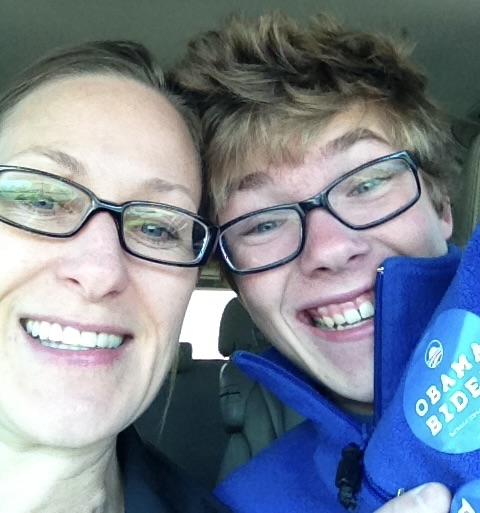
In 2012, President Obama and Sen. Sherrod Brown were up for reelection. Because Akron Public Schools are closed on Election Day, my son Hugo, who was three weeks shy of 16, was home. Our field captain gave us a paper list of Democratic voters near Hoban High School. My 10-week-old daughter, Lyra, was with us, bundled up and strapped onto my chest in an Ergo baby carrier. It was a sunny but very cold day and more than a few women ordered me to get into their warm homes “with that sweet baby.”

MiniVAN app helps volunteers canvassing neighborhoods

This year my youngest son, Leif, is three months shy of 15. On a recent Saturday we canvassed the streets behind the now-closed Walgreens on Copley Road. Things have changed since the 2020 election. Voter lists are on an app called MiniVAN, which automatically uploads information as volunteers take it down. It also identifies which voters have already voted, so volunteers can more efficiently focus on those who have not. I cannot split the list on the app with my son as I did paper lists, but the advances are well worth it.
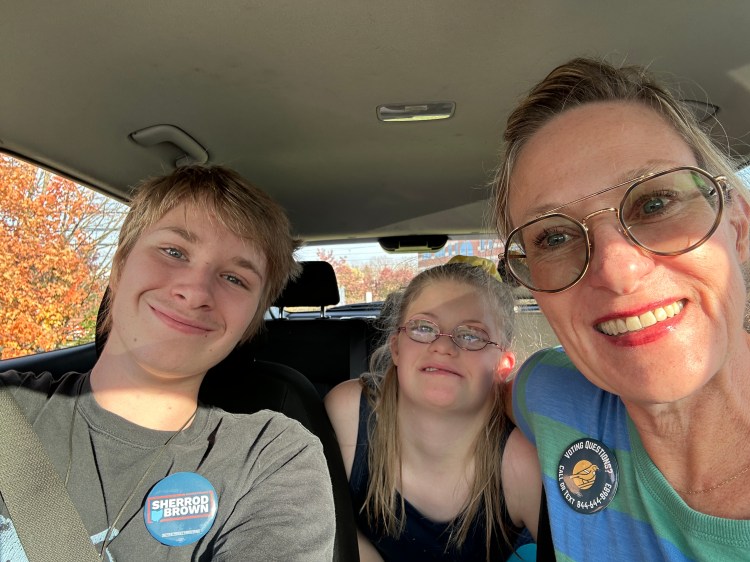
Canvassing this year with Lyra and Leif.

We loaded MiniVAN onto Lyra’s iPad (the only one we own). And, yes, Lyra was with us. She knocked on the doors, I asked questions and Leif documented answers on the iPad. We were visiting with an elderly woman whose house was the farthest away from my car as any on our list when an unpredicted thunderstorm erupted. 

“Do you mind if my children stay on your porch while I get my car?” I asked her.

“Not at all! But let me give you an umbrella,” she said before darting into her home. With her umbrella keeping me dry, I ran to my car while the kind stranger and my children continued visiting. 

The act of explaining something can provide epiphanies, “aha” moments where suddenly the subject makes much more sense. Ask any teacher. Talking with voters, my teens explain why it is important to vote. Later, as adults, they have continued to volunteer in cities far from Akron because they deeply care about democracy, and also because it is quite fun.

In July at a conservative Christian event in Florida, former president Donald Trump told the audience that if he wins this fall’s election, “You won’t have to do it anymore. Four more years, you know what? It’ll be fixed, it’ll be fine. You won’t have to vote anymore, my beautiful Christians.” The last thing I want to happen to our country is the elimination of voting, which would literally be an end to America’s democracy. So out I go with my kids and anyone else who will knock on doors with me.

Thiscol.

Civil Rights · Uncategorized

Vote as though our democracy depends on it


Last weekend, I waited 2½ hours to vote at the Summit County Board of Elections (BOE). I have, with few exceptions, voted early and in person since it has been an option in Ohio. Waiting until Election Day stresses me out. What if something comes up and I can’t make it to the polls?

Sure, I could have requested an absentee ballot, as two of my children did. But if my signature is questioned, I was concerned my vote will not get counted. No, thanks, I’ll wait in line.

In prior elections, I’ve voted early with no wait. This year, the BOE set up a 50-foot long canopy tent in their parking lot for voters to stand under while waiting to enter the building.

And wait they do. Three times earlier in the week, the line for in-person voting was too long for me to stay. Meanwhile, cars by the dozens stretched down Grant Street in both directions as voters waited to turn in their absentee ballots at the only drop box in the county.

This election finds historic numbers of people accepting inconvenience to ensure their votes get counted.

I have voted in all presidential, and most non-presidential elections, since 1984. With the exception of 2008, many people, especially younger ones, rarely vote. Oh, they’ll complain about politicians and their policies, but then dismiss voting as a means to direct government.

I suspect that was in part a reflection of a well-functioning government. Young people weren’t agitated enough to exercise their right to vote when things were working well enough.

Today, nobody seems to believe things are working well in America. Turn out for early voting across the country is at historic highs. But will every eligible citizen who wishes to vote have the opportunity? And if they do, will their votes be counted?

In the decades after the passage of significant civil and voting rights legislation in the 1960s, the Republican Party has made a concerted effort to suppress votes in Democratic strongholds. Recently, their tactics have become openly blatant.

In 1980, Paul Weyrich, a conservative activist and founding member of The Heritage Foundation, an influential right-wing think tank, said in a video-recorded speech, “I don’t want everybody to vote … As a matter of fact our leverage in the elections quite candidly goes up as the voting populace goes down.”

In 2019, the year after Republican strategist Thomas Hofeller died, his daughter released his external hard drives and thumb drives. Known in GOP circles as the Michelangelo of gerrymandering, the data on the drives outlined how for years Hofeller helped guarantee safe Republican districts. One only need look at Ohio’s district map with its several snake-shaped districts to see Hofeller’s impact on redistricting.

Hofeller also promoted the idea of adding a citizenship question to the 2020 census, stating it would reduce the count of Hispanics, a group that predominantly votes Democrat.

In 2000, thousands of Florida voters were misidentified as ex-felons and quietly purged from the voter rolls before the election. At the time, Florida was one of a handful of states that did not allow ex-felons to vote. After the NAACP sued, Florida officials conceded that 12,000 registered voters — who were predominantly black — had been wrongly purged. George W. Bush’s margin of victory in Florida that year was 537 votes.

Some in the GOP saw the Florida purge in 2000 as instructive.

Since then, many Republican-held states have passed voter-suppression laws and rules, including excessive voter ID laws, modern-day equivalents of Jim Crow laws for Native Americans, limits on early voting and reduced polling locations.

The GOP claims these tactics prevent voter fraud, but there is no evidence of such. In a study that reviewed all of the more than 1 billion ballots cast in the US between 2000 and 2014, only 31 instances of voter fraud were found, which is statistically nil.

Why do Republicans work so hard to suppress the votes in Democrat strongholds? The obvious answer is because they don’t want to lose. But the flip side of that is that they rightfully fear their platform no longer appeals to enough Americans for them to win in a majority of districts without gerrymandering and suppressing voters.

A healthy democracy needs two, or more, healthy political parties. America doesn’t have that right now. One positive outcome of a blue tsunami on Tuesday would be for the GOP to reflect on how many Republicans currently don’t recognize their own party.

And, no, the Democratic Party isn’t perfect. Both the Ohio Democratic Party and Democratic National Committee are insiders’ clubs that all too often make bone-headed decisions. Pour a cup of coffee, pull up a chair and I’ll talk all day about frustrations with the Dems’ leadership.

But the Democratic Party does not try to win elections by suppressing Republican votes.

America needs new and vigorous national legislation to expand voting to all eligible citizens while preventing any party from engaging in the chicanery of winning elections by suppressing votes.

In the meantime, vote as though the very existence of democracy in the United States depends upon it. Because, in fact, it does.

This was first published in the Akron Beacon Journal on November 1, 2020.