Uncategorized

Camping trips more work, but value added

If the definition of insanity is expecting different results when repeating something, I have an annual madness. Each spring I long for the freedom my children and I will enjoy when school ends. Summer arrives like an empty cargo ship docking on shore after being distantly visible for many months. Yet almost immediately, shipping containers of places to go, people to see and things to do fill the entire boat. Stop the longshoremen! I want to yell.

Since late June, I have not been home for more than three consecutive days as I have visited friends and family in faraway places. In mid-July, two adult-sized children, one tiny dog, all our camping gear and I filled every available inch of space in my small car. Spare shoes went under the seats, while in the back seat my daughter leaned on bedding stacked into a tower taller than her. My son’s size-12 feet were trapped on the car floor, surrounded by my computer bag, snacks, his sword and an intimidatingly large Nerf blaster. 

I don’t consider myself a camping kind of person. I suppose that’s because, unlike my 28-year-old son, Hugo, I don’t spend months longing for the day I can load up the car, head to a camp ground and party like it’s 1899. And yet I’ve camped most years of my life. When I was a young child, my grandparents, Eagle Scout-level camping people, took me to parks near Chicago. They had all the gear, including canvas tents tall enough to stand in and wide enough to set up multiple cots. Later, after they’d retired to Arizona, they bought an Aristocrat mid-sized trailer camper. I cherish memories of comfortably camping with Grandma at remarkable state and national parks in the 1970s and ’80s, including multiple trips to the Grand Canyon and Lake Powell.

Holly Christensen's grandma cooks on a camp stove in the late 1960s.
Christensen’s grandma making dinner on a camp stove in the late 1960s.

Beginning in the ’90s, I took my children every summer for over 15 years to Karme Choling Buddhist Meditation Center in Vermont for a nine-day family camp. The mountainside behind the center’s large building is dotted with semi-permanent tents set upon wooden platforms. Two adults and three children could sleep comfortably inside the tents on thick foam pads provided by the center. Served in a large dining tent, all meals were prepared and served with the help of the adult attendees. For several years, I arose early each day and made many gallons of coffee.

Camping at Karme Choling was lot like living in a college dorm. The tents, beds and meals were provided. Mothers and small children showered and dressed together in community bathrooms. It wasn’t as cushy as staying in a camper or cabin, but neither were we roughing it.

My children have also grown up spending a portion of their summers with family in Charlevoix, Michigan, just 50 miles south of the Mackinac Bridge. From 2020 to 2023, my youngest two kids and I stayed in a camper set up in the driveway of family for five weeks each summer. The outdoor day camp on Lake Michigan that my children attended provided some semblance of normalcy during COVID. But with the death their grandfather last fall, we no longer have family in Charlevoix. 

Though our family is gone, the many things that make northern Michigan a summer delight remain, which gets us back to my packed-to-the-gills car. This year, we pitched camp at Young State Park. Tents have come a long way since the medieval-like structures my grandparents owned in the ’60s. My 15-year-old son, Leif, and I can set up our eight-person tent in less than 15 minutes. (Note: Unless the people sleeping in the tent are all 3 years old, divide the number a tent says it can sleep by two. A two-person tent sleeps but one adult, our eight-person tent is best for no more than four.) 

Holly Christensen's children and dog at their tent last month at Young State Park in Michigan
Leif and Lyra at Young State Park in Boyne City, MI, July 2025.

While Leif has a thin camping pad under his sleeping bag, my 12-year-old daughter, Lyra, and I sleep on an air mattress. After a day of packing, driving eight hours and setting up camp, it was almost 10 when we collapsed in our tent.

“Hold still,” Leif said suddenly and came to investigate something next to my head. I thought it was perhaps a mosquito, but it was much worse. A leak in the mattress. I patched it with what I had – two Bandaids. It was a chilly 48 degrees when Lyra and I awoke the next morning with only two layers of plastic under our sleeping bag as the mattress had deflated much earlier. All three of us giggled. 

Yes, camping takes me out of my comfort zone. Campground bathrooms are utilitarian community spaces usually a healthy trot away from the campsite. Keeping food fresh in a cooler is a messy, difficult preoccupation. Cooking on a fire pit or camp stove is doable, but again requires extra effort and then there’s the cleanup. Cleanliness standards are apt to slide.

And yet what trips are most memorable? The perfectly comfortable hotel room is easily forgettable. Some of the most amazing starry skies I’ve gazed up at have been on walks to camp bathrooms at 3 a.m. The drift to slumber in a tent, where children are all within arms’ reach, is often accompanied by soft chatter and laughter. Once home, that first shower, cooked meal and night on a firm mattress are savored unlike most. So those longshoremen loading adventures on the ships that are my summers? They are free to carry on.

This was first published in the Akron Beacon Journal on Sunday, August 3, 2025.

Uncategorized

Graduations, weddings and goodbyes: Navigating life’s journeys

Change happens every moment, accumulating mostly in unnoticeable measures. Think of the relative who remarks how much your child has grown since last summer. But sometimes monumental changes occur in short and dramatic order, seemingly in series of three. 

This spring, the last of my children to attend Spring Garden Waldorf School graduated the eighth grade. I enrolled my eldest son there in January of 2001 and, after driving from our home in Ohio City for two years, decided to move to Akron. 

Unlike public schools, Waldorf teachers and administrators are not hemmed in by federal and state testing requirements that limit innovation and the deployment of scientifically proven best practices. Waldorf students don’t know that. They believe it’s normal to have outdoor recess in all weather, the same classroom teacher and classmates for eight years, no computers nor textbooks. Classmates bond like cousins, which explains the gauntlet of events that filled our calendar prior to Leif’s graduation.

The next morning, we began three days of hard driving. Five days after Leif’s graduation, my son Hugo married his fiancée in the Teton Mountains. 

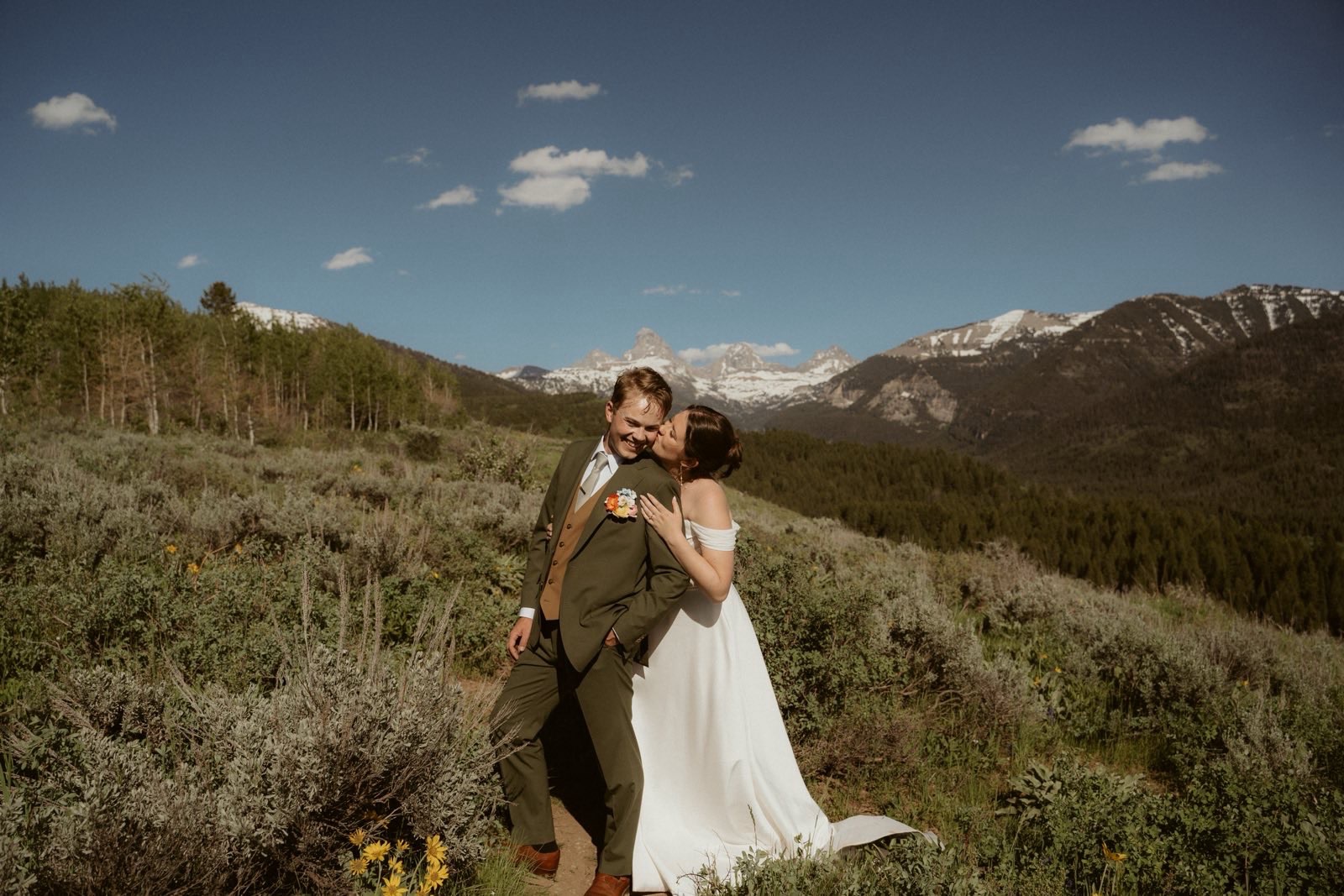
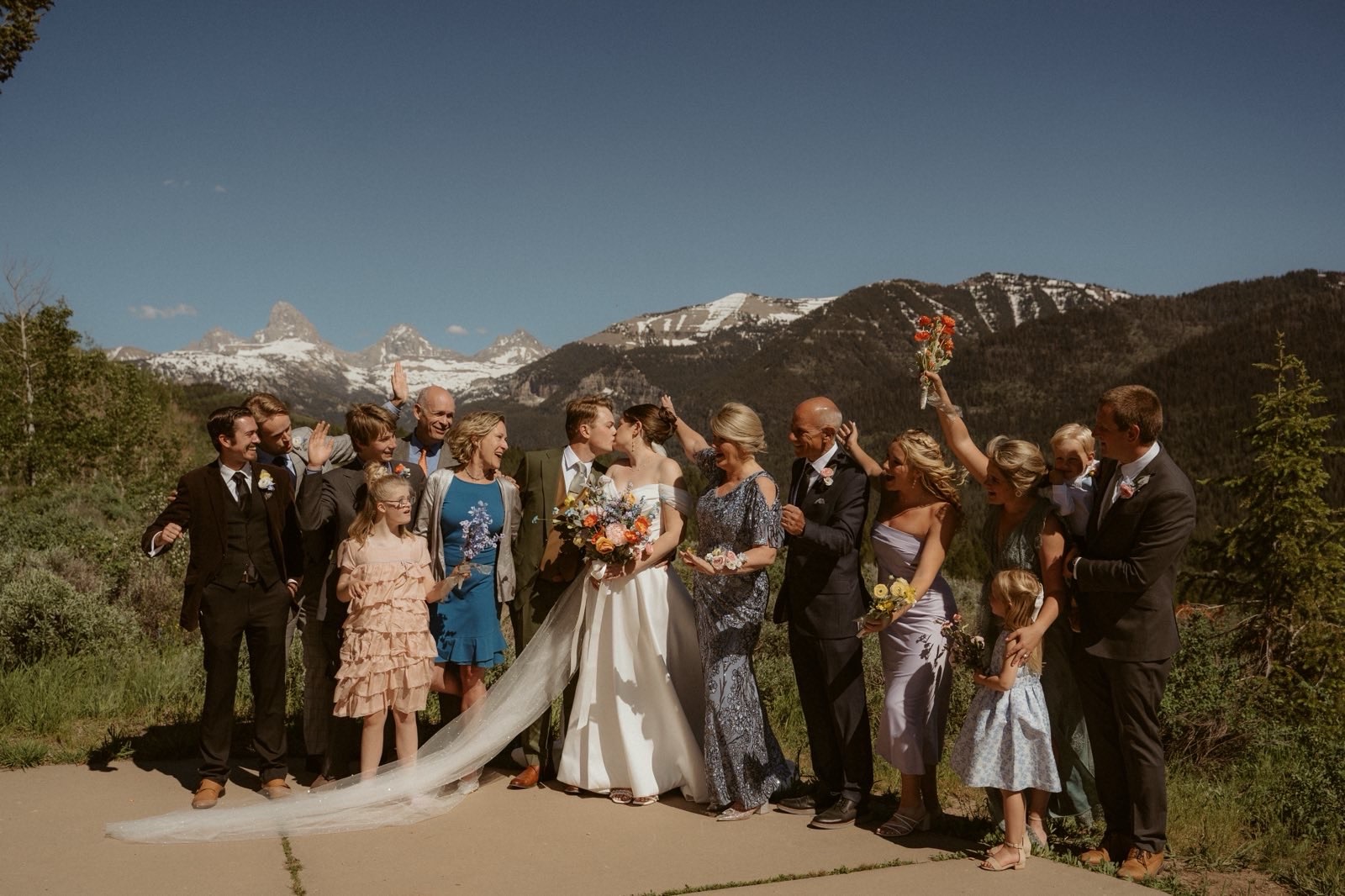
Hugo and his bride, Claudia, chose to wed at a scenic lookout in front of Grand Teton Mountain. Instead of staying in nearby Jackson Hole, Wyoming which is horrendously touristy and expensive, everyone was booked in a resort just across the border in Idaho. Then, three days before the wedding, the Teton Pass collapsed, increasing the drive from the resort to the wedding site by two hours each way.

Portending a successful marriage, the bride and groom swiftly found an alternate site near our hotel, which turned out to be as good, if not better, than the original one. The weather mimicked the bride’s serene beauty, while the ceremony included charming traditions both old and new.

The next day everyone dispersed, most heading back east.

We drove west to Crater Moon National Park and stayed the night in Twin Falls, Idaho. From there we traveled to Salt Lake City, where I have dear family and countless ancestral sites. I showed my youngest children the homestead property of my great-great grandparents, Christina and Soren Peder Henrichsen. Born in Sweden, they were children when they immigrated in the 1860s to Holladay, Utah, where they raised 10 children.

After two days of heritage touring, Lyra flew back to Ohio with family, leaving Leif and me to began our own adventure. In 2007, my first three sons and I circled most of the country in my 5-speed Toyota Matrix. That summer the boys were 13, 10 and 7 and their father and I had decided to divorce. Two of them think of their childhoods as pre- and post-road trip segments, yet, in spite of the divorce, they frequently refer to that summer’s travels with fondness. 

Leif will be a freshman at Akron Early College High School this August, going from a small school to a college campus. Hearkening the ’07 road trip, I was eager to spend time away with my last son during the liminal months between his boyhood and young adulthood. 

The drive from Salt Lake City to our campsite in Grand Teton National Park was just under six hours. When we arrived, we learned the temperature that night would plummet to 28 degrees and it would snow (back east, Akron was sweltering under a heat dome). At the park gift shop, we bought woolen caps and socks, insulated mittens and thermal sweatpants. 

That night, we broke a national park rule. Wearing all our new gear, coats and several shirts, we took blankets and sleeping bags into our car where we slept poorly, yet giggled frequently. Many happy memories are made when handling life’s challenges well.

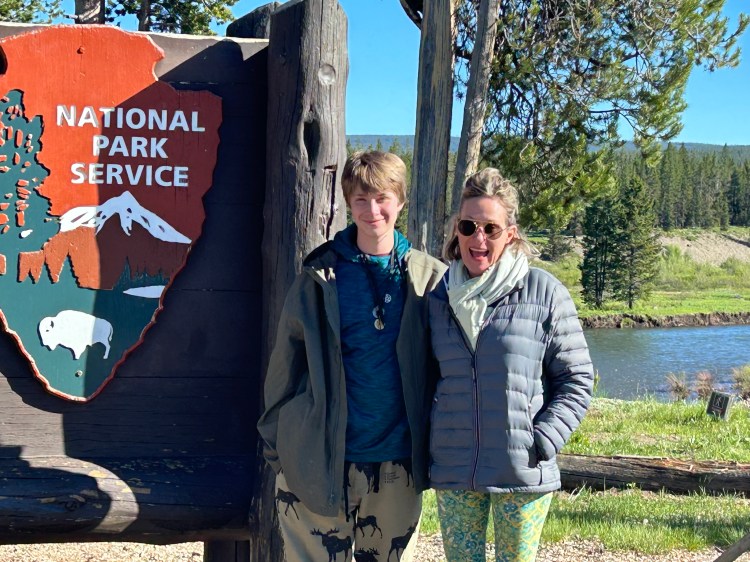
Arriving at the south entrance of Yellowstone National Park after a freezing night spent in our car.

The next day we made the short trip to Yellowstone National Park, where we spent two days. The park understandably forbids cell towers to dot its vistas, making cell service almost non-existent. But as we pitched our campsite, a call came through from my sister. Our step-father had been unexpectedly diagnosed with Stage 4 cancer. 

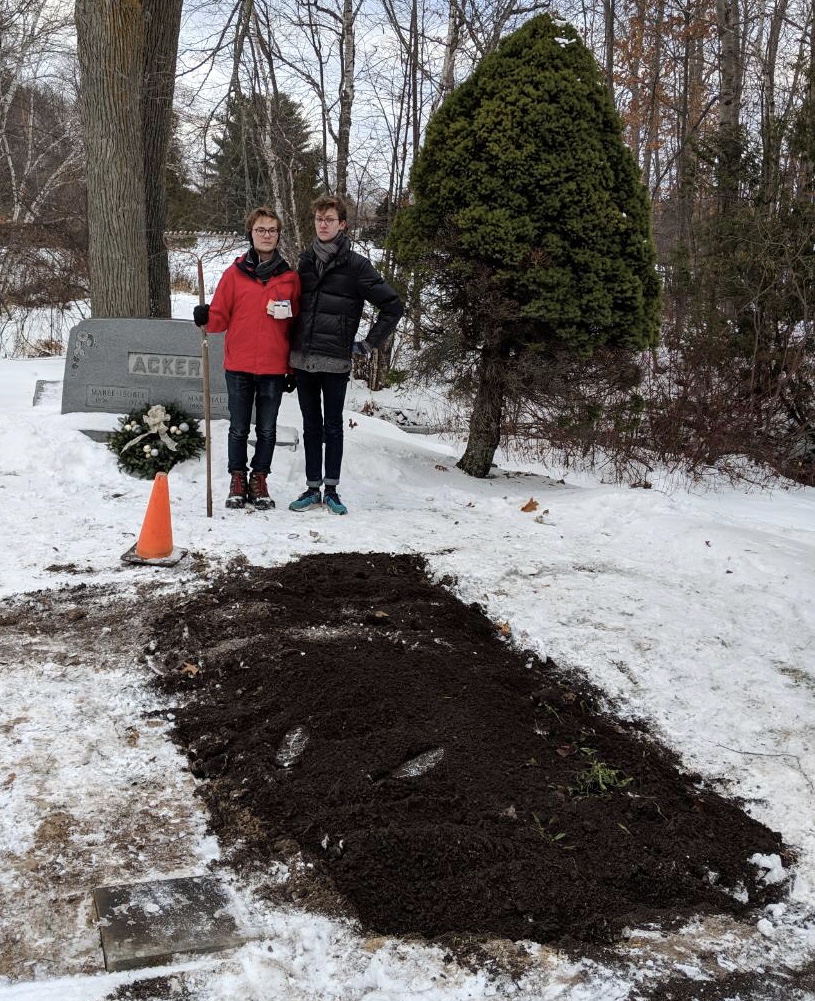
Bob McGhee is the only grandfather my children have ever known. A laconic man, the boys realized early on that the best time with Gramps, as they call him, was when helping him at the cemetery where he was sexton. He taught them how to use power equipment, but also how to fish. Two days after my eldest son graduated from high school, he was working at the job Gramps had gotten him. Together they buried an unembalmed body that had been packed in dry ice and flown to northern Michigan from California.

When the boys were in college, they’d drive up in mid-May to help Gramps prep the cemetery for Memorial Day. He never asked, they just showed up and spent time with the man who always showed up for them in whatever way he could.

As Leif and I worked our way back east over several days, he frequently told me he was glad we were road tripping. This summer, my youngest son leaves behind the things of a child, while his brother Hugo begins life as a husband and their grandfather prepares to make the greatest transition. My sons quickly moved work schedules and funds for one more road trip this summer — to visit Gramps before he departs.

This was first published in the Akron Beacon Journal on Sunday, July 7, 2024.

Uncategorized

A much-needed (and cheap!) respite in Chicago

Akron was recently heralded as one of the best cities for retirees because it’s both affordable and livable, something Akronites already knew. A transplant myself, I frequently extoll Akron’s friendly people, many parks with trails and, yes, affordable and beautiful housing stock.

Akron’s low cost of living also allows me to do something else I treasure — get away. Many a February, I head to warmer climes to elevate my vitamin D levels and shift my perspective. Getting out of the forest, as it were, reminds me that trees are just trees and not to sweat the small stuff.

But this year I didn’t leave the Midwest. Instead, I went to its de facto capital: Chicago. 

I chose Chicago because of a French woman I long have loved. Like so many great women throughout history, Camille Claudel, who died in 1943, was all but erased from history. Fortunately, the 1988 release of the eponymous French film starring Isabelle Adjani and Gerard Depardieu launched her canonical restitution.

I saw the film 34 years ago just before traveling to France where I studied in a program that required students to visit five museums. What piffle. France offers a feast for museum lovers, and I visited dozens. But the art at the Musée Rodin so moved me, I visited it, and it alone, twice.

A prolific and talented sculptor, Auguste Rodin is perhaps best known in the U.S. for The Thinker, a larger-than-life-size bronze of a naked man, seated with an elbow on one knee, his chin on the back of that arm’s hand. The Musée Rodin, located in what was Rodin’s Paris home, has 20 Claudel sculptures permanently displayed in one room. 

Photo of young Claudel behind her bust titled "Giganti" at the Art Institute of Chicago.
Photo of young Claudel behind her bust titled “Giganti” at the Art Institute of Chicago.

Twenty-four years her senior, Rodin was first Claudel’s teacher, then her lover and artistic collaborator. With their sculptures in close proximity, it’s impossible not to compare their talents, and even though it’s like contrasting the work of demigods, I found Claudel’s to be slightly superior. 

The recent Camille Claudel exhibit at the Art Institute of Chicago provided the chance to see 58 of Claudel’s pieces. (The exhibit closed on Feb. 19 and will reopen at the J. Paul Getty Museum in Los Angeles in April). Unlike most museums worldwide, the AIC is open Mondays (as is Chicago’s Field Museum and Museum of Science + Industry), which is great. Airline tickets typically cost less on Saturdays and Tuesdays than on Fridays and Mondays. Two round-trip tickets on Southwest Airlines were $372.

My companion and I arrived at Midway Airport Saturday morning, bought three-day Chicago Transit Authority passes for $15 each and took an Orange Line train to a station a block from our hotel. Cheap and easy. But the best tip is next.

CitizenM hotel chain provides a luxury hotel experience at an affordable price and, boy, do they deliver. I found them on Expedia.com when booking a room in Washington D.C. and was so impressed, I stay at CitizenM hotels whenever possible. Each room is only as wide as the king-sized bed nestled against the wall opposite the door, but because they are so efficiently laid out, the rooms never feel cramped. Located in the heart of downtown on Michigan Avenue and Wacker, I could see the Chicago River from the wall-to-wall window above the bed. 

The off-season price for our room was $291 for three nights, which included all taxes and fees. Breakfast is not included, but the spread they lay out is decadent and well worth the $19 per person. In the evening, the same “canteen” has a full bar and serves a small selection of dinner options. Two 16-ounce local beers cost us $11.

After checking into our room, we walked to an Asian Lunar New Year festival at the Navy Pier and on our way back to CitizenM, stocked up on snacks at a Whole Foods that is larger than the one in Akron.

The TV in CitizenM rooms is over the die-for-it comfortable bed (after my first stay in D.C., I bought the same mattress for my home). Propped up on lush pillows–CitizenM ought to sell them to guests–we streamed the 1988 Claudel biopic. The movie holds up to the test of time and prepared us for the exhibit.

More than 30 years after first comparing her sculptures to Rodin’s, I again found Claudel the superior artist, hairsplitting though that is. (I wonder if she observed autopsies as the musculature of her figures is so exacting.) We spent two full days wandering the AIC, also enjoying other temporary exhibits — drawings by Picasso and a retrospective of South African photographer David Goldblatt — as well as AIC’s tremendous permanent collection from ancient to modern periods.

And any visit to the AIC must include viewing the 68 historically accurate miniature rooms, think dollhouses on steroids, meticulously constructed during the Great Depression. The 1:12 scale project, managed and funded by heiress Narcissa Niblack Thorne, provided much-needed employment for out-of-work artisans.

Yes, we have top-notch cultural institutions in Northeast Ohio and I’ve visited them all many times. But only when unplugged from the chores of home life by travel can most of us indulge in spending entire days at museums. 

Now where to next? Hmm. New York City has two CitizenM locations and MOMA is also open on Mondays…

This column was first published in the Akron Beacon Journal on Sunday, February 25, 2024.