Uncategorized

It’s time to quit blaming the poor for our status

A 2023 Harvest for Hunger ad featuring a photo of a young girl revealed more about those who created the ad than it did about people who are food insecure. In a column, I imagined how the advertising company decided to portray her and wrote: “The result is a hackneyed stereotype of the poor — a child whose hair is messy, a stand-in for dirty, which is just a short walk to laziness. Not far behind laziness is dishonesty. Charles Dickens couldn’t have done better.”

The pervasiveness of bias, if not outright bigotry, against poor people surfaced in a letter to the editor responding to my most recent column, in which I explained that I am factually and legally a member of America’s working poor. I described how our nation’s policies currently favor the richest 1% over everyone else, causing income inequality to explode in recent decades. Unlike much of the second half of the 20th century, today jobs that pay a living wage and offer comprehensive benefits packages, including health care and retirement, are hard to come by.

And I described the benefits cliff – when people who receive government assistance, in my family’s case Medicaid, can lose all benefits when they earn only a little more than 138% of the federal poverty level. My column concluded: “The problem isn’t the poor, working or not. The problem is our systems.”

The overwhelming response to that column was positive. Yet the point was lost on some who, rather than recognize America’s intentional and systemic imbalance in wages, health care, housing costs and more, would blame the poor – in this case me – for our status.

Marcia Schray’s letter to the editor dismissed my factual and legal status as a working poor American and called me disingenuous. Her letter repeated a number of widely held, but false, biases and stereotypes about the poor. Chief among them is the belief that if poor people have lives that are anything but coarse and miserable, they must be grifting. Or, as another reader pointed out, apparently I am “not poor enough” for Schray.

Schray claims to have long read my columns and gives my “travels, foreign and domestic, [and] summer long vacations” as examples of my not being factually and legally poor. Yet every time I’ve written about trips I’ve taken, I’ve pointed out that anyone can travel cheaply if willing to forgo things in order to save for travel and rough it when they go. I mostly travel by car to the homes of family and friends. I do not take summer-long vacations, but for years enrolled my children in municipal summer camps in Michigan where we stayed in a small camper in their grandparents’ driveway. I cannot teach in the summer as there are no teaching jobs then, but work all year long as a freelance proofreader and writer, which I can do remotely.

Schray then mentions my children’s father, whom I left years ago, is an attorney. Why? My best guess is Schray believes all attorneys live like those on the TV show “The White Lotus” with fabulous incomes and no concerns for mundane expenses like health care.

That’s simply fantasy.

Solo practitioners lack access to corporate benefits packages and pay a premium for health insurance with high deductibles and measly coverage.

Most poor Americans, Schray states, don’t own a home, let alone two or three. That’s likely true. I bought a house in Akron in 2003 for $112,500. In 2014, I was able to acquire on a lease-to-own contract the neighboring home that had a mortgage balance of $52,000. I’ve shared this information before because there are few places besides Akron where someone could purchase two homes for a total of $164,500.

I live in an inner-city neighborhood that is economically and ethnically diverse. My homes are over 100 years old and designed very differently than new homes. All of which is to say, many people aren’t willing to live in houses like mine in neighborhoods like mine, a choice I happily made for many reasons, including the fact that it allows me to live within my means.

As for my means, my adjusted gross income in 2024 was $19,414. I earned just over $25k in wages last year, but my AGI was $4,072 due to the expenses of my one rental home. Rather than making me rich, as Schray seems to believe, my one rental home allows me to invest in a safe asset, the income and expenses of which, over the course of several years, roughly break even.

Meanwhile, as a self-reported regular reader, Schray forgets the many times I’ve written about being a “Second-hand Rose” to quote a Streisand song. From my base-model car to most of my shoes and everything in between, including what I buy for my children, I purchase used, and at bargain prices.

Bias is generally based upon assumptions that fall apart when met with facts. The poor are no more lazy, slovenly or mendacious than the rich. Nor are the poor Dickensian caricatures. As I wrote before, most people are doing all that they can to take care of their families as best they know how, but federal policy changes beginning in the 1980s have left the majority of Americans behind, even as the rich prosper. No wonder we have to find creative ways to live that are not coarse and miserable, something those who would shame us might consider.

This was first published in the Akron Beacon Journal on Sunday, March 1, 2026.
Uncategorized

Who are America’s working poor? People like me

Who are America’s working poor? The official definition is those Americans who spend at least 27 weeks a year in the labor force and yet have incomes below the federal poverty line.

I am one of those Americans.

I work all year as a freelance writer and about 35 weeks as an educator. And yet my adjusted gross income remains well below the federal poverty line, making my family eligible for Medicaid. I came of age during the Reagan Revolution when Republicans promised cutting regulations and taxes would increase corporate profits that would trickle down to the middle and lower classes.

That’s not what happened. As historian Heather Cox Richardson recently reported, “A February 2025 report from RAND, a nonprofit, nonpartisan research organization…found that if the system in place before 1975 had stayed in place, the bottom 90% of Americans would have had almost $80 trillion more in 2023 than they did.”

Put another way, in reporting by the Washington Post, “Between 1930 and 1980, only the bottom 90% saw their incomes rise. After 1980, only the top 1% saw their incomes rise.” At the same time that wages for the working and middle classes stagnated, costs for basic living expenses, particularly housing and education (still one of the best ways to increase lifetime income) have exploded. But perhaps more than any other expense, nothing in the U.S. has increased like health care. In 1980, the nation spent $247 billion on health care. By 2024 it had jumped to $5.3 trillion.

The cost of insurance, deductibles, co-pays and treatment is so great that, should a family’s income move slightly over the poverty line and lose eligibility for Medicaid, something referred to as the “benefits cliff,” it can be economically devastating. While my two underage children and I are healthy in the general sense, because my daughter was born with Down syndrome, cataracts in both eyes and hypothyroidism, she has high medical needs. She had four eye surgeries her first year and weekly physical, occupational and speech therapies her first three years.

Each of her first 10 years, she went under general anesthesia for various procedures. We’ve long referred to ourselves as “frequent flyers” at Akron Children’s Hospital. Committed to doing all I could to set my daughter up for maximal success given her diagnoses, I could not work a traditional job after her birth. Instead, for 10 years, I proofread legal documents, a job I could do most anywhere, including waiting rooms. Even with that income, which was essential, our family remained well below the federal poverty line.

When my daughter’s appointments became less frequent, I transitioned back to teaching, yet my income continues to place us below the poverty line. I could not have met all my daughter’s needs without Medicaid. I have three college degrees and a resume full of experience, but because wages have remained stagnant while health care costs have skyrocketed, most full-time jobs would mean falling off the benefits cliff: we’d lose Medicaid for expensive health insurance with far less coverage that would result in a net reduction of my household income, and far less comprehensive medical care.

In an interview in 2024, Republican Ohio gubernatorial candidate Vivek Ramaswamy said he believes Medicaid and Medicare were mistakes and that Medicaid recipients should be required to work. But like so many statements coming from today’s Republicans, Ramaswamy’s is a fiction meant to mislead voters.

According to the Kaiser Family Foundation, in 2024, 64% of “Medicaid covered adults (age 19-64) who do not receive benefits from Supplemental Security Income (SSI) or Social Security Disability Insurance (SSDI) and are not also covered by Medicare” worked either full time (44%) or part time (20%). Those who didn’t work were caregivers, ill or disabled, attending school, retired or unable to find work.

The victim-blaming trope that the poor are poor because they’re lazy is something I’ve heard often but not observed.

It’s a myth.

I’ve worked for years in schools where most students’ households were below the federal poverty level. I’ve lived for decades in a neighborhood that is economically diverse. I’ve witnessed no more reticence to work in poor communities than I have in rich ones. Most people are doing all that they can to take care of their families as best they know how.

America spends far more on health care than any other nation. And yet we are less healthy and have lower life expectancies than any other rich country. The problem isn’t the poor, working or not. The problem is our systems. 

This column was first published in the Akron Beacon Journal on Sunday, February 15, 2026.

Uncategorized

Violence by federal officers can’t be normalized

Renee Good and Alex Pretti. Both were killed by ICE agents while peacefully protesting in Minneapolis this month.

Anything can become normalized, including changes in people, health and relationships. And adapting to change is generally a desirable goal. Changes can also occur, and normalize, with governments, borders, peace and war.

When I was born, America and the USSR were in a lengthy Cold War that defined almost every aspect of American foreign policy. But then, when I was 26, the Soviet Union dissolved like mounds of snow in an early spring rain, and what had seemed an entrenched world order quickly washed away. 

Not so long ago, residential neighborhoods in the United States were visited by hyper-militarized law enforcement only when violent crimes were in process, such as active-shooter or hostage situations. Police SWAT teams, trained in such high-risk operations, have been around since the 1960s but their specialized services are infrequently required.

The United States of America, my country, has become unrecognizable in the past year.

Yes, we have known for decades that police departments too often lie about the excessive use of violence. When everyone began carrying cell phones with state-of-the-art video cameras, police brutality became harder to cover up. And, yes, our government has fabricated reasons to invade countries (Iraq, 2003) and influence military coups of democratically elected leaders of other nations (Chile, 1973), none of which were beneficial to any country, including our own, in the long run.

At home, however, we could believe noble principles still prevailed.

The preamble of the Declaration of Independence, penned by Thomas Jefferson 250 years ago, begins, “We hold these truths to be self-evident, that all men are created equal, that they are endowed by their Creator with certain unalienable Rights, that among these are Life, Liberty and the pursuit of Happiness.” Subsequent citizens, including Dr. Martin Luther King Jr., have pushed our nation to make these words a reality, that all people should experience equal opportunity, liberty and justice, and laws be fairly upheld and administered.

The same year our Founding Fathers signed the Declaration of Independence, Thomas Paine published “Common Sense,” a widely read and influential pamphlet in which he wrote, “For as in absolute governments the king is law, so in free countries the law ought to be king; and there ought to be no other.”

But today, our nation is run by a scofflaw, bent on dismantling America’s foundational ideals.

Inspectors general were dismissed days after President Trump’s inauguration. The Department of Justice and many of the courts have been packed with loyalists and are no longer independent and free from political influence. Civil servants, who for more than 140 years have been hired strictly on a merit-based system to avoid political corruption, have been fired capriciously. Entire agencies and departments that were created by Congress, and which only Congress can legally eliminate, have been rendered non-existent by work-around executive orders.

The congressional majority has proven itself more concerned about Trump’s ire than upholding their oath of office to “support, defend, and bear true faith and allegiance to the U.S. Constitution against all enemies, foreign and domestic.”

In one year, the invasion of American cities by poorly trained, militarily armed ICE (Immigration and Customs Enforcement) officers, whom Trump and many in his administration publicly call to be violently aggressive as they descend mostly upon Democratic cities, has become commonplace. They are not responding to active, “hot” crimes, but hunting down in war-like fashion immigrants in their homes simply for the crime of being in our country. Immigration is a perennial problem that everyone can agree needs solving, but terrorizing entire cities for the passive crime of being here illegally is akin to using a machine gun to kill mosquitoes and does the opposite of increase safety in our streets.

An investigation into the Jan. 7 murder of Renee Good in Minneapolis by an ICE agent will not yield accurate findings because, in order to control all findings, Trump’s Justice Department has blocked Minnesota’s state investigators from doing their jobs. In response to this disturbingly biased approach, six federal prosecutors resigned this past week. To watch videos of an ICE officer shooting Good in the head and then read the administration’s spin to not believe what your eyes see or your ears hear is as Orwellian as it gets.

While the end of the Soviet Union was a positive disruption to the world order, what we are witnessing now is not. The disruption of the foundational principles of our nation, which have guided this country through turmoil and prosperity, must not become normalized, for if it does, the 250-year-old American experiment will perish.

This column, first published in the Akron Beacon Journal on Sunday, January 18, 2026, is now more urgent in light of the killing of ICU nurse Alex Pretti by ICE on January 24.

Uncategorized

Experience matters in Akron school board race. These 3 candidates stand out.


For the past few years, most of the attention and energy at Akron Public Schools unfortunately has focused on performance issues with the past two superintendents, the school board’s dysfunction and the unhealthy relationship between the administrations and board members.

This has cost the district financially – the contract buyout to part ways with Superintendent Christine Fowler-Mack in 2023 totaled $462,585.68, not mention significant legal fees. But more importantly, it has negatively impacted the education of the district’s 20,000 students. Yes, APS’s rating in this year’s state report card improved, but it also revealed that only 45% of the district’s third graders read at a proficient level.

In 2023, Gov. Mike DeWine took the teeth out of the state’s Third Grade Reading Guarantee when he signed a budget that, unlike before, allows parents whose children did not pass the third grade state reading test to sign a waiver to promote the child to the fourth grade anyway. The research is clear: promoting children to the fourth grade who cannot read at the third grade level significantly increases drop-out rates.

If the district’s current graduation rate of just under 89% is to improve, early literacy needs urgent attention. And that is but one complex issue facing the district. There are also financial concerns – rebuilding North High, construction of a building for the newly merged Pfeiffer and Miller South schools and a looming budget shortfall in 2028. Successfully addressing these issues and more requires strong leadership in both the administration and the school board.

Choosing board members, which voters are asked to do in the upcoming election, should be approached like hiring high-level personnel at a business with an annual budget of over half a billion dollars, because that’s what it is. What matters most are the qualifications of the candidates.

Fortunately, in this election highly qualified candidates are on the ballot, and Akron citizens have an opportunity to replace weak members with qualified ones, Phil Montgomery and Gwen Bryant.

For nearly four years, Montgomery has been Summit County’s director of finance and budget, managing annual budgets of more than $160 million. Prior to that, he was the chief financial officer for Summit County Job and Family Services with annual budgets around $45 million. The district needs the financial acumen Montgomery would bring to the school board as it makes the critical financial and infrastructure decisions it faces.

Bryant has worked in education for over 30 years, starting as a teacher in Akron’s schools. For the past 14, she has worked as an educational consultant at Instructional Empowerment Inc., whose mission is “to end generational poverty and eliminate achievement gaps through redesigned rigorous Tier 1 instruction.”

Bryant has worked with hundreds of school districts in cities across the country, including Chicago, DC, Baltimore, Detroit, Portland and Oklahoma City, to improve their educational outcomes. In electing Bryant voters would hire an experienced educator and educational consultant who will bring a sophisticated understanding of the educational problems facing the district and the best practices for solving them. 

Montgomery and Bryant must replace Diana Autry and Carla Jackson. Autry and Jackson were members of the school board that, in the summer of 2023, rushed through the hiring of former superintendent Michael Robinson despite community leaders citywide calling for the board to wait until after elections that fall. Throughout Robinson’s unendingly bombastic tenure, including the final weeks before he left following an investigation concluding he created a toxic work environment, Autry remained obsequiously deferential to Robinson.

Not surprisingly Jackson, who is principal of a private religious school in Akron that accepts vouchers, supports the school voucher program. This is why many find her position on the board of a public school district a conflict of interest.

The other sitting board member running for election is Pastor Gregory Harrison. Harrison was chosen last October to replace board member Job Perry when he stepped down to become a Summit County Court of Common Pleas magistrate. Harrison has been a fixture at school board meetings for many years, often as a vocal critic of both the district’s priorities and the dysfunction of its leadership. If anyone thought putting him on the board would keep him quiet, they were misguided.

Harrison, unlike some of his board colleagues, attends every board meeting thoroughly prepared to discuss agenda items. He is passionately committed to solving the problems of low student language and math literacy skills. Harrison deserves to remain on the board for a full term as the district continues to overcome past poor leadership and tackle the serious challenges it faces.

Early voting begins Tuesday, October 7.

This column was first published in the Akron Beacon Journal on Sunday, September 28, 2025.

Uncategorized

Trump earns an F for abolishing the Department of Education

When the Department of Education (DOE) was created in 1979, President Jimmy Carter warned supporters, “This thing won’t work as well as you think it will.” Time has shown his prediction accurate, however, not working as well as thought is not the same as working badly. 

Just what does the Department of Education do? Many things.

The department oversees federal funding for colleges and universities as well as K-12 public schools. The bulk of federal funding for higher education comes in the form of Pell Grants, student loans and research funding. Most K-12 schools receive 10% of their funding from the department but as recently as the 2021-2022 school year, it was 14.6% for Ohio schools, or $2,600 per student. 

Two DOE programs support school districts with the greatest needs. Title 1 helps fund supports for schools with high-poverty rates while REAP (Rural Education Achievement Program) specifically targets rural schools, which comprise more than a quarter of all U.S. public schools. My job as a tutor in an Akron Public Schools building with high-poverty rates is paid for with Title 1 funding. I see first hand the need for this support and how impactful it is.

The department also provides federal oversight for the Individuals with Disabilities Education Act (IDEA). Enacted in 1975, IDEA’s role is to ensure all states provide a free appropriate public education to students with disabilities both physical and intellectual. Within the department is the Office for Civil Rights to which students with disabilities can file complaints if they are not receiving a free appropriate public education as outlined by IDEA.

When I graduated high school in the spring of 1983, I had attended 10 public schools in four states. In none of these did I have classmates with intellectual disabilities, such as Down syndrome, nor physical disabilities that required wheelchairs or adaptive equipment. This changed in the years after IDEA federally required public schools to allow students with disabilities to attend, something that doesn’t just benefit students with disabilities. It also normalizes having friends with a range of abilities as students work and play with classmates who only a few decades ago were not encouraged, or sometimes even allowed, to attend public schools.

Just as important to know is what the Education Department does not do. It does not set curricula (what is taught) in public schools. It does not determine how schools receive funding outside of what it provides. It does not set standards for teachers nor graduation requirements. All of this is, and always has been, decided by the states.

On March 11, the Trump Administration put more than 1,300 DOE employees on administrative leave. The agency’s statisticians who analyze the data to determine which school districts qualify for Title 1 and REAP funding went from 100 to three employees, making it impossible to efficiently and effectively conduct their assigned task. The expected result is the funding for schools that rely on Title 1 and REAP will not be allocated and, therefore, distributed going forward.

Then, on March 20, President Donald Trump signed an executive order charging Education Secretary Linda McMahon to “take all necessary steps to facilitate the closure” of the department, “to the maximum extent appropriate and permitted by law.” And to give “the authority over education to the States and local communities.” Which is something they already have now. Trump also promised that the funding for Title 1 and REAP would remain intact, but with the department gutted of the employees who oversee the allocation of said funding, it remains intact in name only.

No president can constitutionally eliminate an agency established by Congress — only Congress itself can do that. But officially closing an agency isn’t the only way to kill it. Lawsuits have been filed by 21 Democratic state attorneys general and parents. The state AGs’ suit claims the massive reduction of Education Department employees is the de facto death of the Education Department, while the lawsuit by parents claims the cuts mean student rights will not be protected. 

As a parent advocate for the nonprofit Oklahoma Parents for Student Achievement, Kristy Heller has worked with the DOE’s Office for Civil Rights on behalf of Oklahoma families whose children have not received the public education required by IDEA. Also a mother of a child with Down syndrome, Heller told an NPR interviewer that her family is considering moving because without federal oversight “states like Oklahoma…I don’t feel place the same importance on educating students with disabilities.” 

Here in Ohio, I worry that Akron Public Schools may eliminate or significantly water down the SAIL program my daughter with Down syndrome attends. This program, designed for students with intellectual disabilities who attend about half of the day in a general education classroom, has been a game changer for my daughter’s education. Like Kristy Heller, I am not confident that my state will carry on the work of educating students with disabilities without federal oversight and funding.

Secretary McMahon has said IDEA will remain in place but perhaps at a different governmental agency — none of which have been prepared to take over such a large and important federal act. Nor could they possibly have been in the two months since Elon Musk and Donald Trump began dismantling several federal governmental agencies. It is far easier to break things than it is to repair or rebuild them. And just who benefits from this wide-scale destruction? Certainly not America’s students.

Uncategorized

Knocking on likely voters’ doors is a rite of passage for my teenagers

The 2024 presidential election marks a rite of passage for my fourth child: knocking on doors to get out the vote, or GOTV. It’s not the first time he’s witnessed the importance I place on active citizenship — I often take my children with me when I vote, have them help me with leaflet drops and I’ve housed out-of-state election volunteers.

But during the last presidential election before my sons can vote, I take them with me to meet voters at their homes. We start off together and then, once they feel comfortable enough, I send my teenager on his own with half of the list of voters.

Yes, they are nervous when they get started. But people are overwhelmingly civil, if not outright friendly, and my sons quickly become as giddy as I do, checking to see if registered Democrats have already voted and, if not, making sure they have what they need, such as candidate and issue lists, and answering any questions they may have.

There are other ways to volunteer during elections, including nonpartisan jobs at polling locations. However, the bulk of volunteer work is done at the party level. Many people choose phone banking, which like many phone jobs post-COVID can now be done from a volunteer’s home. 

But I prefer walking in the brisk autumn air and meeting Akron voters in person. Every time I walk in a neighborhood I normally drive past, I am impressed by the care people take of their homes. Flower and vegetable gardens, some only a few feet long, are now in their dwindling season and yet the fondness with which they were tended for several months is evident.

Prior to the voter registration deadline, GOTV efforts focus on registering voters. After the registration deadline has passed, volunteers visit registered voters of their party. In my decades of volunteering with the Democrats, I have gone out both before and after the registration deadline and have never had an unpleasant interaction. I enlist my children, however, once the registration deadline has passed and our list is of registered Democrats only. (Though there are no guarantees — I’ve met Republicans who switched their party affiliation in order to vote in the Democratic primary and then forgot to re-register with the Republicans afterwards.) 

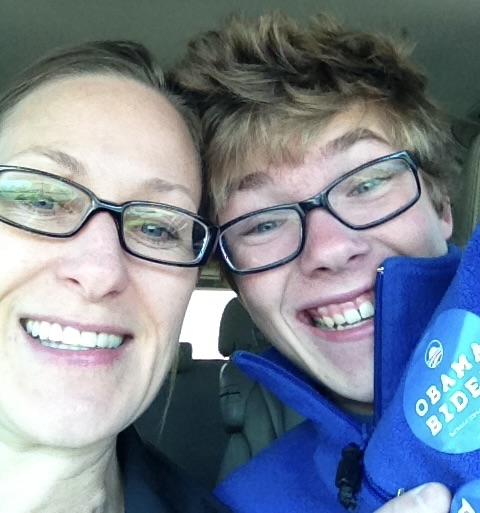
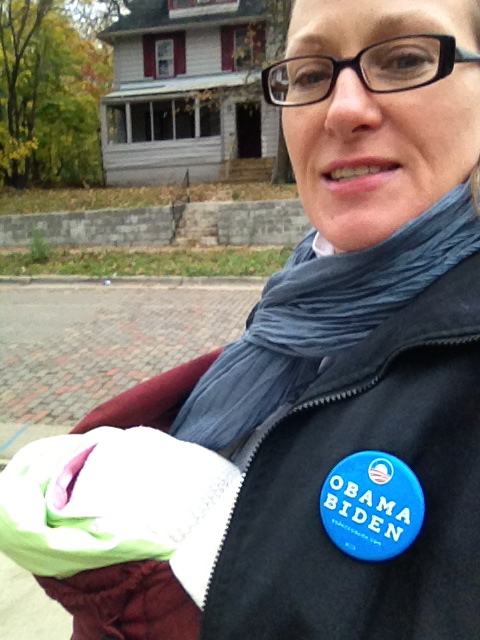
In 2012, President Obama and Sen. Sherrod Brown were up for reelection. Because Akron Public Schools are closed on Election Day, my son Hugo, who was three weeks shy of 16, was home. Our field captain gave us a paper list of Democratic voters near Hoban High School. My 10-week-old daughter, Lyra, was with us, bundled up and strapped onto my chest in an Ergo baby carrier. It was a sunny but very cold day and more than a few women ordered me to get into their warm homes “with that sweet baby.”

MiniVAN app helps volunteers canvassing neighborhoods

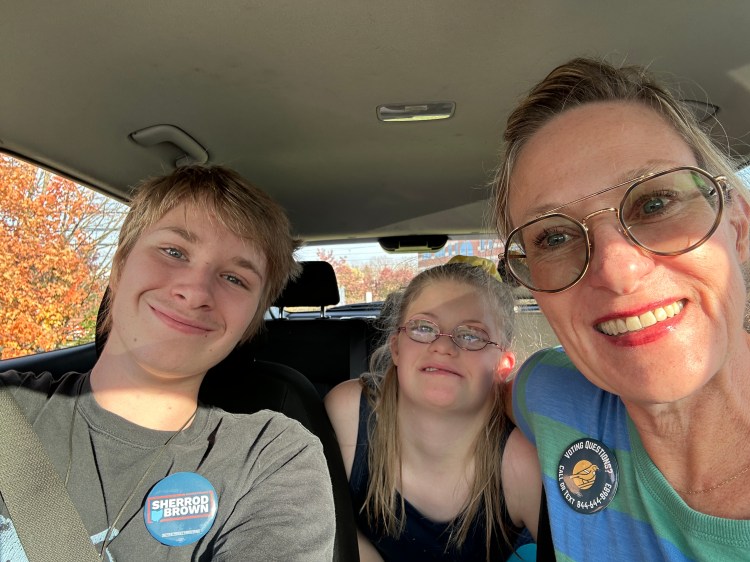
This year my youngest son, Leif, is three months shy of 15. On a recent Saturday we canvassed the streets behind the now-closed Walgreens on Copley Road. Things have changed since the 2020 election. Voter lists are on an app called MiniVAN, which automatically uploads information as volunteers take it down. It also identifies which voters have already voted, so volunteers can more efficiently focus on those who have not. I cannot split the list on the app with my son as I did paper lists, but the advances are well worth it.

Canvassing this year with Lyra and Leif.

We loaded MiniVAN onto Lyra’s iPad (the only one we own). And, yes, Lyra was with us. She knocked on the doors, I asked questions and Leif documented answers on the iPad. We were visiting with an elderly woman whose house was the farthest away from my car as any on our list when an unpredicted thunderstorm erupted. 

“Do you mind if my children stay on your porch while I get my car?” I asked her.

“Not at all! But let me give you an umbrella,” she said before darting into her home. With her umbrella keeping me dry, I ran to my car while the kind stranger and my children continued visiting. 

The act of explaining something can provide epiphanies, “aha” moments where suddenly the subject makes much more sense. Ask any teacher. Talking with voters, my teens explain why it is important to vote. Later, as adults, they have continued to volunteer in cities far from Akron because they deeply care about democracy, and also because it is quite fun.

In July at a conservative Christian event in Florida, former president Donald Trump told the audience that if he wins this fall’s election, “You won’t have to do it anymore. Four more years, you know what? It’ll be fixed, it’ll be fine. You won’t have to vote anymore, my beautiful Christians.” The last thing I want to happen to our country is the elimination of voting, which would literally be an end to America’s democracy. So out I go with my kids and anyone else who will knock on doors with me.

Thiscol.

Civil Rights · Education · Local Politics

2024 will be a wild ride in politics

Last month, pundits aplenty predicted that national politics in 2024 will be a wild bronco ride. With many of the current do-nothing Congress members in Washington up for reelection and a likely rematch of President Joe Biden and former President Donald Trump, that seems to be more statement of fact than prognostication.

Local and state politics will be similarly tumultuous.

As for local politics, the bad news first. Akron Public Schools, a major anchor for the city, which in turn is the economic and cultural driver of Summit County, has suffered poor leadership for far too long.

Last summer, Akron’s school board rushed to pick a new superintendent. This was after Superintendent Christine Fowler-Mack, hired by many of the same board members, was released from her contract 17 months early.

The board chose a candidate who has no experience running a district as large, diverse and poor as Akron’s.

I often feel like a bookie given the number of people who volunteer how long they think C. Michael Robinson will last. All bets are between 18 and 24 months.

There was an opportunity last November to elect school board members who could effectively mitigate the district’s many problems. Yet voters, as they often do everywhere, instead treated the election like a popularity contest. Two of the three open seats were filled by candidates with high name recognition but who in the debates revealed a critical lack of understanding of the district’s issues or any practical solutions.

The good news is that Akron has a new mayor. The city was long overdue for a new generation of leaders. In the May primary (Akron’s de facto mayoral election), voters hired 32-year-old Shammas Malik by nearly 18 points more than the second-place candidate.

Some citizens, especially those who have long known Malik, are wildly enthusiastic about his ascension to the city’s highest position. Others remain skeptical of his ability to root out cronyism and effect positive changes for every ward in Akron, especially those that need it the most. 

Anyone who speaks with Malik quickly realizes his passionate commitment to Akron. He’s smart and a tireless worker who has shown acumen in the appointments he’s made to his administration. He deserves the chance to show the city what he will do.

Last fall, Ohio voters overwhelmingly approved both a constitutional amendment guaranteeing the right to an abortion and a law legalizing recreational marijuana. In response, Ohio Senate Republicans unsuccessfully attempted to modify the new marijuana law. They’ll likely try again, but with the law now in effect, making substantive, if any, changes is less likely.

Meanwhile, Ohio House Republicans discussed moving the jurisdiction of the abortion-rights amendment from the judiciary to — ta-da! — the Republican-controlled legislature. This is not the first time Ohio’s Republican state lawmakers have decided they need not comply with laws that they do not like.

Republican legislators have long enjoyed a supermajority in Ohio due to gerrymandering and in 2022 had no qualms ignoring two Ohio Supreme Court rulings that rejected Republican-drawn state redistricting maps as unconstitutional.

And like so many Republican-dominated states, Ohio’s legislature has taken aim at transgender youths and their families. A bill that would have banned trans females from playing sports on female high school and college teams, as well as severely restricted the medical care of trans youths under the age of 18, passed both the Ohio House and Senate.

But with a signature that angered many Republicans, Ohio Republican Governor Mike DeWine vetoed the bill. Ohio Democrats shouldn’t have been too surprised.

After stridently opposing the passage of the constitutional amendment protecting the right to an abortion in part by falsely claiming it would take away parents’ rights (it doesn’t), DeWine could not bring himself to sign into law a bill that openly and aggressively takes away the rights of parents to make medical decisions for their trans children.

These wedge issues will continue to dominant this important election year as Republicans try to draw attention away from the restrictions to reproductive rights they’ve imposed since the Supreme Court overturned Roe v. Wade in June 2022.

So, yes, hang on to your hats; 2024 politics, here we go!

This was first published in the Akron Beacon Journal on Sunday, January 14, 2024.

Postscript:

Ten days after this column was published, Ohio’s Republican legislature overturned Governor Mike DeWine’s veto of House Bill 68. Now, “access to gender-affirming health care for transgender minors and adults in Ohio is set to be heavily restricted under proposed administrative rules filed earlier this month by the state Health Department.” Once enacted (90 days after the overturn), many believe it will be a de facto ban on gender-affirming care for any Ohioan.

HB 68 also includes a ban on transgender females from participating in scholastic athletics. Currently there are only six such athletes in Ohio. Those six athletes had to meet rigorous qualifications to ensure they were not competing with an unfair physical advantage, which is why many referred to this ban as a solution in search of a problem.

Since DeWine’s veto of HB 68 was overturned, many Ohio families with transgender members have reported plans to leave the state. There also are concerns that people offered jobs in Ohio, including at the new Intel facility near Columbus, will no longer be willing to relocate to the state.

Uncategorized

Getting to Goals

One reason why I started this blog was to give myself deadlines. I didn’t plot out goals when I began, but I see now that posting once a week, at minimum, is my goal. I got that memo last week when I did not post and felt like my boss should write me up.

Who’s my boss? You might ask. She’s a severe taskmaster named Helga. She lives inside my head and is always ready with a pen and a long pad of legal paper, the yellow kind, to list my mistakes in grand detail. Her hair is wound up tightly in a French twist and her glasses perch in the middle of her nose so that she can look over them and glare at me, which she does often. Come to think of it, Helga looks quite a bit like me—only thinner and perpetually wearing suits (usually slate-grey wool flannel, pencil skirt ending just below the knees, silk blouse with elongated collar points).

We have a love-hate relationship, Helga and me. Not easily amused, she makes me write and miserable when I don’t.

Ah, but last week. My dedicated writing days are Tuesdays, Wednesdays and Thursdays–the days when two-year-old Leif goes to daycare. But, I tell Helga, last week was not any old week. There was the election and anxiety kept me up much of Monday night. A week later, I cannot recapture that heart-thudding anxiety, which was so real and is now literally unimaginable, though factually I know it was there. Big events will do that—wedding preparations, a set of final exams, even Christmas—all truck in anxiety in advance of their arrival. Born, I imagine, out of the desire to control something that is never controllable. I know others were feeling the same early last week, because so many (of all political persuasions) were posting it on Facebook.

Feeling groovy after finishing a four hour shift of GOTV on Election Day.

Tuesday was, of course, Election Day. Akron Public Schools are closed when we have elections because many of the schools are polling locations. Currently, Hugo is my only child in an APS school and I signed him up to work Get Out The Vote (GOTV) with me. His only complaint was that we had to be at the Democratic Headquarters at nine a.m. Four years ago, when he was eleven, Hugo walked to the Obama headquarters on his own volition, while I was at work, and asked what he could do to help. They had him roll posters for as long as he was willing.

Last week, we went together to a union hall for packets of addresses and directions to the neighborhood we were to work. If you haven’t done it before, you might think GOTV would be stressful, going to the doors of complete strangers. On Election Day, the goal is not to convince people to vote for the Democratic candidates but rather to make sure previously identified Democrats have voted and, if not, encourage them to do so as soon as possible. Generally, these voters are happy to see you, but Hugo was naturally nervous and went with me to the first few houses before we split up and took opposite sides of the streets we were working.

Working GOTV often reminds me of an issue that is important to me—the reality versus the mythology of poverty. See this Truthout.org piece on what these myths are and how perniciously they impact society: Lies of Plutocracy: Exploding Five Myths that Dehumanize the Poor. By chance, this year the neighborhoods I walked for the Democrats were poor, working class neighborhoods including one near the Akron Zoo, which I drive through often. When driving, I see the boarded up houses and the few that are in derelict condition.

But when going to the doors of the homes in this neighborhood, I saw what I do not when driving by at 35-45 miles an hour. Modest homes kept as tidy, if not tidier, than mine. Lawns edged around the sidewalks, weed-free gardens, porches swept clean.  Children well cared for and friendly. Ubiquitous evidence that poor people are overwhelmingly NOT lazy, no more so (perhaps even less so) than any other demographic. Many people gave me guarded looks when answering their doors—just as I do when strangers knock on my door, but once I identified myself as working for the Obama campaign, many adults were happy to talk with me about the election. Lyra was a great assist as I carried her on my chest in her Ergo baby carrier, older women often telling me to “keep that baby warm, now!”

Citizen Lyra helps with the 2012 GOTV

True confession: I enjoy working in predominantly African-American neighborhoods where I would not typically have reason to venture. It’s no secret that black Americans frequently do not feel welcome in predominantly white neighborhoods. The tragedy of Treyvon Martin earlier this year gives grim evidence as to why. So why should I feel entitled to waltz through a black neighborhood? Well, I don’t. Not because I am afraid I will be shot, I’m not, but as a white woman, I do not want anyone in a black neighborhood to think I’ve condescended to ask for his or her vote. And were the candidate for whom I was urging them to hustle to the polls for white, it just might smack of condescension. But he isn’t. The candidate, our president, is black and my children will not recall a time when a black president was unimaginable. But it is my opinion that Barack Obama is, irrespective of his color, one of the best presidents of my lifetime.

Shortly after Obama won his first presidential election, the satirical online magazine, The Onion, posted this piece: Nation’s Blacks Creeped Out By All The People Smiling At Them | The Onion – America’s Finest News Source. I suppose I’m one of those people, I felt so good after we elected (and re-elected, perhaps just as remarkably) Barack Obama. Yes, there is so much work to be done with regards to race relations and poverty in this country—and don’t think the two aren’t connected, they are. See point number three in the above TruthOut.org piece. Seemingly the hardest part is how to even have a discussion in this country about race, particularly across racial lines. Having a black man win the presidency and then win re-election does not mean we do not have significant work to do with regards to issues of race and poverty, we do. But we are, at least in leadership, in this one instance, moving in the right direction. And it momentarily puts a white middle class mama like me on common ground with some working-class black Americans. It is a place of hope for change, real change, because we all want the economy to improve and good jobs to become more plentiful. But to move past the intransigence of “Us versus Them”–whether the paradigm is class, color, religion, sexual orientation–is tectonic change. And a worthy goal. Perhaps the most worthy goal in life.

And so Hugo and I worked our packets, going to each and every door on our lists. That night, we stayed up to watch the results come in and, as we did four years ago, when Ohio was called for President Obama, we trudged out back and shot off three Roman Candles, before filing to bed. We were spent. Wednesday, my head ached and I was tired like a sick person. I did not drink the night of the election, but I felt hungover nonetheless. It’s over; finally this long election is over. May the work of our government, the essential work, now begin. May our leaders work with sincerity and not cynicism, for all citizens, not just those they agree with, and may they guide the nation out of war and economic recession. And perhaps in so doing, guide themselves away from polemic politicking.

On Thursday of last week, we took our little Lyra to the Down’s Clinic at Akron Children’s Hospital for an evaluation by their medical team. But that is a topic for another post, which I know Helga believes should reasonably post this week. If I can be sure of anything in this world it’s that she’ll keep after me until it does.