
Uncategorized

A love letter to my inner-city neighborhood

I love my inner-city Akron neighborhood.

Surrounded by beautiful homes and friendly residents, we are less than five minutes away from EJ Thomas to enjoy Akron Symphony concerts, the downtown Akron-Summit County Library to hear award-winning authors speak, the Akron Art Museum for spectacular exhibits and talks, and The Nightlight Cinema to see movies not shown elsewhere.

Each year when spring arrives, I all but abandon the interior of my home. I set up outdoor furniture for months of open-air living and plant garden beds and pots with flowers, vegetables and herbs. Impromptu visits with neighbors—all but impossible during months burrowed inside warm homes—resume. On the first temperate day last April, my next-door neighbor Joe and I stood in my driveway and lingered in inconsequential conversation while our combined six dogs frolicked. None of us wanted to leave the warm sun and moist spring breeze.

Summer in my neighborhood, stocked with century-old homes, is a huge part of why I love where I live. Built in the days before air conditioning, most of the houses have invitingly large front porches. Like me, many of my neighbors drink their morning coffee and, later in the day, eat dinner on porches set up like living and dining rooms.

My favorite season, however, has long been fall, when the temperatures and humidity drop, the blue of the sky deepens and life somehow feels easier (the kids returning to school helps).

Soon after they appear at Acme, pumpkins and multi-colored gourds cascade down the steps of my porches. Then, on the third Thursday of September, I drive to Barberton to buy half a dozen or more potted chrysanthemums from the Barberton Mum Festival. Priced at five for $40, the festival sells large mums in a wide variety of colors, all robustly healthy.

Helpful Henry surrounded by the fall decor.

There’s work a-plenty to be done outside this time of year. Flowerpots need hauled into the garage to shelter from the coming winter. The leaves from several 80-foot oak trees repeatedly obscure my lawn and its regular supply of dog bombs. The satisfaction that comes after hours of hauling leaves to the curb is both simple and substantial.

Years ago, the owner of Constantine’s Garden Center in Bath, not far from where my two dyslexic sons saw their tutor for many years, told me the sales of spring flower bulbs have dropped dramatically, perhaps as much as 75%, from what it was in the 1960s and ’70s.

There have been years when bulbs I bought never made it into the ground. I was afraid the same would happen this year when October seemed interested in only serving dreary, cold rain on the weekends. And then, on November 1, autumn appeared to have clocked out early, and we awoke to over 2 inches of snow on the ground. My impatiens, coleus, dahlias and many (though not all) zinnias crumpled and turned brown. And that’s the poignant lesson of fall. Throughout October, I enjoy each warm sunny day and the kaleidoscope of color blooming in my yards even more than I had all summer because I know full well it will soon be gone.

My home, all decked out for Halloween, on the morning of November 1.

But as often happens, the death freeze was quickly followed by gossamer summer. Last weekend, the first nice one in a month, I planted dozens of bulbs, this year attended by my new assistant, Henry. A Yorkipoo puppy we brought home last winter, Henry is what some call a “Velcro dog” because he never wants to be parted from his humans, especially me. Nine pounds of keen intelligence and outsized personality, Henry rules the house. He wrestles with our 90-pound German shepherd with a pugnacious ferocity, but then sweetly allows my 11-year-old daughter to carry him around like a baby.

As I dug 6-inch holes for tulips, hyacinths and daffodils, Henry and I visited with neighbors who walked to the stores at the end of my street. Diversity has always been one of Akron’s strengths, and I take pride in my own slice of the city, which is both ethnically and economically diverse.

Or, as my 20-something sons tell me, my neighborhood “slaps.”

Thirty years ago while visiting my grandmother in Tucson, she and I struck up conversation with a man who was visiting from Seattle. When I mentioned that Seattle had recently become a popular place to relocate, he told me, “Shhh, don’t tell anyone.”

When I bought my 1909 Akron Arts and Crafts house 21 years ago, like the man from Seattle, I believed I’d gotten in on one of the best-kept livable city secrets. There are many reasons to believe in Akron’s potential, which I don’t hesitate to write about.

Now, more than ever, I believe in this city and its citizens and am committed to our success.

This column was first published in the Akron Beacon Journal on Sunday, November 10, 2023.
Uncategorized

The upward spiral of integration of people with intellectual disabilities

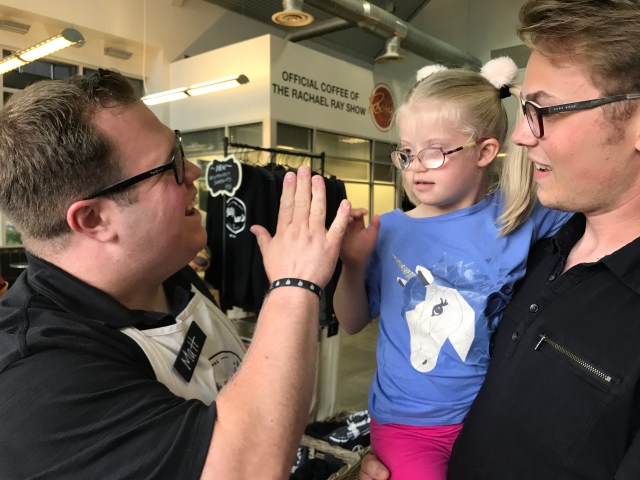
Matt Dean, an employee at Bitty & Beau’s, interacts with author’s daughter, Lyra, this month in Wilmington, NC while Lyra’s brother Hugo looks on.

Babies with Down syndrome are the cutest, with their round little faces and eyes, tiny ears and noses, cuddly bodies. Even as they become toddlers, it’s not uncommon for strangers to comment on just how adorable kiddos with DS are.

But most parents of a child with DS harbor this fear: What happens when our children grow up and society no longer sees them as darlings? When their precociously friendly behavior is expressed as a teen or adult? What to do when it is no longer possible to scoop up a child who resists your every move?

Some of these concerns came to life for us when we vacationed this month in Carolina Beach, North Carolina.

Lyra loved ocean waves knocking her back as she sat on the shoreline and with all our big boys there, adults outnumbered children. Eyes were always on Leif as he learned to boogie board while someone else played with Lyra in the surf.

Four days in, several of us unsuccessfully ventured to a renowned serpentarium in nearby Wilmington. Like a Southern Gothic tale, the owner of over 100 reptiles was shot and killed by his wife two years ago. Six months later, the serpentarium’s cold-blooded residents were resettled in several zoos.

Our plans kiboshed, we instead walked along the Cape Fear River. Suddenly, Lyra stopped and said, “No! Go back!” I asked where she wanted to go and she pointed ahead, in the direction we were already walking, “This way!” Alrighty, then.

Moments later, Lyra dropped to the ground, refusing to move. Max carried her as she bitterly complained, “No! This way! Car!” While we had beautiful weather that week, it is the South and at 85 degrees and 1,000 percent humidity, wrangling Lyra was a surefire way to sweat up a thirst.

At the Platypus and the Gnome pub, Lyra continued to struggle until our secret weapon was set before her: a plate of french fries.

What is this behavior? Anxiety in response to new environments and changed routines is common in people with Down syndrome or autism spectrum disorder. What is familiar, both in time and space, provides predictability.

I imagine it’s like traveling in a country where English isn’t spoken. When I travel abroad, I’m more confident when I know what to expect and how much of the native tongue I’ll need to attempt, making guidebooks and Google Translate essential tools.

Many children with intellectual and developmental disabilities (ID) also have sensory integration disorder. Loud noises and crowd environments overwhelm them. At school fire drills, Lyra plasters her hands over her ears and trembles with fear while repeatedly screaming, “No!”

When we visited an aquarium, two school groups were also there. The noise and chaos caused Lyra to flee. Going forward, I will accept the sensory bags offered by museums and zoos. They include things like headphones to reduce noise and toys to distract anxious children.

One afternoon, I ended up alone on the beach with Leif and Lyra. Lyra approached a woman and her grown daughter and, as she often does, Lyra grabbed their hands and placed them together, creating a circle. The women kindly played ring-around-the-rosy with Lyra until one became dizzy. Lyra, however, refused to stop.

I called Leif out of the water so I could take Lyra inside, and when I turned to take her hand, she was 50 yards away, racing down the beach as if being chased by a land shark but with no fear.

The day we left NC, we visited Bitty and Beau’s, a cafe in Wilmington. Named after the owner’s two children with Down syndrome, Bitty and Beau’s cafes (there are three), employ people with ID.

At the counter, Matt Dean, who has DS, gave us a quick overview of the items on the menu.

“We have breakfast and lunch sandwiches and a new line of gluten-free cookies,” he told us, passing his hand over the cookie display. After we ordered, we waited at the pickup counter near the entrance for our food.

Lyra darted to the door, pushed it open with seemingly superhuman strength and ran outside, Hugo hot on her heels. Matt walked over and said, “I used to do that.”

“You used to run?” I asked.

“Oh, yeah, I was a runner!” he told me in his charming Southern accent. I asked Matt how old he is. “Most people don’t believe it, but I’ll turn 30 in October. By the way, what job do you think Lyra will want when she works here?”

“She’s very social like you. I think she’ll want to work the register.”

“Oh, like me!” said Matt, clearly delighted. “You know before I had this job, I was shy and reserved. Yes, I was. Shy and reserved.”

If we lived in Wilmington, I’d frequently visit Bitty & Beau’s, especially on the days Matt works.

Matt reminds me of Tim Harris, a successful restaurateur with Down syndrome. I learned that before he ran his restaurant, Harris was not nearly as verbal as he became. In 2015, I heard him give a superb keynote address to over 1,000 people.

This is the upward spiral of integration.

When people with Down syndrome were institutionalized or, post-institution, put into workshops together to perform menial tasks, often for less than minimum wage, their language and social skills remained limited. Not because they had Down syndrome, but because they were isolated from enriching relationships and experiences.

Celebrity chef Rachael Ray only uses coffee from Bitty & Beau’s. She wants to see their cafes compete with Starbucks. So do I. Eighty percent of people with ID are unemployed, a number that does not reflect the abilities of people with ID.

Bitty & Beau’s cafes accomplish several sorely needed things. They provide integrated employment with fair wages for people with ID, which, in turn, fosters the upward spiral of integration. And just as important, at Bitty & Beau’s cafes, the public interacts with people who have ID. Nothing dispels the falsehoods of what a person with ID is capable of than meeting someone with ID.

I encourage everyone to grab a hankie and check out Bitty & Beau’s Facebook page. Who knows? Maybe one day it will open a cafe here in Akron. If it does, it’ll become my new favorite hangout.

From my perspective

Family, small victories, big struggles, everyday life....

Tripping Fantastic 2

The Fantastic family of six and our adventures near and far! See also our previous adventures at trippingfantastic.wordpress.com

ECUADOR - Living in Cuenca

Stories of an Ohio family that are personal, political, always questioning

Tripping Fantastic

The Fantastic Family of 6 and our adventures near and far! Please also see trippingfantastic2.wordpress.com for adventures after February 2016

Roadkill Goldfish

Stories of an Ohio family that are personal, political, always questioning

Green Tea Ginger

Stories of an Ohio family that are personal, political, always questioning

Squeeze the Universe

Stories of an Ohio family that are personal, political, always questioning

My Blog

Just another WordPress.com site

Kimchi Latkes

Spicy taters!

Margaret and Helen

Best Friends for Sixty Years and Counting...