Uncategorized

After months of work, 1909 house transformed into a gem

There are few American cities with the cultural and educational amenities combined with a relatively low-cost of living as is found in Akron, where I am fortunate enough to own two homes. In 2003, I bought a 1909 Arts and Crafts home, which I call Dreisbach House, for $112,500. After a divorce in 2010, I refinanced the balance of the mortgage on a 15-year note and paid it off early by rounding up each payment.

The Great Recession depressed housing prices longer in Akron than other parts of the country. I bought the neighboring house, which shares a driveway with Dreisbach House, in 2014 on a lease-to-purchase loan because even with a $54,000 mortgage it was under water. I expect to pay off what I call Cressler House in the next two years.

I raised my three eldest sons and birthed my fourth in Dreisbach House. Then, for several years, I rented it out and used the proceeds to pay both properties’ mortgages. After my last tenants moved out three years ago, I began restoring the house with the plan to move back into it and turn Cressler House into an AirBnB.

Several considerations led to this decision. First, several friends have acquired properties and turned them into AirBnBs, which have earned more annually than has renting Dreisbach House on a long-term lease. Secondly, short-term guests aren’t there long enough to be as hard on a home as long-term tenants. And, finally, I dream of having a place where my adult children, their spouses/partners and, hopefully one day, children can stay when they visit.

But plans change. Last summer I decided to remain in the more modest Cressler House and instead turn Dreisbach House into an AirBnB. At the time, drywall covering the original walls, window frames and baseboards in three of Dreisbach House’s four bedrooms had been removed. Plaster walls and the wood of the window frames and baseboards needed repaired (or replaced), while proper electrical outlets needed installed.

Not a floor nor a step in Dreisbach House squeaks because the exterior walls are constructed of two layers of brick. The thick masonry keeps the home as cool as a cave in summers – an important consideration in 1909 when air conditioning was not available – while cheap coal once fueled the boiler in winters. Gas lights hung from the bedroom ceilings, the plumbing of which has been discovered each time I’ve installed a ceiling fan, and the original electrical wiring was knob and tube.

The interior brick behind the plaster walls and new up-to-code wiring in Holly Christensen's house.
The interior layer of brick under the lathe and plaster, exposed to install wiring to code.

In order to install GFCI (ground fault circuit interrupter) outlets in the bedrooms, several inches of lathe and plaster were removed, revealing the interior layer of brick. That brick causes the plaster walls to often bubble and crack and I considered covering them with paneling after the wiring was completed. But the supervising contractor, Paul Mann, had a different solution.

“Look, Holly,” he said, “paneling would hide any moisture that may seep through the walls as well as any mold that develops as a result. Also, the remaining original baseboards will likely crack if we pull them off to install paneling behind. You’ll save the original baseboards and some money if you refinish the plaster walls. Any bubbles or cracks that occur down the road can be repaired.”

The bedroom ceilings also needed thought. One had been covered with acoustic tiles, while in another bedroom I had bead-board paneling hung to cover water damage caused when a third-floor radiator ruptured and leaked. Paul recommended putting in drywall ceilings, an upgrade to the project, but worth the added cost long term.

Jack, the contractor who did the work, turned the bedrooms into pristine boxes. In the bedroom with an elongated closet over the staircase, he reconfigured the closet by installing a wall on one side so that it is now only slightly wider than its door. A nook was created by cutting a hole in the wall that had been part of the closet. Paul helped Jack design Arts and Crafts-style framing around the original closet door and nook opening.

The original fresco at Holly Christensen's house.

The house did the next step: choose colors. When I bought Dreisbach House, wallpaper covered the walls on the ground floor. The first day I took possession of the house, I pulled it all off. In the living room and stairway, original frescos of cherry branches in full bloom were revealed. Unfortunately the plaster was severely cracked in many places and had to be patched and painted over – except for one panel alongside a window on the landing to the second floor.

Using a chart of historic colors from January Paints, I matched a color called Venetian Glass to a green stripe in the remaining fresco. It is now the color of the bedroom walls. In the hallways and living room I chose Parsnip, an off-white bordering on light taupe. These colors look both original to the house and make the wooden accents pop in complementary splendor.

By mid-January Dreisbach House had been put back together and it was time determine what else was needed to turn it into an AirBnB. Stay tuned for the next installment.

This column was first published in the Akron Beacon Journal on Sunday, April 13, 2025.

Home renovation · Uncategorized

A new stovetop leads to a kitchen transformation

It all started with the Roper stovetop

I own two side-by-side houses and I’m slowly remodeling the one we call Dreisbach House, an Arts and Crafts home built in 1909. Meanwhile, I live in Cressler House, which underwent significant modernizing in the 1960s, including the installation of that Roper stovetop.

With two parallel rows of burners mounted into the countertop, the Roper was a romantic throw back, sexy even. After all, it produced visible fire and tangible heat. The busiest burner, on the front right corner, sometimes required assistance to ignite its flame. There’s a singular satisfaction in seeing a robust round of fire erupt in the presence of a lit match.

The Roper’s pilot lights ran high. Plates set on burners I wasn’t using, while cooking on others, quickly became too hot to touch with bare hands. The slightest wind would extinguish the Roper’s pilot lights, which, given its proximity to the back door, was frequent

Charming but dangerous, effective but inefficient, the Roper needed to retire. Rather than gas, I chose an induction stovetop. Induction stovetops heat cookware electromagnetically, thus, only cookware made with magnetic materials work. Caste iron is a go, caste aluminum is not. Most of the cookware I already own works just fine.

According to the U.S. Department of Energy, induction stovetops are up to three times more efficient than gas stoves. Other perks include no release of the pollutants related to gas stovetops and shockingly fast heating times —induction stovetops boil water up to 40% faster than gas or conventional electric stovetops.

In researching which stovetop to buy, I looked at the website Wirecutter, which reliably reviews just about everything. I chose a GE Profile, which was more than I’d planned to spend. Like the Barbra Streisand song, I’m a second-hand rose. Most of my clothing (and that of my children) is thrifted, my car was used when I bought it and I’ve never been the first owner of a home. But with some purchases, particularly appliances, it is wise to spend more for better. Also, I found some kickbacks.

Before purchasing the stovetop at Lowe’s, I went to Get-Go, the gas station owned by Giant Eagle, and bought gift certificates for the hardware store using a credit card that gives me 3% back on gas station purchases. And because I have a Giant Eagle rewards card, I also earned a lot of free gas.

Not so fast. The induction stovetop is made of tempered glass and the kitchen’s copper-tile backsplash, which is probably as old as the Roper, was embedded with years of stains no amount of elbow grease and Pink Stuff (or Bar Keeper’s Friend, steel wool, etc.) could remove. In order to avoid damaging the new stovetop, the backsplash needed replaced first. But a new backsplash would accentuate how deeply worn the countertops were. 

Which meant before the counters, backsplash and stovetop, I needed to pick new flooring as I use the floor to dictate the color of the other components. And that’s when I learned how out of sync I am with seemingly everyone else in America.

I will never install a tile floor in a kitchen. For someone who stands in the kitchen everyday, tile is too cold in the winter, too hard on joints everyday and when you drop something in a room with a tile floor, kiss it goodbye because whether it’s glass, plastic or a small creature, it’s going to break when it lands.

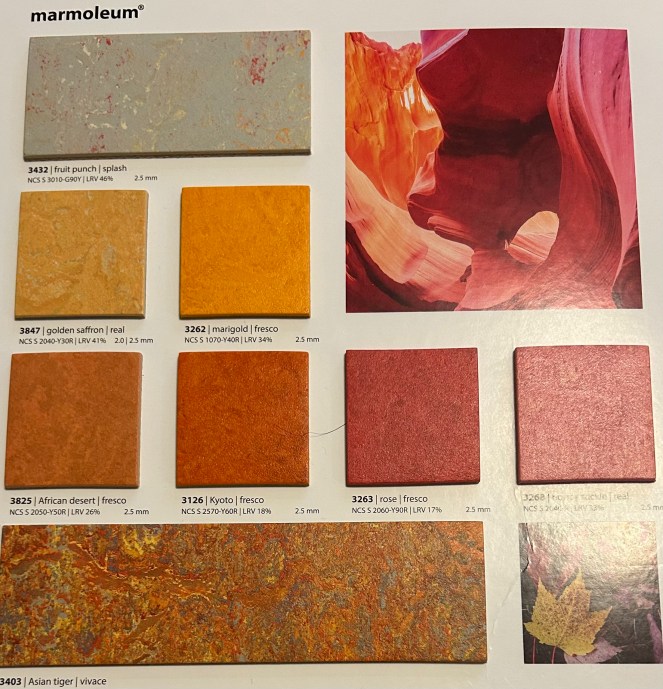
I love linoleum that unapologetically looks like linoleum. Akron’s First Flooring & Tile can order Marmoleum by Forbo, which is old-school vegetable linoleum. The patterns are beautiful, the material is both environmental and durable, while also gentle on the legs. In 10 minutes I chose Asian Tiger, an orange swirl with reds and grays that, yes, would be a perfect floor for children to play hot lava.

I then ordered a quartz countertop that looks like white marble with subtle streaks of grey and brown to complement the busy flooring. So, too, does the white subway tile backsplash with flecks of terra cotta.

The countertop, backsplash and induction stovetop have all been installed. When I walk into the kitchen and look at them, I feel a small trill in my chest, so long as I don’t look at the floor. 

Home decor styles come and go. Thirteen years ago, when I put a new floor in Dreisbach House’s kitchen, First Flooring & Tile’s showroom had rows of vinyl linoleum on 12-foot rolls. Today they have none. It’s all ceramic tile and floating floor planks (think Pergo). There are appropriate places for both types of flooring, but not in my kitchen.

With the loss of sheet linoleum so, too, has gone the people who can install it. Two flooring companies and Home Depot have not been able find anyone who will install Marmoleum. At the suggestion of the flooring companies, I emailed Forbo and asked for help finding an installer. They responded by telling me to contact the flooring companies. Sigh.

Perhaps soon floating laminate and tile floors will peak and make way for the return of sheet linoleum. Until that time, my newly refurbished kitchen will include the old flooring with throw rugs strategically placed to hide wear and tear. 

This column was first published in the Akron Beacon Journal on Sunday, March 31, 2024.

Since publication, Akron architect Hallie Bowie contacted me with this very useful information:

“I want to be sure you know that you can get a tax credit if you had any electrical panel upgrades done to help with the installation of the cooktop.  And you could mention that those earning less than 150% of the median income in our area will  soon be able to get rebates on the cooktop itself, up to 100% of the cost of the appliance or $840 max. https://pearlcertification.com/news/electric-cooktop-rebates-and-tax-credits

Uncategorized

New windows restore an Akron house’s Arts and Crafts charm

Architectural and interior styles change over time and as they do, people often change their spaces accordingly. My next-door neighbors’ home was built at the turn of the last century by the family that owned Akron Brewing Co. Sometime in the mid-20th century, the kitchen’s wooden cupboards were removed and replaced with “modern” stainless steel ones.

Luckily, an original section of the bottom cupboards remained on the back porch, which my neighbors, having removed all the metal ones, painstakingly restored and integrated into their new kitchen, creating a pleasing mix of old and new.

My two side-by-side homes on the near westside of Akron were treated very differently by the families that lived in them for over 60 years. None of the original decorative woodwork remains in Cressler House, where I live. I have a photo of Claire Cressler and his wife, Gloria, gleefully attacking with crow bars the oak columns that had been near the front door.

Next door, at Dreisbach House, Herman and Ruth Dreisbach were more surgical when remodeling. Perhaps they appreciated its Arts and Crafts style, or maybe it was because they had been gifted the home by Herman’s uncle, Herman Zimmerly, who built the house in 1909. But they, too, looked to modernized their house with the changes they made.

The Dreisbach House, circa 1915.
Dreisbach House, circa 1910, the year after it was built. Holly Christensen

Between 1905 and 1915, several houses were built on my street with either golden or dun-colored brick, all held together with red mortar. Dreisbach House has the dun brick (the Akron Brewery home is of the golden brick). Large blocks of yellowish sandstone form the foundation while substantial pieces of pinkish limestone were used for the exterior window sills and lintels.

The windows in the living room, dining room, stairway landing and third floor of Dreisbach House are the original (and never painted) oak sash windows, with pulleys and weights to hold opened windows in place. The glass is leaded, creating a charmingly warbled view of the outdoors, and the interior brass handles have decorative flourishes.

In probably the 1980s, the Dreisbachs had the kitchen and all the bedroom windows replaced with white vinyl ones. They painted the exterior of the remaining original windows white to match the vinyl ones. Presumably that is also when they replaced the roof’s wooden soffits and fascia with white aluminum, which they also used to cover all exterior wooden features. And finally, they enclosed the front porch using louvered windows with, you guessed it, white frames.

The Dreisbach house in 2011.
Dreisbach House in 2011.

A conundrum of owning a historical home is while some upgrades make the home more efficient and even more comfortable, it doesn’t necessarily mean they look right. The many white exterior features make the dun-colored brick look washed out.

Two years ago, my home contractor begin scraping the white paint, which clearly contained lead, off the original windows. Underneath was the color the windows had undoubtedly been painted at construction: a brownish red, often referred to as “oxblood.” Not only does it accentuate the reddish mortar, it also gives a much-needed richness to the brick.

New kitchen windows at Holly Christensen's house restore the "oxblood" trim, giving a much-needed richness to the brick.
The new windows restore the “oxblood” trim, giving a much-needed richness to the brick.

Meanwhile, the decades-old vinyl replacement windows had become so warped, they could only be opened and closed by a strong man with tools. The replacement windows needed replaced. This was the moment I decided that, with the mortgage nearly paid off, I would pay more for windows that honor the original Arts and Crafts design of the home.

Wooden Anderson Windows, baby, that’s what I’m talking about. The interior of the windows were factory stained to match the original frames. The exterior of the wooden windows, however, are clad in aluminum and installed with an aluminum casing, both of which can (for an upcharge, of course) be color matched.

As to finding contractors for a variety of jobs outside the scope of my home contractor, I use the social media site Nextdoor. When you join, you are connected to other Nextdoor members who live in your area. Ask people for a good painter, concrete company, housecleaner and, yes, window installer, and you will get several responses from satisfied customers. That’s how I found Jim Sutcliffe, owner of Windows, Doors and More, whose work I highly recommend.

Sutcliffe gave a chip paint from one of the original windows to Anderson Windows, who uses Sherwin Williams for color matching. The results are exterior window sashes in Sherwin Williams Manhattan Brown surrounded by casings of standard antique bronze.

The difference color can make is remarkable. I replaced 11 windows and whenever I look across the driveway from Cressler House at Dreisbach Houses new windows, I feel a small trill of satisfaction. It’s a feeling I hope to have over and again as this renovation continues.

This was first published in the Akron Beacon Journal on Sunday, March 3, 2024.