
Uncategorized

Bridges Learning Center offers students a path to success

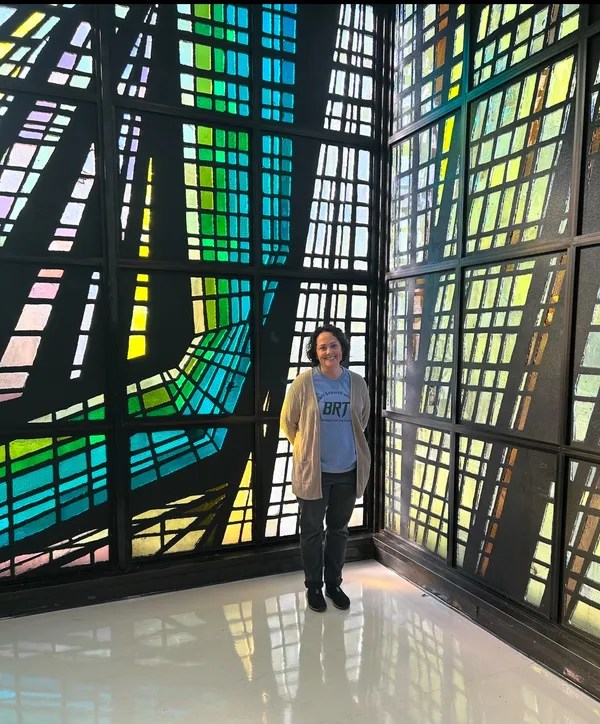
Principal Michele Angelo in front of one of several stained glass walls in Bridges Learning Center.

When I recently parked across the street from Bridges Learning Center, I was shocked at how many times I’ve driven by the building without noticing it. A pleasant combination of Brutalist and Prairie styles of architecture, Bridges is set further back on Thornton Street than its neighbor, Akron’s Fire Station No. 4. The school building is a hidden gem, and what occurs inside its walls is even more valuable. We are fortunate in the United States that federal law guarantees all states must provide all students with a Free Appropriate Public Education (FAPE) in the Least Restrictive Environment (LRE). This has not always been the case and is the result of hard-won civil rights campaigns waged in the second half of the last century. (For more on that history, read “Being Heumann: An Unrepentant Memoir of a Disability Rights Activist.”)

Mandated to educate all children, what do public school districts do when a child’s behavior  limits or prevents them, and often their classmates, from learning? Ideally, they follow clearly defined steps of positive behavior intervention supports (PBIS) to help students learn to regulate their emotions. As a tutor in two elementary buildings in Akron schools over three years, I have witnessed faculty, administrators and staff patiently assist students with PBIS.

But what if a child does not adequately respond to these intervention supports? Smaller districts might pay for the student to be placed outside the district at specialized schools. But Akron, like many larger districts, has its own dedicated facility. Bridges Learning Center was created in 2006 when programs for elementary and middle school students merged. A decade later, high school classes were added and, since 2019, the former Reidinger Middle School has been home to Bridges Learning Center. 

One might imagine the school having a carceral environment, but quite the opposite is true – every corner of the building is calm, orderly and inviting. It reflects the school’s mission to “provide social, behavioral, and academic skills through high quality teaching…by creating a positive, nurturing and supportive environment.” Michele Angelo, the school’s principal, repeatedly used the words “restorative” and “family” or “team” approach to describe what occurs in the school. Students in the United States with special education needs receive Individualized Education Plans (IEPs) – protocols developed by educators, specialists and the student’s guardians as a team – that outline specific, individual services and accommodations needed. All students at Bridges were placed on IEPs in their home schools, and it was their IEP teams at their home schools that determined a placement at Bridges was appropriate.

The range of student abilities at Bridges includes children with multiple physical and cognitive disabilities, children who are non-verbal and children with various learning disabilities. For a few students, placement at Bridges is determined to be the best location for the duration of their education. But the goal for most of the 102 students currently at Bridges (the majority of whom are in grades 3 to 12) is to acquire the necessary emotional regulation needed to return to their home schools.

How do the faculty and staff at Bridges accomplish this goal? Each classroom is staffed with a teacher, an intervention specialist (special education teacher) and an aide. Also, three full-time, floating educational assistants are available to go to any room where extra assistance is needed. And Red Oak Behavioral Health, which partners with schools throughout the district, has two counselors and three case managers at Bridges full time.

Music therapist Edie Steiner's board at Bridges Learning Center in Akron.
Music therapist Edie Steiner’s board at Bridges Learning Center.

But wait, there’s more. Art therapist Shenan May and music therapist Edie Steiner work with students both one-on-one and in group settings. In addition to their education and experience in art and music therapies, they have been trained in dialectical behavior therapy-informed (DBT) practices. According to the Cleveland Clinic’s website, DBT “focuses on helping people accept the reality of their lives and their behaviors, as well as helping them learn to change their lives, including their unhelpful behaviors.” Ms. Steiner’s classroom is filled with instruments, including several electric guitars and two drum sets – much of it purchased with grant funding. I could devote an entire column to the benefits of these therapies, but a quick look at Ms. Steiner’s board for her classes shows the seamless integration of music and behavioral development students experience in her class.

Behind Bridges are expansive fields the school integrates into its student experience. Second grade teacher, Kim Zeffer, obtained funding from Lowe’s to install several raised planting beds, gardening equipment, benches and more. One of the Red Oak therapists received grant money to create a remote-control race car team. As any parent knows, most kids love RC cars. Participation on the RC team helps students “focus on teamwork, problem-solving, and self-regulation during races.”

And Bridges also helps its students prepare for life after they leave. High school students, some of whom are reintegrating after time in juvenile detention or residential placement for mental health issues, not only work on academics and emotional regulation, but also with other governmental service providers such as Summit DD, Ohio Department Job and Family Services and High School Job Training that come to the building to help with job training and placement.

Bridges’s students are members of our community. The team approach at Bridges is an effective way to assist these students to succeed not only when they return to their home schools, but throughout their lives. What happens inside Bridges helps not only its students, it’s a benefit to us all.

This was first published in the Akron Beacon Journal on Sunday, October 12, 2025.

Uncategorized

Trump earns an F for abolishing the Department of Education

When the Department of Education (DOE) was created in 1979, President Jimmy Carter warned supporters, “This thing won’t work as well as you think it will.” Time has shown his prediction accurate, however, not working as well as thought is not the same as working badly. 

Just what does the Department of Education do? Many things.

The department oversees federal funding for colleges and universities as well as K-12 public schools. The bulk of federal funding for higher education comes in the form of Pell Grants, student loans and research funding. Most K-12 schools receive 10% of their funding from the department but as recently as the 2021-2022 school year, it was 14.6% for Ohio schools, or $2,600 per student. 

Two DOE programs support school districts with the greatest needs. Title 1 helps fund supports for schools with high-poverty rates while REAP (Rural Education Achievement Program) specifically targets rural schools, which comprise more than a quarter of all U.S. public schools. My job as a tutor in an Akron Public Schools building with high-poverty rates is paid for with Title 1 funding. I see first hand the need for this support and how impactful it is.

The department also provides federal oversight for the Individuals with Disabilities Education Act (IDEA). Enacted in 1975, IDEA’s role is to ensure all states provide a free appropriate public education to students with disabilities both physical and intellectual. Within the department is the Office for Civil Rights to which students with disabilities can file complaints if they are not receiving a free appropriate public education as outlined by IDEA.

When I graduated high school in the spring of 1983, I had attended 10 public schools in four states. In none of these did I have classmates with intellectual disabilities, such as Down syndrome, nor physical disabilities that required wheelchairs or adaptive equipment. This changed in the years after IDEA federally required public schools to allow students with disabilities to attend, something that doesn’t just benefit students with disabilities. It also normalizes having friends with a range of abilities as students work and play with classmates who only a few decades ago were not encouraged, or sometimes even allowed, to attend public schools.

Just as important to know is what the Education Department does not do. It does not set curricula (what is taught) in public schools. It does not determine how schools receive funding outside of what it provides. It does not set standards for teachers nor graduation requirements. All of this is, and always has been, decided by the states.

On March 11, the Trump Administration put more than 1,300 DOE employees on administrative leave. The agency’s statisticians who analyze the data to determine which school districts qualify for Title 1 and REAP funding went from 100 to three employees, making it impossible to efficiently and effectively conduct their assigned task. The expected result is the funding for schools that rely on Title 1 and REAP will not be allocated and, therefore, distributed going forward.

Then, on March 20, President Donald Trump signed an executive order charging Education Secretary Linda McMahon to “take all necessary steps to facilitate the closure” of the department, “to the maximum extent appropriate and permitted by law.” And to give “the authority over education to the States and local communities.” Which is something they already have now. Trump also promised that the funding for Title 1 and REAP would remain intact, but with the department gutted of the employees who oversee the allocation of said funding, it remains intact in name only.

No president can constitutionally eliminate an agency established by Congress — only Congress itself can do that. But officially closing an agency isn’t the only way to kill it. Lawsuits have been filed by 21 Democratic state attorneys general and parents. The state AGs’ suit claims the massive reduction of Education Department employees is the de facto death of the Education Department, while the lawsuit by parents claims the cuts mean student rights will not be protected. 

As a parent advocate for the nonprofit Oklahoma Parents for Student Achievement, Kristy Heller has worked with the DOE’s Office for Civil Rights on behalf of Oklahoma families whose children have not received the public education required by IDEA. Also a mother of a child with Down syndrome, Heller told an NPR interviewer that her family is considering moving because without federal oversight “states like Oklahoma…I don’t feel place the same importance on educating students with disabilities.” 

Here in Ohio, I worry that Akron Public Schools may eliminate or significantly water down the SAIL program my daughter with Down syndrome attends. This program, designed for students with intellectual disabilities who attend about half of the day in a general education classroom, has been a game changer for my daughter’s education. Like Kristy Heller, I am not confident that my state will carry on the work of educating students with disabilities without federal oversight and funding.

Secretary McMahon has said IDEA will remain in place but perhaps at a different governmental agency — none of which have been prepared to take over such a large and important federal act. Nor could they possibly have been in the two months since Elon Musk and Donald Trump began dismantling several federal governmental agencies. It is far easier to break things than it is to repair or rebuild them. And just who benefits from this wide-scale destruction? Certainly not America’s students.

Education · Lyra's Latests

SAIL program a great success in Akron Public Schools

In the decades after World War II, families in America and other countries whose newborns had Down syndrome were told it was in everyone’s best interests that the child be placed in an institution immediately, usually never to be seen by the family again. 

Warehoused, neglected and often abused, frequently for the duration of their lives, these people did not develop to their full potential, but not because they had Down syndrome. Institutionalization was a self-fulfilling prophecy of low expectations. 

Then, in 1964, a longitudinal study compared a group of infants with Down syndrome who were institutionalized to a group who were raised at home. Eight years later, findings showed that the children who were raised at home functioned at higher levels of “mental, motor, and social development on nearly all outcome measures at 2, 5, 6, and 8 years of age.”  

That study was one of the early steps in rethinking what it means to have Down syndrome and reconsidering the wholesale institutionalization of this population. 

(Now is a good time to grab a paper and pencil to write down some of the many educational acronyms I’m about to spell out. Ready? OK.) 

In 1975, Congress passed what is now known as the Individuals with Disabilities Education Act (IDEA), requiring public schools to no longer restrict children with intellectual and/or physical disabilities from attending. 

 IDEA also requires public schools to provide a “free, appropriate public education” (FAPE) that includes five provisions: appropriate evaluation, individualized education plan (IEP), least restrictive environment, parental participation and procedural safeguards. 

In the decades since, as children with intellectual disabilities now mostly remain with their birth families (or are adopted by other families), and early interventions in speech, physical and occupational therapies have become commonplace, previous assumptions of what a Down syndrome diagnosis means have been decimated. 

And yet, as a mother of a child with Down syndrome, I am not always confident that I am providing my daughter, Lyra, with the education she needs. In hindsight, her first three years of life — when I was panicked about her correctly learning how to walk, talk and use her hands — seem like a cakewalk. 

Shortly after her third birthday, Lyra became a preschooler at Akron Public Schools’ Early Learning Program, which enrolls kids with and without disabilities. For three years, Lyra was in a classroom with fewer than 10 students staffed by several adults, and received regular therapies along with academic instruction. 

Holly Christensen's daughter Lyra holds up affirmations that she chose herself.
Lyra holds up affirmations she chose for herself. Courtesy of Caroline Kajder.

 At age 6, Lyra began kindergarten in a general education classroom at Case Elementary. Her IEP called for her to work with an intervention specialist (what we used to call a special ed teacher). That educational structure is called “cross category,” or “cross-cat” for short, as the children are instructed in general education and special education settings. 

Sometimes Lyra’s intervention specialist would “push in” and provide supplementary instruction to Lyra in the classroom. Other times Lyra would get “pulled out” and taken to her intervention specialist’s room for lessons. 

Still, kindergarten in a classroom with one teacher and more than 20 students, many of whom had never attended preschool, was challenging. Lyra repeated kindergarten the next year and for the first time an aide was assigned to help her stay on task. 

That seemed to be just what Lyra needed. The results of standardized tests conducted just after winter break of her second kindergarten year indicated Lyra was on track for the first grade the next fall. 

Two months later, COVID hit and Akron Public Schools, like many urban school districts, went 100% remote for 12 months. 

 Last month, testing of K-12 students revealed that children nationwide regressed in math and reading during the pandemic. This is regardless of whether a child was in states like Texas or Florida, where public schools were mandated to reopen early in the pandemic, or in states like Ohio where the districts were allowed to remain closed for a year or more if they so chose. 

That said, children on IEPs lost more ground than their friends without an IEP.  Trying to have my then 8-year-old with an intellectual disability learn via a computer screen was absolute folly. 

 Lyra’s academic work ethic also regressed, which became readily apparent when Akron reopens its school buildings in March 2021. 

Thus, at the recommendation of her school team, we agreed to have Lyra attend second grade in a multiple disability (MD) classroom (formerly called special-ed classrooms). MD classrooms do not follow the same Ohio curriculum as the general education classrooms and the longer a child is in an MD classroom, the more difficult it becomes for her to switch back. 

Lyra’s experience was mixed. She relearned academics, and how to work in class and follow a structured day. But she was also one of the highest performers in a class where she was the youngest student. That is not a good thing. I felt as though I had failed my daughter. 

 Last spring, I asked Lyra’s IEP team about Akron Public Schools’ new SAIL program, which stands for Students Adapted Individualized Learning, and if she met the criteria for placement. SAIL students must be able to work in a general education classroom without being disruptive, which Lyra is. 

Developed by Tammy Brady, the district’s special education director, SAIL is designed for the few students whose abilities fall betwixt and between MD classroom and cross-cat placements. 

 Currently, APS has five elementary and three middle school buildings with SAIL, serving children from across the district. Each elementary building has two SAIL classrooms divided by grades: one for kindergarten through second grade, the other for third through fifth grade. Each class can have a maximum of 10 students. 

Lyra does math with seeds she scooped from a pumpkin in her SAIL class.
Lyra does math with seeds she scooped from a pumpkin in her SAIL class. Courtesy of Caroline Kajder.

SAIL students attend a general education classroom, as well as specials (gym, art, music) with neurotypical peers, and return to their SAIL classroom with its dedicated intervention specialist for additional instruction. Some students require an aid, others do not. The time spent in the general education classrooms provides positive language and behavior modeling, along with academic instruction. 

 This fall, Lyra was placed in a third- through fifth-grade SAIL classroom at Resnik. At the end of each school day, her SAIL teacher sends an email telling us about Lyra’s day. For the first month, I teared up every time I read these daily reports. 

Her teacher regularly comments on how hard Lyra is working, how well she is doing in math (she’s working with numbers in the thousands) and reading (she nails the third grade vocabulary). We also hear how well she’s interacting with other students in her general education and SAIL classrooms. 

With the addition of SAIL classrooms, APS is more fully inline with the federal requirements of IDEA. Though a program still in its infancy, SAIL is showing great promise and is something the district can be proud of having developed. 

As a society, we’ve come a long way since the days of my childhood, when I never saw people with intellectual or physical disabilities in the public schools I attended. By simply allowing beloved family members with intellectual disabilities to live at home and providing them with an appropriate education, today many of these people grow up to have full, and often independent, lives. As it should be. 

This column was first published in the Akron Beacon Journal on Sunday, November 13, 2022.

Holly Christensen:Protecting community midwifery for all Ohioans

Holly Christensen:Finding common ground requires interaction