Uncategorized

‘When the frost is on the punkin,’ enjoy the sights and smells of autumn

“They’s something kindo’ harty-like about the atmusfere
When the heat of summer’s over and the coolin’ fall is here—
Of course we miss the flowers, and the blossums on the trees,
And the mumble of the hummin’-birds and buzzin’ of the bees;
But the air’s so appetizin’; and the landscape through the haze
Of a crisp and sunny morning of the airly autumn days
Is a pictur’ that no painter has the colorin’ to mock—
When the frost is on the punkin and the fodder’s in the shock.”

Years ago, I gave each of my children $5 once they’d memorized Hoosier poet James Whitcomb Riley’s homage to autumn, “When the Frost Is on the Punkin.” The verses are my delightful ear worm every fall. Like a seasonal soundtrack, the lines randomly erupt from my lips in the car, on walks or wherever I take in the sights and smells of the season.

This past spring, when it seemed it would rain forever, my yard was fenced in to keep neighborhood dogs from leaving me unwanted presents while also keeping my dogs from dining at a buffet of cat food one neighbor daily places on the ground. Though installed as a matter of function, the fence immediately gave the feeling of outdoor “rooms” in my now private yard.

I didn’t birth several sons because of how much labor they could one day provide, but it’s worked out nicely. My adult children returned home Memorial Day Weekend to paint fences both new and old, refinish patio furniture, divide and reposition hydrangeas along the new fence and plant new trees and bushes, including a genie magnolia. The sodden spring ensured everything we planted was happily established by mid-summer when drought set in.

Every morning, I meet up with other dog owners in a park where we walk two miles with our eager pups. Once the drought hit, I spent half an hour watering the gardens after each morning walk. And while the drought prevented the dogs from becoming muddy, it turned the trails into fine dust that water alone cannot wash off their fur. I stationed a vat of dog shampoo next to my hose in July and my three dogs quickly became accustomed to the post-walk wash drill.

As happens most years, we had a brief foretaste of autumn at the end of August before the heat of summer returned. The first weeks of September, I arose at dawn to get the dogs to the park before the sun yanked the mercury up. Yet because it was September, the days grew shorter and the last heat wave of the year could not settle in for an extended stay.

When the heat lifted and autumn truly began, the last stanza of Riley’s poem, where he declares that if angels were to come a-calling he’d want them to arrive this time of year, resonated as it always does. Tree leaves first hint at, then explode in a color show. Sunlight becomes golden; nights are cool enough to leave the windows open. If you kept up with watering, many flowers continue to bloom, particularly dahlias and zinnias. All of this makes it a joy to be outside for any reason and I’ve served more meals on my patio in the past five weeks than I had in the prior five months.

The first autumn I lived in Akron, it snowed on Oct. 4. I remember standing in my house slack-jawed at the sight of flurries outside. More than two decades later, winter consistently arrives later and leaves earlier. Climate change is a fact with horrible consequences, which is why I feel a twinge of shame for relishing the mild weather that now gloriously extends well into October.

My 15-year-old son, Leif, has loved Halloween from the moment he was old enough to understand it. Every year, he’d want to set up Halloween decorations as soon as school started but I’d make him wait until the last weekend of September. This year, I hung a glittery skull face on the front door but it seems Leif has outgrown his passion for all things Halloween − except dressing up in a costume. Plastic skeletons, ghouls and zombie flamingos remain boxed up in the garage while chainmail and swords go on the boy. 

Everything transitions.

However glorious and temperate autumn is, its poignant beauty heralds the coming death, albeit temporary, of garden, leaves and grass. Soon we will stay mostly indoors, where some of us will eagerly plan next year’s gardens. Snow will arrive, bringing its own sparkling beauty, blanketing the earth while she rests, collecting energy for spring and all that it, too, brings.

This was first published in the Akron Beacon Journal on Sunday, October 26, 2025.

Uncategorized

Bridges Learning Center offers students a path to success

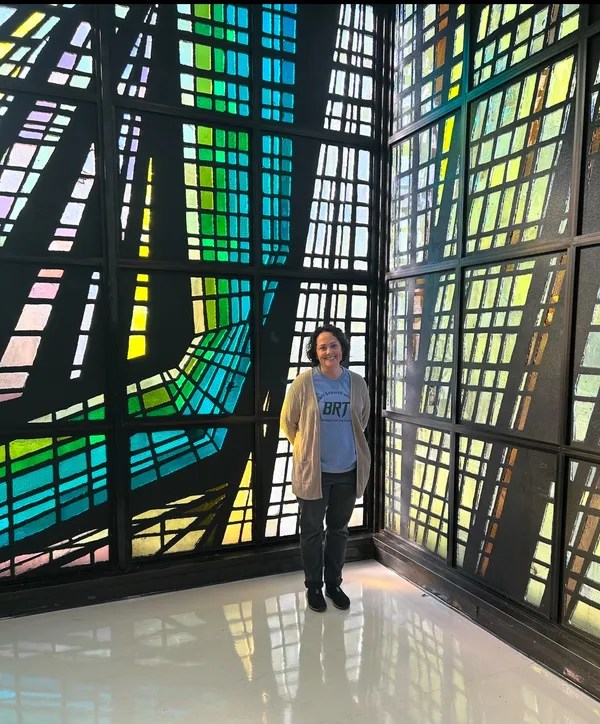
Principal Michele Angelo in front of one of several stained glass walls in Bridges Learning Center.

When I recently parked across the street from Bridges Learning Center, I was shocked at how many times I’ve driven by the building without noticing it. A pleasant combination of Brutalist and Prairie styles of architecture, Bridges is set further back on Thornton Street than its neighbor, Akron’s Fire Station No. 4. The school building is a hidden gem, and what occurs inside its walls is even more valuable. We are fortunate in the United States that federal law guarantees all states must provide all students with a Free Appropriate Public Education (FAPE) in the Least Restrictive Environment (LRE). This has not always been the case and is the result of hard-won civil rights campaigns waged in the second half of the last century. (For more on that history, read “Being Heumann: An Unrepentant Memoir of a Disability Rights Activist.”)

Mandated to educate all children, what do public school districts do when a child’s behavior  limits or prevents them, and often their classmates, from learning? Ideally, they follow clearly defined steps of positive behavior intervention supports (PBIS) to help students learn to regulate their emotions. As a tutor in two elementary buildings in Akron schools over three years, I have witnessed faculty, administrators and staff patiently assist students with PBIS.

But what if a child does not adequately respond to these intervention supports? Smaller districts might pay for the student to be placed outside the district at specialized schools. But Akron, like many larger districts, has its own dedicated facility. Bridges Learning Center was created in 2006 when programs for elementary and middle school students merged. A decade later, high school classes were added and, since 2019, the former Reidinger Middle School has been home to Bridges Learning Center. 

One might imagine the school having a carceral environment, but quite the opposite is true – every corner of the building is calm, orderly and inviting. It reflects the school’s mission to “provide social, behavioral, and academic skills through high quality teaching…by creating a positive, nurturing and supportive environment.” Michele Angelo, the school’s principal, repeatedly used the words “restorative” and “family” or “team” approach to describe what occurs in the school. Students in the United States with special education needs receive Individualized Education Plans (IEPs) – protocols developed by educators, specialists and the student’s guardians as a team – that outline specific, individual services and accommodations needed. All students at Bridges were placed on IEPs in their home schools, and it was their IEP teams at their home schools that determined a placement at Bridges was appropriate.

The range of student abilities at Bridges includes children with multiple physical and cognitive disabilities, children who are non-verbal and children with various learning disabilities. For a few students, placement at Bridges is determined to be the best location for the duration of their education. But the goal for most of the 102 students currently at Bridges (the majority of whom are in grades 3 to 12) is to acquire the necessary emotional regulation needed to return to their home schools.

How do the faculty and staff at Bridges accomplish this goal? Each classroom is staffed with a teacher, an intervention specialist (special education teacher) and an aide. Also, three full-time, floating educational assistants are available to go to any room where extra assistance is needed. And Red Oak Behavioral Health, which partners with schools throughout the district, has two counselors and three case managers at Bridges full time.

Music therapist Edie Steiner's board at Bridges Learning Center in Akron.
Music therapist Edie Steiner’s board at Bridges Learning Center.

But wait, there’s more. Art therapist Shenan May and music therapist Edie Steiner work with students both one-on-one and in group settings. In addition to their education and experience in art and music therapies, they have been trained in dialectical behavior therapy-informed (DBT) practices. According to the Cleveland Clinic’s website, DBT “focuses on helping people accept the reality of their lives and their behaviors, as well as helping them learn to change their lives, including their unhelpful behaviors.” Ms. Steiner’s classroom is filled with instruments, including several electric guitars and two drum sets – much of it purchased with grant funding. I could devote an entire column to the benefits of these therapies, but a quick look at Ms. Steiner’s board for her classes shows the seamless integration of music and behavioral development students experience in her class.

Behind Bridges are expansive fields the school integrates into its student experience. Second grade teacher, Kim Zeffer, obtained funding from Lowe’s to install several raised planting beds, gardening equipment, benches and more. One of the Red Oak therapists received grant money to create a remote-control race car team. As any parent knows, most kids love RC cars. Participation on the RC team helps students “focus on teamwork, problem-solving, and self-regulation during races.”

And Bridges also helps its students prepare for life after they leave. High school students, some of whom are reintegrating after time in juvenile detention or residential placement for mental health issues, not only work on academics and emotional regulation, but also with other governmental service providers such as Summit DD, Ohio Department Job and Family Services and High School Job Training that come to the building to help with job training and placement.

Bridges’s students are members of our community. The team approach at Bridges is an effective way to assist these students to succeed not only when they return to their home schools, but throughout their lives. What happens inside Bridges helps not only its students, it’s a benefit to us all.

This was first published in the Akron Beacon Journal on Sunday, October 12, 2025.

Uncategorized

Experience matters in Akron school board race. These 3 candidates stand out.


For the past few years, most of the attention and energy at Akron Public Schools unfortunately has focused on performance issues with the past two superintendents, the school board’s dysfunction and the unhealthy relationship between the administrations and board members.

This has cost the district financially – the contract buyout to part ways with Superintendent Christine Fowler-Mack in 2023 totaled $462,585.68, not mention significant legal fees. But more importantly, it has negatively impacted the education of the district’s 20,000 students. Yes, APS’s rating in this year’s state report card improved, but it also revealed that only 45% of the district’s third graders read at a proficient level.

In 2023, Gov. Mike DeWine took the teeth out of the state’s Third Grade Reading Guarantee when he signed a budget that, unlike before, allows parents whose children did not pass the third grade state reading test to sign a waiver to promote the child to the fourth grade anyway. The research is clear: promoting children to the fourth grade who cannot read at the third grade level significantly increases drop-out rates.

If the district’s current graduation rate of just under 89% is to improve, early literacy needs urgent attention. And that is but one complex issue facing the district. There are also financial concerns – rebuilding North High, construction of a building for the newly merged Pfeiffer and Miller South schools and a looming budget shortfall in 2028. Successfully addressing these issues and more requires strong leadership in both the administration and the school board.

Choosing board members, which voters are asked to do in the upcoming election, should be approached like hiring high-level personnel at a business with an annual budget of over half a billion dollars, because that’s what it is. What matters most are the qualifications of the candidates.

Fortunately, in this election highly qualified candidates are on the ballot, and Akron citizens have an opportunity to replace weak members with qualified ones, Phil Montgomery and Gwen Bryant.

For nearly four years, Montgomery has been Summit County’s director of finance and budget, managing annual budgets of more than $160 million. Prior to that, he was the chief financial officer for Summit County Job and Family Services with annual budgets around $45 million. The district needs the financial acumen Montgomery would bring to the school board as it makes the critical financial and infrastructure decisions it faces.

Bryant has worked in education for over 30 years, starting as a teacher in Akron’s schools. For the past 14, she has worked as an educational consultant at Instructional Empowerment Inc., whose mission is “to end generational poverty and eliminate achievement gaps through redesigned rigorous Tier 1 instruction.”

Bryant has worked with hundreds of school districts in cities across the country, including Chicago, DC, Baltimore, Detroit, Portland and Oklahoma City, to improve their educational outcomes. In electing Bryant voters would hire an experienced educator and educational consultant who will bring a sophisticated understanding of the educational problems facing the district and the best practices for solving them. 

Montgomery and Bryant must replace Diana Autry and Carla Jackson. Autry and Jackson were members of the school board that, in the summer of 2023, rushed through the hiring of former superintendent Michael Robinson despite community leaders citywide calling for the board to wait until after elections that fall. Throughout Robinson’s unendingly bombastic tenure, including the final weeks before he left following an investigation concluding he created a toxic work environment, Autry remained obsequiously deferential to Robinson.

Not surprisingly Jackson, who is principal of a private religious school in Akron that accepts vouchers, supports the school voucher program. This is why many find her position on the board of a public school district a conflict of interest.

The other sitting board member running for election is Pastor Gregory Harrison. Harrison was chosen last October to replace board member Job Perry when he stepped down to become a Summit County Court of Common Pleas magistrate. Harrison has been a fixture at school board meetings for many years, often as a vocal critic of both the district’s priorities and the dysfunction of its leadership. If anyone thought putting him on the board would keep him quiet, they were misguided.

Harrison, unlike some of his board colleagues, attends every board meeting thoroughly prepared to discuss agenda items. He is passionately committed to solving the problems of low student language and math literacy skills. Harrison deserves to remain on the board for a full term as the district continues to overcome past poor leadership and tackle the serious challenges it faces.

Early voting begins Tuesday, October 7.

This column was first published in the Akron Beacon Journal on Sunday, September 28, 2025.

Uncategorized

Anthology of poetry a perfect companion to scientific assessment of nature in America

In 2009, my three children and I drove to the Rocky Mountains for a family reunion. Though I hadn’t visited the Rockies since I’d lived in Wyoming two decades earlier, as we began our ascent into the mountains, they felt like an old friend whom time cannot estrange. Surrounded by flat prairies that emphasize the overwhelming enormity and ruggedness of the mountains, the range leaves an indelible impression. 

But as the car reached higher altitudes, the landscape became horribly unfamiliar. Once verdant mountainsides covered in pine forests had turned a reddish color, not unlike that of a commonly used deck paint, which is also the color of pine needles after a tree has died. Though dead, the desiccated trees looked ashamed of their hideousness. To prevent wildfires, National Forest Service employees worked to clear cut the pine corpses, which were stacked in piles as large as barns. It looked to be a job with no end.

For the first time in my life, climate change wasn’t abstract reports of faraway glaciers melting, sea levels rising or storms growing stronger. Everywhere I looked for several days I saw the immediacy of climate change and its impact. The winters in Colorado are no longer cold enough to kill pine beetles and their numbers skyrocketed. Hungry beetles gorged until their food source, in this case pine trees, collapsed.

In 1990, Congress created the U.S. Global Change Research Program to “assist the Nation and the world to understand, assess, predict, and respond to human-induced and natural processes of global change.” Under this mandate, 15 federal agencies worked with scientists and citizens from all walks of life to create a first-of-its-kind National Nature Assessment (NNA1) of the “status, observed trends, and future projections of America’s lands, waters, wildlife, biodiversity, and ecosystems and the benefits they provide, including connections to the economy, public health, equity, climate mitigation and adaptation, and national security.”

This comprehensive assessment was nearing completion when its federal funding was pulled this January. Given the critical and urgent value of the NNA1–for how can we understand how our climate is changing if we do not take stock of where it is now–the non-federal authors of the assessment formed a new non-profit, United by Nature, sought and received non-governmental funding to complete their work.

The NNA1 is scheduled to be released this fall as is “Nature of Our Times,” a poetry anthology companion to the NNA1. Many of the book’s poems reflect solastalgia, a word that means longing for a home that still exists but is rapidly changing before our eyes, just as the Rocky Mountains were when I visited 15 years ago.

I thought of that trip when reading Phil Levin’s foreword to “Nature of Our Times.” The director of United by Nature, Levin describes a knowledge that “resists spreadsheets and equations. It is the knowledge that comes from standing still. From watching a great blue heron glide above a salt marsh or listening to the layered calls of frogs at dusk. The lessons from such stillness are different than science, but no less true. And they remind us that the root of so much science is reverence.”

Kent State University’s Wick Poetry Center was a natural partner for the anthology. In 2017, poet Jane Hirshfield wanted a poetry presence at that year’s Earth Day March for Science on the Mall in Washington D.C. and collaborated with the Wick Poetry Center to create Poets for Science. Why poetry? When I asked Wick’s director David Hassler this question, he explained, “Poems focus receptivity to being aware and attending nature, as the late environmentalist and scholar Joanna Macy wrote, ‘whether as midwives to a new chapter of nature or hospice providers to a dying world, because presence and action are needed regardless.’ Poems offer us the possibility of emotionally shared experience that can spur people to interact beyond data and politics.” 

Hirshfield puts it this way: “The microscope and the metaphor are both instruments of discovery.” Scientific data can be overwhelming, sometimes even obtuse, to the non-scientist. Whereas poetry, which speaks to emotions, can help communicate our understanding of science.

Poets for Science created an ongoing interactive website and put out a call for poems on how nature shapes our lives and how we can shape the future of nature. The website accepts submissions from anyone, not just published poets, and so far has received over 1,300 submissions, 210 of which were selected for the book and organized in four sections: Nature & Well-Being: Self & Community, Nature & Heritage, Nature, Risk & Change, Now & in the Future: Bright Spots.

This Thursday, Sept. 18, “Nature of Our Times” will be released. That evening at 7, there will be a poetry reading and discussion with Levin and the book’s co-editors at the Kent State Student Center Ballroom Balcony. The following day, Cleveland Public Library’s downtown branch will unveil more than two dozen banners with poems from the book coupled with nature photography. 

Poetry won’t solve nature loss, but according to Levin, “The poet’s job is to speak what cannot be said in any other way. The scientist’s job is to seek the truth with rigor and openness. The public’s job—our job—is to listen, to learn, and to respond.”

This was first published in the Akron Beacon Journal on Sunday, September 14, 2025.

Uncategorized

These 2 Akron teachers saw a problem and had the vision to fix it

Optometrist Dr. Laura Knight provides a free examination for a student at Crouse Elementary School in Akron Public Schools
Optometrist Dr. Laura Knight provides a free eye exam for a student at Crouse Elementary School in Akron Public Schools.

Accurately diagnosing a problem is only the first step in solving it.

Last year, I wrote about the lack of an optical department at Akron Children’s Hospital’s Vision Center. Many of their patients, such as my daughter, Lyra, who has Down syndrome and was born with cataracts in both eyes, have unique conditions and facial features that require specialized glasses frames. Yes, the ophthalmologists and optometrists at ACH are top notch, but without ease of access to the glasses that would correct the accurately diagnosed problems, the care they provide is not truly comprehensive. After the column published, I was asked to meet with administrators at ACH and agreed. I also received an uncharitable letter from an ACH employee who works with the surgeons at the Vision Center. That letter helped me understand I had not effectively described the dire struggle most parents face when trying to find appropriate glasses for their children, so I wrote a follow-up piece. The hospital subsequently contacted me to cancel our meeting.

Many parents wrote to me and confirmed their struggles. I also heard from those who are boots on the ground in this matter — teachers of the visually impaired (TVI) in public schools. TVIs work with visually impaired students to determine what interventions, including equipment and font size, they may need. They help teachers understand a child’s vision needs and guide the children on using any adaptive tools such as closed-circuit televisions that enlarge text, Braille and more.

TVIs underscored the widespread problem of children with vision impairment who do not find glasses that fit properly, or who don’t have any glasses at all. Decades of research has continuously shown that children with uncorrected visual impairments do not do as well in school as they would with corrected vision. They fall behind and the gap grows wider each year their vision remains uncorrected.

One day last spring, I walked out of the classroom where I tutored at Crouse, an elementary in Akron Public Schools, and was surprised to find in the hallway two of my daughter’s TVIs along with Dr. Laura Knight, an optometrist at Midwest Eye Consultants. Melanie Sargent was my daughter’s TVI in APS’s Early Learning Program and her first years of elementary school. Then, when Lyra was in the second grade, Kate Mozingo took over and has remained with her since.

These two teamed up to find a solution to a pressing problem — getting glasses to students identified as needing them. Currently, APS elementary school nurses perform vision screenings on students in kindergarten and grades one, three and five. They send letters home with those students who fail the screening, encouraging the parents to get the child’s eyes examined.

Unfortunately, the poorer a school’s student population, the less likely it is that those who failed the screening will get an eye exam. Last year, students in Akron Schools who did not access optometric care were identified by school staff. Together, Sargent and Mozingo essentially piloted a program that could, and very much should, be replicated wherever the need exists.

They contacted Wendy Giambrone at the Ohio Optometric Association. Giambone runs the association’s iSee Ohio, a program that provides free school-based eye exams and glasses to children in need. She put them in contact with Dr. Knight, who voluntarily examined the identified Crouse students and was wonderful with them all. Crouse was chosen by Sargent and Mozingo because the building’s vision screenings had the highest failure rate last year.

Optometrist Dr. Laura Knight with some of the Akron Public Schools students who received free glasses. Knight volunteered to examine the childen and fit them for glasses.
Optometrist Dr. Laura Knight with some of the APS students who received free glasses.

A couple of weeks after I ran into the women in the hallway, they returned with glasses. I remember well what it was like to get my first pair of glasses in the fifth grade after I failed a school vision screening. I spent days looking at trees with and without my glasses, stunned at how articulated each leaf was when observed through corrective lenses. To be in a room with several students having the same experience was akin to Christmas morning after Santa had been particularly generous.

One fifth grader with a substantial correction had never owned a pair of glass. I spoke with him a few days after he received his first pair from Dr. Knight and he said more than the trees, he was shocked at the detail he could now see in the floors and ground. Imagine the improvement in his ability to see and read text.

Imagine also if the comprehensive care Sargent and Mozingo voluntarily managed to provide to a small group of students was replicated for all students and, yes, Vision Center patients, who need it. How might it literally change the trajectory of children’s lives? Motivated by the struggle they see firsthand, these two women chose to do something. Who else can help solve this problem?

This was first published in the Akron Beacon Journal on Sunday, August 31, 2025.

Uncategorized

Chance meeting in Europe turns into lifetime friendship

When a friend asked me to accompany her to Peru to hike the Inca Trail, I incorrectly envisioned something like the Great Wall of China – wide paths with few inclines. The Inca Trail hike is four grueling days of high altitude climbing in the Andes Mountains on 600-year-old stone stairs that are now catawampus. Everyone moves at their own slow pace. Alone, I put one foot in front of the other, eyes trained mostly on my feet and the path. When stopping to drink water, I’d look back at dramatic vistas, each time astonished by the distance my legs had carried me.

When studying in France in 1990, I had a two-week midterm break. I’d originally planned to go to Rome, but after months of being the tallest blonde around, I instead took a train to Amsterdam where I hoped to blend in. It worked –the locals often initiated conversations with me in Dutch.

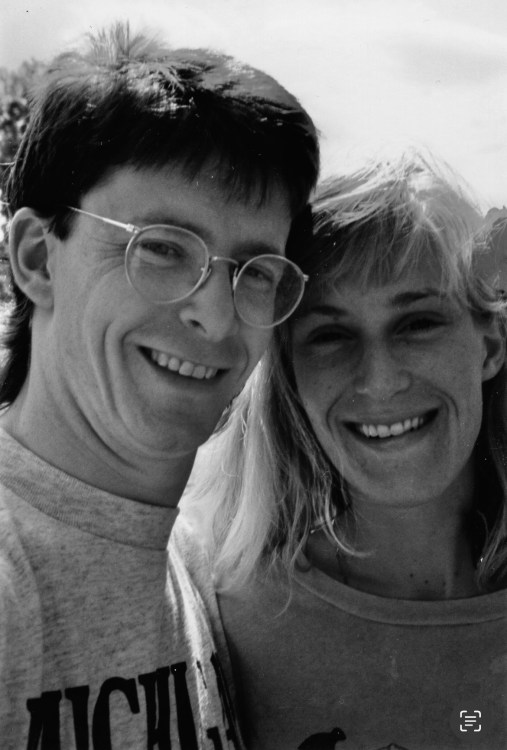
 On my second evening in Holland, I walked into a small crowded jazz bar. A quartet, with an upright bass that took up more room than one of the handful of tables, was tearing it up. I asked a young man with a dark mullet and glasses if the empty chair at his table was available and immediately heard his Boston accent when he said sure. That’s how I met Mike Reardon.

He was traveling alone until friends of his who lived in another Dutch town returned from England. The next day we visited the Van Gogh Museum together where there was a large retrospective exhibit because it was the centenary of the artist’s death. That evening we hatched a plan. Mike and I would tour France’s Loire Valley together. I’d be his personal translator and he’d be my buffer from flirty Frenchmen.

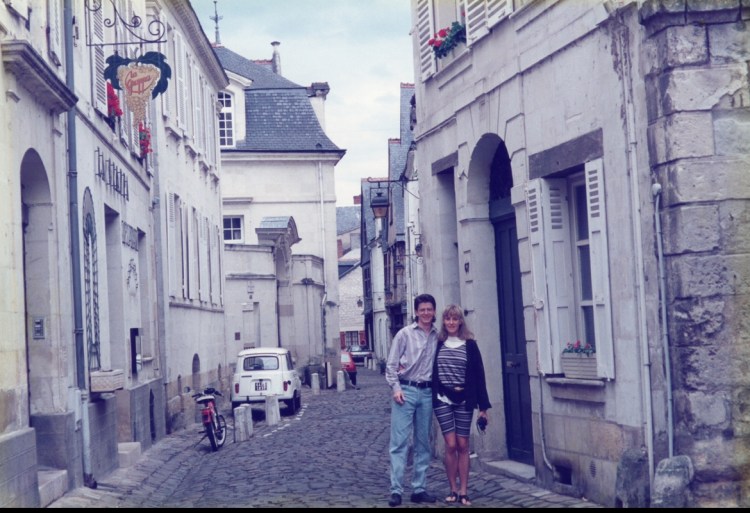
The next week we rode bicycles rented at train stations to wineries and chateaux. Some, such as those in Blois and Chambord, are immaculately maintained, while others, like Chinon, where Joan of Arc met with King Charles VII to tell him of her visions, are in ruins. All that remains of the chateau built by Cardinal Richelieu (who was villainously portrayed in “The Three Musketeers”) is a stone foundation flush with the earth. Mike and I ate lunch nearby in a restaurant filled with truck drivers. It was the best meal of my life.

After we parted in Paris, Mike and I stayed in touch. As with all faraway friends in the 1990s, we wrote letters. Later, when I briefly lived in Boston, we’d get together. Soon after I left Boston, Mike moved to South Dakota where he lived for 20 years. A trained jazz guitarist, Mike’s a musician’s musician and played with a variety of groups across genres during his time in Rapid City. My first three sons and I stayed with him there while on a cross-country road trip in 2007. I next saw my friend in 2015 in Phoenix, where he’d moved in part to be closer to his mother. A few months ago, I noticed on Facebook that Mike was leisurely making his way across the country. He stayed a good while in South Dakota, making music with friends and planning an annual festival in honor of one beloved musician who recently died.

I got the full story when Mike arrived in Akron earlier this month. Seven years older than me, Mike was in his early 30s when we met in Europe. He’s now old enough to collect Social Security and decided to do so this year, which allowed him to pack up and travel north during Arizona’s hottest months, something he plans on doing every year.

What to do when your musician friend of more than three decades stops in for a long visit? Why make music, of course. Mike and I spent a morning practicing George Gershwin’s “Summertime” before recording it several times using equipment he managed to fit in his small car packed for 10 months of travel. And then we took our show on the road, by which I mean we performed at Akron Symphony Orchestra’s first Wednesday Broadway Karaoke Experience at Jilly’s.

“You know,” I whispered to Mike while he tuned his guitar on stage before we performed a jazzy rendition of the popular song from ‘Porgie and Bess,'” I’ve secretly always wanted to be a lounge singer.”

Mike’s recent visit was the most time we’d spent together since we traveled France. He’s still as pleasant and interesting to be around as he was then. We’re the same people, but the days since France now add up like steps crossed on the Inca Trail. Standing high on the mountainside of life, the tremendous number of years that have passed and the distances we’ve both traveled, were readily evident. It’s a breathtaking vista most days overlooked while simply living.

I figure if Mike comes back every year, in a decade we will have recorded enough songs for an album.

This was first published in the Akron Beacon Journal on Sunday, August 17, 2025.

Uncategorized

Camping trips more work, but value added

If the definition of insanity is expecting different results when repeating something, I have an annual madness. Each spring I long for the freedom my children and I will enjoy when school ends. Summer arrives like an empty cargo ship docking on shore after being distantly visible for many months. Yet almost immediately, shipping containers of places to go, people to see and things to do fill the entire boat. Stop the longshoremen! I want to yell.

Since late June, I have not been home for more than three consecutive days as I have visited friends and family in faraway places. In mid-July, two adult-sized children, one tiny dog, all our camping gear and I filled every available inch of space in my small car. Spare shoes went under the seats, while in the back seat my daughter leaned on bedding stacked into a tower taller than her. My son’s size-12 feet were trapped on the car floor, surrounded by my computer bag, snacks, his sword and an intimidatingly large Nerf blaster. 

I don’t consider myself a camping kind of person. I suppose that’s because, unlike my 28-year-old son, Hugo, I don’t spend months longing for the day I can load up the car, head to a camp ground and party like it’s 1899. And yet I’ve camped most years of my life. When I was a young child, my grandparents, Eagle Scout-level camping people, took me to parks near Chicago. They had all the gear, including canvas tents tall enough to stand in and wide enough to set up multiple cots. Later, after they’d retired to Arizona, they bought an Aristocrat mid-sized trailer camper. I cherish memories of comfortably camping with Grandma at remarkable state and national parks in the 1970s and ’80s, including multiple trips to the Grand Canyon and Lake Powell.

Holly Christensen's grandma cooks on a camp stove in the late 1960s.
Christensen’s grandma making dinner on a camp stove in the late 1960s.

Beginning in the ’90s, I took my children every summer for over 15 years to Karme Choling Buddhist Meditation Center in Vermont for a nine-day family camp. The mountainside behind the center’s large building is dotted with semi-permanent tents set upon wooden platforms. Two adults and three children could sleep comfortably inside the tents on thick foam pads provided by the center. Served in a large dining tent, all meals were prepared and served with the help of the adult attendees. For several years, I arose early each day and made many gallons of coffee.

Camping at Karme Choling was lot like living in a college dorm. The tents, beds and meals were provided. Mothers and small children showered and dressed together in community bathrooms. It wasn’t as cushy as staying in a camper or cabin, but neither were we roughing it.

My children have also grown up spending a portion of their summers with family in Charlevoix, Michigan, just 50 miles south of the Mackinac Bridge. From 2020 to 2023, my youngest two kids and I stayed in a camper set up in the driveway of family for five weeks each summer. The outdoor day camp on Lake Michigan that my children attended provided some semblance of normalcy during COVID. But with the death their grandfather last fall, we no longer have family in Charlevoix. 

Though our family is gone, the many things that make northern Michigan a summer delight remain, which gets us back to my packed-to-the-gills car. This year, we pitched camp at Young State Park. Tents have come a long way since the medieval-like structures my grandparents owned in the ’60s. My 15-year-old son, Leif, and I can set up our eight-person tent in less than 15 minutes. (Note: Unless the people sleeping in the tent are all 3 years old, divide the number a tent says it can sleep by two. A two-person tent sleeps but one adult, our eight-person tent is best for no more than four.) 

Holly Christensen's children and dog at their tent last month at Young State Park in Michigan
Leif and Lyra at Young State Park in Boyne City, MI, July 2025.

While Leif has a thin camping pad under his sleeping bag, my 12-year-old daughter, Lyra, and I sleep on an air mattress. After a day of packing, driving eight hours and setting up camp, it was almost 10 when we collapsed in our tent.

“Hold still,” Leif said suddenly and came to investigate something next to my head. I thought it was perhaps a mosquito, but it was much worse. A leak in the mattress. I patched it with what I had – two Bandaids. It was a chilly 48 degrees when Lyra and I awoke the next morning with only two layers of plastic under our sleeping bag as the mattress had deflated much earlier. All three of us giggled. 

Yes, camping takes me out of my comfort zone. Campground bathrooms are utilitarian community spaces usually a healthy trot away from the campsite. Keeping food fresh in a cooler is a messy, difficult preoccupation. Cooking on a fire pit or camp stove is doable, but again requires extra effort and then there’s the cleanup. Cleanliness standards are apt to slide.

And yet what trips are most memorable? The perfectly comfortable hotel room is easily forgettable. Some of the most amazing starry skies I’ve gazed up at have been on walks to camp bathrooms at 3 a.m. The drift to slumber in a tent, where children are all within arms’ reach, is often accompanied by soft chatter and laughter. Once home, that first shower, cooked meal and night on a firm mattress are savored unlike most. So those longshoremen loading adventures on the ships that are my summers? They are free to carry on.

This was first published in the Akron Beacon Journal on Sunday, August 3, 2025.

Uncategorized

The hunt is part of the fun of building collections

When my three sons were children, we’d think nothing of driving 8 hours to stay with friends or family or go camping in state and national parks. Audio books helped the boys be patient travelers, but now and again we all needed to stop and shake a leg. We frequently did so at antique malls because they are heated in winters, cooled in summers and often cavernously large.

Once inside, I would remind the boys of their mission before turning them loose. Some might ask, Wait, what? You would let three young children freely roam among vast arrays of fragile antiques? Indeed I did. They all knew how to mindfully navigate around delicate items. Over the years, a few things were chipped, crushed or shattered at our home, but never at an antique mall.

As for their mission, it was to find miniature glass nesting hens once used as salt holders at each table setting. Two original manufacturers, Boyd and Mosser, produced hens in both clear and slag glass in a wide variety of colors. If my children found a nesting hen and I bought it, I gave them a dollar. They became excellent not only at finding them, but discriminating originals from reproductions.

A portion of Holly Christensen's miniature nesting hen collection.
A portion of Christensen’s miniature hen collection.

My collection grew rapidly in the early aughts as we found at least one hen at every antique mall we visited. And then they seemed to vanish. The expansion of online shopping made many collectibles harder to find in shops and substantially more expensive if you did. Hunting online is easy, but it’s not as fun as culling through booths of antiques. It’s also harder to gauge the quality of the glass hens online and after a few disappointing purchases, I stopped looking.

Instead, I began collecting other things, including rolling pins, small glass bottles, miniature pitchers, Maida Heatter jewelry, Spanish and English porcelain flowers and, more recently as regular readers know, Capodimonte porcelain. Mr. Tressler, the father of my longtime friend, Jen Marvelous, left me his ice cream scoop collection, which I keep in a crockery bowl found at the Bomb Shelter on Akron’s south side.

Holly Christensen's burgeoning rolling pin collection.
Christensen’s burgeoning rolling pin collection.

Grouped together, these collections make visually appealing displays that are inexpensive to acquire. I started my rolling pin collection when purchasing several at an old theater-turned-store in Toledo near where I had lived in the second grade. I wasn’t allowed to walk to past that theater on my way to school because in the early ’70s all its films were X-rated. It was delightful to walk inside decades later and find something as wholesome as rolling pins. 

Determining how to display the rolling pins — each exhibiting signs of repeated use by the hands of former owners — took years. Then, when I hosted wine tastings at World Market before COVID, I found wall-mounted wine racks. The rolling pins slot perfectly into two metal circles, a small one meant for the neck of a wine bottle and a larger one for the base. I foolishly bought only two racks, enough for the number of rolling pins I had at the time, as if I’d never be tempted to buy yet another.

McKinney, Texas, where I spent a week last month, has a charming downtown much like Medina’s with a courthouse surrounded on four sides by blocks of restaurants and shops, including the Antique Company Mall. I darted into ACM to get out of the heat for a spell and am glad I did. Unlike every antique mall I’ve visited in the Midwest and Northeast for the past decade, ACM has incredible prices (check out their Facebook page). I spent well over an hour on my first visit, with helpful employees repeatedly taking items from my hands to a holding area. One helped me search for miniature nesting hens, to no avail. Another employee took my number and said she’d call various dealers to see if they had any they could bring in. 

Sweet success! I returned the next day and bought a jadeite hen and another that is ceramic, something I’ve not seen before. I also found several small bottles in a variety of shapes and colors and two rolling pins. I rarely check baggage when I travel, but because Southwest Airlines didn’t charge me, I had with me a largely empty suitcase. 

Everything made it home without damage and has been threaded into my collections. Now if only someone would loan me a pickup truck or large van for a week I’d roadtrip to McKinney straightaway to purchase one of ACM’s pristine $300 Hoosiers.

This column was first published in the Akron Beacon Journal on Sunday, July 13, 2025.

Uncategorized

Former Akron Schools superintendent drama is over. Now it’s time to focus on kids.

The saying, “A fish rots from the head down,” colorfully suggests that bad leaders cause an organization harm. A prime example is C. Michael Robinson’s tenure as superintendent of Akron Public Schools.

wrote in July 2023 that the unqualified candidate had been hubristically rammed through a hiring process in the final months of then-school board president Derrick Hall’s tenure despite several community leaders urging the board to wait until after that fall’s election.  

Former APS superintendent Micheal Robinson.

Robinson proved a poor choice from the get go. Six months into his tenure, I mentioned in a column feeling like a bookie because of how many people with a connection to the district gave me unsolicited opinions on how long he would last. The majority indicated 18 to 24 months, which wasn’t far off. 

Several local media outlets, including this paper and its education reporter, Jennifer Pignolet, provided excellent coverage of Robinson’s toxic leadership throughout his tenure. Robinson’s churlishness caused unnecessary upheaval in the district. Like bombs going off in the middle of a famine, the needs of the district’s students were neglected in order to deal with Robinson’s chronic explosions. Volumes of data exist on how COVID devastated the educations of K-12 students. Robinson’s tenure only exacerbated that devastation for Akron’s students. Repairing the damage he caused will take years.

Given the extremity and viciousness of Robinson’s attacks —h e stated God would punish one board member and her children because she had the temerity to ask relevant questions before a board meeting and expect answers —i t is understandable why some community and school board members did not want to give him a severance package. But court hearings over his dismissal without severance would have extended the drama. It was wise to spend $200,000 to be done with Robinson immediately and forever — a rotten head suddenly cleaved from the body it was destroying. 

APS new superintendent Mary Outley.

The move to promote interim superintendent Mary Outley to superintendent was also prudent. I wrote in 2023 that she, while a valued administrator, was not the ideal candidate at that time. She is now. A nationwide search of candidates for superintendent would have taken time and money that is better spent pivoting to the planning and implementation of educational best practices for Akron’s students. In immediately choosing Outley, the district has someone who knows the community, the problems facing our schools and who could step in immediately. Also, it allows the board to focus on the pressing matters facing the district without being absorbed by a hiring process. 

Speaking of the board, it understandably has focused lately on how to fund the construction of two new buildings —North High School and a combined Pfeiffer Elementary and Miller South School for the Visual and Performing Arts. But addressing student deficits in reading and mathematics is woefully overdue. For too long, APS has suffered a weak board and several members who are up for reelection this fall should be replaced. Most newer board members have shown mettle and show up to meetings having read the materials on the agenda, which seems reasonable but is not always the case. Significant work needs to occur and APS cannot afford a single board member who regularly phones it in.

When Robinson was installed as superintendent, the federal funding for ESSER (Elementary and Secondary School Emergency Relief) was still flowing to states to help K-12 students recover from COVID-related educational losses. At the time, I was one of eight tutors at the APS elementary building where I work. ESSER funds ended in September 2023 and in the school year that just ended, the building had only four tutors. Next year it is slated for two. And yet anyone who works in the building will tell you eight tutors are needed as the learning deficits are that dire. Given President Trump’s recent gutting of the Department of Education, more school funding cuts likely are coming.

As a parent of a child with Down syndrome who has greatly benefitted from APS’s SAIL (Students Achieve Independent Learning) program, changes in the past two years are concerning. Created by former APS special education director Tammy Brady before she retired, SAIL has lost its original integrity under new leadership that, in all fairness, was reporting to a superintendent who was no advocate of disabled students.

Where our schools go, so goes our city. Now that the telenovela drama of the Robinson administration has ended, I call on Akron’s public, non-profit and governmental leaders, along with all citizens, to work immediately and continuously on righting the ship that is Akron Public Schools. Our children deserve no less. 

This was first published in the Akron Beacon Journal on Sunday, June 15, 2025.

Uncategorized

Planting roots in Akron cultivates countless friendships

For 10 years, I rented out the 1909 Arts and Crafts home I own. When the last tenants moved out in 2022, I decided to renovate the house and live in it once again. But those plans came to a crashing halt last summer just when the renovations were at the torn-apart stage.

This past winter, a contractor I’ve known since he was a boy put the house back together, and it looks better than ever.

Rather than rent out the house longterm as I had before, I decided to make it an AirBnB because I believed that would generate more income and cause less wear and tear. Also, it would provide a place for my children to stay when they come to visit. While my contractor worked on the house, I researched how to set up and run a short-term rental.

Not surprisingly, tasteful and comfortable furnishings were cited as important for attracting new and repeat guests. The renovations gave me time to shop for the right items at the best prices. I bought a set of Arts and Crafts-like dishes at the American Cancer Society Discovery Shop on West Market, where complete sets for little money are always available. I also purchased utensils, pots and pans, glasses and other kitchen items from a variety of stores.

Wirecutter, the New York Times’s product review section, recommended a Novilla memory foam mattress as the best affordable option, and also offered $100 coupon off each mattress purchased for a limited time. I bought two with frames for $580 plus tax.

When renovations were far enough along to begin setting up the AirBnB, I contacted Shane Wynn, whom many consider Akron’s photographer because she’s often hired to document important public and private events. Her photography has received both art and journalism awards, but she also owns and manages several AirBnBs with a group of partners.

I gave Shane, whom I’ve known over 20 years, a tour of my rental house. She underscored many of the tips I’d learned online, such as: Install noise reporting machines, the knowledge of which keeps guests quiet; require a two-day minimum stay to reduce troublesome guests; use a cleaning crew and give them the full cleaning fee.

Shane shared with me the places she acquires all things needed for AirBnBs at great prices and offered to help in any way I might need. I asked how much income she thought my house could generate as a short-term rental. Just three years ago, when there were fewer AirBnBs in Akron, it might have grossed twice as much annually as it can when rented longterm. But today, Shane believes it would earn the equivalent of a longterm lease.

“So from where the house is right now, what do I need to do to have it ready for my first AirBnB guest?” I asked. Shane’s response floored and freed me.

“About $15,000 to $20,000 in furnishings and three months of working everyday.” I have neither that money nor that time and knew instantly I’d rent it longterm yet again. The thought that I could immediately stop spending money and pivot to renting the house left me giddily relieved. Her next statement just left me giddy.

“Some of us are going dancing at Jilly’s tonight, do you want to join us?”

Did I ever. Since then Shane and I, along with other friends, have repeatedly gone dancing, taken discounted introductory exercise classes (pole dancing is a killer workout and a blast!) and gotten together for dinners and movies — all of which have gone a long way in lifting me out of a hard spell in my life. 

Final repairs on the house were quickly completed and I could have rented it by mid-March, or April at the latest. Instead, I kept mulling over what else needed done. And then I realized it was my heart holding up the transition. The home I call Dreisbach House is filled with the memories of raising my three eldest children there, but it also contains the now dispatched dreams, nurtured for three years, of moving back into the home with someone I’d loved for over four decades.

Dreisbach house newly remodeled and ready for tenants.

I slapped on my metaphoric big-girl britches and cleared everything out of the house (an unoccupied house is a storage magnet) and then hired a Shane-recommended cleaning crew. They spent 10 hours removing all evidence, including a lot of dust, of a multi-year remodeling project. The following day I listed it as a rental on Zillow and had a signed lease five days later.

I’ve long extolled how friendly Akronites are. But it recently occurred to me that there’s an added layer to the widespread largesse. Until settling in Akron in 2003, I moved almost every year or two of my life. Planting deep roots in Akron has allowed me to develop countless relationships. Some have changed, both growing or receding, throughout life’s seasons, but over time, my bench of friends in this community has become luxuriously deep.

As for my AirBnB purchases, I hope my adult children each want a queen-sized bed for their upcoming birthdays.

This first appeared in the Akron Beacon Journal on Sunday, May 25, 2025.

Uncategorized

Schools should not write off the benefits of teaching cursive

The first week of second grade, I told the girl across the street that I would be learning “grown-up writing.” She was a kindergartener and satisfyingly impressed. In truth, having just mastered reading and writing print letters, the idea of learning to decipher the connected slants and loops of cursive made me anxious.

In a 2022 article for The Atlantic, Harvard professor Drew Gilpin Faust recounts her shock at learning students in her American history course could not read handwritten documents, mostly letters, from the Civil War. It wasn’t because 19th century script had more flourishes, which it did. No, her students told her it they couldn’t read cursive at all, adding “of course.” Faust felt like a “Rip Van Winkle confronting a transformed world.”

Cursive exited most public school educations in 2010 when it was not included in the roll out of Common Core, a federal K-12 guideline of English and math standards many states adopted. As a result, most Americans in Generations Z and Alpha never learned to write, nor read, cursive. (So uncommon is the ability to read cursive today, the National Archives seeks volunteers to transcribe historical documents from cursive to print.)

A comparison of Holly Christensen's cursive writing with writing by a member of her lunchtime cursive club.
A comparison of my cursive (left) and that of one of my students after three months of cursive club.

This is unfortunate on many levels, not the least of which is the acquisition of reading skills and comprehension, which might seem odd at first blush. But according to the University of California Riverside, ample research suggests that “learning cursive can enhance brain development, particularly in areas related to language, memory, and fine motor skills. When students engage in the intricate movements required for cursive writing, this activates different parts of the brain compared to typing or printing.”

This is not new information. When my eldest child, now 31, was first diagnosed with dyslexia, the professionals handling his remediation told me to sign him up for occupational therapy. OT focuses on fine motor skills — picking up small objects with the forefinger and thumb, buttoning clothes and properly holding a pencil. I was told an early indicator of a learning disability is weak hand strength. Furthermore, if a child with a learning disability builds hand strength, their reading skills improve because of the connection between physical activity and the parts of the brain that manage reading.

When Google began giving laptops to public schools, few (if any) asked if that was a good idea. Kindergarteners in Akron Public Schools are given a Google Chromebook the first week of class and are expected to take a placement test on them a few weeks later. Never mind cursive, students spend little time ever writing with paper and pencil and never build hand strength. Each year when I proctor the Ohio State Test to third graders, they complain that their hands hurt after writing one or two sentences with a pencil for the writing section. I tutor a group of APS third graders in phonics four days a week just before lunch. Each chapter of the program we use includes a short spelling test. One day, one of the students attempted to write his answers in something not unlike cursive. “Would you like me to teach you cursive during lunchtime?” I asked. He accept my offer and the other students begged me to teach them, too.

A student in Holly Christensen's lunchtime cursive club practices making loops, cups, waves and hills.
The loops, cups, waves and hills of cursive letters.

I thought it would last a week, maybe two, before they became bored with additional learning, but no. I have spent lunch with them every day since we returned from winter break in January. I contacted a teacher at Spring Garden Waldorf School where they never dropped cursive. She told me to break the lower case letters into four groups of shapes: waves, loops, cups and hills.

 The students bring their lunches to my room at noon. We eat and visit, leaving us 15 to 20 minutes to learn and practice cursive before they go to recess at 12:30. It took the better part of three months to introduce all the lower case letters. I’d put them on the board, then show them on lined paper and, if necessary, helped them with hand-over-hand instruction. In April, we began learning how to connect cursive letters to create words.

I stopped writing in cursive long ago. Showing my students felt like getting on a favorite bicycle rediscovered at the back of a barn. The muscle memory from when I was first taught in 1972 remains. My young students discuss without embarrassment which letters they find beautiful, such as “j” and “k”. One of them told me with all sincerity that he’d come to school on Saturday and Sunday if we could do cursive.

Students in Holly Christensen's lunchtime cursive club made Mother's Day cards to show off their newly found writing skills.
A student’s Mother’s Day card shows off his newly acquired cursive skill.

Just as Buddhist monks practice calligraphy as a form of meditation, practicing cursive seems a form of mindfulness training for my students, and also for me. The creation of flowing letters calmly focuses the mind as all other thoughts recede. Cursive club is easily the favorite part of my workday.

 One of my cursive club boys turned 9 last month. I found a blank card and wrote in cursive on both inside pages. He slowly deciphered the words out loud with great pride. This past week, we made Mother’s Day cards, each child excited to show their mothers the handwriting they’ve begun to master. And should the moms find it difficult to read the sentiments written in cursive their children, unlike Professor Faust’s Harvard students, will be able to help them.

This was first published in the Akron Beacon Journal on Sunday, May 11, 2025.

Uncategorized

Ohio residents and all Summit Co. voters: Our libraries need your support right now

Akron-Summit County Public Libraries’ main branch.

For 4,500 years, libraries contained items, including documents, to be preserved and studied. Not open to the public, most of whom couldn’t read, they were repositories for ruling classes. Libraries as we know them today, in which items can be borrowed and taken from the premises by patrons, were created by Benjamin Franklin, along with some friends, in 1731.

One can only imagine what Franklin would think of Ohio’s library systems, which are the envy of other states. While this is a blessing, it is neither a coincidence nor an accident. Ohio’s citizens time and again have supported robust library systems for our communities. Today our libraries, both local and statewide, need citizen support.

Of the 251 library systems in Ohio, 203 receive a mix of state and local funding, while 48 depend entirely on state funding. For four decades, Ohio has allocated 1.7 % of the state’s general revenue fund to libraries. In his 2026 biennial budget proposal, Gov. Mike DeWine wanted to increase the percentage to 1.75 %. House Republicans rejected DeWine’s increase, and instead sought to reduce current library funding. But they were met with robust, bipartisan pushback and quickly reinstated the 1.7% funding formula. For now

Rather than a non-negotiable percentage of the general revenue fund, Republican legislators have proposed a line-item appropriation for libraries in future budgets. If this were to pass, library funding would be up for negotiation every budget cycle, something that should concern everyone who wants Ohio’s libraries to remain the invaluable community resources they are.

Nationwide, the lack of affordable childcare has made libraries located near schools de facto childcare centers. Akron-Summit County Public Library (ASCPL) librarians have taken this non-mandated, unfunded responsibility seriously. When my second son, Hugo, was a student at Miller South, he spent afternoons at the neighboring Vernon Odom branch. As he did not have a phone, I entered the library each day to let Hugo know I was there and witnessed the planned weekly activities for students, including crafts. On Mother’s Day one year, Hugo gave me lavender soap he had made at the library.Need a break?

My fourth son attends Akron Early College High School in the Polsky Building. After dismissal, he heads to the main branch’s teen center. For two years, he has participated in their after-school Dungeons and Dragons campaigns. The dungeon master has been Kelly, a librarian who will soon move to another department. Several teens have shared with me their distraught over the loss of their dungeon master/librarian/friend.

But ASCPL’s programming isn’t catered strictly to children. At our libraries I have attended free jazz concerts, cultural events, author talks, the annual MLK lecture, movies and more. Unfortunately, many of these events are not widely publicized. The best way to find the many ASCPL offerings is to sign up for their email newsletter.

When public institutions ask voters for funding, B is for “bond” and “building” as bonds fund the improvement of structures. L is for “levies” and “learning” as levies fund what goes on inside an institution. Issue 18 on the May 6 ballot is a bond issue for Summit County’s library system. While the passage of Issue 18 will benefit all of ASCPL’s branches, it is most needed by 19 branches, including the main branch downtown, that were built around the turn of the century and in need of repairs.

Also, the way libraries are used has changed in the past quarter century. In 2000, devices such as smartphones and tablets did not exist, making library desktop computers a technology lifeline for many. Now almost everyone carries a supercomputer in their pocket and rather than rows of desktops at long tables, patrons regularly request workspaces with access to outlets so as to work on their own devices, a change the bond issue, if passed, would help fund.

Issue 18 would be funded through property taxes. For each $100,000 dollars of a home’s value, homeowners will be charged $35 a year. For a home worth $500,000, that comes to just a $14.58 per month increase.

I encourage readers to do three things. First, vote yes for Issue 18. Secondly, sign up for ASCPL’s newsletter and when it arrives in your email inbox, open and read it. (That is where I learned about the Dungeons and Dragons campaigns my son emphatically loves.) Finally, contact your state congressperson and senator and tell them to keep Ohio’s funding of its public libraries at 1.7% of the general revenue fund. The final budget vote is not anticipated before June.

Like many things taken for granted, it is easy to overlook when it is necessary to sustain something so as not to lose it. The time to sustain our libraries is now.

This column was first published in the Akron Beacon Journal on Sunday, April 27, 2025.

Uncategorized

After months of work, 1909 house transformed into a gem

There are few American cities with the cultural and educational amenities combined with a relatively low-cost of living as is found in Akron, where I am fortunate enough to own two homes. In 2003, I bought a 1909 Arts and Crafts home, which I call Dreisbach House, for $112,500. After a divorce in 2010, I refinanced the balance of the mortgage on a 15-year note and paid it off early by rounding up each payment.

The Great Recession depressed housing prices longer in Akron than other parts of the country. I bought the neighboring house, which shares a driveway with Dreisbach House, in 2014 on a lease-to-purchase loan because even with a $54,000 mortgage it was under water. I expect to pay off what I call Cressler House in the next two years.

I raised my three eldest sons and birthed my fourth in Dreisbach House. Then, for several years, I rented it out and used the proceeds to pay both properties’ mortgages. After my last tenants moved out three years ago, I began restoring the house with the plan to move back into it and turn Cressler House into an AirBnB.

Several considerations led to this decision. First, several friends have acquired properties and turned them into AirBnBs, which have earned more annually than has renting Dreisbach House on a long-term lease. Secondly, short-term guests aren’t there long enough to be as hard on a home as long-term tenants. And, finally, I dream of having a place where my adult children, their spouses/partners and, hopefully one day, children can stay when they visit.

But plans change. Last summer I decided to remain in the more modest Cressler House and instead turn Dreisbach House into an AirBnB. At the time, drywall covering the original walls, window frames and baseboards in three of Dreisbach House’s four bedrooms had been removed. Plaster walls and the wood of the window frames and baseboards needed repaired (or replaced), while proper electrical outlets needed installed.

Not a floor nor a step in Dreisbach House squeaks because the exterior walls are constructed of two layers of brick. The thick masonry keeps the home as cool as a cave in summers – an important consideration in 1909 when air conditioning was not available – while cheap coal once fueled the boiler in winters. Gas lights hung from the bedroom ceilings, the plumbing of which has been discovered each time I’ve installed a ceiling fan, and the original electrical wiring was knob and tube.

The interior brick behind the plaster walls and new up-to-code wiring in Holly Christensen's house.
The interior layer of brick under the lathe and plaster, exposed to install wiring to code.

In order to install GFCI (ground fault circuit interrupter) outlets in the bedrooms, several inches of lathe and plaster were removed, revealing the interior layer of brick. That brick causes the plaster walls to often bubble and crack and I considered covering them with paneling after the wiring was completed. But the supervising contractor, Paul Mann, had a different solution.

“Look, Holly,” he said, “paneling would hide any moisture that may seep through the walls as well as any mold that develops as a result. Also, the remaining original baseboards will likely crack if we pull them off to install paneling behind. You’ll save the original baseboards and some money if you refinish the plaster walls. Any bubbles or cracks that occur down the road can be repaired.”

The bedroom ceilings also needed thought. One had been covered with acoustic tiles, while in another bedroom I had bead-board paneling hung to cover water damage caused when a third-floor radiator ruptured and leaked. Paul recommended putting in drywall ceilings, an upgrade to the project, but worth the added cost long term.

Jack, the contractor who did the work, turned the bedrooms into pristine boxes. In the bedroom with an elongated closet over the staircase, he reconfigured the closet by installing a wall on one side so that it is now only slightly wider than its door. A nook was created by cutting a hole in the wall that had been part of the closet. Paul helped Jack design Arts and Crafts-style framing around the original closet door and nook opening.

The original fresco at Holly Christensen's house.

The house did the next step: choose colors. When I bought Dreisbach House, wallpaper covered the walls on the ground floor. The first day I took possession of the house, I pulled it all off. In the living room and stairway, original frescos of cherry branches in full bloom were revealed. Unfortunately the plaster was severely cracked in many places and had to be patched and painted over – except for one panel alongside a window on the landing to the second floor.

Using a chart of historic colors from January Paints, I matched a color called Venetian Glass to a green stripe in the remaining fresco. It is now the color of the bedroom walls. In the hallways and living room I chose Parsnip, an off-white bordering on light taupe. These colors look both original to the house and make the wooden accents pop in complementary splendor.

By mid-January Dreisbach House had been put back together and it was time determine what else was needed to turn it into an AirBnB. Stay tuned for the next installment.

This column was first published in the Akron Beacon Journal on Sunday, April 13, 2025.

Uncategorized

Trump earns an F for abolishing the Department of Education

When the Department of Education (DOE) was created in 1979, President Jimmy Carter warned supporters, “This thing won’t work as well as you think it will.” Time has shown his prediction accurate, however, not working as well as thought is not the same as working badly. 

Just what does the Department of Education do? Many things.

The department oversees federal funding for colleges and universities as well as K-12 public schools. The bulk of federal funding for higher education comes in the form of Pell Grants, student loans and research funding. Most K-12 schools receive 10% of their funding from the department but as recently as the 2021-2022 school year, it was 14.6% for Ohio schools, or $2,600 per student. 

Two DOE programs support school districts with the greatest needs. Title 1 helps fund supports for schools with high-poverty rates while REAP (Rural Education Achievement Program) specifically targets rural schools, which comprise more than a quarter of all U.S. public schools. My job as a tutor in an Akron Public Schools building with high-poverty rates is paid for with Title 1 funding. I see first hand the need for this support and how impactful it is.

The department also provides federal oversight for the Individuals with Disabilities Education Act (IDEA). Enacted in 1975, IDEA’s role is to ensure all states provide a free appropriate public education to students with disabilities both physical and intellectual. Within the department is the Office for Civil Rights to which students with disabilities can file complaints if they are not receiving a free appropriate public education as outlined by IDEA.

When I graduated high school in the spring of 1983, I had attended 10 public schools in four states. In none of these did I have classmates with intellectual disabilities, such as Down syndrome, nor physical disabilities that required wheelchairs or adaptive equipment. This changed in the years after IDEA federally required public schools to allow students with disabilities to attend, something that doesn’t just benefit students with disabilities. It also normalizes having friends with a range of abilities as students work and play with classmates who only a few decades ago were not encouraged, or sometimes even allowed, to attend public schools.

Just as important to know is what the Education Department does not do. It does not set curricula (what is taught) in public schools. It does not determine how schools receive funding outside of what it provides. It does not set standards for teachers nor graduation requirements. All of this is, and always has been, decided by the states.

On March 11, the Trump Administration put more than 1,300 DOE employees on administrative leave. The agency’s statisticians who analyze the data to determine which school districts qualify for Title 1 and REAP funding went from 100 to three employees, making it impossible to efficiently and effectively conduct their assigned task. The expected result is the funding for schools that rely on Title 1 and REAP will not be allocated and, therefore, distributed going forward.

Then, on March 20, President Donald Trump signed an executive order charging Education Secretary Linda McMahon to “take all necessary steps to facilitate the closure” of the department, “to the maximum extent appropriate and permitted by law.” And to give “the authority over education to the States and local communities.” Which is something they already have now. Trump also promised that the funding for Title 1 and REAP would remain intact, but with the department gutted of the employees who oversee the allocation of said funding, it remains intact in name only.

No president can constitutionally eliminate an agency established by Congress — only Congress itself can do that. But officially closing an agency isn’t the only way to kill it. Lawsuits have been filed by 21 Democratic state attorneys general and parents. The state AGs’ suit claims the massive reduction of Education Department employees is the de facto death of the Education Department, while the lawsuit by parents claims the cuts mean student rights will not be protected. 

As a parent advocate for the nonprofit Oklahoma Parents for Student Achievement, Kristy Heller has worked with the DOE’s Office for Civil Rights on behalf of Oklahoma families whose children have not received the public education required by IDEA. Also a mother of a child with Down syndrome, Heller told an NPR interviewer that her family is considering moving because without federal oversight “states like Oklahoma…I don’t feel place the same importance on educating students with disabilities.” 

Here in Ohio, I worry that Akron Public Schools may eliminate or significantly water down the SAIL program my daughter with Down syndrome attends. This program, designed for students with intellectual disabilities who attend about half of the day in a general education classroom, has been a game changer for my daughter’s education. Like Kristy Heller, I am not confident that my state will carry on the work of educating students with disabilities without federal oversight and funding.

Secretary McMahon has said IDEA will remain in place but perhaps at a different governmental agency — none of which have been prepared to take over such a large and important federal act. Nor could they possibly have been in the two months since Elon Musk and Donald Trump began dismantling several federal governmental agencies. It is far easier to break things than it is to repair or rebuild them. And just who benefits from this wide-scale destruction? Certainly not America’s students.

Uncategorized

A family friend is restoring my house. But first he restored his life.

If you find a contractor who is knowledgeable, talented, honest and sober, do all you can to keep them happy because they are about as hard to find as a four-leaf clover growing in Akron in January. Contractors who are all that are highly sought and it may take months, sometimes years, to schedule your project.

After I purchased Dreisbach House in 2003, contractor Paul Mann updated many things for me. He remodeled the upstairs bathroom and one of the four bedrooms. Because Dreisbach House is constructed of two layers of brick, the walls cannot be insulated. Paul suggested blowing cellulose insulation between the ceiling of the second floor and the floor of the third. It made the house noticeably warmer in winter

Now 70, Paul has been trying to work less for several years. I have used another contractor who fits the bill when Paul isn’t available, including last spring’s deconstruction of the walls in the three bedrooms in Dreisbach House that Paul hadn’t remodeled. But last summer this contractor told me he would not be able to finish the project for a while due to health issues. 

It was a perfect storm. My house was torn apart, the contractor who started the project was unable to work, and because I had to abruptly end what I thought was the last relationship of my life, I needed my empty house to generate income ASAP. I called Paul, not sure he hadn’t fully retired, and told him the scope of the project. He said, “Holly, do you remember Jack?”

Just a little younger than my eldest son, Jack went to the Waldorf school with my first three children. He taught them Dungeons and Dragons and how to fish. Back then, I’d leave my boys with their grandparents in northern Michigan for a month each summer. In 2009, Jack accompanied them. They fished off the the town’s lighthouse pier on Lake Michigan when they weren’t working at the cemetery with Grandpa, the city’s sexton. One weekend, the grandparents took the boys to an inland lake down a long dirt road where a friend had a small cabin. The lake had been stocked long ago, but nobody fished there anymore. The boys caught 80 fish (or 10 dumb ones eight times) in one day. They christened it “Lake Heaven on Earth.”

Two of Holly Christensen's sons and Jack fishing off the lighthouse pier in Charlevoix, Mich.
Holly’s sons Claude and Hugo fishing off the lighthouse pier with Jack in Charlevoix, Mich., 2009.

In high school, my sons mentioned who smoked marijuana. Jack was one of them. Many nights he climbed out his bedroom window and went who knows where. His mom said she if she put her foot down, Jack would go live with his father. I understood her anxiety; he very well might have. But being adamant about house rules, sometimes confrontationally so, is an expression of love. Deep down, it is also what children want. For when instead parents do nothing, the child feels they have given up on him.

“Paul,” I said, “Jack has disappointed me in the past.” Paul said the same was true for him.

Jack became a father at 19. When his girlfriend was pregnant, they rented a room in Dreisbach House for a few months, and he also did some yard work for me. Though Jack is an incredibly intelligent person, in both situations I observed behaviors that showed a lack of maturity, particularly for someone about to become a parent.

The relationship with his child’s mother didn’t last, and over the course of his 20s Jack’s alcohol and marijuana consumption increased. Eventually he started using what he calls “roulette powder,” something sold as cocaine, but which users know is often cut with other white powdery substances — some inert like baby powder, others potentially lethal. Jack understood any dose might be laced with something that would kill him, and he thought maybe that was best.

Then one night, while getting high on roulette powder, he watched a movie in which a man finds his son’s body several days after he’d overdosed. Jack had an epiphany. Whatever his miseries, none compared to what his child would have to live with if Jack overdosed.

“So, Holly,” Paul tells me, “Jack’s sober, he’s married to a wonderful woman and they go to church.”

He shared at length the quality of Jack’s work, describing projects where he had exceeded clients’, and Paul’s, expectations. Paul ended with, “And, Holly, you and I both believe everyone deserves a second chance, don’t we?”

Jack, now 30, and another worker began putting Dreisbach House back together last October. A week after they started, I went over to answer some questions Jack had. I entered the living room and found the floor covered with tarps upon which rows of baseboards and trim were organized neatly.

I began to cry, releasing a stress I hadn’t known I was holding. Where there had been overwhelming chaos, things were now orderly. I’ve since learned that Jack’s skills do indeed live up to Paul’s praise. Jack and I have had many long talks and he also has reconnected with my sons. It feels like a once lost nephew has returned home.

Home renovation · Uncategorized

Restoring 1909 home to former glory can’t stop for curveballs

I met 88-year-old Herman Dreisbach twice in 2003 before purchasing the house his uncle built in 1909 and gifted to him in 1946. Herman and his wife, Ruth, raised their two children in the home, the only one in which the couple lived as Ruth died in 2002. As regular readers know, I raised my three eldest sons in what I call Dreisbach House and am now raising my youngest two children next door in Cressler House, named after Claire Cressler, who lived in his home for six decades with his wife, Gloria. Claire was my neighbor and frequent dinner guest until his death in 2007. Both homes feel imbued by the love of the couples who lived in them.

For 11 years, I rented out Dreisbach House, which paid for both mortgages. When my last tenants moved out, I was in a relationship with the man I fell in love with at 17. Though external forces pulled us apart in 1983, we never lost contact. For four decades and many moves across the country, I kept a box of his letters because in a back pocket of my heart I believed we would one day reunite. And so we did in the spring of 2021. After 2 1/2 years of a long-distance romance, he moved to Akron. Together we decided to restore Dreisbach House beyond its former glory and live there for the rest of our days. Instead of finding new tenants, we began renovations. 

By necessity, windows went first. While most of the main floor windows are original, several decades ago the Dreisbachs replaced the second floor and kitchen windows with vinyl ones, which had warped with age. Two remained permanently closed while one was stuck 4 inches open and had to be covered with wood and plastic. We replaced them with Andersen wooden windows that have color-matched exterior aluminum cladding in oxblood red, the exterior color of the windows in 1909. We discovered this when layers of white paint were scraped off the existing original windows. That, along with their non-standard sizes, caused the manufacture to take more than 16 weeks.

The next step was to begin the great undoing of Herman Dreisbach’s 1950s improvements of the bedrooms. I assume Dreisbach’s goal was to cover the plaster walls, which now and again form bubbles and cracks, and situate outlets. First he mounted heavy-gauge wire atop the 10″ baseboards. Then he installed drywall, with holes strategically placed for outlets to connect to the wire, over the walls and baseboards. Not exactly up to code, but it worked for 70 years without incident.

Last spring, contractors removed the drywall, revealing the original baseboards and window frames, which also had been covered, all of which needed repaired or replaced. In one bedroom I had a sizable hole cut into the wall of a closet that extended several feet over the stairwell so as to create a sitting nook.

Then, when the project was at the point where everything was undone, my relationship went topsy-turvy, as someone less besotted might have predicted. There will never be a love in my life greater than that for my children. The remorse for what my 15-year-old son was exposed to will stay with me all my days. But he also witnessed my swift and irrevocable response.

Where the brain accepts hard truths, the heart can be slow to follow. The loss of a dream I thought had come true pushed me into an unrelenting grief that too often doubled me over with sobs from the bottom of my gut, made me shake palsy-like and weep in public for no apparent reason. The only other time I felt as hollowed out was after the death of my grandmother. If you’ve run into me in the past year and what I said made little sense, you now know why.

But grief is not depression. I carry on, busily working on projects I had set aside for three years. Most importantly, I am held by the loving support of family and friends. My eldest sons have taken monthly turns traveling home to spend weekends with me, while faraway friends schedule calls to talk for as long as I need. Here in Akron, my friends Bruce and Jim share meals with me most weeks as they patiently guide me through this difficult passage. 

Because it was in the middle of a renovation when I was thrown a curveball, I found myself with a house that could not generate revenue. My income last year was almost $20k, so I had to get creative. I took out $17,000 on two credit cards at zero percent interest for 18 months and began to put the beautiful Dreisbach House, and my life, back together. I’m eager to share some results in the weeks ahead.

This was first published in the Akron Beacon Journal on Sunday, March 2, 2025.

Uncategorized

One-of-kind artwork turns Akron kitchen into a personal museum

Last summer, my home received a one-of-a-kind installation. When I was traveling out West for my son Hugo’s wedding, and the house was empty of all creatures save for two cats, an artist set up shop in my kitchen.

I’ve written many times how home projects can morph from a singular improvement to a full-scale remodel, as was the case with my kitchen. But even after the stovetop necessitated a new backsplash, which itself necessitated a new countertop — all of which I shared here previously — the “Farmer and the Dell” saga continued.

As can happen, the paint I chose for my kitchen cabinets and soffits did not look as I expected. The color’s name is “light blue” and it is supposed to coordinate with the deep, bluish-purple of the kitchen walls. The only window in my kitchen, however, is on the north side of the house, which means the sunlight entering the room is indirect and dim. The 18″ soffits looked like the vast sides of a battleship.

Holly Christensen's old kitchen chandelier is getting a new home within her Akron house.

Because repainting was too costly, I felt something off-the-charts fun was needed to break up all that drab grey. Off I went to Facebook Marketplace where I found the perfect item — a white porcelain Capodimonte chandelier with flying cherubs and dangling rosettes.

Full disclosure: I had never heard of Capodimonte Italian porcelain art, which I’ve come to learn is famous, like Hummel figurines, but Capodimonte items come in greater variety, scale and imagination. Once the chandelier was hung, friends raved about it while my eldest son, Claude, told me I have developed old-lady taste. Whatever. I soon found a Capodimonte clock to hang over the kitchen sink.

“You know what those soffits need?” my friend Jim asked as he admired the chandelier. He was over for dinner one evening while his husband was off in Europe painting plein air landscapes. I took the bait and asked what, to which he replied, “A Stebner original.”

And that’s how Bruce Stebner came to work in my kitchen while I traveled out West. He showed me photos of foliage he’d painted on the ceilings of a mansion. I loved it and told him to do as he saw fit. Just before he began, Bruce texted me to see if I wanted anything specific. I told him to take full artistic license.

The results could not be more personalized, nor fabulous. Like the Palace of Versailles outside Paris, stylized dauphins (dolphins) and plants frame portraits of my three dogs and my son Claude’s two white cats (who’ve been waiting over two years to be retrieved by their owner). The painting of the female cat fondly reminds me of the Disney animated film “The Aristocats,” which I first saw in the theater with my daycare provider when I was four.

The Capodimonte clock, with its central location above the sink, is now flanked not by one, but two images of my Yorkipoo, Henry (the only thing that could be better than my Henry would be two of my Henrys). My Sheltie, Angus, sits attentively over the stovetop while my German shepherd, Otto, does the same over the refrigerator. 

Custom artwork makes Holly Christensen's kitchen her own personal museum.

When I first entered the kitchen after my trip, I couldn’t believe my good fortune. I now cook in a room fit for a museum. Where my soffits had been dull, they became actively whimsical and the Capodimonte clock fits right in. However, the chandelier did not. While others disagreed, I felt its frolicking busyness didn’t complement the artwork. 

Back to Facebook Marketplace I went with something specific in mind. I wanted another chandelier, but one in darker colors that evoke the design of the Stebner paintings. Clearance for my tall boys’ noggins eliminated multiple options that fit my visual goal, but were too large.

Five months after I started looking, I found the perfect fixture. Even friends who thought the cheeky cherubs looked splendid agree the new chandelier is better. The metal is reddish brown and rather than dangle, crystals are held upright around the fixture’s arms in a manner that resembles the foliage of the Stebner paintings. Once the new chandelier was installed, it felt like putting the final pieces of a difficult jigsaw puzzle into place. Sublime.

A new chandelier is a perfect match for the custom artwork in Holly Christensen's kitchen.

As for the Capodimonte chandelier? It is currently resting on a cushion under my Buddhist shrine. I vaguely see it each morning when I meditate. It’s hinged arms are stacked three on each side of the base, not unlike a beautiful octopus minus two arms. It is waiting to hang in my office, which has dusky pink walls and a golden floor, where it will look heavenly.

This column first appeared in the Akron Beacon Journal on Sunday, February 16, 2025.

Uncategorized

Responses to my columns are appreciated

After years of writing for the ABJ, I remain unable to predict which pieces will elicit readers to reach out (except for columns about local politics, which trigger a barrage of responses). When I expect to spend my Sunday afternoon responding to emails, I receive only a handful. Other times, such as after my last column on the joys of a cold and snowy January, unanticipated messages fill my inbox. In that case, all in agreement on the splendor of a hearty winter in Summit County.

I was first surprised when, in 2017, I wrote about whether or not to replace the manual transmission on my 2003 Toyota Matrix 5-speed. The car had over 200k miles and was like Frankenstein’s monster — a hodgepodge of aftermarket and salvaged parts. The hubcaps frequently flew off and after a few years I stopped replacing them. A beloved jalopy, it was the childhood car of my eldest sons, then the one in which they had learned to drive and their high school ride.

The response to that column could not have been greater had the Matrix itself hired a PR firm to lobby for repairs. I enjoyed readers’ stories of cars kept well beyond what most people would consider practical and was strongly encouraged to do the same. I did and the Matrix provided reliable transportation for three more years.

To give my mind a reprieve from local, national and global events, this past year I have kept my nose in one novel after another. That said, good fiction is never all pleasantries, nor is it always entirely fictive. I’m currently enjoying “The Brief Wondrous Life of Oscar Wao” by Junot Díaz, a story of three generations of one family that doubles as a primer on the brutal 20th-century history of the Dominican Republic.

Last summer, I shared my novel recipe for reducing the consumption of stress-inducing news and readers exploded my inbox with book recommendations. Several underscored the praise for Barbara Kingsolver’s “Demon Copperhead,” which I had mentioned was on my list. A reader who lives nearby insisted I have her copy and I had the pleasure of visiting with her and her dog, Annie, at their home. “Demon Copperhead” is on deck (i.e., my bedside table), waiting for me to finish the Díaz novel.

In November, I wrote of my son Hugo’s love of Norman Rockwell’s art and how I enjoy finding Rockwell collectibles for him in thrift stores. Among the many responses to that column, a 90-year-old man named Joe wrote to share that he and his wife, Sue, also loved Rockwell’s art and had two exquisite books purchased at the Rockwell Museum in Stockbridge, Massachusetts. He wanted to give them to Hugo. 

As luck would have it, only a couple of weeks after I heard from Joe, Hugo flew home to spend a long weekend with me. He and I brought holiday cookies from the Westside Bakery to Joe at his condo on a December afternoon. A beautiful Frazier fir, bedecked in a lifetime of collected ornaments, filled the window at the end of Joe’s sunny living room where he shared stories of his life with Sue, who recently died. The couple first dated when undergraduates at Cornell.

As so often happens in Akron, Hugo and I quickly learned that our host was not a truly a stranger. Until shortly before the pandemic, Joe and Sue had lived for decades on the same cul-de-sac in West Akron where a good friend of mine once lived and whom I frequently visited. My friend’s eldest son and Hugo were buddies from preschool through the first grade. Joe and Sue undoubtedly saw wee Hugo playing outside their home more than 20 years ago. 

The three of us reminisced about the colorful neighbors on that cul-de-sac, including a retired Firestone High School English teacher who could talk to anyone. Thin as the side of a yard stick with skin deeply tanned 12 months of the year, I don’t believe I ever saw the woman without a lit cigarette in her hand. She died in her 90s. 

Joe and Sue also happened to be active members of Westminster Presbyterian Church where my dear friend Jim Mismas was the music director and organist for over 20 years. A month after Hugo and I visited Joe, I returned to his condo with Jim and Jim’s husband, Bruce Stebner, for a lunch that my dear reader/new friend had prepared for the four of us. 

It is a privilege to write a column in my local newspaper for many reasons. At the top of the list, however, is the pleasure of hearing from those of you who take the time to write to me.

This column was first published in the Akron Beacon Journal on Sunday, February 9, 2025.

Uncategorized

This blustery winter is living up to my expectations

I recently read a description of the month of January that conjured to mind a long forced march in a notoriously cruel POW camp — a horrid event one must endure to the bitter end because there is no other choice. Perhaps if I lived in New York City, as does the author of the piece I read, I’d feel the same about the most wintery month, but I doubt it. For one thing, driving is pretty much optional in NYC. But, also, I simply love January.

Compared to other months, January in northern climes supports contemplative thinking like a monastery abbot. The fun and (oh, so much) work of the holidays are over. Social demands all but vanish. The kids are back in school. Winter settles in like a chicken getting cozy on her nest, deeply hushing everything under her feathery body. If we are lucky enough to have snow, even the sounds of busy streets are muted. 

This January — unlike the past two when local ski slopes had to postpone the start of ski clubs due to un-wintery weather — is living up to my ideal. Throughout December, the weather was cold, but not cold enough to freeze. The ground remained muddy and so did my dogs. It was warm enough for me to hose down my large German shepherd and mid-sized Sheltie with admittedly frigid water. 

Then there’s my 9-pound, close to the ground, Yorkie Poo, Henry. His fine, curly hair secures remarkable quantities of dirt to his skin, released only by a vigorous shampooing in the kitchen sink, which he had everyday for the better part of two weeks. Then, on the first weekend of 2025, an Arctic freeze came to stay, eliminating Henry’s daily baths, thus making him another fan of January.

The longer the temperature remains well below freezing, the better for our environment. Warm winters encourage invasive plant and animal species to thrive and overtake native ones. Another benefit of the current extended cold is the death of more fleas and ticks than we had in the past two years — a demise most people, and certainly every dog owner, can celebrate.

The word apricity means “the warmth of the winter sun.” Those of us who love going outdoors in the winter well know that a calm, sunny day when the temperature is between 20 to 25 degrees feels warmer than when it’s 35 degrees but blustery and overcast. But even on those days, winter activities will keep anyone toasty.

With the right clothing (snow pants, warm coat, gloves, socks and boots), outdoor play is endlessly fun in Summit County. A full-length down coat I bought on clearance one spring keeps me perfectly comfortable on my daily 2-mile dog walk even when the temperatures drop into the single digits.

One Christmas I bought my now-adult sons hockey skates, sticks and pucks. They spent the next several winters knocking the pucks around the 2-acre skating rink at Big Bend Metropark. Citing climate change (read: too many winters where it was too warm to freeze the water in earthen basins rangers flooded to create the rinks), today the Metroparks have just one outdoor rink at Furnace Run.

Of the county’s many sledding hills, our favorite is at the end of North Hawkins Avenue. Steep enough for a lengthy and fast ride, the hill is not too steep for little kids to walk back up repeatedly. Last weekend, I had to promise my 12-year-old daughter, Lyra, hot cocoa and cookies if she’d stop sledding. We’d been there for two hours, the sun had set and it was time to make dinner. But Lyra wanted to keep flying down and trudging up that hill.

Lyra and her 14-year-old brother, Leif, participate in a school ski club at Boston Mills, as did their three older brothers. When my first two sons turned 18, I bought each of them a set of downhill skis and boots. Now ages 31 and 28, those sons ski at resorts around the country, often together, in their birthday skis. Next year, the big boys plan to take Leif on his first ski trip to New York’s Holiday Valley. Learning to ski as a child is the gift of a lifetime we are fortunate to have available in Northeast Ohio.

Hugo & Claude on a ski trip in Wisconsin in 2024.

But whether you love being outdoors in winter or not, I can think of little else as cozy as sitting inside on a snowy January day with a warm beverage, a fire in the fireplace, a pot of stew, chili or soup on the stove while curled up on the couch under a blanket reading a book or visiting with friends and family. The Danish have a term for this quiet coziness of deep winter: hygge (pronounced “hue-guh”).

Happy hygge!

This column was first published in the Akron Beacon Journal on Sunday, January 19, 2025.

Uncategorized

Forget egg prices. Soaring home insurance is the real budget buster

Last year, much political hay was made of grocery prices, particularly eggs. It didn’t matter that inflation was up worldwide after the COVID pandemic, nor that the United States had managed to slow it down better than any other country. The price of eggs was the talk of the nation, emblematic of consumer frustration. 

My income is limited. Two months each year when I do not teach, I am eligible for food stamps. Thus, I am well aware of the price of eggs and yet dubious as to why it got so much attention. The week before Election Day, NPR aired several stories on consumer anxiety that included a clip of a man complaining that “eggs cost $6.99 a dozen at Seven-Eleven.”

Prices at Seven-Eleven are not representative of average costs. Convenience store prices are high because their hours and locations are convenient — it’s right there in the name. Fancy brown eggs, supposedly from hens fed better grain and allowed to run around, were just $3.49 a dozen at Acme this week. While some grocery prices are higher than they were before COVID, the percentage of my budget spent on groceries seems the same. My income is slightly higher and, like many, I buy differently when prices go up. 

But there is one budget item skyrocketing like Lex Luthor trying to outpace Superman: homeowners insurance.

I own two side-by-side homes, living in one and renting out the other. In April of 2020, while COVID had us sheltered in our homes, a major hail storm hit Akron. In its aftermath, Akronites described 2020 on social media as cursed in biblical proportions. For me, however, the hail proved a blessing. Liberty Mutual covered the cost of a complete new roof for my rental home and the replacement of the porch roof of my residence.

I soon learned, however, that insurers commonly raise rates after a claim. The premiums for my residential home increased from roughly $1,400 to $1,700. I responded by switching to an independent insurance agent who found a policy with Cincinnati Insurance that not only lowered my premiums to $1,200 (less than before the claim), it also increased my coverages.

In the fall of 2023, my residential home’s premium again went up to $1,700 while my rental property’s premium stayed about the same. My agent told me it had to do with inflation as the costs of rebuilding homes had increased given the increased costs of materials. I kept the policies.

Last fall my rental property’s insurance increased slightly, but my residential home’s premium jumped to $2,620. That’s more than double what I paid just three years earlier on a home for which I have made no claims during that time. My agent told me the latest increases were due to the high number of claims nationwide resulting from natural disasters. 

This time I sought competing quotes from other companies. My auto insurer, Geico, was $600 less for my residential home, but $400 more for my rental while all the coverages were much lower than what I have now. Multiple independent agencies came within $100 of my existing policy premiums, and gave the same reason for the high prices — recent heavy losses due to natural disasters. 

According to Forbes Magazine, in 2023 homeowners insurance increased by 10% or more in over 25 states. The cumulative increase between 2018 and 2023 for nine well-known insurance companies was between 32% (Allstate) to a whopping 55% (Progressive). A 10th company, State Farm, was the list’s outlier as their rates went up only 14%.

Unlike the Gulf and Atlantic Seaboard states, in Northeast Ohio we mercifully do not suffer hurricanes. Nor do we have ravaging wildfires and destructive earthquakes like California. And while it’s not true of the entire state, in our part of Ohio tornadoes are infrequent and seldomly devastating. For my homes, the elevation of the land they’re built upon means flooding will never be a concern.

Yes, insurance is a pooling together of premiums so when disasters occur the funding exists to rebuild. But does it not seem reasonable that regions like ours — where the chances of it being declared a federal disaster area are close to zero — should have insurance rates markedly lower than in regions prone to natural disasters?

In three years time, the monthly mortgage payment on my residential home has risen by more than $200, more than half of which is because of increased insurance premiums. Unlike groceries, this markedly effects my limited budget. Politicians can’t do much about the price of eggs, but they can pass legislation that regulates premium increases for homeowners insurance. And should NPR call me for a quote, I’ll give one far better than the Seven-Eleven egg man.

This was first published in the Akron Beacon Journal on Sunday, January 5, 2025.

Uncategorized

Show grace to families of kids with disabilities at live performances

Many parents know the particular stress of boarding an airplane with a baby, a toddler or, worse yet, both. Packed at the ready are pacifiers, snacks, favorite toys, iPads with downloads for the toddler. When my children were still of nursing age, I wore loose shirts so I could face plant a whimpering infant to my bosom in T-minus three seconds.

Having nowhere to go with a noisy child, parents on an airplane become like low-expectations party hosts. They aren’t trying to make everyone’s flight great, they just don’t want people to have a bad time. The parent holding a fussy, noisy baby is keenly aware of each sideway glance, shaken head, grumbling and, occasionally, outright nasty comment.

If you’ve ever been that parent on an airplane, you pretty much know how it feels to take a child with an intellectual disability to a live performance. We want to share the experience of concerts and theatrical productions with our children, but do not want their behavior to compromise the event for other audience members.

Each year there is no shortage of festive performances in Akron in December. My youngest son, Leif, is 14 and my only daughter, Lyra, is 12 and, as regular readers of this column know, she has Down syndrome. The first event we attended, along with their father, was Handel’s “Messiah” performed by Apollo’s Fire at St. Paul’s Episcopal Church. Most know the “Hallelujah Chorus” of what is an otherwise beautiful but long opera. Lyra and I missed the “Hallelujah Chorus” because it occurs after the intermission.

From the beginning, Lyra, who sat between her brother and me, fidgeted, flopped around in the pew in the back balcony and made quiet comments. Two people offered us cough drops when she began fake coughing. Lyra enjoyed the music, but with little to look at the performance is challenging for children with or without intellectual disabilities. As Lyra and I put on our coats at intermission, people seated near us said, “Please don’t leave on our account!” I felt a sense of relief that caused me to realize how stressed I’d felt trying to keep Lyra quiet and still.

In mid-December we attended Ohio Shakespeare Festival’s “Every Christmas Story Ever Told” at Greystone Hall. It is reminiscent of “The Complete Works of Shakespeare” in that it smashes several stories into one athletic performance involving frequent instances of audience participation. Seated in a front row of the thrust theater, Lyra was engaged by the actors’ antics and it was impossible for her laughter and movement to bother anyone.

Lyra Christensen with her brother Leif after Akron Symphony's performance of Bruckner's "Symphony No. 4."
Lyra and Leif after Akron Symphony’s performance of Bruckner’s “Symphony No. 4”

Less formal than the Handel opera, but more so than the play, we also attended Akron Symphony’s holiday pops concert at EJ Thomas. Lyra is a pro at the concerts because last year my then-boyfriend and I had season tickets for us and the children. Akron Symphony is an arts gem in our community that, in my opinion, does not get the attention and plaudits it deserves. The concerts are varied in many and often surprising ways, while the conductor, Maestro Christopher Wilkins, marvelously engages the audience between pieces.

Children with intellectual disabilities commonly also have sensory issues, which manifest differently. Some desire sensory input and want to wear tight-fitting clothes. Others, like Lyra, are the opposite. At a symphony concert last March, Lyra chose to wear sparkly blue leggings under her dress. Seated in the center balcony, Lyra soon began rubbing her legs. “They’re itchy, ” she whispered. After asking three times if she wanted to remove her leggings, Lyra agreed.

While the symphony’s talented musicians transported the audience with the heavenly sounds of Bruckner’s Symphony No. 4 “Romantic,” Lyra and I performed something a little more Gypsy Rose Lee. From our seats I removed each of Lyra’s shoes. She then lifted her bottom and slid the leggings down. I pulled one, then the second leg off of her before slipping back on each shoe. Though we were stealthily quiet, anxiety sweat beaded up on my brow.

At the recent Holiday Pops concert, we walked past a young girl and her family to get to our seats in the same row. The child had fidget toys, was waving her arms and wouldn’t put down her legs. “Don’t worry, I’ll step over them, my daughter with Down syndrome is seated just ahead with her brother.” The girl’s mother mentioned her daughter’s autism.

The girl make a sound or two during the fun concert, but when I looked down the row during the final sing-along the family was gone. I found them in the lobby after the concert and went to tell them that their daughter was not disruptive. If someone can’t hear a child happily hoot during “Sleigh Ride,” it is perhaps they who should skip the concert.

All children learn proper public decorum by being in public, whether it’s how to act in a restaurant or a live performance. Yes, if my child becomes truly disruptive, I will remove them. Most parents of children with disabilities err on the side of caution because we fear anger and rejection are close at hand.

The audience at St. Paul’s for the “Messiah” production modeled the behavior of acceptance and grace. I encourage everyone to do the same, and not just passively. Display with smiles and words that all are welcome. For remember, we are all on the path to disability.

This was first published in the Akron Beacon Journal on Sunday, December 29, 2024.

Uncategorized

Cuyahoga Valley National Park poetry collection makes a great gift

Most Decembers, I write a column on holiday gifts that are mindful, yet generous in ways beyond price. Most items I give have a charity component such as Bombas socks and Out of Print T-shirts. My kids don’t just anticipate, but expect, a pack of Bombas’s high quality socks every year. For each pair of socks purchased, Bombas donates a pair, many going to those experiencing homelessness. 

Out of Print, owned by Penguin Random House, sells clothing, tote bags and other items sporting classic and popular book illustrations. The company has donated over 5 million books and supports literacy initiatives throughout the world. Some of my sons’ favorite T-shirts have images from “Frog and Toad,” “Pride and Prejudice” and “Pete the Cat.” My favorite (a T-shirt for them, a T-shirt for me) is Edward Gorey’s “The Gashly Crumb Tinies.”

Rather than an overabundance of toys, few of which will last beyond the holiday break, I strongly encourage grandparents to give the gift of family memberships to institutions such as museums, zoos or aquariums. An annual membership offers multiple experiences to a favorite institution, but can be too costly for young families to afford. 

And for those who do not need or want any more things, there are many non-profits to which even small donations can have significant impact. To ensure a non-profit is using the majority of the donations they receive for their mission, I turn to Nicholas Kristof’s website KristofImpact.org. There you will find lesser-known non-profits that have been vetted whose missions are life changing, if not life saving, for the people they benefit. I have given to many of Kristof’s charity choices over the years, some on https://kristofimpact.org, on a monthly basis.

But there is another gift I often give yet haven’t written about: books. Usually the right book for someone is highly individualized. Besides, when I find a perfect book for someone, I rarely wait for a birthday or holiday. The minute I finished reading a review of it in August, I sent my eldest son the novel “Tomorrow, and Tomorrow, and Tomorrow” by Gabrielle Zevin. He has repeatedly told me how much he enjoyed it. Priceless!

This year, however, there is a book I will give to many. “Light Enters the Grove” is a locally published, deeply appealing, collection of poems about Cuyahoga Valley National Park written by authors with a connection to the region. The collection is complemented by original art also produced locally.

Northeast Ohio native Charlie Malone, one of the book’s three editors, edited a collection of poems about Rocky Mountain National Park when he lived in Colorado more than a decade ago. Malone eventually moved back to be near family and then decided he wanted to create a similar collection of poems about our national park.

Once Kent State University Press agreed to publish the collection, Malone and the other two editors, Carrie George and Jason Harris, sent out an email blast to writers. Those who wanted to participate were then given a list of three randomly chosen plant or animal species that exist in CVNP. From that list of three, authors picked one species for the focus of their poem. Several stated they felt a deep personal connection to the species they chose.

Virginia Konchan’s poem, “Song Sparrow,” begins with what sounds like sage advice given to a young sparrow by his father, advice humans might also consider: “Female song sparrows are smart and strategic: they’re attracted not just to the male’s song, but how well it reflects their ability to learn. The greater the repertoire, and incorporation of a song tutor’s legacy, the better chances/the male has of capturing a female’s heart.”

The book is organized by poems related to fields, forests and waters. The corresponding illustrations, created by Each+Every design firm in Kent, harken the scientific drawings of naturalists doing fieldwork. In some instances, images of the poem’s species are collaged with area-specific maps giving the illustrations both a modern and 19th-century feel. 

With as many writers as there are poems, the poetry styles run from experimental to traditional to prosaic. No matter the poem’s form, however, all consider birds, bugs, flowers, fish and more that are familiar to the many Northeast Ohio residents who enjoy the ease with which we can hike, bike, picnic, ride trains, and even wed in our national park.

This well-written, visually appealing collection is priced at $22 and available at many local bookstores, including Loganberry Books in Shaker Heights, The Learned Owl Book Shop in Hudson and Mac’s Backs-Books on Coventry in Cleveland Heights. In Akron you can find “Light Enters the Grove” at Elizabeth’s Bookshop & Writing Centre as well as at Barnes & Noble Booksellers.

However many copies of “Light Enters the Grove” you purchase to gift this holiday season, be sure to include one for yourself to enjoy on the cold nights of winter, perhaps after an afternoon of hiking or skiing in CVNP.

This column was first published in the Akron Beacon Journal on Sunday, December 8, 2024.

Parenting & Family · Uncategorized

Thanksgiving where people stay put while the art of Norman Rockwell travels

On July 7, 2007, the expanded and renovated Akron Art Museum reopened with a retrospective exhibit of American painter Norman Rockwell. In my 1970s childhood, Rockwell’s endearing, if not sentimental, covers from the Saturday Evening Post — 322 painted over 47 years — were ubiquitously reproduced. 

Rockwell’s 1943 “Freedom of Speech.”

Yet Rockwell did not shy away from political subjects, including 1943’s Four Freedoms covers (freedom of speech and of worship, from want and from fear), 1961’s “Golden Rule” (a version of which Nancy Reagan gifted the United Nations in 1985) and 1964’s iconic “The Problem We Live With” in which 6-year-old Ruby Bridges walks to school escorted by four U.S. marshals. Bridges was the first Black child to attend a formerly all-white public elementary school in New Orleans. Though not shown, Rockwell makes clear that the crowd Bridges walked past was viciously hostile.

My first three sons, then ages 13, 10 and 7, enjoyed the exhibit, but it most impressed my second son, Hugo. The following spring, when Miller South students were to dress as their favorite artist, Hugo wore a chambray shirt, khaki pants, horn rimmed glasses and held a  tobacco pipe in his mouth — just as Rockwell does in a self-portrait. Ten years later, when Hugo worked at Boston Symphony Orchestra’s summer home in Lenox, Massachusetts, he toured Rockwell’s nearby home and museum.

Over the years, I’ve purchased Rockwell collectibles at thrift stores and estate sales for Hugo. The most treasured is a museum-quality book with glossy color reprints, several lightly attached to pages so they can be removed and framed. Last month at the American Cancer Society Discovery Shop in Wallhaven, I found six porcelain replicas of various Rockwell Saturday Evening Post covers. All were 50% off their already reasonable prices.

But did my nearly 28-year-old, recently married son really want half a dozen figurines? I called to check.

“Oh, it’s impossible to go overboard on Rockwell, Mama. Claudia and I were just joking that we might need to buy a display cabinet for my collection.”

After we hung up, I also found several mugs emblazoned with Rockwell images. I bought them all.

Holly Christensen found these Norman Rockwell collectibles for her son Hugo's birthday at the American Cancer Society Discovery Shop in Akron's Wallhaven neighborhood.
Hugo’s birthday bounty. Three of the figurines included miniature copies of the original Saturday Evening Post cover they replicate.

For many years, my family made the long drive to northern Michigan for Thanksgiving. My stepmom’s next door neighbor, who spent Thanksgivings in Ohio, would let us stay at her house. My stepmom and I used both kitchens to cook up enough dishes to cover a large table while my boys helped their grandpa, the city sexton, tidy the cemetery before he furloughed during winter’s coldest months.

After my first two sons went away to college, we managed complicated logistics to continue spending Thanksgiving together in Michigan, which we all treasured. And then, like many families, we did not gather in 2020 because of COVID. The next summer, my stepmom and the neighbor got into a (stupendously silly) dispute and we lost our place to stay.

Everyone came to Akron in 2022, but last year, Hugo, whose birthday was on Thanksgiving, had to work that weekend. From Akron and D.C., we made our way to Madison, Wisconsin. where Hugo and his wife live. Hugo again must work this year but rather than travel, we’ve decided to stay in our respective cities. There are those who persist, sometimes at great lengths, in carrying on traditions long after they are enjoyable. Forced annoyance, if not misery, makes no sense. It can also preclude the joy found in fresh experiences.

Once the decision was made, I felt a sense of relief. No long drive after days of packing food, gifts (might as well swap Christmas presents when together) and all that is needed for several humans and dogs. And with just my two youngest children with me, to heck with the traditional (labor intensive) dinner portrayed in Rockwell’s “Freedom from Want.” 

The dad of my littles (now 14 and 12) had no plans, so I invited him to join us. Together we will make pork shoulder roast with peach and whole grain mustard gravy, mashed potatoes, Brussel sprouts, coleslaw and my butternut squash pies, which for more than a quarter century Hugo has considered his birthday “cakes.”

Alas, Hugo won’t be here for his pies this Thanksgiving and I had to spend a small fortune to ship his birthday bounty of fragile figurines to Madison. But I am comforted by two thoughts. First, someone’s Rockwell collection, probably donated by their children, happily made its way to a new collector. Secondly, I will make my pies again in mid-December when Hugo flies to Akron to spend a long weekend with me. 

All will be well, and all will be well and all manner of things will be well. Blessings on your Thanksgiving.

Uncategorized

In these overwhelming times, remember abundant goodness also exists

I worked in Youngstown when I pregnant with my fourth son and, as with all my pregnancies, I was chronically exhausted. On the long drive to and from work, friends would take turns talking with me on the phone to make sure I stayed awake. These were small, but incredibly helpful, acts of kindness.

Lately I have felt as exhausted as I did when pregnant, which at 58 is no longer a consideration. I have also struggled to eat. The only other time I’ve lost weight this easily was during my divorce (something so common, it’s referred to in medical literature as the “divorce diet”).  

The night before Election Day, I felt weary enough to go to bed at 6 p.m., but that meant I’d awaken at midnight with a mind of worry. I decided instead to look for something light and fun to stream on TV. Sitting on my couch searching for something to watch, I realized that after weeks of doing what I could to help my candidate, all that was left was to wait and see who wins. And that’s when I began to cry. My fatigue and loss of appetite I realized were due to the stress of the campaign season.

For the past several months, I’ve intentionally limited my consumption of articles on the election and how each candidate would impact everything from immigration to the economy, education to health care, foreign policy to national security. But like a bit of diced potato floating in an autumn stew, it has been impossible to avoid absorbing an excess of election news. 

Heightened times feel unique, but they are not. Every generation has faced the likes of natural disasters, wars, dire economies and more. The only thing somewhat new on the global plate of worries is the warming of the planet, which is changing the climate and causing extreme weather events that, in turn, increase the number of refugees fleeing their home countries. But as for intense political polarization in America, it was similar in the 1960s, with violence and upheaval even more prevalent then. 

And this is not the first time in American history citizens have believed their political opponents endangered American democracy. In July 1861, President Lincoln said: “Our popular government has often been called an experiment. Two points in it our people have already settled – the successful establishing and the successful administering of it. One still remains – its successful maintenance against a formidable internal attempt to overthrow it.”

Yes, there was a civil war, but ultimately it did not destroy our democracy.

Caring about something beyond yourself is a good thing. And in overwhelming times like ours it is important to see the abundant goodness that also exists. Yes, work on large issues, for many hands do make a cumulative difference. But little kindnesses, like my friends talking with me when I was pregnant and fatigued, can also have great impact not just on the recipient, but the giver as well.

Share a meal with friends or conversations with strangers in public spaces such as the grocery store. For even greater positive impact, volunteer for something that is meaningful to you, be it people or animals in need or helping with the condition of a park or neighborhood.

I am a Democrat. Most of my extended family members are Republicans and I of course love them. When we talk with one another, they are not “other people” whom I disparage because we don’t always agree. Yes, the GOP has changed dramatically in the past decade and it will continue to do so, as will the Democratic Party. But most Republicans voters I know generally want the same things I do — safe communities, good jobs and schools, affordable housing, food and durable goods. Which policies can accomplish these goals is where we often, but not always, disagree, and where civil discourse should be encouraged.

On Election Day I felt calmer. It was a gloriously beautiful day in Akron and I spent hours clearing leaves from my yards. In the weeks ahead, I will remind myself to stay present in the moment and not to borrow trouble from tomorrow. And should troubles arise, as troubles always do, I will do what I can to resolve them and remember that this, too, is a transient moment in history.

This column was first published in the Akron Beacon Journal on Sunday, November 10, 2024.

Uncategorized

Knocking on likely voters’ doors is a rite of passage for my teenagers

The 2024 presidential election marks a rite of passage for my fourth child: knocking on doors to get out the vote, or GOTV. It’s not the first time he’s witnessed the importance I place on active citizenship — I often take my children with me when I vote, have them help me with leaflet drops and I’ve housed out-of-state election volunteers.

But during the last presidential election before my sons can vote, I take them with me to meet voters at their homes. We start off together and then, once they feel comfortable enough, I send my teenager on his own with half of the list of voters.

Yes, they are nervous when they get started. But people are overwhelmingly civil, if not outright friendly, and my sons quickly become as giddy as I do, checking to see if registered Democrats have already voted and, if not, making sure they have what they need, such as candidate and issue lists, and answering any questions they may have.

There are other ways to volunteer during elections, including nonpartisan jobs at polling locations. However, the bulk of volunteer work is done at the party level. Many people choose phone banking, which like many phone jobs post-COVID can now be done from a volunteer’s home. 

But I prefer walking in the brisk autumn air and meeting Akron voters in person. Every time I walk in a neighborhood I normally drive past, I am impressed by the care people take of their homes. Flower and vegetable gardens, some only a few feet long, are now in their dwindling season and yet the fondness with which they were tended for several months is evident.

Prior to the voter registration deadline, GOTV efforts focus on registering voters. After the registration deadline has passed, volunteers visit registered voters of their party. In my decades of volunteering with the Democrats, I have gone out both before and after the registration deadline and have never had an unpleasant interaction. I enlist my children, however, once the registration deadline has passed and our list is of registered Democrats only. (Though there are no guarantees — I’ve met Republicans who switched their party affiliation in order to vote in the Democratic primary and then forgot to re-register with the Republicans afterwards.) 

In 2012, President Obama and Sen. Sherrod Brown were up for reelection. Because Akron Public Schools are closed on Election Day, my son Hugo, who was three weeks shy of 16, was home. Our field captain gave us a paper list of Democratic voters near Hoban High School. My 10-week-old daughter, Lyra, was with us, bundled up and strapped onto my chest in an Ergo baby carrier. It was a sunny but very cold day and more than a few women ordered me to get into their warm homes “with that sweet baby.”

MiniVAN app helps volunteers canvassing neighborhoods

This year my youngest son, Leif, is three months shy of 15. On a recent Saturday we canvassed the streets behind the now-closed Walgreens on Copley Road. Things have changed since the 2020 election. Voter lists are on an app called MiniVAN, which automatically uploads information as volunteers take it down. It also identifies which voters have already voted, so volunteers can more efficiently focus on those who have not. I cannot split the list on the app with my son as I did paper lists, but the advances are well worth it.

Canvassing this year with Lyra and Leif.

We loaded MiniVAN onto Lyra’s iPad (the only one we own). And, yes, Lyra was with us. She knocked on the doors, I asked questions and Leif documented answers on the iPad. We were visiting with an elderly woman whose house was the farthest away from my car as any on our list when an unpredicted thunderstorm erupted. 

“Do you mind if my children stay on your porch while I get my car?” I asked her.

“Not at all! But let me give you an umbrella,” she said before darting into her home. With her umbrella keeping me dry, I ran to my car while the kind stranger and my children continued visiting. 

The act of explaining something can provide epiphanies, “aha” moments where suddenly the subject makes much more sense. Ask any teacher. Talking with voters, my teens explain why it is important to vote. Later, as adults, they have continued to volunteer in cities far from Akron because they deeply care about democracy, and also because it is quite fun.

In July at a conservative Christian event in Florida, former president Donald Trump told the audience that if he wins this fall’s election, “You won’t have to do it anymore. Four more years, you know what? It’ll be fixed, it’ll be fine. You won’t have to vote anymore, my beautiful Christians.” The last thing I want to happen to our country is the elimination of voting, which would literally be an end to America’s democracy. So out I go with my kids and anyone else who will knock on doors with me.

Thiscol.

Uncategorized

Fall in Northeast Ohio is a treasure

The return of children to school in late August always sneaks up on me. It’s still summer, vegetable gardens are at peak production, swimming pools are open and filled with cavorting water babies of all ages. Soon thereafter, however, Mother Nature usually sends Northeast Ohio a save-the-date sample of autumn weather. This year, it arrived last weekend. Sweaters, jeans and ankle boots were pulled out after months of wearing T-shirts, skirts and sandals.

Fall in my part of the world is a treasure. Forests filled with trees of multihued leaves rival any found in New England. The humidity, which is never that bad here, evaporates altogether leaving cerulean skies decorated with pretty clouds unique, in my observations, to the Great Lakes region.

And yet, unlike the other season of dramatic change, spring, there is a poignancy to fall. Summer flora is winding down and though it will be many weeks before the last garden bloom turns brown and gifts its seeds to the ground for the coming year, some are already wrapping up their colorful shows. Crickets chirp ever longer each day and spiders have gone berserk making webs like Amish barn builders in competition.

The term spring cleaning comes from an era when homes were heated with wood and coal, fuel that left ash and soot throughout a home. When the cold of winter receded for the warm, wet days of spring, it was time to take down curtains and wash them along with bedding, rugs, windows, floors, walls and all the contents found under a roof.

Springtime fills me with an urgency to go outside and garden. It is fall, in which I make way for everything that must come inside, that has me sorting and editing my possessions. Garages need cleaned out to make space for outdoor furniture. Potted plants, including some flowers, such as begonias, need interior real estate near sun-filled windows. Closets are culled of items outgrown, worn out or plainly no longer in style (though that last one becomes less of a concern with time and age).

One of my favorite things to haul inside is the produce I’ve grown, gotten in my CSA share or purchased at a farmer’s market. I spend several weekends putting up the sweet tastes of summer while imagining the joy it will bring when served on future cold and snowy nights.

Jars of peaches that I canned last year, the succulent syrup sweetened with local honey, still fill an entire shelf in my cellar. I’m glad of this because I’m not sure when I’d have time to put up a new bushel given all else I need to process. This has been a banner year for just about everything in the garden, both flower and vegetable.

Across the United States, people have raved about 2024’s hydrangea blooms and mine are no exception. Two tree-like hydrangeas have for years provided the most delightful privacy scrim when I sit on my front porch. Bouquets of their flowers have filled vases for several weeks, and I’ve also given many to friends. But you could never tell looking at them as they remain laden with white blossoms the shape of grape clusters. In the backyard, round hydrangea bushes produced the first flowers since 2020 — round, multicolored blossoms.

The past several years, I planted several basil plants, mostly Genovese, only to have them fizzle by mid July no matter how much I watered them. Remembering that, I only bought three plants this year, which was a good call because they each grew a yard high, nearly as wide, with leaf-covered branches. A batch of pesto requires two tightly packed cups of basil leaves. I’ve put up two batches and easily have enough basil left for three or more batches.

Established on a section of one basil plant is an intricate funnel web and its arachnid weaver, a member of the Agelenidae family. Unlike many people, spiders don’t bother me. Quite the opposite — I admire their handiwork and industry in hunting and devouring pesky arthropods, i.e., insects like Japanese beetles.

Last Sunday, I put on a new-to-me album, “Another Dimension” by pianist Charles Bell and the Contemporary Jazz Quartet (1963), and then spent the better part of the afternoon chopping tomatoes, onions, peppers (hot and mild), cilantro and garlic. I squeezed the juice of several limes, mixed it all together with freshly ground Himalayan salt and when I had finished, salsa filled an 8-quart pot.

I took one of several containers of my salsa fresca straight away to my next-door neighbors. They ate half of it with chips and used the other half to make meat loaf, a slice of which they gave me the next day when returning my container.

And I think to myself, whatever the season, life in my Akron home is good.

This was first published in the Akron Beacon Journal on Sunday, September 15, 2024.

Uncategorized

Spelling for success: non-profit LAVA helps students thrive

In the spring of 2023, I prepared three third-grade Akron Public School students for the reading section of the Ohio State Test (OST), which must be passed in order for a child to go on to the fourth grade. In preliminary testing, these students had scored close to the minimum required, and simply needed targeted small-group instruction to meet the goal.

With Amina Gulley holding her cash prize and trophy after winning second place in LAVA’s inaugural championship spelling bee on August 23, 2024.

All three were bright. One came from a family without stable housing and the child was chronically absent. The other two seemed to have missed critical learning in the first years of school due to remote-only access during COVID, a problem that has been documented nationwide.

A little over a year later, I was asked to judge a spelling bee organized by a local non-profit for elementary school children. I was delighted to discover one of my reading group students, Amina Gulley, among the 20 or so participants. I burst with pride when she came in second place. Amina clearly had studied long and hard, and with cash prizes of $500, $250 and $100 for the first three places, it paid off financially, but in many more ways as well.

How best to improve our schools, particularly our inner city and poor rural schools, is a perennial concern. And while I’ve heard many people, myself included, opine on various ways to support students, few put their ideas into action. Even more rare is the establishment of an organization that has a well thought-out plan to sustain its mission. LAVA (Learning Abilities for Victory and Achievement), the non-profit that hosts the spelling bees I’ve judged, does all that and more.

In 2004, three years after he’d graduated from the University of Akron with a B.A. in social work, Marcus Bentley’s younger brother was shot and killed. The following year, he began coaching middle school basketball at Arlington Christian Academy. Coaching made him feel like he had several little brothers, which helped him process the grief over the death of his actual brother.

Bentley went on to coach football and track at Hoban where he also helped young Black athletes with skills off the field. In 2015, while working as a teaching assistant at Akron Digital Academy, he was asked to create a program to mentor life skills for students, including effective communication, dressing for success and applying for jobs.

Bentley wanted to find ways to help his students become all that they could. In 2020, he launched LAVA, a 501(c)(3) nonprofit that “delivers access to customized prevention, intervention, and Community Occupational Athletic Centered Health (COACH) providers to support our students’ mental, behavioral, and social-emotional health.”

Bentley, who is also an ambassador of the Black College Football Hall of Fame, realized most of the students he works with are not familiar with Historically Black Colleges and Universities (HBCUs). Every Labor Day Weekend, the Black College Football Hall of Fame Classic is held at the Football Hall of Fame. It includes a football game between two HBCU teams, a marching band competition (every bit as exciting as the football game), college and job fairs, music and theater performances and other events.

Bentley’s vision to improve literacy rates and academic achievement in inner city youth led him to establish a culture of spelling competition in elementary schools that has become the “Road to the Classic,” a final championship spelling bee held each August at the Football Hall of Fame just prior to the Black College Football Hall of Fame Classic weekend.

Starting this school year, participating elementary and middle schools in Akron Public Schools will hold fall and winter spelling bees in their buildings. Two students from each grade in each building will then be nominated to compete in the semifinal spelling bee held in May at the downtown branch of the Akron-Summit County Public Library. The top finalists from that event will go on to the championship spelling bee at the Football Hall of Fame in August.

Coach Bentley with third place winner Kallena Stewart, her brother and first place winner, Ian Stewart, and second place winner, Amina Gulley.

The semifinal and final spelling bees offer sizable cash prizes. Thus far, the money for the prizes has been earned by youth volunteers working with LAVA coaches to clean the facilities at Edge Academy. Moving forward, as the program expands into additional schools, Bentley wants to recruit more “coaches” from the community to also help students practice for the spelling bees.

It is possible that the sole reason some of the students initially compete in the spelling bees is to try and win the cash prizes. And that’s okay. When judging, I sit in front of the students and look at their faces as their spelling word is announced. I know immediately which students have studied the word list because their eyes grow large and sparkle when they know that they’ve got it memorized.

Academic accomplishment that comes after studying hard produces a feeling that is often addictive. I liken it to sports like swimming or distance running. Yes, students compete with their school teams, but each athlete is specifically working on improving their individual PR, or personal record. 

At this year’s inaugural LAVA championship spelling bee, multiple students I have tutored demonstrated the intelligence and agency I always knew they had, they just needed the extra support and encouragement that LAVA provides. Tapping into that potential can change the trajectory of students’ lives. It also builds and benefits the entire community.

This was published in the Akron Beacon Journal on Sunday, September 8, 2024.

Uncategorized

Drowning in news feeds? Escape the tumult with a good book

Every Sunday morning a report appears on my phone. It tells me the average time I spent looking at my phone each day over the prior week, which, until recently, was around three hours. Wow, you might think, that’s a lot of screen time, and I would agree. However, the majority of that time was spent reading news and analysis.

Broadcast television pieces are too short for in-depth reporting, while cable news channels — both conservative and liberal — are repetitive and patently skewed to partisan emotions. Instead, I listen to NPR and read multiple publications that are well rated by the independent media watchdog, Ad Fontes Media.

I start each morning with newsletters from both the left-leaning New York Times and the right-leaning Wall Street Journal. Comparing their daily headlines — which reveals what is most important to their respective audiences — as well as the differences in coverage of any issue or event, is insightful.

Throughout the day, other newsletters appear in my email inbox from both publications, as well as from the Washington Post, The Atlantic, The New Yorker, the Akron Beacon Journal and Signal. I signed up for most of these during Trump’s presidency. Between Trump’s unconventional everything and the first pandemic in a century, I went from a well-informed voter to someone who consumed news like I was drinking from a fire hose.

Then, a few months after Biden’s inauguration, a shift occurred. Politics quieted down and vaccinations for COVID rolled out, reducing the risk of contracting the virus. Life slowly began to feel less chaotic and dangerous and my daily news consumption dropped from full-blast fire-hose to a two-liter bottle consumed in sips. This allowed me to rediscover the pleasure of listening to music and reading books.

I’ve enjoyed reading in bed at day’s end since childhood. I was one of those kids who’d surreptitiously read under the covers with a flashlight. But let’s be real, nowadays my head starts to bob two pages into any reading after 8 p.m. This is why I also began to read books in the morning before getting out of bed and while eating lunch. Before long, an ineffable shift soon occurred. I became less anxious about the state of the world and more able to let go of things I cannot control.

However, starting in 2022, national politics once again became as impossible to turn away from as a 100-car train wreck. Eye-popping Supreme Court decisions, a presidential race that was setting up to be a replay of the last one until, whoah, that June debate, an assassination attempt of the former president and then the history-making changes of the Democratic ticket. Whew! Remember at the beginning of the year when I wrote that this would be a strap-on-your-seatbelts year in politics? What an understatement.

Having recently lived through dramatic times, when I found myself once again reading multiple takes on every issue from the economy to reproductive and voting rights to climate change to education and more, I quickly questioned if this was necessary. Ok, maybe a yes on education. But for all other topics, I am once again limiting my intake, which feels healthy. While being an informed citizen is critically important, my ability to change the trajectory of current policy and history is limited. No matter one’s political perspective, an excessive consumption of news only serves to aggravate the consumer.

This summer I resumed my effort to balance my reading diet with more books. My 14-year-old son, Leif, and I started our own two-person book club. I picked “Parable of the Sower” because I love Octavia Butler and he likes science fiction. A post-apocalyptic novel with a protagonist who is Leif’s age, “Parable of the Sower” is more grim than I expected, yet Leif did not want to stop reading it when I gave him the option.

To keep myself from sliding back to over-reading news stories, I’ve assigned myself a book a week. Separate from my mother-son book club, I’m enjoying “Confederacy of Dunces,” a book long recommended to me by many. And while my home has piles of unread books, I’m tempted to buy more from the New York Times’s recently published list of the best 100 books of the 21st century, particularly “Demon Copperhead” by Barbara Kingsolver, another favorite author of mine.

Reading good books may not directly change the state of affairs. But it does give one’s brain a break, which is important at a time when it is easy to get worked up about everything everywhere all at once. And in that break, fresh perspectives might take root and grow. Now if only there was a way to receive a book-reading report at the end of each week.

This was first published in the Akron Beacon Journal on Sunday, August 15, 2024.

Uncategorized

Fresh color brings new life to 1903 Akron home

Nothing can change how a space makes people feel more easily than color. Industrial-organizational psychologists research how color affects mood in institutions from prisons to hospitals to schools. Long ago, the Chinese developed feng shui, an art form that employs a nine-block color grid (or bagua) to create optimal balance and harmony in spaces. But until the 1990s few Americans painted interior walls anything but shades of white.

Today, most paint companies have so many colors, picking one can feel overwhelming. Applying the feng shui bagua can reduce options and, thereby, stress. So can an old Martha Stewart tip: choose colors from an item, say a painting or textile, you find pleasing. The Middle Eastern rug in my office guided my choices for that room’s walls and floor.

But remember that light can be a trickster. Online, a brown-beige I picked looked similar to the color of paper grocery bags. On the walls it made the room look like the inside of a cantaloupe. Fortunately, it took only a day and $100 of new paint to change the room from fruit- to nut-colored.

Painting the exterior of a home is far more expensive than a room, adding importance, and anxiety, to choosing colors. Last summer I received bids to paint my home between $6,000 and $7,000, plus materials. I needed the winter to save up the funds and consider my options.

Plank-width aluminum siding was installed over the original clapboard easily 50 years ago. I wanted to remove it, but feared it might trigger a cascade of necessary repairs. For instance, I know from photos that the back door was moved from the corner to the center of the back wall. A sheet of plywood might be all that covers the old doorway under the aluminum siding. To prevent budget-busting surprises, the siding stayed.

Claire Cressler lived in the home with his wife, Gloria, for nearly 70 years. When we became next-door neighbors in 2003, he was a long-retired artist and widower and the house was ochre with black trim. After Claire died in 2008, his estate attorney decided to upgrade the 1903 home before selling it. Sadly, the original slate roof was torn off to make way for asphalt shingles. But on the plus side, an energy-efficient gas furnace replaced a mid-century cylindrical gravity furnace that operated similarly to a stove. It had a metal door that was so large, the first time I saw it I recalled how Hansel and Gretel outsmarted the candy-house witch.

The attorney also had the house painted a light teal green with cream trim, but the young couple who bought the home decided it should be a darker shade of teal, which they painted themselves. However, they could not reach the peak under the roof in the front and decide not to bother painting the back of the house, except for where they’d trialed the darker color around the back door. 

The house remained like this for the decade I’ve owned it until last summer, when I bought tiny jars of paint and sampled colors on both sunny and shady sides of the house. (The cantaloupe surprise taught me well.) The previous owners’ efforts combined with my color testing resulted in a multi-toned hodgepodge on the back and south sides of the house. It looked like a Disney monster (Mad Madam Mim, perhaps) with a polychromatic pox and I winced in my car each time I rounded the corner of my street.

When spring arrived, I was grateful I hadn’t had the cash on hand last year because after a year of seeing the sampled sections, I no longer wanted those colors. Instead, I fell victim to a current trend seen across the country: I had the entire house painted dark blue (Hague Blue by Farrow & Ball). Instead of white trim, as is often used on dark blue homes, I chose Farrow & Ball’s Cooking Apple Green, a warm cream with a hint of green that complements the blue. 

Magic Painters, a family-owned company I have used before on interior projects, spent a week metamorphosing my home. They did not use a sprayer, as was done 15 years ago, but painted every inch by hand, two coats. Protected by storm windows screwed into the exterior frame, the three original bay windows on the first floor were not painted 15 years ago and remained black. My painters removed the storm windows, re-caulked the sash windows, painted them Cooking Apple Green and washed all the glass, leaving nary a smudge.

The transformation of my home simply by having it painted is delightfully satisfying. Each time my children and I pull onto our street, even now, two months later, someone in the car comments on just how wonderful it looks.

This column was first published in the Akron Beacon Journal on Sunday, August 4, 2024.

Uncategorized

Good night, sweet prince: Remembering long life of treasured friend

Knowing someone who is over 100 means death is always seated at the table, routinely inserting itself into conversation, patient knowing the wait won’t be long. The day death stands up, clears its throat and gently takes the hand of the aged friend, no one is surprised. Not really. Earlier this month, and just five weeks before his 102nd birthday, my long-time friend and confidante Bascom Biggers III died. It is said that when an elder passes, it is as though a library has been destroyed. 

Bascom in 1923.

Bascom was 7 when the stock market crashed in 1929, launching the Great Depression. Born and raised in Atlanta, Bascom watched from his father’s business on Peachtree Street when President Roosevelt drove by on his way to Warm Springs. In 1939, Bascom was among the crowd of people looking to spy Clark Gable and Vivian Leigh at the premiere of “Gone with the Wind” at Loew’s Grand Theater, also on Peachtree Street.

In 1943, after Bascom attended Emory University on an ROTC scholarship, the Army sent him to New York City. He arrived on his 21st birthday and lived in Brooklyn for nearly a year while awaiting orders to ship to the European theater, where he would spend 33 months. Having first subscribed to The New Yorker in his late teens, young Bascom felt sophisticated living in NYC. He took classes at Pratt and went to Broadway shows for the 25-cent soldiers’ admission.

After the war, Bascom settled in Cleveland to work with his cousin Laura Riebel who owned a direct-mailing company located near the downtown Greyhound station. He ran the offset presses and over time they took a toll on his hearing — especially in his left ear, which was closer to the ink rollers. He eventually owned the business, which he ran until he retired.

Over the past two decades, my friend and I shared countless dinners (sometimes after attending shows at Playhouse Square or the Cleveland Orchestra), always done Bascom style: We arrived early and stayed late. We did not order food until after we’d enjoyed a cocktail. And we treasured above all else restaurants where we could easily hear one another. 

When, in 2019, former New York Times food critic Frank Bruni wrote a column titled, “The Best Restaurant if You’re Over 50,” Bascom and I felt vindicated for disparaging fashionable restaurants with hard surfaces that amplify sound and servers who rush diners. We discussed, among many things, articles in the latest issues of the subscriptions we both had — the New York Times, The New Yorker and The Sun. At a restaurant patio a few summers ago, a couple in their 60s came over to tell us they found our conversation most interesting. We had been discussing a piece on the decades-long misadventures of Dorothy Parker’s ashes.  

In 2019, The New Yorker published “The Strangeness of Grief” by V.S. Naipaul. The essay meanders the way the best essays do, never going from point A to point B in a straight line, but taking diversionary routes before bringing it altogether in the final paragraphs. It starts with the deaths of Naipaul’s father and brother, which occurred several years apart, but then switches to the tale a cat with writing that effortlessly disarms readers. In the final paragraphs the full freight of loss lands heavily on the sternum, leaving only people carved of stone dry eyed.

Sonata snuggling with one of my sandals while Bascom and I visited at his home.
.

Not waiting until our next date, Bascom called me an hour after he’d read and digested Naipaul’s piece. He and his life partner, Sandy Reichart (who died in 2008), were worshipful, as childless couples can be, to a lifetime of cats, each with names that began with the letter S. After her littermate, Summerboy, died about 10 years ago, Bascom devoted himself to the health and happiness of Sonata, a rare orange female.

On a whim, I once gave Bascom a McDonald’s Happy Meal toy. It was a tiny stuffed Chloe, the curmudgeonly cat from the animated film, “The Secret Life of Pets.” The next time I saw him, Bascom was giddy. “Sonata uses Chloe to communicate with me!” he said. Each night, Bascom set Chloe on his kitchen counter. Every morning, Chloe would turn up elsewhere, sometimes still in Sonata’s company.

Equally elderly for their species, I long wondered what would happen to Bascom if Sonata died and vice versa. In the end, it was as if together they had worked out a plan. While Bascom was in the hospital for low oxygen numbers, Sonata deteriorated and the veterinarian euthanized her. A few hours later, Bascom was also gone.

With my science and data-loving brain pushed to the side, I imagine a kindly death guiding Bascom to his beloved Sonata and that they were met by the many, many others, both human and feline, that Bascom loved over his long, rich lifetime.

———————————————————————————————————–

Along with my column linked above on Bascom’s most harrowing war experience, other columns I’ve written about my beloved friend can be read here and here.

This column appeared in the Akron Beacon Journal on Sunday, July 21, 2024.

Uncategorized

Graduations, weddings and goodbyes: Navigating life’s journeys

Change happens every moment, accumulating mostly in unnoticeable measures. Think of the relative who remarks how much your child has grown since last summer. But sometimes monumental changes occur in short and dramatic order, seemingly in series of three. 

This spring, the last of my children to attend Spring Garden Waldorf School graduated the eighth grade. I enrolled my eldest son there in January of 2001 and, after driving from our home in Ohio City for two years, decided to move to Akron. 

Unlike public schools, Waldorf teachers and administrators are not hemmed in by federal and state testing requirements that limit innovation and the deployment of scientifically proven best practices. Waldorf students don’t know that. They believe it’s normal to have outdoor recess in all weather, the same classroom teacher and classmates for eight years, no computers nor textbooks. Classmates bond like cousins, which explains the gauntlet of events that filled our calendar prior to Leif’s graduation.

The next morning, we began three days of hard driving. Five days after Leif’s graduation, my son Hugo married his fiancée in the Teton Mountains. 

Hugo and his bride, Claudia, chose to wed at a scenic lookout in front of Grand Teton Mountain. Instead of staying in nearby Jackson Hole, Wyoming which is horrendously touristy and expensive, everyone was booked in a resort just across the border in Idaho. Then, three days before the wedding, the Teton Pass collapsed, increasing the drive from the resort to the wedding site by two hours each way.

Portending a successful marriage, the bride and groom swiftly found an alternate site near our hotel, which turned out to be as good, if not better, than the original one. The weather mimicked the bride’s serene beauty, while the ceremony included charming traditions both old and new.

The next day everyone dispersed, most heading back east.

We drove west to Crater Moon National Park and stayed the night in Twin Falls, Idaho. From there we traveled to Salt Lake City, where I have dear family and countless ancestral sites. I showed my youngest children the homestead property of my great-great grandparents, Christina and Soren Peder Henrichsen. Born in Sweden, they were children when they immigrated in the 1860s to Holladay, Utah, where they raised 10 children.

After two days of heritage touring, Lyra flew back to Ohio with family, leaving Leif and me to began our own adventure. In 2007, my first three sons and I circled most of the country in my 5-speed Toyota Matrix. That summer the boys were 13, 10 and 7 and their father and I had decided to divorce. Two of them think of their childhoods as pre- and post-road trip segments, yet, in spite of the divorce, they frequently refer to that summer’s travels with fondness. 

Leif will be a freshman at Akron Early College High School this August, going from a small school to a college campus. Hearkening the ’07 road trip, I was eager to spend time away with my last son during the liminal months between his boyhood and young adulthood. 

The drive from Salt Lake City to our campsite in Grand Teton National Park was just under six hours. When we arrived, we learned the temperature that night would plummet to 28 degrees and it would snow (back east, Akron was sweltering under a heat dome). At the park gift shop, we bought woolen caps and socks, insulated mittens and thermal sweatpants. 

That night, we broke a national park rule. Wearing all our new gear, coats and several shirts, we took blankets and sleeping bags into our car where we slept poorly, yet giggled frequently. Many happy memories are made when handling life’s challenges well.

Arriving at the south entrance of Yellowstone National Park after a freezing night spent in our car.

The next day we made the short trip to Yellowstone National Park, where we spent two days. The park understandably forbids cell towers to dot its vistas, making cell service almost non-existent. But as we pitched our campsite, a call came through from my sister. Our step-father had been unexpectedly diagnosed with Stage 4 cancer. 

Bob McGhee is the only grandfather my children have ever known. A laconic man, the boys realized early on that the best time with Gramps, as they call him, was when helping him at the cemetery where he was sexton. He taught them how to use power equipment, but also how to fish. Two days after my eldest son graduated from high school, he was working at the job Gramps had gotten him. Together they buried an unembalmed body that had been packed in dry ice and flown to northern Michigan from California.

When the boys were in college, they’d drive up in mid-May to help Gramps prep the cemetery for Memorial Day. He never asked, they just showed up and spent time with the man who always showed up for them in whatever way he could.

As Leif and I worked our way back east over several days, he frequently told me he was glad we were road tripping. This summer, my youngest son leaves behind the things of a child, while his brother Hugo begins life as a husband and their grandfather prepares to make the greatest transition. My sons quickly moved work schedules and funds for one more road trip this summer — to visit Gramps before he departs.

This was first published in the Akron Beacon Journal on Sunday, July 7, 2024.

Uncategorized

Wedding major bridge to adulthood

For a decade after high school, I regularly attended bridal showers, rehearsal dinners and weddings. The first few felt like theater performances in which my friends and I play-acted adult roles wearing bridesmaids dresses of mauve or sea foam green — colors that screamed, “It’s the ’80s!”

Wedding of high school bestie Lorrie Heckman (1984)

The season of weddings was followed by the arrival of babies and a new wave of showers. Those showers were often full of silly games and presents, but not much useful preparation for the radical life changes a first baby delivers.

Eventually, the wedding and baby cycle all but ceased. That is until a few years ago when envelopes with fancy calligraphy began dropping into my post box once again. Nowadays, like a flower girl preceding a bride down the aisle, save-the-date cards with engagement photos arrive several weeks before a wedding invitation. Most are from people whose diapers I once changed — nieces, nephews, offspring of the aforementioned friends.

One friend shared with me that when his son recently became a husband, he was struck, a little shocked even, by the realization that his boy is undeniably now a man. Three of my four sons left Akron for college, traveled the world and eventually moved away — what’s more adult than that? Little did I know.

My second son, Hugo, was the hardest child to raise in no small measure because he’s the most like me. And yet we were always close. “You’ll cry the hardest at my funeral,” I sometimes told him when he was mad at me. At age 19, Hugo saw a photo of 18-year-old me and it hit him that I was always more than just his mom. He’s called me multiple times a week ever since.

Hugo went to Rochester, New York, in 2015 to study opera vocal performance and European history. Three years later, he spent a summer studying in Graz, Austria, where he met Claudia, who is also an opera vocalist. Their now six-year relationship has followed the contours of a Hallmark Channel movie.

Claudia Holen with Holly Christensen's son, Hugo Christensen, and the couple's dog, Rutabaga, at the Grand Teton National Park in 2020.
Claudia and Hugo with their dog, Rutabaga, at the Grand Teton National Park in 2020.

For two years, while finishing college, they had a long-distance relationship. But then, in 2020, the pandemic brought them to Akron to shelter in place. That summer, when everyone was feeling cooped up, they packed Claudia’s car with camping gear (and their puppy) and drove to the Pacific Ocean and back.

Over Thanksgiving weekend in 2022, Hugo and I went to Sam’s Emporium on East Exchange Street and he bought Claudia an engagement ring. A few days after Christmas, he proposed to her at a romantic cabin in upstate Wisconsin.

Since then, they’ve lived in wedding world. Four months after Hugo proposed, there was an engagement brunch in Madison, Wisconsin, where they moved nearly three years ago for management jobs with performing arts organizations. They looked at locations for an outdoor wedding near Madison for several months before deciding to “elope.” 

My idea of elopement is a couple who tells their families, “Hey, while we were gone last week, we stopped at a justice of the peace and tied the knot.” Hugo and Claudia’s idea of elopement is inviting their immediate family members to join them next month at Grand Teton National Park in Wyoming (their favorite stop on their 2020 road trip) for a service officiated by a friend.

I flew to Madison this past March for Claudia’s bridal shower in her hometown of Rockford, Illinois, an hour’s drive from Madison. For much of the four days I was there, Claudia was in Rockford with close friends who’d flown in for both the shower and a bachelorette party.

Claudia, Hugo and me at bridal shower.

Meanwhile, Hugo and I walked his dogs at several expansive dog parks across Dane County, many located on reclaimed landfills (Hey, Summit County, not a bad idea, that!), cooked, gave ourselves facials and watched movies. One afternoon Hugo took me to Indochino, a men’s custom suit shop, to see the fabrics and style of suit he’d ordered for the wedding.

On the day of the bridal shower, Hugo dropped me off at a restaurant in which a lodge-like room was packed with women and plenty of presents. He left to join Claudia’s father at a shooting range. Claudia was still opening gifts when Hugo returned two hours later and he took a seat beside her. 

I’m not sure what happened next. But both my eyes began leaking while I silently watched the young, but very adult, couple. Not a steady drip, drip, but rivulets coursed down my cheeks and onto my silk blouse. In the photos taken before we left the restaurant, my face looks like I’d stuck my head into a hornets’ nest.

The poignant feeling as the first of my children commits to spending his life with the woman he loves is hard to describe because it’s like no other emotion. Happiness mixed with the tender, yet weirdly surprising realization that my son truly has become a grown man who no longer needs me like he once did. And that is as it should be.

This column was first published in the Akron Beacon Journal on Sunday, May 26, 2024.

Uncategorized

Annual return of hollyhocks welcome reminder of old friend

Every Mother’s Day, my children wash my car and help me plant flowers. Last week, as I prepared the garden beds of my two side-by-side homes, I found one of what I call “Claire’s hollyhocks” growing where it didn’t belong and relocated it alongside its cohorts. 

One morning in the spring of 2005, my next-door neighbor, Claire Cressler, walked over to chat while I gardened. Our century-old homes have a feature that zoning ordinances long ago disallowed: a shared driveway. Twenty years ago, our yards were populated with oak trees (two dramatically fell over, roots and all, in the years since), leaving scarcely a sunny spot for flowers to grow. The best place was in the narrow strip of earth between the side of my home and our shared driveway. 

When he joined the Army in World War II, Claire was 5-foot-7, but after 95 years of gravity tugging on his frame, he was a good bit shorter than me.  He drove to the barber’s every four weeks to trim his impressively thick, white hair. On either side of a well-groomed goatee, Claire’s cheeks were jowly and usually clean-shaven. A retired artist, Claire’s clothes were old, but stylish. That day he wore a plaid shirt, Levis and a cowboy belt. As always when we talked, Claire immediately began turning up the volume in his right ear.

Claire Cressler at Holly Christensen's house in June 2005 to celebrate her son Jules' fifth birthday,
Claire visiting for dinner a few weeks after his roundabout request for hollyhocks.

“How’s your garden coming?  Do you have all your plants in?” he asked.

“I still have a flat of coleus to put in pots on the patio, but I’m done here on the side of the house.” 

I was happy to see Claire outside. He’d had shingles earlier that spring and I was concerned by how long it took him to recover. In previous springs, he’d do a little yard work every day, neatly bundling yard waste with twine. That year, his yard was littered with the debris continuously dropped by mature oaks: catkins, acorns, leaves, twigs and the occasional branch. Dead hydrangea flowers and iris leaves from the previous summer hadn’t been cut back. Geraniums he had wintered in his basement had yet to return to their summer home on his back stoop.

“Say, do you know what flower I liked as a boy?”

“No,” I answered, “What?”

“Hollyhocks.”

“Really?” I asked. A flower of a bygone era, hollyhocks had diminished in popularity long before I was born.

“Yeah, I know many people think they are a crude flower, but I always liked them.” Oddly enough, the day before I had seen packets of heirloom hollyhock seeds at Crown Point Ecology Center. Written on the back of the packets was the flower’s history.

“You know, Claire, I read that hollyhocks were a favorite flower to plant around outhouses. Do you suppose that’s why they were considered crude?”

“Well, now, that could be,” he said. “I remember when I was a boy, I liked to walk home from school through the alleyways and I would always see hollyhocks growing along the back fences of peoples’ yards.”

“Were there still many outhouses in Decatur when you were a boy?”

“Oh, sure. We called them Chic Sales.”

“Chicksalls?” I asked.

“No, Chic Sales,” he responded, adding emphasis to the separation of the two words. “Chic Sale was a comedian of sorts who told jokes about outhouses, so people started calling the outhouses Chic Sales after him and they called him The Specialist because he, well, specialized in outhouses.”

“Wait, was this before radio?”

“Oh, sure,” he again answered.

“So was Chic Sale a vaudevillian?” I asked, curious how a man’s name became to outhouses what Kleenex is to tissue.

“No,” answered Claire, “I don’t recall that he did vaudeville, he might’ve, I suppose.  His jokes were in books that adults would talk about but wouldn’t let us kids read.”

“Can you tell me any?” I asked.  

“It’s been so long, I can’t remember exactly. I recall he talked about outhouses with grand descriptions of their architecture and the crescent moon on the doors. He also had jokes about the trains going through Arkansas.”

“Arkansas?” I asked.

“Yes. You see in those days, they had boys that went up and down the train cars selling nuts and crackers and that sort of thing. Well, on a train through Arkansas, Chic Sale sees an old man selling this stuff and he asks him, ‘Aren’t you supposed to be a boy?’ and the old man replies, ‘Well, I was when we started out.’” I chuckled.

“It was a slow train, you see,” Claire explained in case I didn’t get it.  “But you know, I really did think those hollyhocks were special when I’d see them, they just made me smile.”

Sometimes I’m a bit slow on the draw. It suddenly occurred to me why Claire had come out to discuss hollyhocks while I was gardening.

“Claire, would you like me to plant some hollyhocks along the driveway?

Some of Claire’s 2024 hollyhocks.

“Well, that’d be all right, I suppose.”  A few days later I told him I had planted his seeds.

“Oh, show me where you put them, so as I know where to look.” 

“I put most of them under my kitchen window where you can see them when you are at your kitchen sink.”

“Well, that’ll be just fine.”

Hollyhocks reseed themselves, returning each year. They start out as bushy mounds of broad leaves, not unlike rhubarb. By June, the center stalks will have shot up 6-to-8 feet. Throughout the summer, the stalks will be covered in large, multi-colored blossoms. Today, I live in Claire’s house and from what is now my kitchen window, I enjoy seeing the descendants of that first packet of hollyhock seeds. Claire’s hollyhocks.

This column was first published in the Akron Beacon Journal on Sunday, May 12, 2024.

Down syndrome · Lyra's Latests · Parenting & Family · Uncategorized

Akron Children’s Hospital needs the vision to add optical care (Part 1)

Rainbow Babies and Children’s Hospital has it. Nationwide Children’s Hospital has it. Even Dayton Children’s Hospital has it. Akron Children’s Hospital, however, does not. What is lacking? An optical department in its Vision Center.

During my pregnancy with my now 11-year-old daughter, Lyra, non-invasive testing revealed nothing unusual. With eyes scrunched shut, Lyra cried loudly at the moment of her birth. I took her in my arms and when she opened her eyes, I saw what the testing had not. “Her eyes look Downsy and her pupils are milky white,” I said.

Dr. Richard Hertle with Holly Christensen's daughter, Lyra, who’s wearing Miraflex frames, in 2018 before she had a procedure under general anesthesia at Akron Children's Hospital.
Dr. Richard Hertle and Lyra, who is wearing Miraflex frames, before an exam under general anesthesia at ACH in 2018.

The first weeks of Lyra’s life were a medical whirlwind. Children’s Hospital’s Genetic Center confirmed that Lyra has trisomy-21, the most common form of Down syndrome. That same week, Dr. Richard Hertle, an ophthalmologist at Akron Children’s Vision Center, diagnosed Lyra’s bilateral cataracts. Her lenses were surgically removed one at a time at ages six and seven weeks. Until Lyra’s diagnosis, I was unaware cataracts could occur congenitally. In the typical population, only one third of 1% of babies are born with cataracts. In the Down syndrome population it is 3%, also a small number.

Unlike cataract surgery for adults, synthetic intraocular lenses (IOLs) are not implanted just after a baby’s lensectomies. Eyeballs grow until age 20, with rapid growth occurring both immediately after birth and again at puberty. Furthermore, studies show that IOLs implanted before the age of 5 significantly increase a child’s chances of glaucoma.

I quickly came to trust Dr. Hertle. When asked details about the surgeries and eye anatomy, he became as animated as a kid at his own birthday party. During her two lensectomies, he installed scaffolding in her tiny eyeballs for the placement of IOLs, should she need or want them at a later date.

After her eyes had healed, Lyra wore contact lenses that when viewed in profile looked like alien space ships —discs with a sizable bulge in the middle. But as she got older (and stronger), changing Lyra’s lenses became difficult. I would hold Lyra tight while one Vision Center technician used a speculum to hold open her eyelids and a second technician changed the lenses.

When she was 3, we all agreed that changing Lyra’s contacts was too traumatizing and switched her to glasses. With no natural lenses, Lyra’s prescription is +22, and the lenses of her glasses are very thick. She wore Miraflex frames, a then widely available brand designed for the small nose bridges of babies and toddlers. They also work well for young children with Down syndrome, as they typically retain small nose bridges throughout life.

Miraflex is no longer an option. In 2020, the brand was acquired by the eye frame mega-conglomerate Essilor Luxotica Group, which promptly discontinued the line. Other brands, including Specs4Us and Erin’s World, also are designed for the unique facial features of people with Down syndrome. But it is a struggle for parents of children with a variety of special vision needs to find these, or other well-fitting, truly functional, frames.

And here’s why: Your local eye doctor does not have many patients with Down syndrome or other diagnoses that require specialized frames, so they are unlikely to carry them. Also, most optometry and ophthalmology practices do not accept Medicaid, which they must in order for a patient to use the Ohio Department of Health’s secondary state medical insurance, Children with Medical Handicaps (CMH). A pair of glasses for a child like Lyra can easily cost more than $500.

The Vision Center at Akron Children’s Hospital does their patients a gross disservice by not having an optical department. Unlike the offices of most eye doctors, the Vision Center’s patient population has an abundance of children who need specialized eyewear. And, like most children’s hospitals, Akron Children’s accepts Medicaid and CMH.

When I first wrote of this glaring optical oversight back in 2018, a team member of the Vision Center reached out to tell me that they would offer frames when they moved to their new location in the Considine Building in 2019. Yet as of today, the Vision Center still lacks optical care.

Lyra wore Miraflex frames for about four years. When she outgrew them, I began buying frames online and modifying them. Nose pads help keep the heavy lenses in front of her eyes, though it’s never as perfect as the frames designed for small nose bridges. And because the stems of frames designed for a typical child are too long for children with DS, I cut them with wire cutters, cover the sharp ends with silicone sleeves and re-bend them to fit around her ears.

On April 1, a letter from the Vision Center informed us that Dr. Hertle had retired two days earlier. Lyra has an army of support for her Down syndrome needs at school and through private therapies. But I have counted on Dr. Hertle alone for her medical eye care. I was shocked when I read the letter and momentarily felt panicked. However, change brings with it opportunities. I would never have left Dr. Hertle’s care. But as he’s no longer at Akron Children’s, we now will make the trek to Rainbow Babies and Children’s for truly comprehensive vision care.

This was published in the Akron Beacon Journal on Sunday, April 14, 2024.

Home renovation · Uncategorized

A new stovetop leads to a kitchen transformation

It all started with the Roper stovetop

I own two side-by-side houses and I’m slowly remodeling the one we call Dreisbach House, an Arts and Crafts home built in 1909. Meanwhile, I live in Cressler House, which underwent significant modernizing in the 1960s, including the installation of that Roper stovetop.

With two parallel rows of burners mounted into the countertop, the Roper was a romantic throw back, sexy even. After all, it produced visible fire and tangible heat. The busiest burner, on the front right corner, sometimes required assistance to ignite its flame. There’s a singular satisfaction in seeing a robust round of fire erupt in the presence of a lit match.

The Roper’s pilot lights ran high. Plates set on burners I wasn’t using, while cooking on others, quickly became too hot to touch with bare hands. The slightest wind would extinguish the Roper’s pilot lights, which, given its proximity to the back door, was frequent

Charming but dangerous, effective but inefficient, the Roper needed to retire. Rather than gas, I chose an induction stovetop. Induction stovetops heat cookware electromagnetically, thus, only cookware made with magnetic materials work. Caste iron is a go, caste aluminum is not. Most of the cookware I already own works just fine.

According to the U.S. Department of Energy, induction stovetops are up to three times more efficient than gas stoves. Other perks include no release of the pollutants related to gas stovetops and shockingly fast heating times —induction stovetops boil water up to 40% faster than gas or conventional electric stovetops.

In researching which stovetop to buy, I looked at the website Wirecutter, which reliably reviews just about everything. I chose a GE Profile, which was more than I’d planned to spend. Like the Barbra Streisand song, I’m a second-hand rose. Most of my clothing (and that of my children) is thrifted, my car was used when I bought it and I’ve never been the first owner of a home. But with some purchases, particularly appliances, it is wise to spend more for better. Also, I found some kickbacks.

Before purchasing the stovetop at Lowe’s, I went to Get-Go, the gas station owned by Giant Eagle, and bought gift certificates for the hardware store using a credit card that gives me 3% back on gas station purchases. And because I have a Giant Eagle rewards card, I also earned a lot of free gas.

Not so fast. The induction stovetop is made of tempered glass and the kitchen’s copper-tile backsplash, which is probably as old as the Roper, was embedded with years of stains no amount of elbow grease and Pink Stuff (or Bar Keeper’s Friend, steel wool, etc.) could remove. In order to avoid damaging the new stovetop, the backsplash needed replaced first. But a new backsplash would accentuate how deeply worn the countertops were. 

Which meant before the counters, backsplash and stovetop, I needed to pick new flooring as I use the floor to dictate the color of the other components. And that’s when I learned how out of sync I am with seemingly everyone else in America.

I will never install a tile floor in a kitchen. For someone who stands in the kitchen everyday, tile is too cold in the winter, too hard on joints everyday and when you drop something in a room with a tile floor, kiss it goodbye because whether it’s glass, plastic or a small creature, it’s going to break when it lands.

I love linoleum that unapologetically looks like linoleum. Akron’s First Flooring & Tile can order Marmoleum by Forbo, which is old-school vegetable linoleum. The patterns are beautiful, the material is both environmental and durable, while also gentle on the legs. In 10 minutes I chose Asian Tiger, an orange swirl with reds and grays that, yes, would be a perfect floor for children to play hot lava.

I then ordered a quartz countertop that looks like white marble with subtle streaks of grey and brown to complement the busy flooring. So, too, does the white subway tile backsplash with flecks of terra cotta.

The countertop, backsplash and induction stovetop have all been installed. When I walk into the kitchen and look at them, I feel a small trill in my chest, so long as I don’t look at the floor. 

Home decor styles come and go. Thirteen years ago, when I put a new floor in Dreisbach House’s kitchen, First Flooring & Tile’s showroom had rows of vinyl linoleum on 12-foot rolls. Today they have none. It’s all ceramic tile and floating floor planks (think Pergo). There are appropriate places for both types of flooring, but not in my kitchen.

With the loss of sheet linoleum so, too, has gone the people who can install it. Two flooring companies and Home Depot have not been able find anyone who will install Marmoleum. At the suggestion of the flooring companies, I emailed Forbo and asked for help finding an installer. They responded by telling me to contact the flooring companies. Sigh.

Perhaps soon floating laminate and tile floors will peak and make way for the return of sheet linoleum. Until that time, my newly refurbished kitchen will include the old flooring with throw rugs strategically placed to hide wear and tear. 

This column was first published in the Akron Beacon Journal on Sunday, March 31, 2024.

Since publication, Akron architect Hallie Bowie contacted me with this very useful information:

“I want to be sure you know that you can get a tax credit if you had any electrical panel upgrades done to help with the installation of the cooktop.  And you could mention that those earning less than 150% of the median income in our area will  soon be able to get rebates on the cooktop itself, up to 100% of the cost of the appliance or $840 max. https://pearlcertification.com/news/electric-cooktop-rebates-and-tax-credits

Civil Rights · Education · Uncategorized

All Akron children deserve access to quality early learning

In his first month as mayor, Shammas Malik asked Akron Public Schools to prioritize launching a universal pre-K program. The district has wasted no time boosting its commitment to early learning.

Next fall, Akron schools will offer full-day programming for Akron children ages 4 and up.

Why is funding a public school program for preschoolers so important and what results can be expected? Luckily, numerous long-term studies of preschool programs exist, yielding an abundance of data supporting their many benefits, particularly for the most underserved children.

Head Start, a federal-to-local pre-school program, was launched in the 1960s as part of President Lyndon Johnson’s “War on Poverty.” It wasn’t mandated, so not all school districts adopted it. However, nearly 60 years later, research on the first groups of Head Start students show the impactful, life-long and even multi-generational benefits of attending preschool.

According to a recent Brookings Institute report, when compared to their older siblings who were preschool age before Head Start existed, students who attended three years of Head Start were “3% more likely to finish high school, 8.5% more likely to attend college, and 39% more likely to finish college.”

The financial benefit, both to the people who attended Head Start and taxpayers, is also notable. Again from the Brookings Institute, “Female students were 32% less likely to live in poverty as adults, and male students saw a 42% decrease in the likelihood of receiving public assistance.”

Early programming is an investment with long-term payoffs — in other words, it is not politically expedient. Also, as children do not vote, politicians often cater less to their needs than they do citizens at the other end of the age spectrum, the elderly, who not only can vote, but reliably do in large numbers.

Before entering kindergarten, students who have attended preschool will have learned many educational building blocks — things like the alphabet, numbers, colors, shapes. They also gain exposure to vocabulary that may not exist at home.

But equally important, students learn how to be in school. I’ve seen first-hand how consequential this is because my daughter, Lyra, who has Down syndrome, attended APS’s existing preschool programming, the Early Learning Program (ELP).

In Ohio, state support for children with disabilities is provided for the first three years of life through county developmental disability boards. Then, from ages three to 22, state support is delivered through the public schools, which is why Akron has an ELP.

Lyra attended Akron’s ELP for three years and when she began kindergarten, just after her sixth birthday, she could read, had basic math skills and knew her colors, shapes and more. She also knew how to behave in a classroom. Unfortunately, the same was not true for many of her more than 20 kindergarten classmates, most of whom were attending school for the first time. When the Akron Education Association negotiated a new contract with the district in 2022, student violence was a primary concern. Halfway through the 2022-2023 school year, kindergartners accounted for 24% of student “assaults” on staff and teachers.

Even with a fantastic kindergarten teacher, given the chaos of the classroom, Lyra did not learn the skills for first-grade readiness. We had her repeat kindergarten, this time with an aid to help her stay on task no matter what was happening in the classroom.

Children who are kindergarten ready when they start school are more likely to be first-grade ready at the end of the year. It’s reasonable to expect that the implementation of all-day pre-K means more Akron students will perform at grade-level. The accumulation of age-appropriate education, or the lack thereof, has exponential impact. Each year a student is promoted without the skills needed for their current grade level, the harder it becomes to acquire the skills of the next grade. But when a child has mastered grade-level curriculum, they are poised for success the next year.

The rate of return on the investment in preschool programming is eye-popping. For every dollar spent, communities gain $4 to $9 in return because students who\’ve attended pre-K are more likely to graduate and contribute to the economy and less likely to need public assistance or become incarcerated.

All-day kindergarten is a good step, but Akron still needs universal pre-k, which ensures any family that wants to enroll their preschool-aged child in a publicly funded program has the opportunity.

Foundations in Akron and Summit County should eagerly participate with the city and the school district to fully fund universal pre-K programming in because it is a direly needed game changer. The only problem with universal pre-K is that APS didn’t launch it many years ago.

This column was first published in the Akron Beacon Journal on Sunday, March 17, 2024.

For further reading of recent research on universal pre-K, see this NPR article.

Uncategorized

New windows restore an Akron house’s Arts and Crafts charm

Architectural and interior styles change over time and as they do, people often change their spaces accordingly. My next-door neighbors’ home was built at the turn of the last century by the family that owned Akron Brewing Co. Sometime in the mid-20th century, the kitchen’s wooden cupboards were removed and replaced with “modern” stainless steel ones.

Luckily, an original section of the bottom cupboards remained on the back porch, which my neighbors, having removed all the metal ones, painstakingly restored and integrated into their new kitchen, creating a pleasing mix of old and new.

My two side-by-side homes on the near westside of Akron were treated very differently by the families that lived in them for over 60 years. None of the original decorative woodwork remains in Cressler House, where I live. I have a photo of Claire Cressler and his wife, Gloria, gleefully attacking with crow bars the oak columns that had been near the front door.

Next door, at Dreisbach House, Herman and Ruth Dreisbach were more surgical when remodeling. Perhaps they appreciated its Arts and Crafts style, or maybe it was because they had been gifted the home by Herman’s uncle, Herman Zimmerly, who built the house in 1909. But they, too, looked to modernized their house with the changes they made.

The Dreisbach House, circa 1915.
Dreisbach House, circa 1910, the year after it was built. Holly Christensen

Between 1905 and 1915, several houses were built on my street with either golden or dun-colored brick, all held together with red mortar. Dreisbach House has the dun brick (the Akron Brewery home is of the golden brick). Large blocks of yellowish sandstone form the foundation while substantial pieces of pinkish limestone were used for the exterior window sills and lintels.

The windows in the living room, dining room, stairway landing and third floor of Dreisbach House are the original (and never painted) oak sash windows, with pulleys and weights to hold opened windows in place. The glass is leaded, creating a charmingly warbled view of the outdoors, and the interior brass handles have decorative flourishes.

In probably the 1980s, the Dreisbachs had the kitchen and all the bedroom windows replaced with white vinyl ones. They painted the exterior of the remaining original windows white to match the vinyl ones. Presumably that is also when they replaced the roof’s wooden soffits and fascia with white aluminum, which they also used to cover all exterior wooden features. And finally, they enclosed the front porch using louvered windows with, you guessed it, white frames.

The Dreisbach house in 2011.
Dreisbach House in 2011.

A conundrum of owning a historical home is while some upgrades make the home more efficient and even more comfortable, it doesn’t necessarily mean they look right. The many white exterior features make the dun-colored brick look washed out.

Two years ago, my home contractor begin scraping the white paint, which clearly contained lead, off the original windows. Underneath was the color the windows had undoubtedly been painted at construction: a brownish red, often referred to as “oxblood.” Not only does it accentuate the reddish mortar, it also gives a much-needed richness to the brick.

New kitchen windows at Holly Christensen's house restore the "oxblood" trim, giving a much-needed richness to the brick.
The new windows restore the “oxblood” trim, giving a much-needed richness to the brick.

Meanwhile, the decades-old vinyl replacement windows had become so warped, they could only be opened and closed by a strong man with tools. The replacement windows needed replaced. This was the moment I decided that, with the mortgage nearly paid off, I would pay more for windows that honor the original Arts and Crafts design of the home.

Wooden Anderson Windows, baby, that’s what I’m talking about. The interior of the windows were factory stained to match the original frames. The exterior of the wooden windows, however, are clad in aluminum and installed with an aluminum casing, both of which can (for an upcharge, of course) be color matched.

As to finding contractors for a variety of jobs outside the scope of my home contractor, I use the social media site Nextdoor. When you join, you are connected to other Nextdoor members who live in your area. Ask people for a good painter, concrete company, housecleaner and, yes, window installer, and you will get several responses from satisfied customers. That’s how I found Jim Sutcliffe, owner of Windows, Doors and More, whose work I highly recommend.

Sutcliffe gave a chip paint from one of the original windows to Anderson Windows, who uses Sherwin Williams for color matching. The results are exterior window sashes in Sherwin Williams Manhattan Brown surrounded by casings of standard antique bronze.

The difference color can make is remarkable. I replaced 11 windows and whenever I look across the driveway from Cressler House at Dreisbach Houses new windows, I feel a small trill of satisfaction. It’s a feeling I hope to have over and again as this renovation continues.

This was first published in the Akron Beacon Journal on Sunday, March 3, 2024.

Uncategorized

A much-needed (and cheap!) respite in Chicago

Akron was recently heralded as one of the best cities for retirees because it’s both affordable and livable, something Akronites already knew. A transplant myself, I frequently extoll Akron’s friendly people, many parks with trails and, yes, affordable and beautiful housing stock.

Akron’s low cost of living also allows me to do something else I treasure — get away. Many a February, I head to warmer climes to elevate my vitamin D levels and shift my perspective. Getting out of the forest, as it were, reminds me that trees are just trees and not to sweat the small stuff.

But this year I didn’t leave the Midwest. Instead, I went to its de facto capital: Chicago. 

I chose Chicago because of a French woman I long have loved. Like so many great women throughout history, Camille Claudel, who died in 1943, was all but erased from history. Fortunately, the 1988 release of the eponymous French film starring Isabelle Adjani and Gerard Depardieu launched her canonical restitution.

I saw the film 34 years ago just before traveling to France where I studied in a program that required students to visit five museums. What piffle. France offers a feast for museum lovers, and I visited dozens. But the art at the Musée Rodin so moved me, I visited it, and it alone, twice.

A prolific and talented sculptor, Auguste Rodin is perhaps best known in the U.S. for The Thinker, a larger-than-life-size bronze of a naked man, seated with an elbow on one knee, his chin on the back of that arm’s hand. The Musée Rodin, located in what was Rodin’s Paris home, has 20 Claudel sculptures permanently displayed in one room. 

Photo of young Claudel behind her bust titled "Giganti" at the Art Institute of Chicago.
Photo of young Claudel behind her bust titled “Giganti” at the Art Institute of Chicago.

Twenty-four years her senior, Rodin was first Claudel’s teacher, then her lover and artistic collaborator. With their sculptures in close proximity, it’s impossible not to compare their talents, and even though it’s like contrasting the work of demigods, I found Claudel’s to be slightly superior. 

The recent Camille Claudel exhibit at the Art Institute of Chicago provided the chance to see 58 of Claudel’s pieces. (The exhibit closed on Feb. 19 and will reopen at the J. Paul Getty Museum in Los Angeles in April). Unlike most museums worldwide, the AIC is open Mondays (as is Chicago’s Field Museum and Museum of Science + Industry), which is great. Airline tickets typically cost less on Saturdays and Tuesdays than on Fridays and Mondays. Two round-trip tickets on Southwest Airlines were $372.

My companion and I arrived at Midway Airport Saturday morning, bought three-day Chicago Transit Authority passes for $15 each and took an Orange Line train to a station a block from our hotel. Cheap and easy. But the best tip is next.

CitizenM hotel chain provides a luxury hotel experience at an affordable price and, boy, do they deliver. I found them on Expedia.com when booking a room in Washington D.C. and was so impressed, I stay at CitizenM hotels whenever possible. Each room is only as wide as the king-sized bed nestled against the wall opposite the door, but because they are so efficiently laid out, the rooms never feel cramped. Located in the heart of downtown on Michigan Avenue and Wacker, I could see the Chicago River from the wall-to-wall window above the bed. 

The off-season price for our room was $291 for three nights, which included all taxes and fees. Breakfast is not included, but the spread they lay out is decadent and well worth the $19 per person. In the evening, the same “canteen” has a full bar and serves a small selection of dinner options. Two 16-ounce local beers cost us $11.

After checking into our room, we walked to an Asian Lunar New Year festival at the Navy Pier and on our way back to CitizenM, stocked up on snacks at a Whole Foods that is larger than the one in Akron.

The TV in CitizenM rooms is over the die-for-it comfortable bed (after my first stay in D.C., I bought the same mattress for my home). Propped up on lush pillows–CitizenM ought to sell them to guests–we streamed the 1988 Claudel biopic. The movie holds up to the test of time and prepared us for the exhibit.

More than 30 years after first comparing her sculptures to Rodin’s, I again found Claudel the superior artist, hairsplitting though that is. (I wonder if she observed autopsies as the musculature of her figures is so exacting.) We spent two full days wandering the AIC, also enjoying other temporary exhibits — drawings by Picasso and a retrospective of South African photographer David Goldblatt — as well as AIC’s tremendous permanent collection from ancient to modern periods.

And any visit to the AIC must include viewing the 68 historically accurate miniature rooms, think dollhouses on steroids, meticulously constructed during the Great Depression. The 1:12 scale project, managed and funded by heiress Narcissa Niblack Thorne, provided much-needed employment for out-of-work artisans.

Yes, we have top-notch cultural institutions in Northeast Ohio and I’ve visited them all many times. But only when unplugged from the chores of home life by travel can most of us indulge in spending entire days at museums. 

Now where to next? Hmm. New York City has two CitizenM locations and MOMA is also open on Mondays…

This column was first published in the Akron Beacon Journal on Sunday, February 25, 2024.

Uncategorized

State grant to expand tutoring shouldn’t be limited to private firms

Just before winter break, a tutor I work with in Akron Public Schools stated what had become soberingly obvious based upon students’ December test results: “In order to work with all the third, fourth and fifth graders who need to get to grade level, we have to sacrifice our time with first and second graders. There’re just not enough of us.”

Nationwide, the longer schools were 100% remote during the COVID-19 pandemic, the farther behind students in those districts fell. Tutors like myself are tasked with teaching grade-level skills such as multiplication and division to fourth and fifth graders (they were kindergartners and first graders when APS was remote) who have yet to master addition and subtraction.

Disparities among affluent and poorer districts had been slowly shrinking in the years before the pandemic. Those gains were vaporized in schools that remained closed to in-person learning longterm. Many students fell a year or more behind in both math and reading.

Intensive, small-group tutoring has proven an effective tool to help kids get to grade level, which is why the federal government, and many states, have invested in it. But not all tutoring is equally beneficial.

Akron schools are not alone in questioning the Ohio legislature’s offer of grant money for tutoring that can only be spent on tutoring by private companies. And these services only target fourth graders who did not pass what were, until late last summer, the reading requirements for promotion from the third to the fourth grade.

I wrote about Gov. Mike DeWine’s deeply misguided decision to promote last year’s third graders who did qualify, children whom I know well. In the second semester of the last school year, I worked every day with a group of third graders who read just below grade level. My job was to get them to grade level by the time they took the year-end reading test.

Then, for the entire month of June, I worked with another group of students who had not passed that year-end test. We worked for six hours a day, five days a week, in Akron’s Third Grade Reading Academy. Our mornings were spent on an intensive phonics program and in the afternoons we worked on reading comprehension.

I was struck by how my students with the lowest reading skills most enjoyed the morning phonics. As we broke down English into its various letter combinations, these students had several “Ah-ha” moments as the patterns and rules began to click for them. Anyone who has worked on something difficult knows the specific joy that comes with the mastery of once-elusive concepts.

Six of my eight students in the Third Grade Reading Academy passed the Ohio State Test. One of the two who did not was a student I called Tyronne in a previous column. Tyronne worked very hard in my class, which paid off because his score improved by 30 points. That put him in a strong position to acquire the skills to become fourth grade ready when repeating the third grade.

It is important to note that holding back third graders who cannot read at grade level does not stigmatize them. According to a story in the New York Times, “A [2023] Boston University study found that those held back did not have any negative outcomes such as increased absences or placement in special education programs. On the contrary, they did much better several years later in sixth-grade English tests compared with those who just missed being held back. Gains from being held back were particularly large for Black and Hispanic students.”

In other words, the folks down in Columbus blew it last year by promoting third graders who could not read at grade level and now they want to remedy their wrong-headed decision by giving those same students after-school online tutoring with people in Missouri.

That is just plain dumb.

A large factor in this year’s fourth graders being so far behind is that Akron schools were entirely remote for a full year during the pandemic. There is no credible reason to believe that remote tutoring, with people who do not know the students or the district, will fix the problems caused by remote learning.

When students are tutored in person, their tutors are part of a collaborative team that includes other tutors, the classroom teachers, the principal and the assistant principal. These teams know the students, their history both in and out of school, their strengths and weaknesses. Teams work collaboratively to teach each child.

Would Akron’s students benefit from additional funds for tutoring? Absolutely. But not the kind of tutoring for which the state has limited the grant funds. As school board member Rene Molenaur pointed out in a recent school board meeting, students would be far better served if the state gave the district $200,000 for expanded tutoring.

The state should support expanded tutoring, which our students direly need, by funding the expansion of services provided by the people in our school buildings. Anything else is a cruel waste of time and money.

This column first appeared in the Akron Beacon Journal on February 4, 2024.

Uncategorized

Transforming my beloved family home into a jewel

I met Herman Dreisbach in February of 2003 when he was 88 years old. His wife of 60 years had died the previous February, and he was selling his house to move to Atlanta, where his son and daughter-in-law lived.

Once a tall man, Mr. Dreisbach’s upper back and neck stooped forward from osteoporosis; his slow gait belied muscles that had weakened with age and bones that ached.

Each of the three times I visited his house, the final time with the home inspector, I had small children with me. Unperturbed by youngsters touring his tidy home, Mr. Dreisbach comfortably chatted with them.

The last time we met, Mr. Dreisbach took my hand in both of his, and with tears in his eyes, he told me: “I hope you’ll be as happy in this house as we were.” He died nine months later.

I’ve now owned what we call Dreisbach House for over 20 years. My first three children spent the bulk of their childhoods in the home, and my fourth son was born there. Then, for several years, I lived with the father of my youngest two children in his home and rented out Dreisbach House.

Dreisbach House when I first rented it in 2011. (At the back of the driveway is Hoover, the world’s sweetest Sheltie, who died in 2016.)

No tenant kept the house as clean as I did. But I soon learned that messes can be cleaned and damages repaired. Still, my heart hurt when tenants were not gentle with the house. 

Little expense was spared when a maternal uncle of Mr. Dreisbach built the house in 1909. The exterior walls of the home are two layers of brick, which is why to this day none of the stairs or floors creak. Like a manufactured cave, all that brick keeps the house, which has hot water heat and no air conditioning, remarkably cool in the summer and warm in the winter. 

The Arts and Crafts interior includes quarter-sawn oak columns and panels, a fireplace with decorative tiles from a renowned turn-of-the-century manufacturer, multiple pocket doors and two original light fixtures. And because the home remained in one fastidious family for 94 years, it is in remarkable shape. 

Dreisbach House shares a driveway with its next-door neighbor to the south. In 2014, I bought that house, too.

For more than 60 years, it belonged to Claire and Gloria Cressler. Claire had been a widower for three years when I first met him. Years later, he would die in my arms.

In 2020, I moved into what we call Cressler House. I decided to stop renting Dreisbach House when my most recent tenants moved out. I owe less than $8,000 on the mortgage and, like its first owner, that puts me in a position to remodel the home without sparing many expenses. 

Now, a new thread will be added to the warp and weft of my byline throughout my years as a Beacon Journal columnist − the process of transforming my beloved family home, the Dreisbach House, into a jewel. These columns will include design choices and the progress of projects, but also the histories of the people who previously lived here, as well as my family’s history in these homes. 

Column changes

I was hired in October of 2016 to write a parenting/family column for the Akron Beacon Journal. At the time, my eldest child was in college and my fifth (and youngest) child was in preschool. Those first years, I wrote mostly on parenting. 

Letters from readers often compared me to syndicated parenting columnist John Rosemond. Older readers regularly complimented me on how similarly to Rosemond’s approach I parented, while younger readers wrote to say they admired how differently my parenting advice was to that of Rosemond’s. Go figure.

Throughout my time at the Beacon, I have often written columns that were pointedly political. In 2017, I explained why I, a mother of a child with Down syndrome, was opposed to the Down syndrome abortion ban passed by the Ohio legislature and signed by the governor. Just before that column ran, the Beacon’s editor told me I’d get a lot of negative emails over it, but also that he knew I could handle it.

I’ve gotten far worse emails since, particularly when I’ve written anything involving race. I know I’ve done something right when I’ve provoked the ire of bigots who take the time to let me know what they think − though rarely about what I’ve written. No, bigots like to deride me as a person and, almost always, what I look like. 

Three of my children are now adults. The first two have multiple college degrees and full-blown careers. One is getting married later this year. My relationship with them all is understandably different than it was over seven years ago, and yet, two of my adult sons still call me almost every day.

As a result, the content of my columns has expanded to topics facing our community, which often are issues that directly affect families.

To best accommodate this array of storylines and opinions, my column has a new, and more appropriate, home in the print edition’s community section. Here, I can have columns that are political, others that are personal, and some that are the ins and outs of a major project.

I hope you’ll enjoy reading future columns as much as I will writing them.

This column first appeared in the Akron Beacon Journal on Sunday, January 21, 2024.

Uncategorized

Holiday tree represents readiness to celebrate once again

For the first time since 2019, I feel festive this holiday season. Life is more certain than it’s been in four years, this is true. But there’s more to it than that, which for me somehow involves a tree. 

When I was a child, each December my mother assembled the same artificial tree stored the prior 11 months in a box in the basement. The precise triangle silhouette was created by wire branches with long needles a dark green not found in nature. Unlike a live tree, the branches were strong enough to hold the heavy ornaments my mother once made.

I equated my mother’s Victorian-esque ornaments, Styrofoam balls covered with satin and beads, with elegance. For five years, we lived in a house too big for my mother and her husband to afford furniture for every room. The warmly lit Christmas tree stood in front of a picture window in an otherwise cold, empty living room.

The first years I set up my own tree, which were always live, I was college poor. Far cheaper than ornaments, I inserted sprigs of baby’s breath among the branches, on which I had tied satin ribbons. The shiny red bows and bursts of white flowers distributed on the gray-green branches created its own simple elegance.

After my first child was born, I adopted a charming tradition from his father’s family. My ex-husband had a few ornaments with a year handwritten on each. His mother, who had died before I met him, had given her children an ornament every Christmas. Each year, my children’s ornaments share a theme. One year, they all had different mini nutcrackers; another year, it was tiny tin toys — a carousel that spun, a horse and a steamship, both with wheels that rolled. The first Christmas after my last child and only daughter was born, I purchased four silver gingerbread boys and one gingerbread girl.

For many years, our Christmas trees were richly adorned with ornaments that represented memories as much as the holidays. Only once did I choose glass ornaments. Like waterless snow globes, they contained heartwarming scenes. The following year, our tree fell over twice, breaking those (and many other) fragile decorations.

The summer of 2020, I realized the father of my youngest two children was incapable of giving me what I needed, and I moved back to my home. Intrigued by the pre-lit feature they now have, later that year I decided to buy an artificial tree.

Knowing a fresh tree can never be effectively replicated, what I really wanted was one of those aluminum trees popular in the 1960s. They were illuminated by a rotating color wheel, which changed the trees from green, to blue, to pink, to an odd salmon shade. Instead, I found a tree that is silver at the top and then, in a gentle ombre effect, turns fully gold at the bottom. 

My metallic tree provided welcome light on the dark nights of winter. I left it plugged in for three months that year and did so again the next two winters. But what I didn’t do was decorate it. I simply could not bring myself to drag out the bins of ornaments and holiday decor.

At the time, I figured it was because I’d been holiday decorating for over three decades and I was, well, over it. However, there are things in life that cannot be fully understood without distance. I see now while feeling deep loss, I found it hard to act festive.

When a relationship — either personal or professional — has received years of investment and then ends when it becomes clear a commitment to a common goal is not shared, years of life seem wasted. Asking what lessons were learned only feels pathetic when what has been lost is the one thing that can never be regained — time.

And, of course, those same three years my tree remained unadorned, the world was plunged into a pandemic, making it hard to spend in-person time with family and friends. What life would look like on the other side was unknowable.

Leif and Lyra decorating this year’s tree.

This year, I needed a live tree. Long ago, a friend (aptly named Noelle) introduced me to the perfection of a Fraser fir. With short, soft needles, it’s easy to hang ornaments on their branches without children’s fingers getting pricked. After Thanksgiving, I found Fraser firs at Whole Foods for the competitive price of $70. All were wrapped, so rather than scrutinizing them for the perfect shape, I chose one that was tall, but also bulged with ample branches under the netting.

At home, the fir first looked like it was in the midst of a mugging — its branches all held upwards. But after a day, they relaxed, revealing a most perfect tree. I brought out my ornaments and also my collections of nutcrackers, snow globes and wooden alpine vignettes.

While its passage is irretrievable, time does soften some of life’s rougher patches. This year my heart is tender, but no longer torn. And a fresh Fraser fir, bejeweled in twinkling lights and thoughtful ornaments, reflects my readiness to celebrate once again.

This column first appeared in the Akron Beacon Journal on Sunday, December 17, 2023.

Uncategorized

Making a child’s memories is important part of parent’s life

For all the messes, chaos and, far too often, poor sleep that comes with a house full up with children, I (like many parents) frequently have wished I could keep my children at a specific age and time. 

For his first six months of life, my second baby had such severe colic, the sanguine nature of my third baby was unsettling. Like Shirley MacLaine in “Terms of Endearment,” I confess I sometimes awoke my third baby to ensure he was OK. Accompanying the gift of a child who slept when put to bed and rarely fussed while awake, my older boys were enviably close.  

The same summer my third baby was born, the big boys got bunk beds. Each night I’d tuck in 3-year-old Hugo on the top bunk and 6-year-old Claude on the bottom, just as they wanted. Two hours later, when I’d return to turn off their nightlight, they were always together in the bottom bed, sound asleep, limbs entangled. 

I savored that summer with a sweet baby and little boys in swimsuits eating watermelon on the front porch, competing to see who could spit their seeds farthest out into the garden. So much laughter, I wished I could stop time, but on it marched. 

Hugo and Claude eat watermelon on the porch during the summer their brother Jules was born.
Hugo and Claude enjoying watermelon on the porch the summer their brother Jules was born.

Christmas 2003 was the last year all three boys, then ages 9, 6 and 3, believed in Santa Claus. When they came downstairs that morning, they found a letter from the old elf by their stockings. It told them to follow the ribbon attached to the letter. It wended yards and yards away from the fireplace, through the dining room, into the kitchen, down the basement stairs to, “Oh, my gosh, look!” they cried out to one another, “An air hockey table!” 

The summer of 2007, I packed the boys and plenty of gear into my 5-speed Toyota Matrix and drove due south on the first leg of a cross-country trip. We saw amazing landscapes, national parks and museums. We also had mishaps that were not as funny then as they seem now. It was a pivotal trip, especially for the eldest two, who often refer to their childhoods as either before or after our multistate adventure.  

Claude and Hugo were teenagers when the first of my bumper-crop babies, another boy, arrived. Two years later, my only daughter followed. For several glorious years, I had a home full up with some of my favorite people.  

That’s not to say it was always easy. Hugo, the one who had been a colicky baby, was often a horrid teen. Feeling abandoned by his father, as did his brothers, Hugo’s behavior seemed devised to see if I, too, would abandon him. Instead, I tough-loved him to adulthood. It wasn’t fun, but it paid jackpot dividends. 

Hugo pretends to drive a friend’s Vespa with Claude enjoying the ride.
Hugo “driving” a friend’s Vespa while Claude enjoys the ride.

Too soon — suddenly it seemed — the big boys fledged to college. The first to the University of Michigan, the second to Eastman School of Music in Rochester, the last to Ohio State. The house became quieter, dinners harder to cook. (Scaling down meals after years of doubling batches is oddly difficult.) 

COVID, wretched as it was, brought them all back home for several months. In spite of the many difficulties of a global pandemic, thoughts of 2020 make my heart keen because undoubtedly it was the last time all my children will ever be home for more than a short visit. 

The next best thing, year after year, has been Thanksgiving. 

For more than a decade, we spent it with family in northern Michigan where my stepmom, my partner and I did all the cooking. I appreciated that not all college students eagerly went home for the holidays — some of my sons’ friends spent the holiday with us.  

This year, Hugo, who lives in Madison, Wisconsin, where he’s a manager at a performing arts center not unlike Cleveland’s Playhouse Square, could not get out of work to come home. Thanksgiving also fell on Hugo’s 27th birthday. “What if we all come to you?” I asked him.  

Hugo and I work side by side in the kitchen for a day and a half to prepare a Thanksgiving spread made with many family recipes. When we weren’t cooking, we watched old movies, went on long walks and played euchre with the others, including Claude who flew in from Washington, D.C., and stayed for a week.  

My two eldest sons are still enviably close, which has more to do with luck than anything I ever did. That they were born into the same family as their best friend is a relationship few are fortunate to experience. 

Holly Christensen stands for a portrait at the Thanksgiving table with Hugo's fiancee, Claudia, Joe Studebaker, Holly, Lyra, Leif, Hugo and Claude.
This year’s Thanksgiving dinner at Hugo and Claudia’s home in Madison, WI. Claudia, Joe Studebaker, Holly, Lyra, Leif, Hugo and Claude. (L-R)

This coming summer Hugo will marry his phenomenal girlfriend, Claudia. Yep, that’s her name. And I’m sure at the wedding I’ll once again want to stop time so as to savor the joy. 

Long ago I realized that an important part of a parent’s role is the making of a child’s memories — both those that are fond and others that are instructional. I realize now that in so doing I have also created a book’s worth of invaluable remembrances for myself.  

And no matter how endearing any current moment, I’ve come to trust that the next phase will further expand my heart. 

This was first published in the Akron Beacon Journal on Sunday, December 3, 2023.

Uncategorized

A love letter to my inner-city neighborhood

I love my inner-city Akron neighborhood.

Surrounded by beautiful homes and friendly residents, we are less than five minutes away from EJ Thomas to enjoy Akron Symphony concerts, the downtown Akron-Summit County Library to hear award-winning authors speak, the Akron Art Museum for spectacular exhibits and talks, and The Nightlight Cinema to see movies not shown elsewhere.

Each year when spring arrives, I all but abandon the interior of my home. I set up outdoor furniture for months of open-air living and plant garden beds and pots with flowers, vegetables and herbs. Impromptu visits with neighbors—all but impossible during months burrowed inside warm homes—resume. On the first temperate day last April, my next-door neighbor Joe and I stood in my driveway and lingered in inconsequential conversation while our combined six dogs frolicked. None of us wanted to leave the warm sun and moist spring breeze.

Summer in my neighborhood, stocked with century-old homes, is a huge part of why I love where I live. Built in the days before air conditioning, most of the houses have invitingly large front porches. Like me, many of my neighbors drink their morning coffee and, later in the day, eat dinner on porches set up like living and dining rooms.

My favorite season, however, has long been fall, when the temperatures and humidity drop, the blue of the sky deepens and life somehow feels easier (the kids returning to school helps).

Soon after they appear at Acme, pumpkins and multi-colored gourds cascade down the steps of my porches. Then, on the third Thursday of September, I drive to Barberton to buy half a dozen or more potted chrysanthemums from the Barberton Mum Festival. Priced at five for $40, the festival sells large mums in a wide variety of colors, all robustly healthy.

Helpful Henry surrounded by the fall decor.

There’s work a-plenty to be done outside this time of year. Flowerpots need hauled into the garage to shelter from the coming winter. The leaves from several 80-foot oak trees repeatedly obscure my lawn and its regular supply of dog bombs. The satisfaction that comes after hours of hauling leaves to the curb is both simple and substantial.

Years ago, the owner of Constantine’s Garden Center in Bath, not far from where my two dyslexic sons saw their tutor for many years, told me the sales of spring flower bulbs have dropped dramatically, perhaps as much as 75%, from what it was in the 1960s and ’70s.

There have been years when bulbs I bought never made it into the ground. I was afraid the same would happen this year when October seemed interested in only serving dreary, cold rain on the weekends. And then, on November 1, autumn appeared to have clocked out early, and we awoke to over 2 inches of snow on the ground. My impatiens, coleus, dahlias and many (though not all) zinnias crumpled and turned brown. And that’s the poignant lesson of fall. Throughout October, I enjoy each warm sunny day and the kaleidoscope of color blooming in my yards even more than I had all summer because I know full well it will soon be gone.

My home, all decked out for Halloween, on the morning of November 1.

But as often happens, the death freeze was quickly followed by gossamer summer. Last weekend, the first nice one in a month, I planted dozens of bulbs, this year attended by my new assistant, Henry. A Yorkipoo puppy we brought home last winter, Henry is what some call a “Velcro dog” because he never wants to be parted from his humans, especially me. Nine pounds of keen intelligence and outsized personality, Henry rules the house. He wrestles with our 90-pound German shepherd with a pugnacious ferocity, but then sweetly allows my 11-year-old daughter to carry him around like a baby.

As I dug 6-inch holes for tulips, hyacinths and daffodils, Henry and I visited with neighbors who walked to the stores at the end of my street. Diversity has always been one of Akron’s strengths, and I take pride in my own slice of the city, which is both ethnically and economically diverse.

Or, as my 20-something sons tell me, my neighborhood “slaps.”

Thirty years ago while visiting my grandmother in Tucson, she and I struck up conversation with a man who was visiting from Seattle. When I mentioned that Seattle had recently become a popular place to relocate, he told me, “Shhh, don’t tell anyone.”

When I bought my 1909 Akron Arts and Crafts house 21 years ago, like the man from Seattle, I believed I’d gotten in on one of the best-kept livable city secrets. There are many reasons to believe in Akron’s potential, which I don’t hesitate to write about.

Now, more than ever, I believe in this city and its citizens and am committed to our success.

This column was first published in the Akron Beacon Journal on Sunday, November 10, 2023.

Uncategorized

Pick strong leaders for Akron school board

The League of Women Voters’ voter guide states, “The [Akron Public Schools] board is a policymaking body and members are the chief advisors to the superintendent on community attitudes. Board members do not manage the day-to-day operations of a school district; they see to it that the system is managed well by professional administrators.” 

The last 13 words of that statement have not been the case for a long time.  

Without strong leadership, the needs of Akron’s students have not been given the urgent priority currently required. 

During the pandemic, APS leadership refused to push back on the teachers union and kept all buildings closed to all students for a full year. This all-or-nothing thinking was indefensible. As early as summer 2020, widely published, substantive research proved that schools were not super-spreader locations. However, keeping buildings closed to all students for so long, as was documented in New Orleans after Hurricane Katrina, devastates student outcomes for years. 

Today, teachers and staff are dealing directly with that devastation. Vulnerable children lost tremendous academic ground and the youngest students didn’t adequately learn the academic and social basics needed to function in school and beyond. 

Akron needs school board members who come to board meetings not to learn about the agenda items they will vote on, but already prepared and willing to engage in dynamic discussions, debates even, so as to find the best solutions to the many important issues facing the district. 

On Nov. 7, Akron voters can choose three new school board members from a pool of eight candidates, including one former and one current member. 

The first is Patrick Bravo, who was a school board member for 10 years, and board president during the pandemic. Many poor board decisions, including the hiring of of former superintendent Christine Fowler-Mack, were made while Bravo was on the board. It is concerning that he has not spoken to what he would do differently if again elected. 

Rene Molenaur was chosen to finish out the term of N.J. Akbar when he stepped down last April and must now run for a new term. Molenaur has impressive academic credentials including a Ph.D. in urban education and education policy. Her answers in board meetings and debates are thoughtful and well-informed. But she is not, at least yet, a leader. A strong board president would welcome her input on complex issues — which are most issues at APS. 

Like a game of  “tag you’re it,” three members of the Sykes family, Vernon and Barbara, along with their daughter Emilia, have continuously held seats in the Ohio Statehouse for four decades. 

Barbara last held office in 2006. Her performances at the debates have not included any “aha” moments as to why she’s come out for this race, though it’s widely speculated she’s positioning herself to win Vernon’s state senate seat in 2024.

Gwen Bryant stands out as someone who knows the district and understands the realities of what faculty and staff face each day. Her answers in the debates were pragmatic and forthright. Like Molenaur, Bryant has a graduate degree in education. But she has more experience and has worked with several large, urban school districts. She speaks with a comfortable authority. 

Phil Montgomery is the current director of finance and budget for Summit County and already knows how the district budget works and where it can be improved. Montgomery’s two young daughters are APS students, which informs his keen understanding of the district’s most pressing issues.  

With the current and ongoing financial matters the district has on its plate, it would be a boon to have Montgomery not just on the school board, but also for him to become its president. 

As for Summer Hall, Myron Lewis and Keith Mills, all three believably share a desire to see APS improve, but none has informed, thought-out plans for what issues need addressed and how they would address them. The district can ill afford to have new board members with steep on-the-job learning curves. 

School board races don’t always enjoy high voter turnout. But where the schools go, so too goes the city. If you live in Akron, do your homework and vote for strong leaders for Akron Public Schools.  

A version of this column was first published in the Akron Beacon Journal on Sunday, October 29, 2023.

Uncategorized

Phone monopolies reap vast fortunes while overcharging customers for subpar service

When I was growing up in the 1970s, phones were strictly used to talk to people out of earshot. They were hardwired to walls and a cord connected the handset to the base. A home’s main phone was usually in the kitchen, which meant most calls took place there, too.

Phones today are entirely different, as is how we think of them.

My smartphone is a relatively tiny supercomputer capable of modes of communication few could have imagined in my youth. Instant connectivity, now more so through texting than calling, is ubiquitous.

Answers to most questions can be found using a smartphone’s chosen search engine and math teachers can no longer tell students they can’t go through life carrying a fancy calculator in their pocket. And yet many are the days I’d like to go back. Not for the slower pacing of communication with far fewer daily interruptions, though there is that. 

No, at issue is that while much of the (seemingly miraculous) technology behind smartphones has been, and continues to be, developed in the United States, Americans pay more for less reliable cellphone service than citizens in most other developed nations.

There are two primary reasons for this. One is a lack of competition. In the past half century, the federal government has gotten soft on monopolies, which, as a result, have grown. Two companies, AT&T and Verizon, control the majority of U.S. cellphone plans.

The second is a similar government softness on regulation. The service for cellphones, which have overwhelmingly replaced landlines in the United States, is a significant percentage of most average households’ utility expenses.

For many years, my children and I were AT&T customers. When in 2011 we moved less than 2 miles away, we could not get reliable cell service inside the new house. AT&T’s response was to set up two small signal towers inside the home for a fee, promising me our cellphones would have reception equal to our old landline. Yeah … nope. We continued to walk around our house repeatedly asking, “Hello? Can you hear me now?”

My then-partner was a Verizon customer and did not suffer connection troubles in the house or anywhere else. Eventually, we moved onto his plan. That worked well and when I left my ex, my sons and I moved to our own Verizon plan.

And yet, whenever we called someone’s landline (mostly elderly friends), the caller ID would give my ex’s name. I spent a ridiculous amount of time calling Verizon with what proved to be futile requests to fix this problem. I decided the solution was to go back to AT&T. And I figured it’d been a couple of years so surely AT&T’s connectivity quality had improved on my side of town. Again, yeah … nope. 

The boys and I returned to Verizon last fall for the superior connectivity. But as soon as we switched, multiple people told us their calls to us chronically failed. I missed several calls from an eventual employer, who luckily knows a friend of mine who told me about the calls not connecting.

For several weeks, my boys and I called Verizon about our inability to receive all calls. I also repeatedly asked that my activation fees be waived. Our connections were not fixed nor our activation fees waived until I became exasperated enough to file a complaint with the Ohio Attorney General’s Office.

Activation fees are simply monopolies getting away with making customers pay for the privilege of paying for cell service that is less reliable and more expensive than it should be. It’s like a playbook page from organized crime: You wanna do business with us? You gotta grease some palms. 

Customer service reps told me the activation fees are necessary to keep cell tower equipment in sterling condition. Baloney. Between July 1, 2022, and June 30, 2023, Verizon’s gross profits were $78 billion and AT&T’s were $72 billion. 

In other words, Verizon and AT&T have more than enough money to maintain superior infrastructure without shaking down customers for money for nothing.

This summer, my incoming calls were once again not connecting. After Apple checked my phone and found no issues, the boys and I switched to T-Mobile. The connectivity was not great, but that’s not why we quickly moved back to Verizon.

We switched back because they billed us $1,725 for two phone purchase plans and other perks they can legally remand if a contract is broken in fewer than 24 months.

Even after we returned through Verizon’s Winback program, the company tried to pull the $1,725 from my bank account. Several other erroneous charges remained as well until I, once again, contacted the Ohio Attorney General’s Office. Soon thereafter, a very helpful Verizon corporate representative began fixing our account.

The representatives, both in the stores and on the phone at all three cellular companies, have been professional and courteous. It’s important to remember that the employees do not make their employer’s policies and understandable frustrations should never be taken out on the person just trying to make a living.

Last fall, the Biden administration announced an initiative to reduce or eliminate junk fees charged to consumers. Cellphone service activation fees — which are $35 on average for each line on a plan — should certainly be at the top of the list of fees to be outlawed.

Meanwhile, our legislators, including Akron’s congressional representative, Emilia Sykes, and U.S. Sen. Sherrod Brown, should seek to replicate the policies adopted in Europe that increased the number of cellphone companies, and thereby competition, which in turn improved service and lowered consumer costs.

This column was first published in the Akron Beacon Journal on September 3, 2023.

Uncategorized

Revisiting 2022’s columns

In my final column of 2021, I speculated that COVID, climate change and the continued existence of democracy were issues the world would grapple with in 2022.

While COVID has become more manageable, minimized exposure to seasonal illnesses over the past two years has made our immune systems easier targets. Flu viruses and RSV are filling hospitals this year much like COVID did the past two.

Still, we’ve come a long way. Last December, the Omicron variant was making its U.S. debut, shutting down many public places and forcing vulnerable populations to shelter at home yet again.

Baby steps continue worldwide in the effort to address climate change and protect democracy. For now, the environment and essential democratic institutions, such as free and fair elections, remain vulnerable.

Here are updates on other topics I wrote about this year:

Book Banning

Book banning continues to grow, which does little to nothing to prevent students from finding said books. What it does, as it always has, is put a spotlight on certain books, causing sales of those books to explode. I purchased several of the most banned books this year, both for myself and others. It felt great.

However, the majority of books parents have had banned from schools are about LGBTQ people and people of color. Banning these books tells children who are not white and/or heterosexual that their stories do not belong in our libraries and, by extension, our communities. Which is a cruel way to also tell these children that they themselves do not belong in our communities.

Putin’s War

Vladimir Putin’s war in Ukraine is a horrific example of power consolidated in a supreme leader. This year also marks the 100th anniversary of Ukraine being forced into the Soviet Union. The world was not paying attention then. This time it is.

The spirit, tenacity and humanity of the Ukrainian people, so exemplified in my friend Allah, whom I wrote about soon after the war began, has done much to garner international support for this country fighting an unprovoked and illegal attack on its sovereignty.

But even with support, tens of thousands of Ukrainians and at least 100,000 Russians have died for one man’s delusions. Furthermore, cities and infrastructure that Ukrainian civilians rely upon for their existence continue to be targeted by Putin.

I pray that this time next year the story of Ukraine will be of its great postwar rebuilding.

Inclusion over ableism

I wrote multiple pieces on equal access and, therefore, equal rights for the disabled. My journey with my daughter, Lyra, a 10-year-old who has Down syndrome, has taught me much. In my lifetime, disability rights have progressed tremendously, yet much work remains.

Lyra’s father sold his house in Akron this fall and bought a new one in Copley so we can have another educational option. At the same time, Lyra was placed for the first time in SAIL (Students Achieving Independent Learning), a newer program at Akron Public Schools for some intellectually disabled students.

Lyra has been so successful in SAIL, we cannot imagine her attending school elsewhere. This is an important reminder that quality public schools are an anchor in keeping people of all socioeconomic levels from leaving cities when they have children.

Justice for all

Akron’s racial disparities and relations were on international display in 2022. As protests were occurring over the police shooting death of Jayland Walker, I wrote about three young Black men spending what ended up being two months in jail.

The three were playing basketball on June 2 in a fenced-in court that has only one usable entrance. They were attacked by four Firestone students with water pellet guns designed to look and sound like automatic rifles. A fight broke out. One of the Firestone four fell back, hit his head and died from a broken occipital bone.

After hearing the account of that night’s events from the Firestone students who’d initiated the attack, the police chief and mayor promoted a misleading narrative. When more information came to light, the three in jail had their bail amounts dramatically reduced and were quickly released.

In October, Donovan Jones, one of the three basketball players, pleaded no contest and was convicted of a first-degree misdemeanor. A trial for the other two will likely occur in February.

Why does Jones have a criminal record for defending himself when the three remaining Firestone students have not been charged for attacking Jones?

Access to museums

After I wrote about Museums for All, a program that facilitates modest fee admissions to museums for families who receive food stamps, I heard from one of my favorite librarians at Akron-Summit County Public Library.

Barb White was the head librarian at the Highland Square branch when my big boys were growing up. Today she’s a deputy director of our fabulous library system. She wrote to tell me that people who do not qualify for food stamps but still cannot afford museum fees can visit area cultural institutions without breaking the bank:

The “Akron-Summit County Library circulates museum passes as part of its Library of Things, and we anticipate increasing the number and variety of museum passes as [our] budget allows. Here’s the link to our Library of Things: https://www.akronlibrary.org/books-more/library-of-things The Museum passes can be found under ‘Recreational.’ ”

As there is a wait for the library passes, it requires planning a visit in advance.

Letters

I try to respond to all letters from readers (except those from trolls, naturally). I usually do so right away, but sometimes it takes a few days or weeks.

I was alarmed, therefore, when I accidentally discovered this fall that Gmail was sending many emails from readers to my spam folder. I presume this has been the case for the entire six-plus years I’ve been writing for the Beacon.

I now check my spam folder regularly, but if you never heard back from me and wondered why, that is probably the reason (unless, of course, you’re a troll).

Also note, if you write me an old-fashioned letter with pen and paper and send it to the Beacon’s offices, it will take several days to a few weeks to get to me, but it will get to me.

Thank you, readers. May 2023 bring peace and wisdom to us all.

This column was first published in the Akron Beacon Journal on December 25, 2022.

Uncategorized

Finding common ground requires interaction

“Holly, we love you. You’re a smart lib.” I laughed when a Toledo midwife told me this on a recent Zoom meeting with several other Ohio midwives, who nodded their heads in agreement.

Being a Democrat or Republican, liberal or conservative, is not the same as ticking off a preset list of requirements. Or, as I often tell my college students, never trust anyone who tells you anything is a simple, binary issue. People are complex, issues are complex and, as a result, so is history.

Holly Christensen:Protecting community midwifery for all Ohioans

In his 2000 book, “Bowling Alone,” author Robert Putnam claimed “our stock of social capital – the very fabric of our connections with each other, has plummeted, impoverishing our lives and communities.” As an example he pointed out that while more Americans were bowling than before, fewer were doing so in leagues.

It is important to seek out situations that are not just echo chambers of already held beliefs. In a recent New Yorker article, “Can Pickleball Save America?” the increasingly popular sport is described as “transcending socioeconomic lines” and “bringing Americans out to meet other Americans in ways they normally wouldn’t.”

The pickleball players I know are evangelically enamored with the game. Similar to tennis and pingpong, pickleball was designed for adults and kids to play together. Baked into the rules is being friendly, while size and strength matter little. Recently a tiny grandma in Pittsburgh made news when she won a pickleball doubles match. Her partner and the other two players were all Pittsburgh Steelers.

To say I’m not athletic is an understatement, so, for now, pickleball is off the table. But I am a Democrat with a strong commitment to social justice. I also have Libertarian leanings.

According to the Libertarian Party’s website, “Libertarians strongly oppose any government interference in your personal, family, and business decisions. Essentially, we believe all Americans should be free to live their lives and pursue their interests as they see fit as long as they do no harm to another.”

Holly Christensen:Museums for all should not be a secret

Like other so-called alternative choices, such as chiropractic care (love it), locally raised food (love it) and home schooling (not for me), home birth appeals to those on the far right, the far left and many along the spectrum of the two.

In the mid-’90s, I worked on protecting the legal status of Ohio’s community midwives for over two years, becoming friends with legislators, midwives and home birth mothers, many of whom were very conservative.

Holly’s sons Jules and Hugo hold their new brother, Leif, moments after watching his birth in 2010.

Many Democratic legislators were resistant to the continued practice of unregulated community midwifery in Ohio. They then feared a two-tiered system of health care delivery based upon the historical lack of access for poor pregnant women to birth in hospitals prior to the enactment of Medicaid in 1965.

Today, in what first looks like an about-face, some Ohio Democrats hope to expand midwifery care to address the unacceptable maternal and infant mortality and morbidity rates of Black mothers and babies. But they would have done so by regulating community midwifery out of existence by criminalizing non-licensed midwives. Their bill, House Bill 402, was introduced in September 2021, then quickly fizzled.

Republican state legislators remain largely uninterested in regulating community midwives. So it was surprising that in one of his final pieces of legislation before he retires, Republican state Rep. Kyle Koehler of Springfield sponsored a bill similar to HB 402.

I’ve participated in virtual meetings with Rep. Koehler and he sincerely hopes his legislation will help address the plight of Black mothers and babies in Ohio. I don’t think it will, but I respect him and believe his efforts arose from earnest concern.

Meanwhile, the very real problem of Black maternal and infant mortality and morbidity needs real solutions and HB 496 is not it.

Working closely with Ohio’s state legislators, both Republicans and Democrats, has taught me not to make broad, iron-clad assumptions about people in either party. At the same time, working with other citizens on community midwifery has taught me that the common ground shared by all Americans is not as small as what cable-TV talking heads would have you believe.

Once the midwifery legislation is settled, perhaps I’ll reconsider joining a pickleball league and get to know people who are diverse in multiple measures over a game known for how fun it is. I know a few retirees who’d love to teach me (and you and everyone) how to play.

This was first published in the Akron Beacon Journal on Sunday, October 16, 2022.

Uncategorized

Protecting community midwifery for all Ohioans

Community midwife Pam Kolanz with Brittany Kash and Kash’s two children and newborn, Theodore, the day of the baby’s planned home birth in North Olmstead. Photo courtesy of Julie Ann Johnson

Benjamin Franklin once wrote, “Nothing is certain except death and taxes.” However, prior to both death or taxes, one must first be born. And throughout human history birthing women have been attended by midwives. Today, this remains true in most countries except for the United States where the majority of women are attended by obstetricians. 

That said, a wide array of midwives do exist in the US. Nurse midwives practice mostly in hospitals and birthing centers under the oversight of doctors.  

But an array of non-nurse midwives, also known as lay, direct-entry or community midwives, practice under laws that vary from state to state. These midwives specialize in the care of mothers and newborns, with the understanding that much of what a nursing degree entails is not relevant to their practices. 

Holly Christensen:Museums for all should not be a secret

Because I had a mother who birthed my two younger sisters at home, I was familiar with midwifery when I became pregnant with my first child in 1993. The same two midwives attended the home births of my first two sons in Columbus while my last three were attended by the same midwife in Northeast Ohio. 

In 1996, while I was pregnant with my second son, community midwifery in Ohio was suddenly jeopardized. In an advanced-practice nursing bill, the State Medical Board tried to have the State Nursing Board take on the oversight of community midwives. 

The State Medical Board mislead the nursing bill’s sponsors when telling them that community midwifery remained only in Ohio’s Amish communities. An early draft of the nursing bill would have made community midwifery, outside of a religious community, a felony for the midwife and a misdemeanor for the birthing mother.  

The bill’s language was so aggressive most community midwives were afraid to speak out for fear their names would be collected and they’d be charged with a crime should the bill pass. Instead, home-birth mothers became the face of community midwifery at the Ohio Legislature.  

As the founding director of Ohio Friends of Midwives, I informed the sponsors of the nursing bill that the Amish are not unique when it comes to home births with midwives. Furthermore, the majority of midwives attending Amish mothers are not Amish themselves. 

The criminalizing language was stripped from the nursing bill and a legislative study council, of which I was a member, was created to help state legislators better understand how community midwives practice in the state and what, if any, regulations should be considered. 

Holly Christensen:Investment of time with oldest friends pays huge dividends

The study council met monthly for 12 months, heard testimony from some in the medical community opposed to community midwives and testimony in support of community midwives from sociologists and nationally recognized community midwives, including Ina May Gaskin, who for many years taught several birthing techniques to obstetrical students.  

But it was the testimony from families who had birthed children with community midwives that perhaps had the most impact on the study council. 

At the July meeting supporters filled a large hearing room and the hallways at the Statehouse. The turnout was higher than at any previous public testimony event for any other issue in the state’s history. A second session of testimony was scheduled and equally well attended. 

In the end, the Direct-Entry Midwifery Study Council decided to leave community midwifery legal and unregulated in Ohio. The Ohio Department of Health created a registration process for community midwives to sign verifications of pregnancy and live births, including birth certificates, and the ODH supplies newborn screening tests to community midwives. 

Also, under the Ohio Administrative Code, community midwives are allowed to practice at exempt birthing centers, of which there are currently six operating throughout the state. 

In the 25 years since the study council submitted its final report, Ohio’s community midwives have continued to attend women throughout the state, serving families from all backgrounds, educations and incomes, in rural, urban and suburban communities. 

And they’ve done so with remarkable outcomes.  

One reason for this is that mothers with high-risk pregnancies, the definition of which is debatable, are referred out to obstetricians. But secondly, the Midwifery Model of Care, which provides a wholistic approach with pregnant women, consistently results in better outcomes.  

While doctors and hospitals have an important role in maternity care, the current system in America needs improvement. The statistics for infant and maternal mortality and morbidity in the U.S. are unacceptably grim. In 2018, the U.S. ranked 32nd among developed countries for infant mortality, while preventable maternal deaths rose nearly 200% from 1993 to 2014.  

When the statistics for Black mothers and babies are removed from the U.S. data, however, the numbers noticeably improve, revealing a complex problem that was the subject of an entire issue of The New York Times Magazine in 2018. 

Holly Christensen:Color my world, or at least my home

Here in Ohio two recent bills propose to radically change the way community midwifery is practiced in the state. Sponsors of both bills claim their legislation will address the unacceptable outcomes of Black mothers and infants by expanding midwifery care.  

Of the two bills, House Bill 496 seems to have the most traction. As written it requires the licensure of community midwives with the goal of providing care in birthing centers, and possibly hospitals, where Medicaid is accepted. But it would also criminalize the practices of all non-licensed community midwives. 

On June 9 of this year, while listening to the local NPR program “The Sound of Ideas,” I was stunned to hear two supporters of HB 496 claim that Ohio doesn’t have what they called “granny midwives” (a condescendingly quaint and grossly inaccurate term). I called the show and informed the host that Ohio has, in fact, more than 100 community midwives practicing everywhere in the state. 

In response to my call, one of the guests, who had just claimed community midwives don’t exist in Ohio, stated that these very real midwives can’t bill insurance, so Ohioans pay for them entirely out of pocket. This is also not true. I’ve given birth to five children at home in Ohio and all were covered by whatever private medical insurance I had at the time, including my last birth in 2012.  

If the practices of community midwives, who are currently legally recognized in the state of Ohio, become criminalized, many women in Ohio will continue to birth at home, particularly in Plain communities, but without the benefit of a midwife. As a result, maternal and infant mortality and morbidity will increase.  

One way to bring the Midwifery Model of Care to mothers on Medicaid without criminalizing community midwifery is to enlist the assistance of what are known as doulas. As pointed out in the New York Times Magazine issue on this topic, when doulas, who provide preventative and supportive care to mothers, work alongside obstetricians, outcomes improve.  

But the simplest solution would be to make licensure optional for Ohio’s community midwives as other states, such as Minnesota, have done.  

There is no reason for Ohio’s legislature to endanger one population in an effort to help another population. For as long as Ohio has been a state, community midwives have been attending birthing women with great success. Their practices present no problems that need solved by criminalizing their profession. 

This was first published in the Akron Beacon Journal on Sunday, October 2, 2022.

Uncategorized

Museums for All should not be a secret

When I moved to Cleveland in 2000, I was three months pregnant and my first two sons were just 6 and 3. Living in the city with children was phenomenal. Edgewater Beach was within walking distance from our home, the downtown library was our branch and my boys regularly roared around the Great Lakes Science Center, especially in winter months. 

We also spent many summer afternoons at the Cleveland Botanical Garden’s Hershey Children’s Garden. Created in 1999, the children’s garden was the first of its kind in Ohio and an impressive addition to the more traditional botanical garden, which was free to the public, mostly outdoors and closed in the winter.

 Magical is a clichéd modifier, but when young children are allowed to engage with the elements — digging in sand, filling containers from an old-fashioned pump so as to water plants or each other, sitting on a floating section of a bridge on a pond filled with frogs — most are actively delighted. 

On a blanket spread on a grassy hillock, I’d unpack sandwiches, fruit and water. While my baby sometimes napped, his brothers climbed the treehouse or tried to catch frogs alongside children from a wide variety of ethnic and economic backgrounds. 

 Then, in 2003, the Cleveland Botanical Garden began a major expansion. An underground garage was added along with two massive interior biomes, one featuring desert plants, the other rain forest flora. 

 As a result, the gardens are now open all year, but they are no longer free. Admission is $16 for anyone 13 or older and $12 for children ages 3 to 12. An annual membership for a family of four is $100. And because it now has a cafe indoors, picnicking is no longer allowed in the children’s garden. 

For all that was gained, the loss of access to the botanical gardens for many people, especially children, was crushing. 

Ample research highlights the benefits of educational institutions such as museums, libraries and historical sites for children. Achievement in reading, math and science are higher in children who visit them by the time they are in kindergarten. These children also have, according to a 2018 study conducted by the U.S. Department of Education, “a greater appreciation of art, higher tolerance, and stronger critical thinking skills.” 

 But research also shows that children in more affluent families are far more likely to visit these institutions. And the greater income inequality is in any given state directly correlates with a greater disparity in attendance. 

In many columns on holiday gift giving, I have encouraged the gift of museum memberships to young families because I know firsthand how spending time at such institutions imbued the lives of my now-adult sons. They regularly tell me so and, yes, also rue the changes at the Hershey Children’s Garden

But not all families have relatives who can afford to purchase a gift membership. In a perfect world, we as a society would support these institutions and make them free to all. Everyone benefits when children have experiences that engage their imaginations and intellects. 

 This is why I was pleased to discover a discount program when I recently took my youngest two children to the Boonshoft Museum of Discovery in Dayton. At the entrance counter, an employee listed the various ticket discounts since we are not members. 

The list was mostly predictable — military members, AAA members and the like. She then asked if we received any food assistance, telling me that with a valid SNAP card (food stamps) up to four members of a household can gain admission for just $2 a person. 

Boonshoft is a member of Museums for All, an initiative of the Institute of Museum and Library Services. According to their webpage, museums4all.org, “Museums for All invites low-income visitors to feel welcome at cultural institutions.” 

Created in 2014-2015, Museums for All includes over 900 institutions in all 50 states, Washington, D.C., and the Virgin Islands, all offering reduced admissions ranging from free to $3 for up to four household members. 

The program is only effective, however, if those who need it know it exists. I encourage school districts to make families aware of Museums for All and identify which area institutions are participating members. 

Over 60 Ohio institutions are participating members. Here in Akron these include the Akron ZooStan Hywet Hall & GardensHower House, Hale Farm & VillageAkron Art Museum and Akron Children’s Museum

And just up the road, the Cleveland Botanical Garden is also a member of Museums for All and, therefore, once again an inclusive institution where cost does not prevent any child from delighting in play at the Hershey Children’s Garden.

This was first published in the Akron Beacon Journal on Sunday, September 18, 2022.