Uncategorized

Good night, sweet prince: Remembering long life of treasured friend

Knowing someone who is over 100 means death is always seated at the table, routinely inserting itself into conversation, patient knowing the wait won’t be long. The day death stands up, clears its throat and gently takes the hand of the aged friend, no one is surprised. Not really. Earlier this month, and just five weeks before his 102nd birthday, my long-time friend and confidante Bascom Biggers III died. It is said that when an elder passes, it is as though a library has been destroyed. 

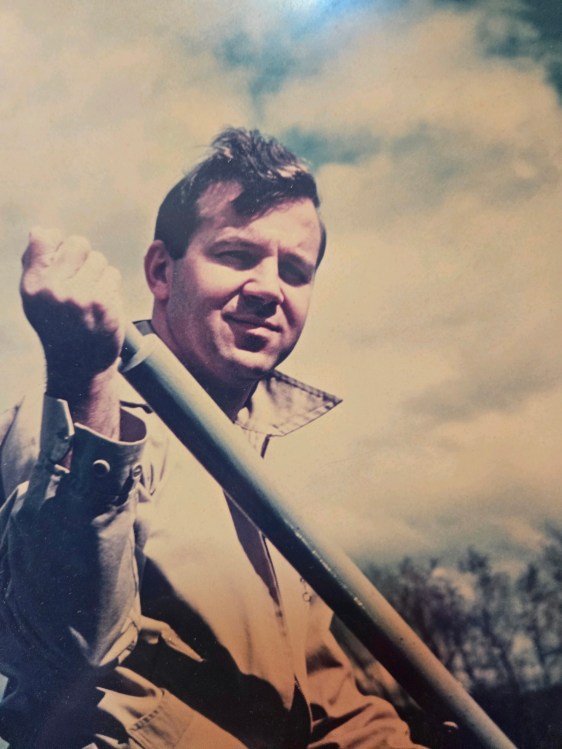
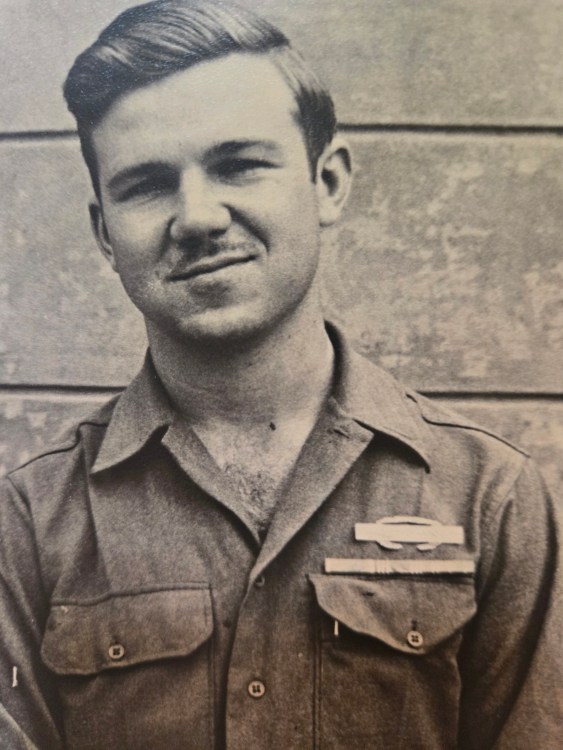
Bascom in 1923.

Bascom was 7 when the stock market crashed in 1929, launching the Great Depression. Born and raised in Atlanta, Bascom watched from his father’s business on Peachtree Street when President Roosevelt drove by on his way to Warm Springs. In 1939, Bascom was among the crowd of people looking to spy Clark Gable and Vivian Leigh at the premiere of “Gone with the Wind” at Loew’s Grand Theater, also on Peachtree Street.

In 1943, after Bascom attended Emory University on an ROTC scholarship, the Army sent him to New York City. He arrived on his 21st birthday and lived in Brooklyn for nearly a year while awaiting orders to ship to the European theater, where he would spend 33 months. Having first subscribed to The New Yorker in his late teens, young Bascom felt sophisticated living in NYC. He took classes at Pratt and went to Broadway shows for the 25-cent soldiers’ admission.

After the war, Bascom settled in Cleveland to work with his cousin Laura Riebel who owned a direct-mailing company located near the downtown Greyhound station. He ran the offset presses and over time they took a toll on his hearing — especially in his left ear, which was closer to the ink rollers. He eventually owned the business, which he ran until he retired.

Over the past two decades, my friend and I shared countless dinners (sometimes after attending shows at Playhouse Square or the Cleveland Orchestra), always done Bascom style: We arrived early and stayed late. We did not order food until after we’d enjoyed a cocktail. And we treasured above all else restaurants where we could easily hear one another. 

When, in 2019, former New York Times food critic Frank Bruni wrote a column titled, “The Best Restaurant if You’re Over 50,” Bascom and I felt vindicated for disparaging fashionable restaurants with hard surfaces that amplify sound and servers who rush diners. We discussed, among many things, articles in the latest issues of the subscriptions we both had — the New York Times, The New Yorker and The Sun. At a restaurant patio a few summers ago, a couple in their 60s came over to tell us they found our conversation most interesting. We had been discussing a piece on the decades-long misadventures of Dorothy Parker’s ashes.  

In 2019, The New Yorker published “The Strangeness of Grief” by V.S. Naipaul. The essay meanders the way the best essays do, never going from point A to point B in a straight line, but taking diversionary routes before bringing it altogether in the final paragraphs. It starts with the deaths of Naipaul’s father and brother, which occurred several years apart, but then switches to the tale a cat with writing that effortlessly disarms readers. In the final paragraphs the full freight of loss lands heavily on the sternum, leaving only people carved of stone dry eyed.

Sonata snuggling with one of my sandals while Bascom and I visited at his home.
.

Not waiting until our next date, Bascom called me an hour after he’d read and digested Naipaul’s piece. He and his life partner, Sandy Reichart (who died in 2008), were worshipful, as childless couples can be, to a lifetime of cats, each with names that began with the letter S. After her littermate, Summerboy, died about 10 years ago, Bascom devoted himself to the health and happiness of Sonata, a rare orange female.

On a whim, I once gave Bascom a McDonald’s Happy Meal toy. It was a tiny stuffed Chloe, the curmudgeonly cat from the animated film, “The Secret Life of Pets.” The next time I saw him, Bascom was giddy. “Sonata uses Chloe to communicate with me!” he said. Each night, Bascom set Chloe on his kitchen counter. Every morning, Chloe would turn up elsewhere, sometimes still in Sonata’s company.

Equally elderly for their species, I long wondered what would happen to Bascom if Sonata died and vice versa. In the end, it was as if together they had worked out a plan. While Bascom was in the hospital for low oxygen numbers, Sonata deteriorated and the veterinarian euthanized her. A few hours later, Bascom was also gone.

With my science and data-loving brain pushed to the side, I imagine a kindly death guiding Bascom to his beloved Sonata and that they were met by the many, many others, both human and feline, that Bascom loved over his long, rich lifetime.

———————————————————————————————————–

Along with my column linked above on Bascom’s most harrowing war experience, other columns I’ve written about my beloved friend can be read here and here.

This column appeared in the Akron Beacon Journal on Sunday, July 21, 2024.
Uncategorized

Graduations, weddings and goodbyes: Navigating life’s journeys

Change happens every moment, accumulating mostly in unnoticeable measures. Think of the relative who remarks how much your child has grown since last summer. But sometimes monumental changes occur in short and dramatic order, seemingly in series of three. 

This spring, the last of my children to attend Spring Garden Waldorf School graduated the eighth grade. I enrolled my eldest son there in January of 2001 and, after driving from our home in Ohio City for two years, decided to move to Akron. 

Unlike public schools, Waldorf teachers and administrators are not hemmed in by federal and state testing requirements that limit innovation and the deployment of scientifically proven best practices. Waldorf students don’t know that. They believe it’s normal to have outdoor recess in all weather, the same classroom teacher and classmates for eight years, no computers nor textbooks. Classmates bond like cousins, which explains the gauntlet of events that filled our calendar prior to Leif’s graduation.

The next morning, we began three days of hard driving. Five days after Leif’s graduation, my son Hugo married his fiancée in the Teton Mountains. 

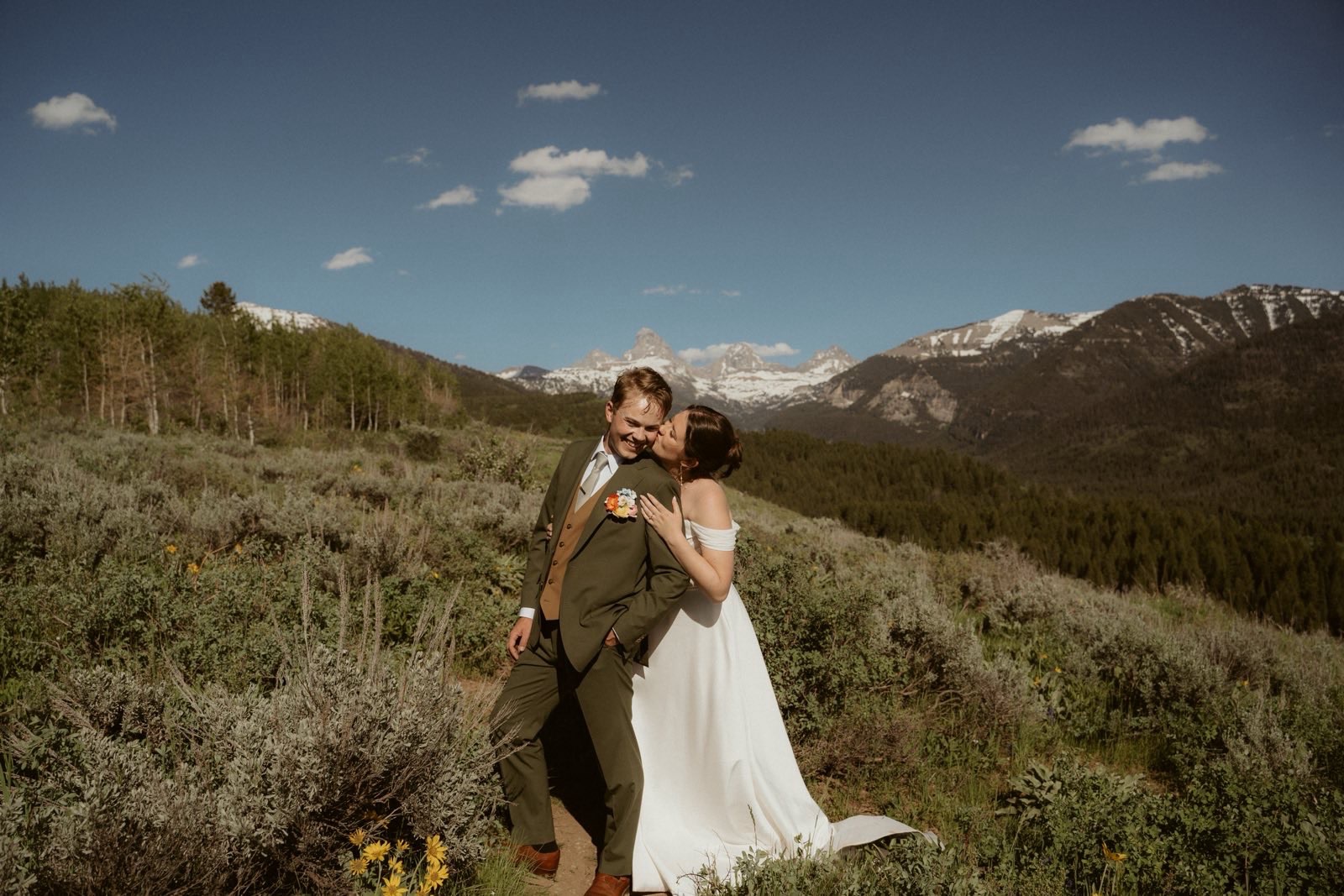
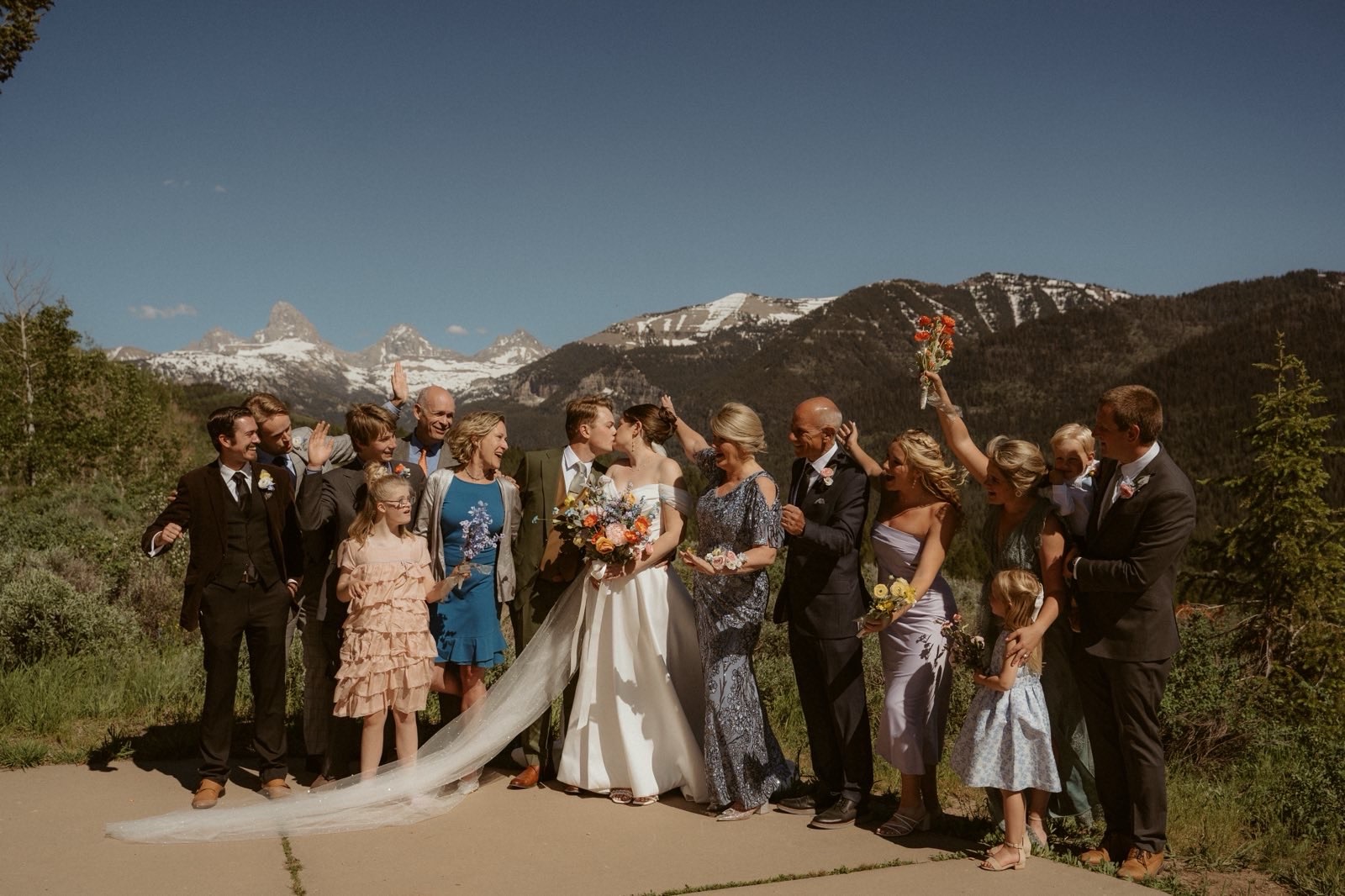
Hugo and his bride, Claudia, chose to wed at a scenic lookout in front of Grand Teton Mountain. Instead of staying in nearby Jackson Hole, Wyoming which is horrendously touristy and expensive, everyone was booked in a resort just across the border in Idaho. Then, three days before the wedding, the Teton Pass collapsed, increasing the drive from the resort to the wedding site by two hours each way.

Portending a successful marriage, the bride and groom swiftly found an alternate site near our hotel, which turned out to be as good, if not better, than the original one. The weather mimicked the bride’s serene beauty, while the ceremony included charming traditions both old and new.

The next day everyone dispersed, most heading back east.

We drove west to Crater Moon National Park and stayed the night in Twin Falls, Idaho. From there we traveled to Salt Lake City, where I have dear family and countless ancestral sites. I showed my youngest children the homestead property of my great-great grandparents, Christina and Soren Peder Henrichsen. Born in Sweden, they were children when they immigrated in the 1860s to Holladay, Utah, where they raised 10 children.

After two days of heritage touring, Lyra flew back to Ohio with family, leaving Leif and me to began our own adventure. In 2007, my first three sons and I circled most of the country in my 5-speed Toyota Matrix. That summer the boys were 13, 10 and 7 and their father and I had decided to divorce. Two of them think of their childhoods as pre- and post-road trip segments, yet, in spite of the divorce, they frequently refer to that summer’s travels with fondness. 

Leif will be a freshman at Akron Early College High School this August, going from a small school to a college campus. Hearkening the ’07 road trip, I was eager to spend time away with my last son during the liminal months between his boyhood and young adulthood. 

The drive from Salt Lake City to our campsite in Grand Teton National Park was just under six hours. When we arrived, we learned the temperature that night would plummet to 28 degrees and it would snow (back east, Akron was sweltering under a heat dome). At the park gift shop, we bought woolen caps and socks, insulated mittens and thermal sweatpants. 

That night, we broke a national park rule. Wearing all our new gear, coats and several shirts, we took blankets and sleeping bags into our car where we slept poorly, yet giggled frequently. Many happy memories are made when handling life’s challenges well.

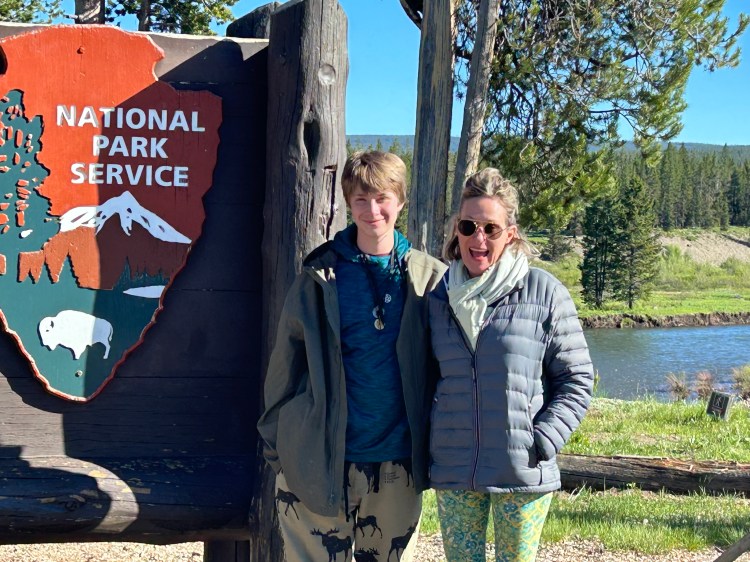
Arriving at the south entrance of Yellowstone National Park after a freezing night spent in our car.

The next day we made the short trip to Yellowstone National Park, where we spent two days. The park understandably forbids cell towers to dot its vistas, making cell service almost non-existent. But as we pitched our campsite, a call came through from my sister. Our step-father had been unexpectedly diagnosed with Stage 4 cancer. 

Bob McGhee is the only grandfather my children have ever known. A laconic man, the boys realized early on that the best time with Gramps, as they call him, was when helping him at the cemetery where he was sexton. He taught them how to use power equipment, but also how to fish. Two days after my eldest son graduated from high school, he was working at the job Gramps had gotten him. Together they buried an unembalmed body that had been packed in dry ice and flown to northern Michigan from California.

When the boys were in college, they’d drive up in mid-May to help Gramps prep the cemetery for Memorial Day. He never asked, they just showed up and spent time with the man who always showed up for them in whatever way he could.

As Leif and I worked our way back east over several days, he frequently told me he was glad we were road tripping. This summer, my youngest son leaves behind the things of a child, while his brother Hugo begins life as a husband and their grandfather prepares to make the greatest transition. My sons quickly moved work schedules and funds for one more road trip this summer — to visit Gramps before he departs.

This was first published in the Akron Beacon Journal on Sunday, July 7, 2024.