
Uncategorized

Wedding major bridge to adulthood

For a decade after high school, I regularly attended bridal showers, rehearsal dinners and weddings. The first few felt like theater performances in which my friends and I play-acted adult roles wearing bridesmaids dresses of mauve or sea foam green — colors that screamed, “It’s the ’80s!”
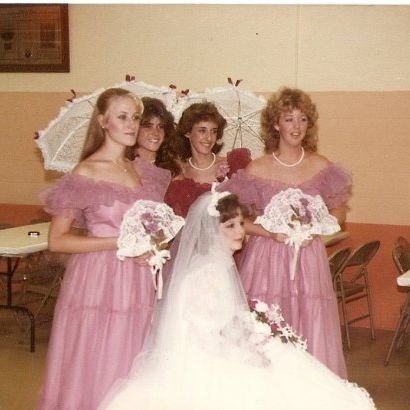
Wedding of high school bestie Lorrie Heckman (1984)

The season of weddings was followed by the arrival of babies and a new wave of showers. Those showers were often full of silly games and presents, but not much useful preparation for the radical life changes a first baby delivers.

Eventually, the wedding and baby cycle all but ceased. That is until a few years ago when envelopes with fancy calligraphy began dropping into my post box once again. Nowadays, like a flower girl preceding a bride down the aisle, save-the-date cards with engagement photos arrive several weeks before a wedding invitation. Most are from people whose diapers I once changed — nieces, nephews, offspring of the aforementioned friends.

One friend shared with me that when his son recently became a husband, he was struck, a little shocked even, by the realization that his boy is undeniably now a man. Three of my four sons left Akron for college, traveled the world and eventually moved away — what’s more adult than that? Little did I know.

My second son, Hugo, was the hardest child to raise in no small measure because he’s the most like me. And yet we were always close. “You’ll cry the hardest at my funeral,” I sometimes told him when he was mad at me. At age 19, Hugo saw a photo of 18-year-old me and it hit him that I was always more than just his mom. He’s called me multiple times a week ever since.

Hugo went to Rochester, New York, in 2015 to study opera vocal performance and European history. Three years later, he spent a summer studying in Graz, Austria, where he met Claudia, who is also an opera vocalist. Their now six-year relationship has followed the contours of a Hallmark Channel movie.

Claudia Holen with Holly Christensen's son, Hugo Christensen, and the couple's dog, Rutabaga, at the Grand Teton National Park in 2020.
Claudia and Hugo with their dog, Rutabaga, at the Grand Teton National Park in 2020.

For two years, while finishing college, they had a long-distance relationship. But then, in 2020, the pandemic brought them to Akron to shelter in place. That summer, when everyone was feeling cooped up, they packed Claudia’s car with camping gear (and their puppy) and drove to the Pacific Ocean and back.

Over Thanksgiving weekend in 2022, Hugo and I went to Sam’s Emporium on East Exchange Street and he bought Claudia an engagement ring. A few days after Christmas, he proposed to her at a romantic cabin in upstate Wisconsin.

Since then, they’ve lived in wedding world. Four months after Hugo proposed, there was an engagement brunch in Madison, Wisconsin, where they moved nearly three years ago for management jobs with performing arts organizations. They looked at locations for an outdoor wedding near Madison for several months before deciding to “elope.” 

My idea of elopement is a couple who tells their families, “Hey, while we were gone last week, we stopped at a justice of the peace and tied the knot.” Hugo and Claudia’s idea of elopement is inviting their immediate family members to join them next month at Grand Teton National Park in Wyoming (their favorite stop on their 2020 road trip) for a service officiated by a friend.

I flew to Madison this past March for Claudia’s bridal shower in her hometown of Rockford, Illinois, an hour’s drive from Madison. For much of the four days I was there, Claudia was in Rockford with close friends who’d flown in for both the shower and a bachelorette party.
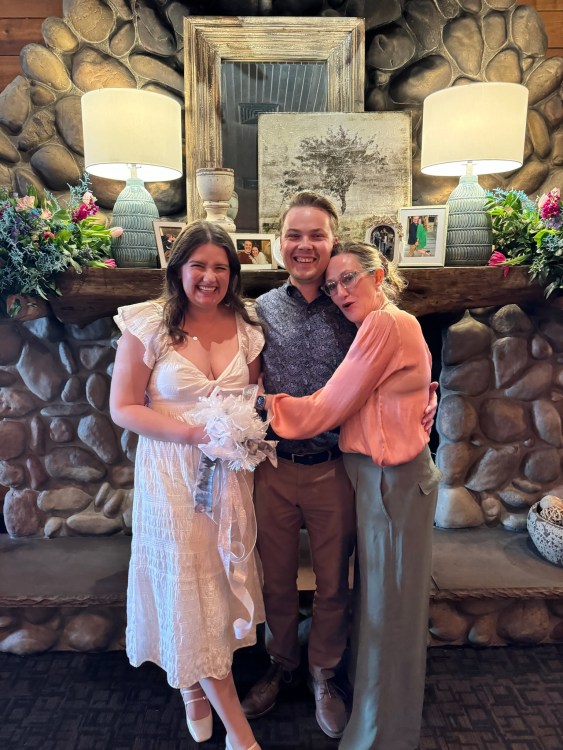
Claudia, Hugo and me at bridal shower.

Meanwhile, Hugo and I walked his dogs at several expansive dog parks across Dane County, many located on reclaimed landfills (Hey, Summit County, not a bad idea, that!), cooked, gave ourselves facials and watched movies. One afternoon Hugo took me to Indochino, a men’s custom suit shop, to see the fabrics and style of suit he’d ordered for the wedding.

On the day of the bridal shower, Hugo dropped me off at a restaurant in which a lodge-like room was packed with women and plenty of presents. He left to join Claudia’s father at a shooting range. Claudia was still opening gifts when Hugo returned two hours later and he took a seat beside her. 

I’m not sure what happened next. But both my eyes began leaking while I silently watched the young, but very adult, couple. Not a steady drip, drip, but rivulets coursed down my cheeks and onto my silk blouse. In the photos taken before we left the restaurant, my face looks like I’d stuck my head into a hornets’ nest.

The poignant feeling as the first of my children commits to spending his life with the woman he loves is hard to describe because it’s like no other emotion. Happiness mixed with the tender, yet weirdly surprising realization that my son truly has become a grown man who no longer needs me like he once did. And that is as it should be.

This column was first published in the Akron Beacon Journal on Sunday, May 26, 2024.

Uncategorized

Annual return of hollyhocks welcome reminder of old friend

Every Mother’s Day, my children wash my car and help me plant flowers. Last week, as I prepared the garden beds of my two side-by-side homes, I found one of what I call “Claire’s hollyhocks” growing where it didn’t belong and relocated it alongside its cohorts. 

One morning in the spring of 2005, my next-door neighbor, Claire Cressler, walked over to chat while I gardened. Our century-old homes have a feature that zoning ordinances long ago disallowed: a shared driveway. Twenty years ago, our yards were populated with oak trees (two dramatically fell over, roots and all, in the years since), leaving scarcely a sunny spot for flowers to grow. The best place was in the narrow strip of earth between the side of my home and our shared driveway. 

When he joined the Army in World War II, Claire was 5-foot-7, but after 95 years of gravity tugging on his frame, he was a good bit shorter than me.  He drove to the barber’s every four weeks to trim his impressively thick, white hair. On either side of a well-groomed goatee, Claire’s cheeks were jowly and usually clean-shaven. A retired artist, Claire’s clothes were old, but stylish. That day he wore a plaid shirt, Levis and a cowboy belt. As always when we talked, Claire immediately began turning up the volume in his right ear.

Claire Cressler at Holly Christensen's house in June 2005 to celebrate her son Jules' fifth birthday,
Claire visiting for dinner a few weeks after his roundabout request for hollyhocks.

“How’s your garden coming?  Do you have all your plants in?” he asked.

“I still have a flat of coleus to put in pots on the patio, but I’m done here on the side of the house.” 

I was happy to see Claire outside. He’d had shingles earlier that spring and I was concerned by how long it took him to recover. In previous springs, he’d do a little yard work every day, neatly bundling yard waste with twine. That year, his yard was littered with the debris continuously dropped by mature oaks: catkins, acorns, leaves, twigs and the occasional branch. Dead hydrangea flowers and iris leaves from the previous summer hadn’t been cut back. Geraniums he had wintered in his basement had yet to return to their summer home on his back stoop.

“Say, do you know what flower I liked as a boy?”

“No,” I answered, “What?”

“Hollyhocks.”

“Really?” I asked. A flower of a bygone era, hollyhocks had diminished in popularity long before I was born.

“Yeah, I know many people think they are a crude flower, but I always liked them.” Oddly enough, the day before I had seen packets of heirloom hollyhock seeds at Crown Point Ecology Center. Written on the back of the packets was the flower’s history.

“You know, Claire, I read that hollyhocks were a favorite flower to plant around outhouses. Do you suppose that’s why they were considered crude?”

“Well, now, that could be,” he said. “I remember when I was a boy, I liked to walk home from school through the alleyways and I would always see hollyhocks growing along the back fences of peoples’ yards.”

“Were there still many outhouses in Decatur when you were a boy?”

“Oh, sure. We called them Chic Sales.”

“Chicksalls?” I asked.

“No, Chic Sales,” he responded, adding emphasis to the separation of the two words. “Chic Sale was a comedian of sorts who told jokes about outhouses, so people started calling the outhouses Chic Sales after him and they called him The Specialist because he, well, specialized in outhouses.”

“Wait, was this before radio?”

“Oh, sure,” he again answered.

“So was Chic Sale a vaudevillian?” I asked, curious how a man’s name became to outhouses what Kleenex is to tissue.

“No,” answered Claire, “I don’t recall that he did vaudeville, he might’ve, I suppose.  His jokes were in books that adults would talk about but wouldn’t let us kids read.”

“Can you tell me any?” I asked.  

“It’s been so long, I can’t remember exactly. I recall he talked about outhouses with grand descriptions of their architecture and the crescent moon on the doors. He also had jokes about the trains going through Arkansas.”

“Arkansas?” I asked.

“Yes. You see in those days, they had boys that went up and down the train cars selling nuts and crackers and that sort of thing. Well, on a train through Arkansas, Chic Sale sees an old man selling this stuff and he asks him, ‘Aren’t you supposed to be a boy?’ and the old man replies, ‘Well, I was when we started out.’” I chuckled.

“It was a slow train, you see,” Claire explained in case I didn’t get it.  “But you know, I really did think those hollyhocks were special when I’d see them, they just made me smile.”

Sometimes I’m a bit slow on the draw. It suddenly occurred to me why Claire had come out to discuss hollyhocks while I was gardening.

“Claire, would you like me to plant some hollyhocks along the driveway?

Some of Claire’s 2024 hollyhocks.

“Well, that’d be all right, I suppose.”  A few days later I told him I had planted his seeds.

“Oh, show me where you put them, so as I know where to look.” 

“I put most of them under my kitchen window where you can see them when you are at your kitchen sink.”

“Well, that’ll be just fine.”

Hollyhocks reseed themselves, returning each year. They start out as bushy mounds of broad leaves, not unlike rhubarb. By June, the center stalks will have shot up 6-to-8 feet. Throughout the summer, the stalks will be covered in large, multi-colored blossoms. Today, I live in Claire’s house and from what is now my kitchen window, I enjoy seeing the descendants of that first packet of hollyhock seeds. Claire’s hollyhocks.

This column was first published in the Akron Beacon Journal on Sunday, May 12, 2024.

Down syndrome · Lyra's Latests · Parenting & Family

Vision Center without optical care loses sight of patient needs (Part 2)

I recently wrote about the Vision Center at Akron Children’s Hospital and pointed out that, no matter how excellent the Vision Center’s eye surgeons and optometrists are, the center abandons their patients in the last mile of care. 

Glasses designed for the general population rarely fit patients with atypical facial anatomy. Compared to typical children, my daughter Lyra’s facial features are clustered closer together, the bridge of her nose is extremely flat and her ears are closer to her eyes. All of which is common in people with Down syndrome, which she has. 

Frames exist for a variety of different facial structures, but few eye doctors carry those lines. That’s because, unlike the patient population at the Vision Center, most eye doctors have few patients who need specialized frames.

Akron Children’s Hospital takes all insurance, but most community eye doctors do not. Lyra’s primary insurance is Medicaid. Her secondary insurance, Children with Medical Handicaps (CMH), is provided by the state of Ohio but only for specific diagnoses. Lyra’s CMH covers her vision care, but because so few providers are approved by the state to accept CMH, and with no optical services at Akron Children’s, we’ve never been able to use it for glasses. (Ohio’s government does not consider Down syndrome a medical handicap and, therefore, care related to DS is not covered by CMH.) 

Lyra began wearing glasses at age 3 when it became too difficult to change her contact lenses. Her first frames were by a company that no longer exists, Miraflex. They were designed for the small nose bridges of babies and young children, making them ideal for young children with DS.

We purchased them at Adolph Optical, a family-owned Akron business. Adolph Optical is a good option for many and they participate in programs that help un- and under-insured patients. They do not, however, take Lyra’s insurance, and her glasses are incredibly expensive. Her prescription is +22 diopters, which means her lenses are too thick for cheaper, but heavier, glass lenses. The thick lenses bulge out of the frames, making it easy for them to get scratched. The best anti-scratch coating is also the costliest. Finally, as most of us over the age of 45 well know, multifocal lenses cost much more than single-focus lenses. Lyra’s specialized bifocals typically take between six weeks and three months to make and cost over $500.

The Eye Site in Copley is the only local optometry practice I have found that takes Lyra’s Medicaid plan, Buckeye Community Health. Buckeye contributes a maximum of $130 per year for glasses. As a small provider, Eye Site has not been able to obtain state approval to accept CMH.

After months of searching, I found an optometry practice in Alliance that takes CMH and drove there with Lyra and her prescription to pick out frames. But when I arrived, I learned that the practice does not take Medicaid. A patient’s primary insurance must first be billed by the same provider before CMH will accept a claim. 

After Lyra outgrew her Miraflex frames, I ordered a pair of frames online and took them to the Eye Site for lenses. But because her lenses are so heavy, they frequently popped out of the plastic frames, and one eventually broke. An optician who regularly works with high prescriptions would have steered me toward wire frames.

Wire frames usually have a screw holding the lenses tightly in place and nose pads that help accommodate tiny nose bridges — though Lyra’s glasses still slide halfway down her nose. I keep a jar of replacement nose pads because they frequently fall off and the spikes they are attached to cut into Lyra’s face.

I also have a jar of silicon sleeves for her frames’ temples. As the temples of most frames are too long for Lyra, I snip the ends with wire cutters and re-bend them to fit around her ears. The flat end of the temples, designed for comfort, are lost in the shortening process. The silicon sleeves help minimize pressure and protect her skin from the cut ends.

In response to my prior column, an ACH employee who works with the Vision Center’s patients sent an email that underscores ACH’s disconnect between excellent medical care and the functional application of treatment: “I have a difficult time understanding why you would not continue to make appointments with the remaining pediatric ophthalmologists at Akron Children’s Hospital and possibly travel elsewhere for optical services.”

They make it sound so simple.

Think of the families less fortunate than I with children who need specialized glasses. A single mom who may have to take off work and use public transportation to get to ACH. Once her child’s eyes have had excellent medical care at the Vision Center, she then has to figure out where to go to get glasses. What are the chances she’ll get them soon, if at all?

The practice nearest to ACH that offers optical services and accepts both Medicaid and CMH also has ophthalmologists who are just as excellent as those at ACH. That would be UH Rainbow Babies and Children’s in Cleveland.

We are fortunate to have a superb children’s hospital in Akron. But why would I get my daughter’s prescription at one hospital only to take it to another hospital for fulfillment when I can do everything in one location? Sadly, that one location is not Akron Children’s.

This was first published in the Akron Beacon Journal on Sunday, April 28, 2024.

Down syndrome · Lyra's Latests · Parenting & Family · Uncategorized

Akron Children’s Hospital needs the vision to add optical care (Part 1)

Rainbow Babies and Children’s Hospital has it. Nationwide Children’s Hospital has it. Even Dayton Children’s Hospital has it. Akron Children’s Hospital, however, does not. What is lacking? An optical department in its Vision Center.

During my pregnancy with my now 11-year-old daughter, Lyra, non-invasive testing revealed nothing unusual. With eyes scrunched shut, Lyra cried loudly at the moment of her birth. I took her in my arms and when she opened her eyes, I saw what the testing had not. “Her eyes look Downsy and her pupils are milky white,” I said.

Dr. Richard Hertle with Holly Christensen's daughter, Lyra, who’s wearing Miraflex frames, in 2018 before she had a procedure under general anesthesia at Akron Children's Hospital.
Dr. Richard Hertle and Lyra, who is wearing Miraflex frames, before an exam under general anesthesia at ACH in 2018.

The first weeks of Lyra’s life were a medical whirlwind. Children’s Hospital’s Genetic Center confirmed that Lyra has trisomy-21, the most common form of Down syndrome. That same week, Dr. Richard Hertle, an ophthalmologist at Akron Children’s Vision Center, diagnosed Lyra’s bilateral cataracts. Her lenses were surgically removed one at a time at ages six and seven weeks. Until Lyra’s diagnosis, I was unaware cataracts could occur congenitally. In the typical population, only one third of 1% of babies are born with cataracts. In the Down syndrome population it is 3%, also a small number.

Unlike cataract surgery for adults, synthetic intraocular lenses (IOLs) are not implanted just after a baby’s lensectomies. Eyeballs grow until age 20, with rapid growth occurring both immediately after birth and again at puberty. Furthermore, studies show that IOLs implanted before the age of 5 significantly increase a child’s chances of glaucoma.

I quickly came to trust Dr. Hertle. When asked details about the surgeries and eye anatomy, he became as animated as a kid at his own birthday party. During her two lensectomies, he installed scaffolding in her tiny eyeballs for the placement of IOLs, should she need or want them at a later date.

After her eyes had healed, Lyra wore contact lenses that when viewed in profile looked like alien space ships —discs with a sizable bulge in the middle. But as she got older (and stronger), changing Lyra’s lenses became difficult. I would hold Lyra tight while one Vision Center technician used a speculum to hold open her eyelids and a second technician changed the lenses.

When she was 3, we all agreed that changing Lyra’s contacts was too traumatizing and switched her to glasses. With no natural lenses, Lyra’s prescription is +22, and the lenses of her glasses are very thick. She wore Miraflex frames, a then widely available brand designed for the small nose bridges of babies and toddlers. They also work well for young children with Down syndrome, as they typically retain small nose bridges throughout life.

Miraflex is no longer an option. In 2020, the brand was acquired by the eye frame mega-conglomerate Essilor Luxotica Group, which promptly discontinued the line. Other brands, including Specs4Us and Erin’s World, also are designed for the unique facial features of people with Down syndrome. But it is a struggle for parents of children with a variety of special vision needs to find these, or other well-fitting, truly functional, frames.

And here’s why: Your local eye doctor does not have many patients with Down syndrome or other diagnoses that require specialized frames, so they are unlikely to carry them. Also, most optometry and ophthalmology practices do not accept Medicaid, which they must in order for a patient to use the Ohio Department of Health’s secondary state medical insurance, Children with Medical Handicaps (CMH). A pair of glasses for a child like Lyra can easily cost more than $500.

The Vision Center at Akron Children’s Hospital does their patients a gross disservice by not having an optical department. Unlike the offices of most eye doctors, the Vision Center’s patient population has an abundance of children who need specialized eyewear. And, like most children’s hospitals, Akron Children’s accepts Medicaid and CMH.

When I first wrote of this glaring optical oversight back in 2018, a team member of the Vision Center reached out to tell me that they would offer frames when they moved to their new location in the Considine Building in 2019. Yet as of today, the Vision Center still lacks optical care.

Lyra wore Miraflex frames for about four years. When she outgrew them, I began buying frames online and modifying them. Nose pads help keep the heavy lenses in front of her eyes, though it’s never as perfect as the frames designed for small nose bridges. And because the stems of frames designed for a typical child are too long for children with DS, I cut them with wire cutters, cover the sharp ends with silicone sleeves and re-bend them to fit around her ears.

On April 1, a letter from the Vision Center informed us that Dr. Hertle had retired two days earlier. Lyra has an army of support for her Down syndrome needs at school and through private therapies. But I have counted on Dr. Hertle alone for her medical eye care. I was shocked when I read the letter and momentarily felt panicked. However, change brings with it opportunities. I would never have left Dr. Hertle’s care. But as he’s no longer at Akron Children’s, we now will make the trek to Rainbow Babies and Children’s for truly comprehensive vision care.

This was published in the Akron Beacon Journal on Sunday, April 14, 2024.