Uncategorized

The problem with Ohio’s Down syndrome abortion ban

Look for the fishies at the KCL pond

In many serious discussions about Down syndrome, abortion is the ghost in the room.

Teaching medical professionals to give accurate and appropriate information when announcing prenatal diagnoses, state funding for early interventions, state funding for K-12 education, federal funding for research, even health care costs — these issues either directly or indirectly relate to the abortions of fetuses with Down syndrome (DS).

I was in my 40s when pregnant with my last two children and knew I had an increased risk of having a baby with Down syndrome. However, I allowed only non-invasive testing because I would not have terminated a pregnancy due to a diagnosis of DS.
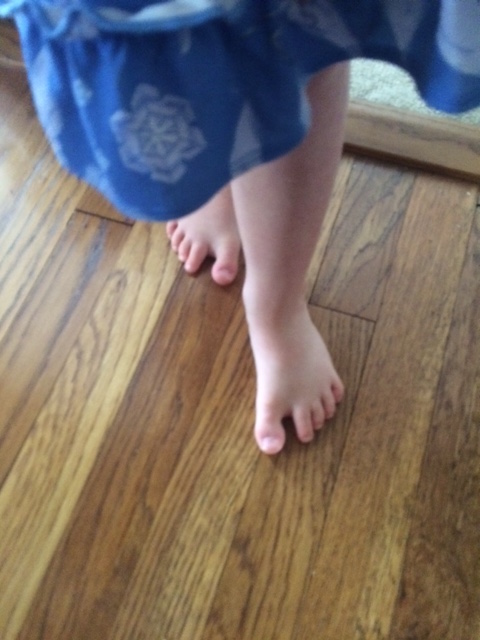
With both pregnancies, I was told there were no concerns based on the results of blood work and high-level ultrasounds. At the birth of my last child and only daughter, Lyra, we immediately recognized two markers of Down syndrome, the shape of her eyes and her sandal toes (each big toe is located far from the four smaller toes, as if designed for flip-flops). Later that week, genetic testing confirmed the diagnosis.

We quickly learned that what we thought we knew about Down syndrome was little and mostly incorrect. As a writer, I process difficult issues and emotions by writing. Three months after Lyra’s birth, I began blogging at Whoopsiepiggle.com, documenting my development as a mother of a child with DS.

Our love for Lyra was immediate and fierce. Max and I felt like we were taking a crash course on DS. We worked to give her the best start possible, including regular speech, physical and occupational therapies. But our first years as parents of a child with DS were also filled with enormous fear. On top of that, I was overwhelmed parenting three teens and two tots, regardless of Lyra’s diagnosis.

Soon, we understood that there has never been a better time to be born with DS. In a column on May 6, 2017, “Busting myths on life with Down syndrome” (http://bit.ly/2E9onV4), I outline how people born with DS today can expect to lead lives more alike than different from their typical peers.

Knowing what I do now, I would encourage any woman who receives a prenatal diagnosis of DS to learn the current facts and strongly consider continuing her pregnancy, even if she feels she would give the child up for adoption (the waiting list to adopt a baby with DS is longer than that to adopt a typical baby).

Avoid bias

I speak each fall to first-year medical students at Case Western Reserve University. I encourage them to guard against bias when interacting with patients who have disabilities and their parents.

And yet, this past fall, I told the students that I and many, though not all, parents of a child with DS oppose the state bill outlawing the abortion of a fetus prenatally diagnosed with Down syndrome.

Nobody likes abortion, not even abortion rights advocates. But, legal or not, abortion has been around as long as pregnancy. The solution to lowering abortion rates is to find out why women have them and address those issues.

I learned at the National Down Syndrome Congress convention in 2014 that the termination rate of fetuses diagnosed with DS is higher in Southern states, where elected officials are overwhelmingly Republican and abortions harder to obtain, than in cities in the North. The reason given is simple — services and supports for children with disabilities are limited in many parts of the South.

In recent years, Denmark and Iceland have adopted policies to entirely eliminate people with DS from their populations. All women receive free prenatal testing in these two countries and are encouraged to terminate when a fetus is discovered to have DS.

Most do, but not all. I know a woman raising a child with Down syndrome in Denmark. Because there are so few children with DS in that country, supports are commensurately limited. And this, I suspect, contributes to many other women choosing not to carry a fetus with Down syndrome to term.

Ethicists around the globe have called for women to terminate pregnancies of children with DS. Richard Dawkins, a Brit, claims doing so reduces suffering. This flies in the face of all research conducted on people with DS and their families.

Australian ethicist Peter Singer, much of whose work I find enlightened and inspiring, believes fetuses with DS should be aborted because they increase the cost of health care for the rest of a country’s citizens. Determining the value of a human life based purely on cost is a slippery slope. What happens when one day we can prenatally test for schizophrenia, bipolar disorder, autism or addiction?

Funds for testing

In the United States, funding for DS research overwhelmingly favors further development of prenatal testing over the development of drugs to improve health and cognition. The primary point of prenatally diagnosing a fetus with DS is to allow for the option of termination. Thus, federal research dollars effectively promote elimination over amelioration.

I know a family who moved back to Northeast Ohio shortly after giving birth to a son with DS. The region where they were living in Michigan had little access to the medical care and educational programming important for a child with DS.

I know a family that moved from Akron to Bath because they felt their child with DS would receive a better education, with more supportive services, in Revere schools than in Akron Public Schools.

In Ohio, the state provides services to children with DS through the county developmental disability (DD) boards for the first three years of life. Then, from age 4 to 22, state services are administered through the public schools.

Our statehouse is controlled by the Republican Party and has been for many years. The same legislators who voted to outlaw abortion of fetuses with DS also voted this past year to remove language that would have increased funding to county DD boards.

The federal Individuals with Disabilities Education Act guarantees as a right for children with disabilities, including DS, a free, appropriate public education. And yet everyone knows all Ohio school districts are not created equal. Some families, like the one I mentioned, move to districts with better resources. But for many that is not an option.

Furthermore, just because a child is guaranteed an education doesn’t mean schools comply, and parents regularly sue school districts for enforcement. Here in Ohio that happens in the Sixth Circuit of the U.S. Court of Appeals.

The Sixth Circuit has a mixed record with disability rights. A recent decision stated a school could not be penalized for strapping a preschool child with disabilities to a toilet with a leather belt because it was part of the school’s pedagogy. Think about that.

Ultimately, I believe underlying the move to eliminate people with Down syndrome is a bias against people perceived to have lower intelligence. Therefore, this is for me an issue of civil rights.

Which is why it’s important to point out that the law outlawing the abortion of fetuses with DS has little, if anything, to do with protecting people with DS. If our state legislators truly cared about this population, they’d put our money where their mouths are.

They’d adequately fund county DD boards, including everything from early interventions for babies to job training and housing with qualified, well-paid staff for adults.

All of Ohio’s public schools would receive the funding to provide equitable education for all students, including those with developmental or intellectual disabilities.

Today, Ohio women wanting to terminate a pregnancy in which the fetus has been diagnosed with DS will need to travel to a state where it is legal. And those who do not or cannot will find themselves in a state that inadequately addresses the needs of their children.

Uncategorized

Give Generously and Benefit Greatly

Give generously. While this may sound like a contradiction to my previous column on giving lightly, it is not. Let me explain.

Falling prey to the Madison Avenue depictions of Christmas trees exploding with wrapped gifts from under their boughs will not bring endless happiness to your children. In fact, it is more likely to promote agitation.

Consider instead giving a few choice presents while using this festive season to talk to your kids about the benefits of charitable giving.

Every December solicitations from non-profits fill both email and postal boxes. Give to a charity before the New Year’s Eve ball falls on Times Square and another tax deduction for the year may be gained.

Christians take to heart Matthew 25:34-40 in which God blesses those who give to people in need and visit the sick and imprisoned, for it is the same as giving to the Lord. We who live in warm homes with stocked cupboards and closets full of clothes and shoes are indeed fortunate.

In December 2010, I read an article to my boys from Parade magazine on the Shoestring Philanthropist, Marc Gold. In 1989, Gold toured India and found small donations were often life-changing or even life-saving. One dollar bought antibiotics for a woman who would have died without them. Thirty-five dollars bought her a hearing aid that allowed her to return to work.

Impressed by how such small sums of cash could bring such great good, Gold asked 100 of his friends to donate a little money. They did and his non-profit, 100 Friends (100friends.org), was created. Through 100 Friends, Gold has helped thousands of people in more than 50 developing countries.

Lead by example

Children take most to heart not what we parents tell them, but what we do. And what I show my children, I hope, is that while generosity is highlighted at this season, it should not be restricted to one month of the year.

With a credit card, I make monthly, automatic donations to several non-profits that are important to me. While my kids couldn’t list these organizations, they know there is a list and that WKSU is on it (a dollar a day) because I dole out the members’ swag. My boys proudly wear sweatshirts, scarves and hats bearing our NPR station’s logo.

Last December at age 16, Jules gave to the Coral Reef Foundation and the Rainforest Trust. He also bought his first Federal Duck Stamp. Issued by the U.S. Fish and Wildlife Service, the Federal Duck Stamp is one of the oldest conservation efforts in the nation, having raised over $950 million since it was introduced in 1934.

Giving one-time or monthly gifts are great ways to help organizations doing valuable work. But what about the people in your daily life? Those people who, throughout the year, make you look good, live well, and give you added time by doing work so you don’t have to?

Because you are a faithful subscriber to Ohio’s best daily newspaper (right?), you know your paper carrier is up long before sunrise, delivering the Akron Beacon Journal to your door before your alarm clock bleats. This month, give your carrier a card with some cash in it. We give $20.

Rain, snow, sleet and heat waves are nothing for the men and women of the U.S. Postal Service. Not only do they bring your mail six days a week, mail carriers are the eyes and ears of a neighborhood. Your mail carrier may one day stop a crime or save your life. Again, give them a card with some cash.

If you are so lucky as to have someone else clean your house, give a year-end bonus. And for the love of all that is right in the world, if you leave town for the holidays and won’t need your home cleaned, still pay the person! Your cleaning person’s bills do not go away when you do.

You put your head in the hands of your hairdresser several times a year. It’s nothing short of foolish not to tip them well. Tip generously all year and you’ll hardly notice the difference, but your stylist will. The same goes for nail technicians. And at the end of the year, tip extra.

I wish everyone had to work as a server the summer before graduating high school. Thereafter, when dining out all people would always tip well and behave graciously. Ohio’s minimum wage for tipped employees is currently $4.05 an hour. Nobody can earn a living wage on $4.05 an hour.

Tip well because it’s the right thing to do.

How much? Twenty percent is an easy sum to mentally calculate and in most cases — whether tipping a server, hairdresser or nail tech — the difference between 15 and 20 percent is little more than a cup of Starbucks coffee.

Giving benefits givers

Giving generously benefits not only the recipient but also the giver. Repeatedly, studies have shown people with fewer resources give more generously, and more often to strangers, than the wealthy. The less you make, the more you understand the struggles of others.

And yet the wealthiest person can benefit from philanthropic giving, even when initiated for less than charitable reasons.

Few may remember that in the 1990s, Bill Gates was almost universally despised. In 2000, a U.S. federal judge determined Microsoft had engaged in anti-competitive practices resulting in a monopoly that should be split apart. I was pregnant with Jules and remember everywhere I’d go people were having schadenfreude-filled discussions about the decision.

Today Jules is 17 and most people think Bill Gates is a pretty nice guy. What happened? That same year the U.S. justice department was going after Microsoft tooth and claw, Gates and his wife Melinda launched the Gates Foundation. Coincidence? I don’t think so.

Like many at the time, I believe the Gates Foundation was created to improve public opinion of Bill Gates and his mega corporation, Microsoft. But I also believe, as is often the case with philanthropists, that the work of the Gates Foundation has changed its funder for the better.

Fighting hunger, disease and overpopulation, while also working to improve education, in over 100 countries has made Mr. Gates a passionate advocate of those who are the least among us.

So please, give generously for everyone’s sake, including your own.

Merry Christmas!

This column first appeared in print in the Akron Beacon Journal on December 17, 2017

Uncategorized

Giving lightly is good for kids and the planet

My eldest child will turn 24 next month. This means I have been acquiring toys for nearly a quarter of a century.

That first year I was a mother, we often visited friends who had a 3-year-old. In their living room were neatly organized baskets filled with animal figures, blocks, books. I was in graduate school at the time (read: poor) and remember wondering if my little boy would ever have such lovely toys.

Now I envy the clutter-free sparseness of those early years.

In the mid-’90s, I scoured thrift stores where I scored wooden train sets and, years before they became collectors’ items, old Fisher-Price toys. We have the wind-up record player, the wind-up radio, the barn set and many animals.

Over the years, I chose toys thoughtfully. Few were plastic, none electronic. Blocks, puppets, animal figures, wooden train sets, games, puzzles, Magnetix and lots of books.

The year my third son turned 10, I likely would have begun shedding our toy collection.

But instead, I gave birth to my fourth son. And so I kept all we’d acquired in the 16 years before Leif was born. And though he was born into a household with an enviable collection of toys, not surprisingly, he still expects presents.

The cost of too much

Kim John Payne is a family therapist and educator whom I heard speak many years ago. After working in refugee camps with children who never knew anything but uncertainty due to war, Payne moved to London. There he discovered middle-class children exhibiting similar symptoms of post-traumatic stress disorder (PTSD) as refugee children, though they’d not experienced traumatic events like the refugees.

What gives? Payne coined the term “cumulative stress reaction” or CSR, and claims that both groups of children were suffering from overactive amygdalae, the part of their brains that controls survival instincts, i.e., what to do when threatened. Fight? Run? Freeze?

In his book Simplicity Parenting, Payne recommends a number of things to restore calm to the children suffering from CSR. What struck me most were his visits to the homes of families in his therapy practice. He’d arrive while the child was at school. In the child’s bedroom with the parents, Payne would pull out a garbage bag and tell the parents to fill it.

Inevitably, this task was difficult. Each toy, book, trinket was somehow special but Payne was uncompromising and the bag was filled. And then he’d pull out a second bag. And then a third.

“What happens when your child only has 10 books to choose from? Predictability, that’s what,” Payne said when I heard him speak.

Yes, I’m sure most kids who returned home to discover themselves relieved of three trash bags of toys were none too happy about it. But who does not feel calmer and think more clearly after finally clearing off a cluttered desk, room or home?

Christmas roundup

Now here comes Christmas. (Yes, these Buddhists celebrate Christmas with gusto.)

Most years I assess things during the first weeks of December. Games and puzzles with missing pieces are tossed, as are books with missing pages. Anything broken is also chucked. Toys everyone has outgrown are donated. (I keep a small box of toys for visiting babies and toddlers.)

When the big boys were little, the only gifts I bought them were stocking stuffers. The big gifts were what the relatives sent. They still had plenty.

Leif was nearly 3 years old when he had an inkling of what’s happening on Christmas morning. He pulled the paper off his first present, a small set of Thomas the Tank Engine trains and a floor map on which to move them about. Leif played with Thomas not only the rest of Christmas Day, but also for a week or more while all of his other presents remained wrapped and under the tree.

I still fill the stockings. But now the big boys get more practical things like lip balm, gift certificates, shaving cream. Under the tree, I give them what I want to receive: Good socks. I believe good socks and underwear go a long way in making life better. If you doubt me, think how miserable uncomfortable underwear and droopy socks make you feel.

Here’s an unabashed product plug: Bombas socks. I’ve given each of the big boys two pairs of their merino wool socks for a few years now. For each pair of socks purchased from Bombas, the company donates a pair. According to their website, socks are the No. 1 item requested in homeless shelters and Bombas has donated over 5 million pairs of socks to date. Now that’s an all-around feel-good gift.

The truth is, while the big boys like Christmas presents, without childhood magic, it’s just a relaxing morning in our pajamas. Last year, Claude told me the best part of Christmas for him now is watching people open the gifts he’s given them.

Buy, buy, buy

Maybe one day we’ll be one of those families who take a trip over the last week of the year. But for now, we still have our two littles, Leif and Lyra. And I admit, each year I struggle to fight the crushing message to buy, buy, buy!

It is well documented that Americans disproportionately consume the earth’s resources when compared not only to Third World and developing countries, but also other industrialized nations. A continuous loop of manufacture, sell, use briefly and discard underpins our economy.

Nonbiodegradable plastics fill our landfills and waterways. Microplastics have entered the marine food chains, which should be a concern for anyone who eats seafood.

I work part-time in a store that sells toys and other really cool things, and I am just as susceptible in the final days of holiday shopping to worry that I have enough for each person to unwrap. In my office closet are toys I bought last December. As we were frantically wrapping everything after the littles had gone to bed last Christmas Eve, I realized it was too much.

And what does giving too much end up doing to your children? Well, possibly giving them a version of PTSD. It’s not good for the planet and it’s not good for the kids.

I intend to give lightly this Christmas, purchasing just a few quality items my family members need. With my intention published in this paper, perhaps this year I can resist the pressure and temptation to spend more than I should on things we don’t need.

Heck, once I wrap the toys hiding in my office, I’m quite possibly done!

This was first published in the Akron Beacon Journal December 3, 2017

Uncategorized

Giving Lightly–It’s Good All Around

My eldest child will turn 24 next month. This means I have been acquiring toys for nearly a quarter of a century.

That first year I was a mother, we often visited friends who had a 3-year-old. In their living room were neatly organized baskets filled with animal figures, blocks, books. I was in graduate school at the time (read: poor) and remember wondering if my little boy would ever have such lovely toys.

Now I envy the clutter-free sparseness of those early years.

In the mid-’90s, I scoured thrift stores where I scored wooden train sets and, years before they became collectors’ items, old Fisher-Price toys. We have the wind-up record player, the wind-up radio, the barn set and many animals.

Over the years, I chose toys thoughtfully. Few were plastic, none electronic. Blocks, puppets, animal figures, wooden train sets, games, puzzles, Magnetix and lots of books.

The year my third son turned 10, I likely would have begun shedding our toy collection.

But instead, I gave birth to my fourth son. And so I kept all we’d acquired in the 16 years before Leif was born. And though he was born into a household with an enviable collection of toys, not surprisingly, he still expects presents.

The cost of too much

Kim John Payne is a family therapist and educator whom I heard speak many years ago. After working in refugee camps with children who never knew anything but uncertainty due to war, Payne moved to London. There he discovered middle-class children exhibiting similar symptoms of post-traumatic stress disorder (PTSD) as refugee children, though they’d not experienced traumatic events like the refugees.

What gives? Payne coined the term “cumulative stress reaction” or CSR, and claims that both groups of children were suffering from overactive amygdalae, the part of their brains that controls survival instincts, i.e., what to do when threatened. Fight? Run? Freeze?

In his book Simplicity Parenting, Payne recommends a number of things to restore calm to the children suffering from CSR. What struck me most were his visits to the homes of families in his therapy practice. He’d arrive while the child was at school. In the child’s bedroom with the parents, Payne would pull out a garbage bag and tell the parents to fill it.

Inevitably, this task was difficult. Each toy, book, trinket was somehow special but Payne was uncompromising and the bag was filled. And then he’d pull out a second bag. And then a third.

“What happens when your child only has 10 books to choose from? Predictability, that’s what,” Payne said when I heard him speak.

Yes, I’m sure most kids who returned home to discover themselves relieved of three trash bags of toys were none too happy about it. But who does not feel calmer and think more clearly after finally clearing off a cluttered desk, room or home?

Christmas roundup

Now here comes Christmas. (Yes, these Buddhists celebrate Christmas with gusto.)

Most years I assess things during the first weeks of December. Games and puzzles with missing pieces are tossed, as are books with missing pages. Anything broken is also chucked. Toys everyone has outgrown are donated. (I keep a small box of toys for visiting babies and toddlers.)

When the big boys were little, the only gifts I bought them were stocking stuffers. The big gifts were what the relatives sent. They still had plenty.

Leif was nearly 3 years old when he had an inkling of what’s happening on Christmas morning. He pulled the paper off his first present, a small set of Thomas the Tank Engine trains and a floor map on which to move them about. Leif played with Thomas not only the rest of Christmas Day, but also for a week or more while all of his other presents remained wrapped and under the tree.

I still fill the stockings. But now the big boys get more practical things like lip balm, gift certificates, shaving cream. Under the tree, I give them what I want to receive: Good socks. I believe good socks and underwear go a long way in making life better. If you doubt me, think how miserable uncomfortable underwear and droopy socks make you feel.

Here’s an unabashed product plug: Bombas socks. I’ve given each of the big boys two pairs of their merino wool socks for a few years now. For each pair of socks purchased from Bombas, the company donates a pair. According to their website, socks are the No. 1 item requested in homeless shelters and Bombas has donated over 5 million pairs of socks to date. Now that’s an all-around feel-good gift.

The truth is, while the big boys like Christmas presents, without childhood magic, it’s just a relaxing morning in our pajamas. Last year, Claude told me the best part of Christmas for him now is watching people open the gifts he’s given them.

Buy, buy, buy

Maybe one day we’ll be one of those families who take a trip over the last week of the year. But for now, we still have our two littles, Leif and Lyra. And I admit, each year I struggle to fight the crushing message to buy, buy, buy!

It is well documented that Americans disproportionately consume the earth’s resources when compared not only to Third World and developing countries, but also other industrialized nations. A continuous loop of manufacture, sell, use briefly and discard underpins our economy.

Nonbiodegradable plastics fill our landfills and waterways. Microplastics have entered the marine food chains, which should be a concern for anyone who eats seafood.

I work part-time in a store that sells toys and other really cool things, and I am just as susceptible in the final days of holiday shopping to worry that I have enough for each person to unwrap. In my office closet are toys I bought last December. As we were frantically wrapping everything after the littles had gone to bed last Christmas Eve, I realized it was too much.

And what does giving too much end up doing to your children? Well, possibly giving them a version of PTSD. It’s not good for the planet and it’s not good for the kids.

I intend to give lightly this Christmas, purchasing just a few quality items my family members need. With my intention published in this paper, perhaps this year I can resist the pressure and temptation to spend more than I should on things we don’t need.

Heck, once I wrap the toys hiding in my office, I’m quite possibly done!

This was first published in the Akron Beacon Journal December 3, 2017

Uncategorized

Thankful for Thanksgiving

This coming Tuesday, Max will bring home our pasture-raised, freshly killed turkey. I will be waiting for him in the kitchen with a bottle of dry Riesling.

No, not to toast the beginning of Thanksgiving, but to mix with kosher salt and several herbs. The turkey will go in a brining bag placed inside our largest cooler. Pour the wine brine on the turkey, seal the bag, surround it with ice, close the cooler and load it into the back of the minivan.

Check, check, check, check. We’re almost ready.

Earlier that day, someone — it’s beginning to look a lot like me — will drive to Rochester to pluck Hugo from college. The house sitter will stop by for an introduction to the four animals we’ve acquired since last Thanksgiving. “Has it been a year again already?” we’ll say to each other.

Food, wine, small gifts will be packed next to the turkey’s cooler that night so in the morning we can toss our clothes and toiletries in the cars and go.

Wednesday, when we’re all antsy to hit the interstate before 9 a.m., someone will suggest coffee and breakfast from Starbucks so we won’t have to clean the kitchen.

And for good reason. It’s a seven- to eight-hour drive to Grandma and Grandpa’s house in Northern Michigan.

When the big boys were little, we went home for Thanksgiving every other year. Since 2012, however, we’ve made the trip each year. One reason is that the grandparents’ next-door neighbor, who ironically spends Thanksgiving in Ohio with her children, graciously encourages us to stay in her empty home. Looking back, I can’t imagine how we used to make the Thursday feast with only one stove and oven.

Grandma is a culinary prodigy. When her own children lived at home, she used a bread mixing bucket our Mormon ancestors hand-carted across the American plains a century earlier to make all our bread, 10 loaves every two weeks. Compared to her granola, the stuff sold in stores seemed like rolled flakes of cardboard. Her renowned burritos included tortillas made from scratch with masa harina.

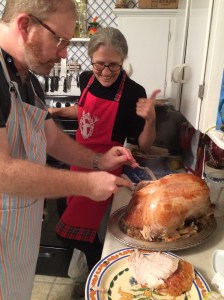
After Grandma cooks him, Max carves Tom Turkey

Thanksgiving is Grandma’s magnum opus. A few things have changed over the years: We’ve added Mama Stamberg’s cranberry relish to the table. Instead of steamed broccoli and cauliflower with cheese sauce, we’ve improved the classic green bean casserole topped with French’s Crispy Fried Onions. If you use fresh beans and homemade white sauce, it’s not a pasty soup-like dish, but refreshingly light with the canned onions adding a savory crunch.

Sacrosanct are Grandma’s core dishes: the turkey, stuffing, gravy, fruit salad, herbed rolls and pies. Years ago, she wrote all her Thanksgiving recipes down for me and taught me how to make pies.

Pies are one of the few baked goods I make and I think mine are now as good as Grandma’s (some might say they’re a wee better because I use lard for my crust instead of Crisco, but don’t tell Grandma).

Yet neither Jules, who had a two-year preoccupation with bread baking, nor I can master Grandma’s herbed rolls.

Watching her, it looks so easy. Mix whole wheat dough with herbs, roll three small balls for each muffin cup, add a dollop of butter and bake. Warm from the oven, their knobby tops are crispy, their insides chewy without being tough. They alone are worth the drive.

“I can’t wait for Thanksgiving,” is the refrain said with increasing frequency by all the big boys starting when school resumes in the fall.

That’s also when Max starts bringing home different bottles of wine, telling me not to open them because, “These are for Thanksgiving!”

Why do we love this holiday so deeply? More than any other?

We’ve talked about it. Gift giving can be stressful and seem contrived. Not a problem at Thanksgiving. And with no specific religious component, Thanksgiving is every American’s holiday. We can all be grateful and give praise to any or no deity.

Close quarters and full bellies–Claude and Hugo

At Thanksgiving our family is both all together and unplugged from the chug-a-chug of our busy lives, with cooking and washing dishes our only chores. Because we are not at home, we are guilt-free for not using the long weekend to take care of projects around the house or at work.

Instead, Max brings his toolbox and revels in helping Grandma fix this and that at both her house and the neighbor’s where we stay.

The big boys and Grandpa, who’s a sexton, drive out to the cemetery. They help clear away the remaining leaves and do whatever needs to be done before the deep cold of winter in Northern Michigan takes hold. It is there that the boys connect with Grandpa, a laconic man who, behind his curmudgeonly aspect, is as soft as a jet-puffed marshmallow.

Otherwise we eat, watch movies, eat, play euchre, eat, listen to Hugo sing and play guitar, eat.

Lyra running to see Santa

To keep our livers from overloading on the rich and plentiful meals, we walk daily along the icy shore of Lake Michigan. The day after Thanksgiving we stroll to town, get our picture taken with Santa and watch as the 20-foot pine tree lights up in the park next to the marina, now void of boats, for the first time that holiday season.

And when there’s snow, we head to Dodger’s Hill, a short cross street with a steep incline that the city doesn’t plow all winter long, leaving it for tobogganers of all ages.

Being busy is like a chronic disease in modern America. Everyone says how busy they are as though not being busy is unacceptable. I try not to overschedule my children with extracurricular activities, instead letting them wander around the house bored. If they complain, I give them a job. They all learned to self-entertain at an early age.

Yet try as I might, I fall into the busy trap. I freelance from home, work part-time in a store (a sanity boost), care for five children all of whom have needs, volunteer both locally and for national Down syndrome groups. You get the drill, and undoubtedly have one of your own. Balancing what is important with what is necessary is easier some weeks than others.

Max and the big boys also step into the busy trap. Especially Hugo and Jules, who are juggling both school and work.

Over the years our solidarity on celebrating Thanksgiving with the grandparents at their house has only grown. For a handful of days, we relax together with few unwanted distractions.

All things truly are transitory.

Eventually this cherished family ritual will end. Knowing this makes each year all the sweeter, my gratitude all the greater, for the time I have with my family on this, our favorite holiday weekend.

Happy, happy Thanksgiving!

This was first published in the Akron Beacon Journal on Sunday, November 20, 2017

Civil Rights · Uncategorized

Don’t Let Your Sons Grow Up to Be Predators

One of my favorite books by Richard Scarry is The Bunny Book. In it, family members of a baby bunny wonder what he will be when he grows up. Cowboy? Firefighter? Doctor? Farmer?

No, none of these. What baby bunny wants to be when he grows up is a daddy bunny who cares for his children. Rather avant-garde kid lit when first published in 1955, The Bunny Book is as relevant today as ever.

When my eldest son, Claude, was in kindergarten, I read The Courage to Raise Good Men by Olga Silverstein. A therapist, teacher and mother, Silverstein argued against the belief that mothers need to let go of their sons and that boys must avoid emotions associated with women.

We all know the clichés: Stop coddling that boy. Big boys don’t cry. Mama’s boy. Feminization of men is destroying the nation.

However, after working as a family therapist for more than three decades, the most common marital problem Silverstein saw was men who were emotionally disconnected. She determined that not nurturing the emotions of sons results in “lost boys, lonely men, lousy marriages, midlife crises.”

And, I would add, an increase in the dehumanization of women. If a man is emotionally disconnected, he cannot empathize with the feelings of others. Couple this with the vigorous patriarchy of our society and too often women become little more than objects, conquests to be taken either by charm or force, then discarded like a used napkin.

Anyone who’s been conscious this past month has heard about movie producer Harvey Weinstein’s long history of sexually assaulting women. Also hard to miss has been the #MeToo campaign in which women who have been sexually harassed or assaulted are posting these two words on their social media accounts.

Men in powerful positions preying on women and getting away with it for years is a scandal that repeats all too regularly. And the sad truth is for every Harvey Weinstein, Roger Ailes, Bill Cosby or Bill O’Reilly, there are thousands of other predators who are never stopped.

Protecting daughters

My only daughter has Down syndrome. The rates of sexual abuse of people with intellectual disabilities, both men and women, are higher than for the general population. My plans to protect Lyra are the same as they would be for a daughter who did not have Down syndrome: talk openly with her about sexuality, what is appropriate, what is not and how to protect herself from sexual harassment and assault.

Yet until there is a wholesale change in how our culture views women and the men who violate them, I will worry for my daughter’s safety. As most any parent of any daughter does. It’s a second #MeToo that walks hand-in-hand with the first.

I have four sons who believe women are fully human, which makes them feminists. I recently asked the three big boys why they treat women as their equals, and why they disparage men who do not. What was it in their upbringing to make them different from the predators we hear about in the news and, horrifyingly, some of my sons’ peers?

Their answer? Nothing and everything.

Nothing in that there is no single thing I did or said that made my sons respect women as their equals. Sure, I’ve given them all the “No means no, even if first she said yes” talk. But that alone did not form their feminist beliefs.

“Because you’re our mom,” said 20-year-old Hugo, “that’s everything.”

Lyra and Leif play with the fairy outfits they both received in their Easter baskets this past spring.

My children were never forced into rigid gender roles. They had some superhero pajamas but others patterned with fish, stars or gnomes. When Claude was 3, he wanted to dress up as a witch for Halloween. Rather than tell him only girls can be witches, I bought him a pointy hat, a small broom and a wand.

My boys played with Brio trains and Matchbox cars, but they also had stuffed animals and, yes, dolls. For boys, just like girls, may one day grow up to be parents.

As for girls, Hugo also pointed out that all three of my big boys have maintained friendships with girls starting in toddlerhood. While many boys and girls start to self-segregate by gender around the fourth grade, my boys did not.

Claude’s best friend for years was a girl he met in the first grade. At Miller South School for the Arts, Hugo studied art and musical performance, concentrations with more girls than boys. As for Jules, who looked like a girl until he cut his long blonde hair at age 12, he is drawn to people who are thoughtful, curious and nonaggressive. Some are men, more are women.

Guiding sons

Letting boys be fully emotional when they are little should be easy. Don’t shame them for crying when hurt or for telling you when they are scared. I hug my boys and tell them I love them every time we part. As adults, they do the same not only with Max and me but also with each other.

Many adults find emotional teens difficult. They are physically big and verbally articulate. It’s hard to always remember with a teenager that there are no wrong emotions; emotions just are, and need acknowledgment. Even if the teen is telling you what an awful parent and person you are. My advice? Buck up and lean in.

One day when Claude was 15, we were driving with his brothers and Max to a swimming spot in the Chagrin River. Claude didn’t want to go and refused to speak.

“Claude won’t talk because he’s mad I made him come with us,” I said after a question from Max had been met with stony silence.

Still looking out the car window, Claude said, “Shut up,” then paused before saying, “you bitch.”

I told Max to pull the car over. He parked and I told Claude to give me his cellphone and get out of the car. Two hours later when we returned to Max’s locked-up house, we found Claude, drained of both anger and energy, drinking from the hose in the backyard.

At the time, I was two years into my 39-month divorce. Divorce is hard for kids. Claude, who was angry with his father in general, felt guilty when he was angry with me over everyday stuff and held it in.

“Look,” I told him, “you are allowed to be angry with me; I can take it. Don’t bottle it up until it explodes and then you say things to me that you will never, ever say to me again, understand?” We talked for over an hour in Max’s basement that afternoon.

Two days later, as I drove us home from a school event, Claude spoke of his deeper fears and emotions. It was dark when I parked in our driveway where he and I stayed and continued talking for two more hours.

The manliness of my sons is in no way diminished for their emotional connectedness. It is enhanced, as they are able to be fully present for women, men and themselves.

If, as a society, we are ever going to make significant progress toward ending the pervasiveness of men harassing and assaulting women, it will be when more families have the courage to raise men with the full range of emotions, not just anger and a sense of entitlement.

This essay was first published in the Akron Beacon Journal on November 5, 2017.

Uncategorized

Sweet Halloween Traditions

When I was a girl, I kept a running list. Each item on the list started with the words: “When I’m an adult I will …”

Today I only remember how a handful of those sentences ended. One was “… buy nice toilet paper like Charmin.” This was because my mother used the five-finger discount at the bars where she worked, filling her saddlebag-sized purse with, among other things, POM industrial toilet paper. It was as soft as a cat’s tongue.

Also on the list was “… buy fantastic candy for trick-or-treaters.” I am happy to honor this promise made by my child self to my adult self. However, for eight years we lived on Oakdale Avenue in a neighborhood with few children. On the Saturday before Halloween, Akron’s official Beggar’s Night, the houses on our street were mostly dark. As a result, for years the boys and I returned to Ohio City, where we had lived in Cleveland, to trick-or-treat with friends.

Then, in summer of 2011, we moved to a home in the heart of West Akron. That October I excitedly bought dozens of full-sized Kit Kats, Butterfingers and Reese’s Peanut Butter Cups.

Claude and Hugo were still in high school and agreed to hand out the candy so Max and I could both take Jules and Leif trick-or-treating (Lyra was born the following summer). The boys conspired to have Hugo pass out the treats while Claude, made up as a monster and cleverly hidden in a pile of leaves, would jump out and scare the kiddies.

Their plan was a bust, as not a single costumed kiddo came a-begging at our door. After an hour of waiting for the doorbell that never rang, the big boys instead watched horror films and ate a good way through the stash of candy bars. (Claude and I hid from each other, found and re-hid the remaining Butterfingers, our favorite candy bars, for several days.)

Jules and Leif, Beggar’s Night 2011

Perhaps our street is too busy or the houses too far apart for trick-or-treating. More likely,however, is something else Max and I learned that night: The residents on the cross streets a stone’s throw from our house so overwhelmingly participate in Beggar’s Night, it feels like a festival.

And by participate, I don’t mean they just hand out candy.

The first house we stop at each year is haunted. Walk in the front door and follow a pathway that winds through the living room, over to an inky-dark enclosed porch and out the back door. Along the way animatronic ghosts, ghouls, spiders and skeletons greet each visitor. The bowls of candy are equally active. Uncle Fester’s head chats away in one, while a hand, presumably Thing, tries grabbing the hands of treat takers in another.

Further down the street is a pirate who is more than a little intimidating when trick-or-treaters first approach him. For those who are brave, he not only hands over candy, he’ll sing a rollicking pirate song.

One of many decorated yards in our neighborhood

Around the corner is a house in which the entire front yard is repurposed into an elaborate graveyard full of skeletons, vampires, werewolves and other creepy creatures. The first week of each October, the grave keeper starts building his cemetery, first erecting a faux wrought iron fence, then tombstones start popping out of the ground and so on until the entire piece de resistance comes together on Beggar’s Night.

In more houses than not, groups of adults sit in driveways around a fire, many drinking beer, all enjoying the evening. They ask the kids about their costumes and are overwhelmingly generous with their treats.

My child self dreamed of a neighborhood like this.

So do children today, which is why many people come from other neighborhoods to trick-or-treat in ours. And the neighbors welcome everyone. Being generous with Halloween candy, big bags of which are only a few bucks at any grocery store, is an easy way to spread sweet joy.

After three blocks of dense trick-or-treating, Leif begs to stop. He wants to return to the first house, the one that is haunted, before we head home. This has become our ritual.

This year, Leif started anticipating Halloween as soon as school resumed in late August. All this month, he has asked us to slow down when we drive past the house that will be haunted. He wants to see if the owners have started putting it together.

“You know, except for the presents, I think Leif likes Halloween as much as Christmas,”

said Max on a recent drive-by of the haunted house. Leif’s not alone. Not only in West Akron but also across the country, Halloween has vaulted beyond jack-o-lanterns and candy to a big-time holiday.

Sure, much of this has to do with retailers getting us to buy more things we don’t really need. I have two large storage tubs of Halloween décor, one with tabletop ghosts, skulls, ravens, candles and more for indoors and the other filled with things to spooky up our yard. All of which 7-year-old Leif adores arranging and attending, each night turning on anything that lights up or moves.

The job of a parent is multifactorial. We are tasked with the health of children’s bodies, minds and spirits. But one more responsibility, which I did not recognize until my first two boys were old enough to reminisce, is this: Parents are the curators of their children’s memories.

No matter which ones you celebrate, holidays are excellent fodder for memory-making. I have no doubt that one day Leif and Lyra will look back with fondness at the Beggar’s Nights of their childhoods in Akron.

And as for my childhood promise to hand out fantastic candy, I have a plan.

When Leif and Lyra no longer need us to marshal them to the door of each house, Max and I will dress as medieval peasants. One of us will pull a wagon laden with full-sized candy bars, followed by the other who will shout, “Bring out your dead!” and ring a bell.

And in our neighborhood of Halloween fanatics, this treat caravan (a riff on Monty Python and the Holy Grail) will fit right in.

This essay was first published in the Akron Beacon Journal on October 22, 2017

Uncategorized

Choosing Words to Live By

This was first published in the Akron Beacon Journal on August 27, 2017

Call them slogans, mantras or sayings. Chosen thoughtfully, they can reflect a personal moral code. If your actions, words or even thoughts don’t jibe with your moral code, don’t waste time deliberating. Variations of “Do unto others as you’d have others do unto you” probably tops the list of universal sayings. Other slogans, however, are specific to a person, family or community.

Years ago, my graduate adviser told me to pick one word as a guiding note when writing my thesis. It was a travel memoir about the cross-country road trip I took with my three sons the summer I told their father I wanted to separate. One word for what ended up a 13-chapter book took some thinking, but not so much as you might expect.

“Rooted” gave spine and structure to my thesis. That may sound odd for a story about traveling thousands of miles with three boys in a five-speed Matrix, but the time and space clarified my decisions. Having quit my supporting role to my ex-husband’s starring one, I declared what I needed in a marriage.

And, perhaps more importantly, after more than 40 years of peripatetic living, in 2007 I solidly planted my flag in Akron, a city my ex never wanted to live in and could not wait to leave.

The divorce was a tedious 39-month passage from who I was to who I became. Repeated readings of William Ury’s books on mediation guided me in choosing a phrase for saying no. When I learned my ex regularly drove all three boys in his Tacoma pick-up that seated only three, I told him, “I’m not comfortable with that.”

It’s also what I said the final time I found him in my home, against court orders.

“Just what do you think I’d do?” he said, trying to change the subject.

“It doesn’t matter, I’m just not comfortable with that.”

When he sneeringly mocked my words as he pushed his way to the door, I recognized how much they’d empowered me.

Finding values

Perhaps all slogans empower, because in order to have one, you must know what you value.

My parenting mantra is “push and lift, push and lift.” Push your kids to work hard on what’s important, including their personal goals. Lift them by showing up and supporting their efforts. And sometimes parents do best by letting children fail.

Helicopter parenting has taken off in recent years. If the goal of parents is to act as agents for their children in perpetuity, then, by all means, they should hover over their children. And lest you think I’m being cheeky, the New York Times recently published an article on the rise of parents insinuating themselves into their children’s job interviews, salary negotiations and even on-the-job disciplinary actions.

My goal is to raise competent adults who can take care of themselves and enjoy life based upon their own definitions of success.

Like a magpie, 20-year-old Hugo has long been drawn to everything interesting on his path. At Firestone High School, he took academic courses in the summer because he couldn’t fit them, or even a lunch period, in during the school year. An instrumentalist who sang his freshman year, Hugo graduated a singer who plays instruments.

The fall of his senior year, Hugo was section leader for the marching band, applying to colleges and preparing for vocal competitions. By October, he’d lost 20 pounds and complained of indigestion. I quietly monitored his health while waiting for him to realize something had to give.

When his indigestion turned into chest pains, I took him to the emergency room. His heart was fine; he had stress-induced GERD (acid reflux). The ER doc said the band could figure out how to live without Hugo as he was, after all, a senior.

A few days later, Hugo decided. I sat next to him when he told the band directors he was quitting and why. It was tough. He felt he was letting down his section and the band. The band directors all too willingly seized on his fears and tried to guilt him into staying. Hugo politely, but firmly, stuck to his decision.

I’d like to say that’s the last time Hugo bit off more than he can chew, but it’s not. However, from that failure and the painful solution, Hugo understands himself better. He now recognizes sooner when his schedule starts spinning beyond his control, making dialing it down easier.

Embracing differences

Personal slogans that work for one person may not work for someone else. “Have a soft plan” is one I live by. When taking a trip, I plot out the journey, yet leave things open for serendipity. I don’t want to miss talking with an interesting person, taking a sublime hike, eating a fabulous meal, meandering in the funkiest antique shop because I’ve scheduled things so tightly there’s no room for chance encounters.

Ha! Did that make me sound cool or what? The flip side is I eschew details. Not only did I never properly pack a diaper bag, but also I rarely carried one. A diaper and a Ziploc of wipes easily fit inside a purse.

That meant I carried neither a cupboard of snacks nor a Santa sack of toys. A couple of times a baby of mine exploded beyond the boundaries of his diaper. That’s when I learned that carefully organized plastic grocery bags protect a car seat just fine. This go-with-the-flow approach keeps me calm, but can drive other people nuts.

As everyone knows, we recently enjoyed a solar eclipse here in Ohio. I put it on the calendar weeks earlier, lest we forget. No chance of that. A week before the event, it was the best nonpolitical news story to be had. Yet we never picked up eclipse glasses (and according to my Facebook feed, neither did anyone else I know).

That morning I showed Jules a website on how to build a camera obscura. He made three before the moon began soft-shoeing his way between Earth and her star. Hugo, who’d taken Lyra to speech therapy, called from the eclipse events at the Seiberling Nature Realm where we’d planned to meet, saying it was impossible to park there. So we stayed home, and soon decided we’d dodged a bullet.

Meanwhile, Lyra plays with the dogs

For not only was it a sunny day, but it also was doggedly hot. Going in and out of the air-conditioned house to grab icy drinks between views on our cardboard devices was refreshing. And with no rush, Max built one more camera obscura out of a 7-foot box. It required a small ladder to see through its peephole and provided a fantastic view.

So there you have some slogans that have helped me personally, as a parent and in general. In the months ahead I’ll share the one slogan that guides me when talking to my kids about the consequential subjects of money, sex and drugs.

Uncategorized

Titles, Travel and Time

“A rose by any other name would smell as sweet,” said Juliet, referring to her lover’s surname, “Montague,” his family bitter rivals with her own, the Capulets. And while she is right—a name alone cannot change the odor of a plant—I suspect far fewer noses would sniff something referred to as, say, skunkweed.

For writers, titles are excessively important. We are compelled to come up with something catchy in order to capture the attention of our precious and elusive targets: readers. For while there are high-paying jobs awaiting every exceptional computer engineer in the world, the most talented writers are, I’m afraid, the cliché dime a dozen.

I once, for example, gave an essay the shocking title “Die with Me,” which sounds like it might be a piece on group suicide. Indeed, it was a death wish–that the dying in my life allow me to attend and midwife their transition, as I was unable to do for my grandmother. She died alone, not wanting to bother anyone with the business of exiting this life.

Newspapers, it turns out, relieve a writer from the tedious work of titling.  There, titles are called headlines and copy editors come up with headlines that physically fit the printed page and, for the online version, contain words their search engine optimizers tell them are terrific bait for clicks. It’s like in the film industry where one production company creates a movie and an entirely different company creates the “Coming soon to a theater near you,” make-them-want-to-see-it trailer (I love trailers).

Some writers have a knack for writing clever titles. The task, however, makes me anxious and several times I have changed titles of essays posted online (where I can edit in perpetuity).

But, like many things, it’s easier to be the critic than the creator.

The headline for my first column in the best daily paper in Ohio, the Akron Beacon Journal, introduced me and my “unusual family.” Hmm, if we are unusual, I wondered, what does a typical family look like? Our family has two loving parents, which is not as standard as it once was, I concede. Five children fathered by two different men? Blended families were common way back in the 1970s when I was a girl. Two sons with learning disabilities and a daughter with a chromosomal abnormality? Given the improvement in diagnosing several disabilities in recent decades, that puts us in league with about half the families I know.

While my family history is not common knowledge and some facts are a bit salacious, I doubt any of it makes us unusual. In fact, after 8 months of rumination, the only “unusual family” I can think of is the fictional one in the novel Geek Love by Katherine Dunn (check it out).

Other than that, the headlines have been mostly fine and happily not my province. Until June. That’s when I wrote about taking our kids up to their grandparents in Northern Michigan for a few weeks. Most years, either Max or I drove the 450 miles each way in two days because we had to hurry back to our jobs. This year, for the first time in our relationship, we both work for ourselves and, therefore, were able to stay a few days longer because we can now work remotely. Sure, we walked the dogs on the beach a few times, but I would not call it a trip that included “relaxation by the lake” as the headline indicated.

Following up on the false equation of Time Away = Relaxation, the headline of my last column read: “Camp allowing family to relax, refresh.” To call our Buddhist family camp relaxing is like saying your Jewish neighbors relax each year at a kibbutz in Israel. Hauling gear and small children up and down a mountainside several times a day while sharing bathrooms with hundreds of other families is not relaxing. Nor is the six hours of work each camper has to do while there. That’s on top of the daily ½ hour of cleaning areas assigned by the class your child attends. It’s all good, but hardly relaxing.

Practicing kyudo archery for rites of practice at Karmê Chöling’s family camp
I’ve spent a good bit of time at Buddhist meditation centers over the years and the truth is people go a little crazy when there. Meditation divorces the mind from the pell-mell busyness we are all so accustomed to, if not addicted, in our modern lives. Quiet the mind and things arise that are easily avoided at home. Family camp is particularly crazy as kids never stop moving and, three days in, they begin melting down all over the mountain. The dates for camp used to change each summer until it was decided to always schedule it as late in the summer as possible. Why? So it occurs when the sun sets a little earlier, helping the kids to sleep more.

This year, I was in the dorm bathroom rather late one night when it was blessedly quiet. Only one other woman was there with her two small children. Her daughter, who was about six, fussed at getting her breathing treatment, after which, she resisted inhaling her Flonase. “Oh, I love Flonase,” I said, trying to distract the child, “It smells like lilacs!” Her weary mother, whose husband could not attend camp because of work, was still cajoling her daughter to cooperate when I left the bathroom. A few minutes later, she walked by me in the main house living room, carrying her son in her arms while her daughter followed behind, repeating chant-like, “I’m sorry you’re my mommy.”

Look for the fishies at the KCL pond
The next morning when the kids were in class, I ran into the mom and asked if I could hug her. Needing no more encouragement, she fell into my arms where I held her long and tight. When we released she looked like Roy Lichtenstein’s “Crying Girl,” tears pooling in her eyes and cascading down her face. “I know she’s not sorry I’m her mom, but I just wish I could be more patient with her.” Ah, what parent hasn’t said that out loud? The truth is, this woman was patient with her daughter. And frustrated. And deeply human. Little kids are tough, man.

Relaxing with young children is like the proverbial butterfly that cannot be chased. I relax best at dinners with my family. But vacations? Never. Sitting with a book on the beach makes me feel sweating and itchy just thinking about it.

I have no interest in climbing Mount Everest, but I’ve climbed a mountain in Michoacán, Mexico at dawn one winter’s day to see the monarch butterflies awaken and flood the air.

For several days, I walked alone on the streets of Rome when I was seven-months pregnant with Jules, finding ancient, medieval and Renaissance structures around every, and I mean every, corner.

Ten summers ago, when I was still the only one with a driver’s license, I took my three boys on a cross-country road trip in my 5-speed Matrix. For many reasons, that journey has become a pivotal memory for all four of us. I packed carrots, apples, cheese sticks, bread, peanut butter, jelly, Nutella, and Red Bull. My pact with the boys was if we could spend less than $20 at restaurants each day during the week, we’d splurge on weekends at a fancy dinner. They were game and we all lost weight, even Jules who was air-fern thin before we left Akron.

Three summers ago, I joined my eldest son, Claude, in Spain after he’d studied in Granada for a term. Madrid-Toledo-Valencia-Barcelona-Bilboa-Madrid, we circled that lovely Iberian country seeking art and tapas. Gracious Spaniards, delicious food (shout out to Marta Diaz Valderas at Casa Aurelio near the cathedral in Toledo!), fabulous museums and architecture greeted us at each stop along the way. The entire trip, including my airfare and all our trains, cost $3,000.

Life is like a bull I want to grab by the horns, throw down, cut open, drink the pulsing blood from its veins and the marrow from the bones I crack open. For even if I am the healthiest 51-year-old alive, and also the luckiest, that still only leaves me with 40 more good years of life.

Relaxing vacations are for those who watch life pass by. I will not wait for death because I know he waits for me.

Uncategorized

Raising Dogs and Kids: It’s more alike than different.

This article first appeared in the Akron Beacon Journal on July2, 2017

Raising children is remarkably similar to raising dogs. I’m reminded of this anew, having taken in two puppies in the past year.

For more than 30 years, I have had a series of German shepherd and Shetland sheepdog pairs. But when Greta, our last German shepherd, died seven years ago, instead of replacing her in kind, I took in a second Sheltie, Lily.

Last summer Hoover, the older Sheltie died, at age 15. Everyone who met him remarked that Hoover really liked him or her. Never pesky, he would lie down next to guests, keeping polite company. “Yes, he sure does,” I would respond, without mentioning he liked everyone.

Hoover’s temperament was no fluke. Jules and I drove to Montreal last July for another Sheltie: Angus, a tricolor like Hoover, bred by the same woman. Days after we returned home, Max, whose birthday is in September, began calling Angus his “early birthday present” while I call him my “favorite son.”

Lily, Angus and 4-mo-old Dorothy

Then in May, I brought home Dorothy, a black German shepherd puppy. Perhaps it’s my age. Many middle-aged women often become cat ladies or dog ladies, adopting far more animals than their children can understand. I like cats and have always had them, but I am a dog lady.

With Lily, Angus and Dorothy, we have, for the first time, three dogs. Our pack.

Here’s how I raise puppies and children:

Babies cannot be naughty, nor can puppies 8 weeks and younger.

Dog mothers know this and tend to all their puppies’ needs for the first months of life.

In utero, babies know no hunger, only warmth and the voice of their mother. When they cry, it’s for a reason. There are many ways to successfully raise children, but on crying babies, I am directive: pick them up. Crying is the only way babies have to communicate. (I’m not talking about colicky babies who cry for hours on end, requiring a parent to put them down and walk away for sanity’s sake.)

Begin training early; do not make excuses for age. And remember, consistency pays off.

The day I bring a puppy home, we begin work on the following commands: “sit,” “come,” and most importantly, “go potty.” They must always sit before receiving a treat and must take all treats gently from the hand.

As soon as they begin to talk, I teach my children manners. “Yes, please” or “No, thank you” is what they say when answering a question. This not only makes life more pleasant, it opens doors for them later on.

Be emotionally available.

Only good can come from doting on a well-behaved dog. My pups sleep in crates until they are fully housebroken. After that, I am happy to have them sleep near us.

Children whose emotional needs are met when young are generally confident and independent when older. If you let your child crawl into your bed after a bad dream, they are less likely to grow into a disaffected teenager.

Praise whenever you can.

Tell dogs they are good all the time, not just when they follow commands. Praise allowed dogs to remain perfectly still in an MRI machine for 13 minutes during a research experiment.

With children, however, praise behavior, not the child. For example, “You worked hard on your homework” rather than “You are so smart.” (See “The Inverse Power of Praise” by Po Bronson.)

Show children you love them often, not just when they are successful. Once or twice a year, I take each of my kids to lunch at a restaurant on a school day. The older boys now wax nostalgic over those dates.

You got to move it, move it.

Puppy brains and child brains work best when the bodies housing them are regularly active. I take my dogs on 2- to 3-mile walks most days. On the days I cannot, the puppies chew what they shouldn’t, have accidents, and won’t leave the other animals alone.

Likewise, I cringe when I hear of classrooms in elementary schools losing recess because the kids have been too loud, didn’t listen, or didn’t stay in their seats. Unlike John Rosemond, the syndicated parenting columnist, I do believe ADD and ADHD are real, but that it is mostly situational. Kids who spend too much time in front of screens and not enough time outdoors will struggle with attention and self-control.

If you can, have more than one dog and more than one child.

Both species will be happier. The sibling relationship is the longest relationship of a person’s life. While not all siblings remain close, when they do it is invaluable.

Not all dogs are the same. Not all kids are the same.

Shelties are ridiculously easy to train because they innately aim to please. German shepherds, on the other hand, are many wonderful things but, like a clever child, repeatedly check to see if you are truly in charge.

Likewise, if I had stopped after my first son, Claude, I would have thought myself God’s gift to parenting. Then I had Hugo, who weighed in at 10 pounds with eyes swollen shut after a difficult birth and was then colicky for four months. From Day 1 he has challenged my ability to be the parent he needs.

Respect those in your care.

I do not insult my dogs by teaching them tricks like “shake” or “roll over.” And they do not insult themselves by begging. As with my children, I raise dogs whose company is enjoyable. Why, I wonder, would anyone want it otherwise?

Embrace leadership.

I suppose it’s hard for some people to be in charge of their children and pets, whether from a misguided sense of fairness or a retiring personality. But everyone has boundaries and if the parent does not clearly set them, the child will push to find them. That’s when parents lose control and begin yelling, or worse.

Small children and puppies do best with parents who are benevolent dictators. For the young, it’s stressful when life is not predictable. Later, when the children are mature, parents can become presidents of democracies whose citizens effectively self-advocate. And when they are adults, if you have earned their trust and respect, your children will regard you as an adviser and confidant.

And that is the brass ring of parenting.


Uncategorized

Busting the Myths on Down Syndrome

This column was published on Ohio.com on May 6, 2017. One column only scratches the surface on the topic of life with Down syndrome in the United States in 2017. For more articles, videos and profiles of adults with Down syndrome, please refer to my public Facebook page, “Whoopsie Piggle,” or my blog of the same name on WordPress.


Two women walk into two separate pediatric medical genetics offices. Both are told by genetics counselors that they are carrying fetuses with Down syndrome and not to expect their children to function beyond the abilities of a 6-year-old child. Ever.

When and where did this happen? The United States in the 1950s? A former Soviet bloc country in the present day?

No. This happened in 2017 at University Hospitals and the Cleveland Clinic. No joke.

Every September since our daughter Lyra was born, I’ve spoken to first-year medical students at Case Western Reserve University. Too early into their medical educations to know what medical specialty they will ultimately practice, these students are the ideal audience.

Why? Because health care professionals in all specialties need to hear this: People with Down syndrome are fully human and today lead lives little different than the students themselves.

One day those students may be the gatekeepers for who receives care, or who even exists. Therefore, unlike far too many of today’s health care professionals, they need to give information based not on assumptions or on outdated and false stereotypes, but on facts. After all, medicine is a science, and science is founded on the pursuit of facts.

So let’s go over some facts:

• Most people with Down syndrome (DS) are born with a mild to moderate intellectual disability, according to the National Down Syndrome Society, which is to say most will function at levels considerably higher than that of a 6-year-old.

• People with Down syndrome have been found in clinical studies to have significant adaptive skills, allowing them to function at levels higher than expected based upon IQ alone.

• Increasingly, children with Down syndrome go to school, graduate from high school and go on to post-secondary education, including college. Many will drive, get jobs, live independently and marry.

In a study in which people with Down syndrome over age 12 were asked to weigh in, “nearly 99 percent of people with DS indicated that they were happy with their lives, 97 percent liked who they are, and 96 percent liked how they look. Nearly 99 percent of people with DS expressed love for their families, and 97 percent liked their brothers and sisters. While 86 percent of people with DS felt they could make friends easily, those with difficulties mostly had isolating living situations.”

And what of the families? More facts:

• The incidence of divorce is lower in families with a child who has Down syndrome than in families who have children with other disabilities and, get this, families whose children are all nondisabled, according to the American Association on Intellectual and Developmental Disabilities.

• In a study of older siblings of a person with Down syndrome, 94 percent expressed feelings of pride for their sibling with DS, and 88 percent cited that they are better people for having a sibling with DS. I venture it’d be hard to replicate those numbers among families with just typical children.

The “Down syndrome advantage” is a phrase that has been coined in light of these and many similar studies. And from my own nonscientific research, confessions of a grandchild with DS being their grandparents’ favorite is so common, it’s almost unanimous.

Yes, challenges exist for parents raising a child with Down syndrome. About half of babies born with DS have congenital heart defects, though most are corrected completely with surgery. Also, most children with DS are born with low muscle tone, which not only results in delayed gross motor skills (sitting up, crawling, walking) and fine motor skills (eating with utensils, self-dressing, writing), it also impacts speech. Our daughter Lyra has been in speech therapy most of her life and may well continue throughout her life.

But there has never been a better time to be born with Down syndrome, at least in most parts of the United States and many other countries, though not all.

So why do so many medical providers persist in sharing horridly inaccurate opinions, as opposed to the facts, as shown in scientific research, when delivering a diagnosis of Down syndrome? I believe this is mostly a generational issue. I cannot recall meeting or hearing of a health care professional under age 40 who is negatively biased towards people with DS.

In fact, among women receiving a prenatal diagnosis of Down syndrome, the number who choose to terminate has decreased slightly in recent years, according to a study published in the journal Prenatal Diagnosis. The presumption is that today’s young women, unlike my generation, grew up seeing people with DS on television, as well as knowing people with DS in their schools and communities. Firsthand exposure to people with DS is the antidote to the biased notion that people in this population cannot function beyond the level of a 6-year-old.

The summer Lyra turned 2, we went to a family-friendly party in a sprawling yard. I had a fabulous conversation with a smart and funny woman my age. Nearby, Lyra was hustling about in her newly perfected bear walk.

“She’s so cute, how she crawls on her hands and feet,” said the woman.

“Yeah, it takes them much longer to crawl and walk with Down syndrome.”

“Wait, your daughter has Down syndrome?”

“Oh, yes,” I said.

“You are so much stronger than I could have been,” the woman said and I disagreed with her. “No,” she continued, “I’m telling you that you are stronger than I was. In my late 30s, I was still single and had IVF to get pregnant. When I was pretty far along, they told me the baby had Down syndrome and gave me two days to decide. I couldn’t do it. I would have been alone, I … I didn’t do it.”

“I have no judgment,” I said, knowing this woman made the best decision she could with the information she was given. I then watched the features on her face rearrange themselves, her eyes going from narrowed and intense to wide and open.

“But I see your daughter and,” she paused, “it makes me wonder.”

I gave her my card, but not surprisingly, I never heard from her. In less than two minutes, I watched a woman think she could not possibly have raised a child with Down syndrome to wondering deeply, perhaps painfully, what her life might really have been like with a child who had Down syndrome. All the wonderful possibilities, along with manageable challenges, that her health care professionals neglected to tell her.

Contact Holly Christensen at whoopsiepiggle@gmail.com.

Uncategorized

A Few Points on Parenting

A friend only a few years into her adventures as a mom posted on my Facebook wall: “You need to write a parenting manual for me.”

I think about parenting a lot and have for a long time. So I quickly responded:

1. You will screw up but your kids will always give you a do-over.

2. Show up. Be present in heart and body whenever you can. Don’t beat yourself up when you can’t.

3. Push your kids to be the best they can be and then support them in their efforts.

4. Read NurtureShock, by Po Bronson and Ashley Merryman.

5. Remember, nobody will ever know you as well as your kids do. Nor will anyone else love you as unconditionally. Remember this especially when they are acting ugly and/or mad at you.

6. Make your parenting decisions thinking about how your child will look back at age 20 and wish you’d parented.

7. Love them knowing it’s the best investment you’ll ever make.

8. Responsibility breeds contentment.

9. It’s not your job to make your kids happy. That’s their job.

Am I an expert? Hardly. I am like a research scientist who collects data and applies the findings in my own lab with plenty of trial and error. Still, the results have been largely successful, which is both a pleasure and a relief. Relief because children learn best from what has been modeled for them.

My parents met at a freshman-sophomore mixer at Chicago Teachers College in the mid-’60s. I was born the day after my mother turned 19. Being a teen when giving birth does not guarantee poor parenting, but in my case, neither of my biological parents ever committed themselves to the task. (And if this sounds petulant, let me be clear: their neglect was far and away better than their attention, which was often violent in word and deed.)

For my mother, I was an inconvenience she would hand off to others frequently but never permanently, because that would make her look, well, like a bad mother.

Luckily they were not the only adults in my life. Even though years of my childhood passed without seeing them, my father’s mother and his second wife immediately and always claimed me. Neither was perfect (who is? see point 1), but my grandmother loved me like the daughter she never had, which is to say unconditionally, no matter what I did (oh, the list is long).

And my stepmother, who divorced my father in the early ’90s, and her husband are the grandparents my three big boys grew up with and adore (see point 2). None of us can recall when they realized Grandma and Gramps, married 22 years this month, are not biologically related to us.

Parenting is work just about anyone can get. But parenting well is a humbling exercise in leadership (see points 6 and 9) that can never be completely mastered. For each day is the first day of having a family the way it is. And while that may be hard to observe every 24 hours, compare years and it becomes clear:

Until this year, I had never had a child with a college degree who was earnestly, if not anxiously, trying to course his adult life.

Until two years ago, I had not realized my recipe for college acceptance and funding did not apply to my second son the way it had for my first son and me (study your butt off in all subjects and it will work out). My second son works hard at one thing: music (see point 3). He is also far more talented than either he or I knew when he began auditioning for schools.

Until months after his second birthday, my third son did not talk. He remains a quiet observer, which is how he has amassed a stunning amount of knowledge on all inhabitants of the planet Earth for one so young (16). In this house of creatives, I did not anticipate a biologist, particularly one who, like a tenured professor, can calmly give presentations to large groups of people.

Until my fourth son was a toddler, I had never experienced a child of mine being a daddy’s boy. The first three were barnacled to me when they were little, but then again, they did not have Max until they were older.

And until my daughter came into my life, I did not know I could love a child so hard I would try to use all my skills, and develop new ones, to change the world for her.

The pain of being an unwanted child bleeds like a wound that looks healed over until you pick at the scar. How I might have turned out had my parents wanted me, I cannot know. But it is from this wound that I chose to study parenting even before I knew I would have children of my own. And parenting my children with intention has cauterized, for the most part, my injuries (see points 5 and 7).

This was first published in the Akron Beacon Journal on April 8, 2017.

Uncategorized

Learning About Lyra: Four Years into Our Journey

When Lyra was a few months old, I first wrote an essay titled, “Learning About Lyra.”  Now, more than four years later, we have traveled far down the road of our journey with our daughter. This short piece was published in the Akron Beacon Journal on March 12, 2017 and can be found on Ohio.com. Please feel free to share it, especially with anyone who has learned their baby has Down syndrome.

“Is there a vagina?” I asked the midwife the moment I pushed a baby out of my womb for the final time.

My fifth child is my first daughter. Or so the doctors had told me during an ultrasound 18 weeks into my pregnancy. But reading ultrasounds is a subjective art and there are no guarantees. We knew this.

Pregnant at 46, I refused amniocentesis because of the small chance the procedure could cause me to lose the baby. The blood work and ultrasounds in the middle of my pregnancy did not reveal any abnormalities and when, in my last trimester, I had a fetal echocardiogram, the cardiologist said everything looked beautiful and “beautiful is better than good.”

Bluish and slippery when the midwife handed her to me, the baby energetically bleated dissatisfaction. With eyes squeezed shut, she easily began to suckle my breast. Her skin pinked up, her umbilical cord was cut and our girl, whom we named Lyra, was perfect.

When she finally opened her eyes, I mentioned they looked “Downsy.” Then I noticed the ghostly pallor of her pupils and the bulk of skin on her neck. The midwife, who had listened to Lyra’s heart the moment she was born, said, “I’ll fully examine the baby in a few minutes, just hold and nurse her for now.”

In the middle of our bed, Max and my son Jules huddled with me around our new child. The midwife knew. So did my friend who was there to photograph the birth.

Our daughter has Down syndrome. And she was blind. The murky white of her pupils was due to bilateral cataracts. When she was born, I knew nothing about Down syndrome; what little I thought I knew was just outmoded and inaccurate stereotypes. Nor did I know anything about raising a child with visual impairment.

On Lyra’s second day of life, we met with a genetic therapist. She took her time answering our questions, which was the start of our education of what it really means to have Down syndrome today in the United States. It is radically different from when Max and I were growing up. For example: When I graduated from high school in 1983, the life expectancy for someone with DS was 25. Now it is 60 and increasing.

The weeks after Lyra’s birth were chock-full of appointments, verifying she had Down syndrome (DS), that she had no life-threatening conditions (about half of babies born with DS have heart defects, most of which can be fixed) and, most urgently, taking care of her cataracts.

At 6 and 7 weeks of age, Lyra’s natural lenses were removed, one surgery at a time, at Akron Children’s Hospital. Because implants are not recommended in children so young, Lyra wore contact lenses until she was 3, when she switched to glasses.

At 3 months, Lyra weighed 9 pounds 12 ounces, less than two of my boys weighed at birth. She didn’t reach her baby milestones at the same age as her brothers due to hypotonia, or low muscle tone, found in nearly all babies with Down syndrome. Yet she remained in the range of normal development compared to typical babies.

Accomplishing this was due in part to participating in Akron Children’s Hospital’s physical, occupational and speech therapies for over two years. We became so close to her therapists that I had mixed feelings when Lyra no longer needed their services. I was thrilled for her success but sad to leave our team.

The truth is, nobody knows what the journey will be with any child. I have two sons with severe dyslexia who required significant interventions. I have another son who turns to gold anything he sets his mind to — music, sports, academics and visual art. Yet it is this ridiculously talented son who regularly commandeers immense amounts of my attention and energy. Watching not only who they become but also how similar and how different each child is from the others is one of the joys of raising a large family.

Today Lyra is 4 and Max and I both feel like we have graduate degrees in Down syndrome studies. But more importantly, we now know our daughter. She’s a talkative extrovert with a chipper personality, unless you try to make her do something she does not want to do. Then she’ll fight you with the might and cunning of an oiled otter. She loves music and, if she likes you, she’ll ask for your hand so you can sing and dance Ring Around the Rosie with her.

Did we grieve over Lyra’s diagnoses? Max immediately and steadfastly saw her as perfect. At first, however, I felt robbed of doing the things I imagined I’d do with a daughter. But I was wrong. Lyra is the daughter I always wanted who does everything any daughter could do, just sometimes at a slower pace.

In future columns, I will further introduce Lyra, and others who shatter the perception that a life with DS is a limited one.

Uncategorized

Where in the World Is Whoopsie Piggle?

When people are ready to, they change. They never do it before then, and sometimes they die before they get around to it. You can’t make them change if they don’t want to, just like when they do want to, you can’t stop them. ~Andy Warhol

Max was ready to change. That had long been clear. Even before he moved to Akron, which made his daily commute twice as long as it had been, he wanted to work elsewhere. Like many major decisions, at first all he knew was he wanted something different, something that let him do the parts of his work that he loved and allowed him to do the other parts of his life he also loved. The process of figuring out just what that would look like took time.

He looked for jobs in Akron, sporadically applying to available positions he found interesting, like in-house counsel for Sterling Jewelers and Akron Public Schools. After a year of casual searching, Max became serious and set up appointments to meet with partners at numerous Akron law firms. Roughly 18 months after declaring he wanted to work in Akron, Max suggested hanging up his own shingle and becoming a solo practitioner. The first time he said it, he acted like he was joking. A few weeks later he said it again, and then with increasing frequency until it was no longer a suggestion but a moment of self-clarity: “I am not just eager to open my own practice, it excites me! This is what I need to do.”

Being miserable at work is not contained by the hours on the time clock. Your misery hops in your satchel and sits in the passenger seat on the drive home, it waltzes into your house beaming displeasure when you do the things you enjoy with the people you love because your job misery owns you, never lets you forget you should be working at home instead of relaxing, constantly reminding you that soon you must leave and take your misery back to your place of employment where you will be held prisoner for yet another day.

I was open to anything.

In August of 2015, Max left his corporate law firm and went to work for Max W. Thomas, LLC. Since then, even when things are at their most difficult, he has never said, “I hate my job.” When he left his misery in an office tower in downtown Cleveland for good, an unfamiliar contentment replaced the space it had occupied.

But let’s get real: Many days have felt like the last scene in Thelma and Louise. Our household income plummeted, we have lived largely on Max’s retirement savings, which means he’s had enormous tax bills. We have navigated insurance without an employer providing coverage, which for us is not as simple as finding an affordable plan for catastrophic care when our child with special needs is a frequent user of health care. A few months after Max left his corporate job, my blood pressure shot up to 168/110 and my doctor prescribed lisinopril. A year later, she doubled my dosage as my numbers had soared yet again.

2016

A doozy of a year for many people. For me it meant helping Max in his legal practice (I may be an unofficial paralegal before I die), continuing to proofread for the clients I have had now for several years, ramping up my hours at World Market from 10 to 24. And then there are the kids. We do not make enough money to hire a nanny, so we juggle and deeply rely on our Google calendar to make sure we are all where we need to be when we need to be there.

Something had to give and it was my writing. There just wasn’t time to write even as life was handing me great new material. Instead, I revisited previously written pieces, editing and submitting them to various publications. This fall, Max suggested we work to pull together my book on Down syndrome and e-publish it because it takes less time to edit existing essays than start from scratch.

The struggle is real, yet we know we are on the right path. After a few months of getting his office organized—he could easily teach a continuing legal education course on starting up a solo practice and how to find the right equipment and services at nominal cost—his practice picked up and has steadily increased most months.

The fact that I could not write even a few sentences in my daily journal was frustrating and, honestly, a full-time career in retail would for me be a tag-you’re-it job in terms of misery. But I always believed it to be a temporary state of affairs. And so it was.

Serendipity or providence, whatever the case may be, I was approached this fall by the Akron Beacon Journal to write a column on parenting. My first column will appear this Sunday, January 29, in the Lifestyle section. For readers who do not live in Akron, the column will also be posted on Ohio.com and I will share it on Whoopsie Piggle’s Facebook page. They will be different than the essays here because I am limited to approximately 750 words. But the content will be what you expect from Whoopsie Piggle.

Beyond the topsy-turvy of starting a business, there has been much to write about this past year and I hope to make up for lost time in my column. I plan to write additional essays on this site that go beyond the scope of my column (What a surreal election and new president, huh?).

Having an audience for Whoopsie Piggle has kept me writing for the better part of four years, with 2016 being the glaring exception. The feedback I have gotten from so many of you, both online and in-person, means more than you can probably imagine (though I hope my former professor, Tom Dukes, knows how much his support has meant to me). I invite you to read my column and, please, share it with others.

Thank you and see you in the funny pages!

Meanwhile, here are some highlights from 2016: